Passengers boarding at Glasgow
for the HS 748 service to Sumburgh in the Shetland Isles
CAPTAIN J. A. MacDONALD Flight
Manager Scotland British
Airways
(Photos courtesy of British Airways)
ln
1975 British Airways procured two new Hawker Siddeley 748 Series 2A
aircraft. These operate a scheduled service from the main Glasgow base
of the Company’s Scottish division to Aberdeen and Sumburgh in the
Shetland lsles, replacing the standard Viscount on this particular
route.
As with so many activities in Britain just now, Oil
provides the basic reason for improving the frequency and reliability
of the service. For many of the North Sea oilfields, Sumburgh Airport
in the Shetlands is the terminal, and this has always been infamous for
its weather and terrain. The short 09/27 runway, with 1026 metres
landing distance, has good approaches and overshoots over the sea at
each end. By contrast, the ‘long’ 15/33 runway with a landing distance
of 1239 metres has hills at each end. The terrain on the approach to 33
is so precipitous that special circling approach procedures are called
for, which are written into the Operations Manual; the normal VASI
angle would be inappropriate and none is installed. On Runway 15 the
VASI is set at 4°.
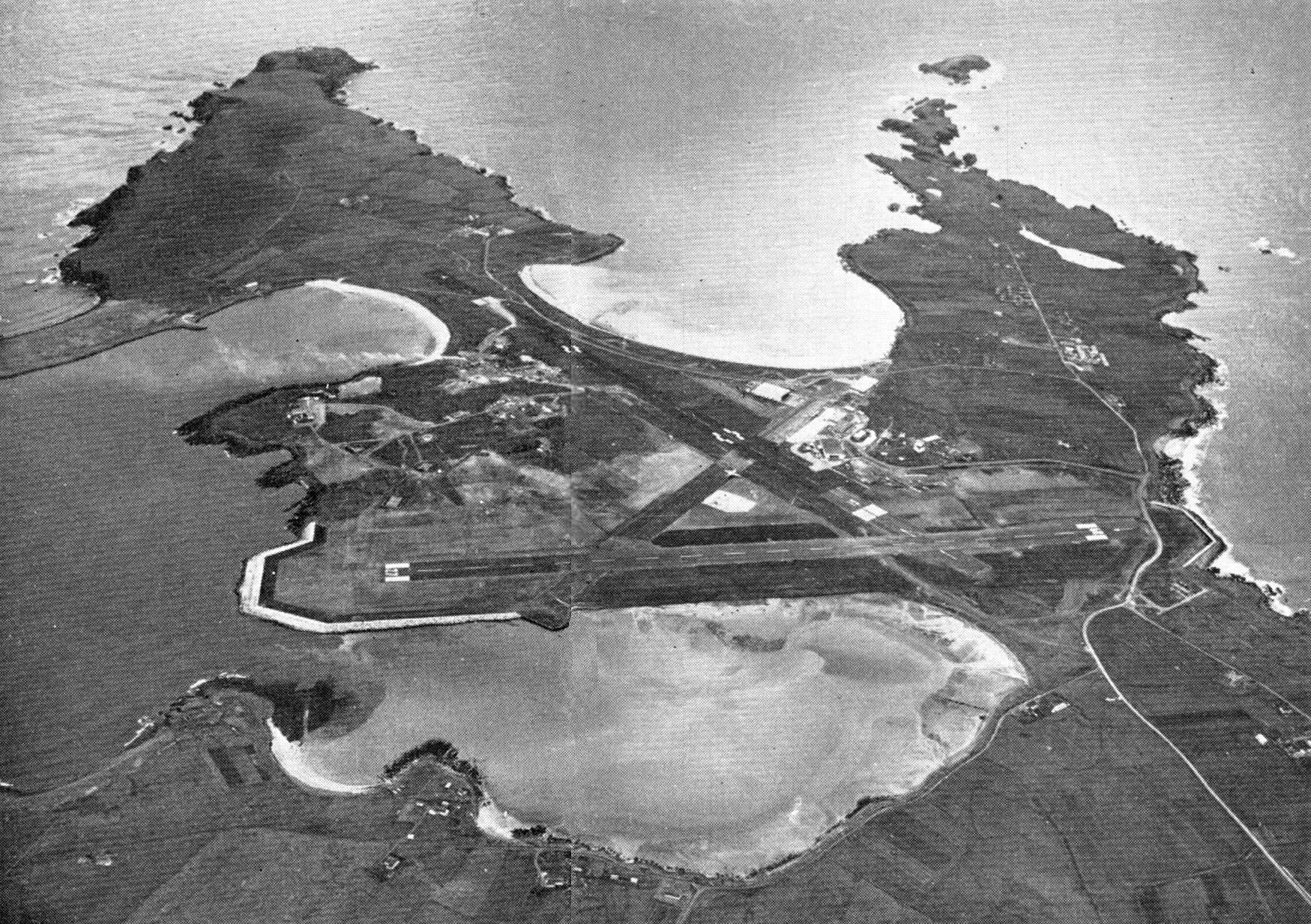
This
view of Sumburgh Airport shows the upgraded Runway 09/27 (foreground)
with extended undershoot /overshoot areas at the North Sea (left) and
Atlantic ends, part of a recent £7.5 million development programme.
Terminal facilities have also been improved
(Photo courtesy of British Airports Authority)
Improved radio facilities in the form of
radar have permitted a reduction in operating limits for the short
runway only, which could not reasonably be lengthened, to a 350 ft
decision height. This compares with the VOR/DME decision height of 700
ft. Hence we required an aircraft for which the short runway could be
the main runway. Frankly there were not a great many types to choose
from and the HS 748 was selected.
Equipment
Most
airlines have by now learned the lesson of choosing an aircraft as
close to the basic offered as possible, for three reasons: spares,
serviceability and cost. British Airways settled for the basic HS 748
plus some few well-proven optional extras, such as nosewheel steering
on the co-pilot’s side.
The one big exception allowed was the
decision to fit a Flight System, in the conviction that the days of
flight on basic instruments are past. The Sperry Stars system was
chosen. Radio fit is standard for present day operation: 2 VHFs, 2
VOR/ILS, 2 ADFs, 2 DMEs, 1 Transponder, 1 CVR, 2 Markers, Wx Radar,
Flight Data Recorder and the usual intercom/ Cabin Address facility.
Operations
The
selection of a 46 seat layout left a minimal capacity for carrying
freight. Occasionally, some compact freight such as newspapers may be
seat-loaded. Limitations necessarily imposed on the order of loading
and unloading freight and baggage to avoid the danger of the aircraft
tipping onto its tail have proved tiresome. There is no provision for a
tail support strut.
An HS 748 simulator does not exist, and
therefore bi-annual checks must be carried out on the aircraft. The
non-availability of a simulator also complicates the assessment of
initial handling techniques for specific cases. Sumburgh’s Runway 15
springs to mind, where an emergency turn procedure—comprising a 15°
banked turn right onto a heading of 220°M—is required at the end of
the runway in the event of losing an engine. The feasibility of this
was checked by an experienced pilot unqualified on type, flying the
procedure on base training with a previous total of 10 minutes in the
HS 748. It says a lot for the handling characteristics and docility of
the aircraft that it lends itself to such practices. An ability to
‘turn on a sixpence’ is invaluable at some of our more restrictive
airfields.
Engineering
It
was discovered the hard way that the Sperry Stars Flight System on our
aircraft is sensitive to overvolts. A faulty Ground Power Unit caused
problems on two occasions, blowing two transistors and the computer on
at least one of these. GPU volts are now carefully monitored by ground
crews and flight crews alike. Still unresolved is a tendency for the
GPU to be thrown off line if Inverters 1 and 2 are run at the same
time. This is an intermittent problem not related to GPU capacity, and
we do not yet know the answer.
There have been no major engineering problems.
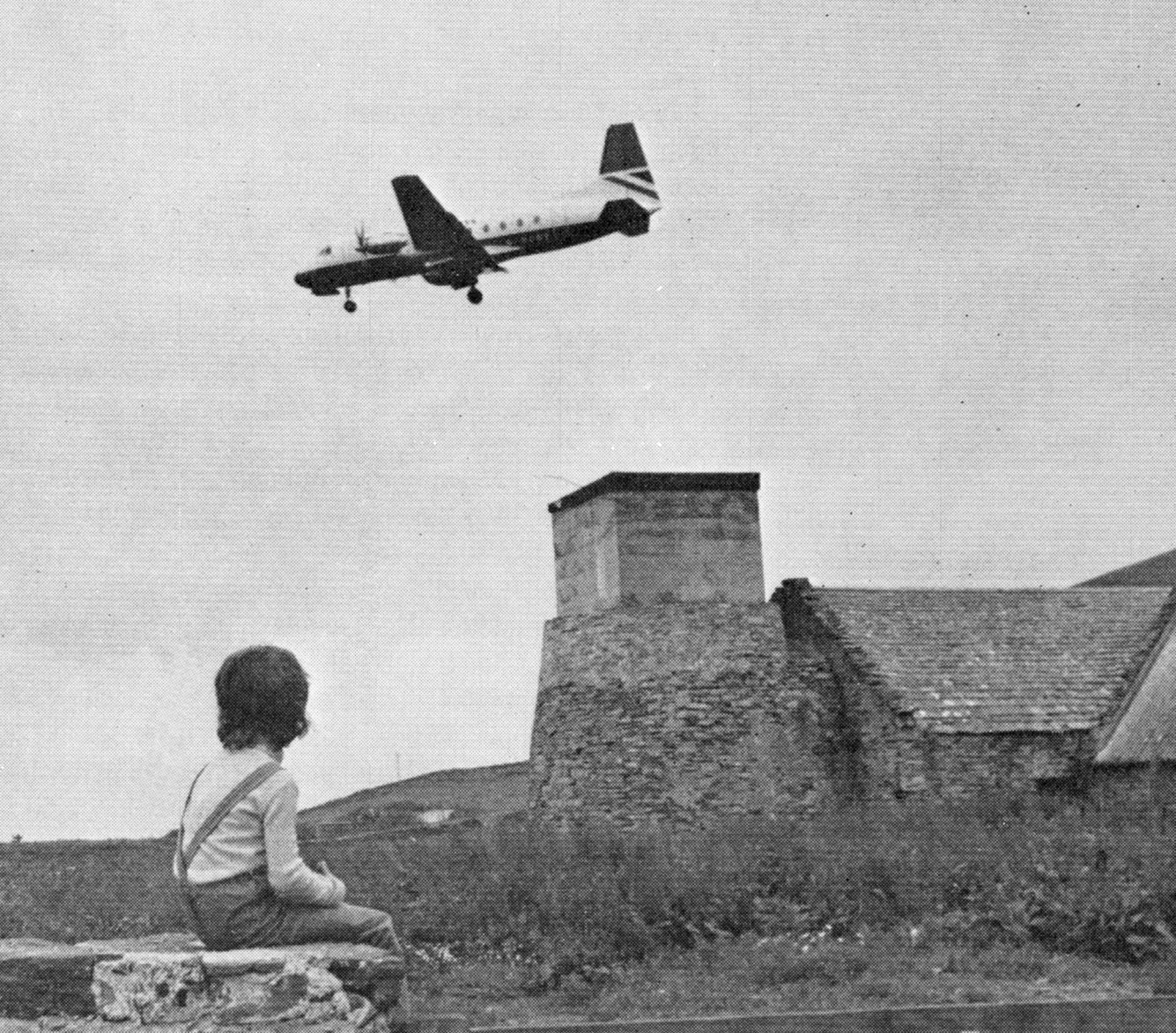
HS 748 on finals to Sumburgh—until recently a remote region of stone built crofts, hills and the sea
Conclusions
If
success is measured by the effective fulfilment of plans, then the HS
748 is a success in Scotland. Regularity during the first year was
95.3%, and this to one of the most difficult airfields in Europe.
Sumburgh, being in a maritime environment, is subject to all the
frequent frontal activity and strong winds associated with the weather
systems forced around the north of the British Isles. In summer, the
well known meteorological phenomenon of Haar or sea fog is particularly
common in these northerly reaches of the North Sea, bringing with it
visibilities of less than 100 ft vertically and 100 metres horizontally.
From
the pilot’s point of view, it is a real pleasure to fly an aircraft in
this day and age of automated systems management—a throwback maybe,
but along with the Viscount some of the last real flying left in a big
company like British Airways.
Finally, and most important from
the passenger’s standpoint—any turboprop suffers by comparison with a
turbojet aeroplane in terms of comfort, noise, speed and flight
environment. While acknowledging this, it is our belief that the HS 748
provides a very acceptable compromise as long as it continues to
produce the regularity required by today’s business fraternity. Some
day, Sumburgh might boast a Gibraltar-type runway, extended into the
sea. Then the choice of available equipment would be
wider.