COLGATE DARDEN


Photos by Chris Sorensen


WHERE DID YOU last see a Douglas DC-2? Try that question on some of your aeronautical friends. l’ll bet you dollars to donuts the answer depends only on the age of the person you ask. The younger ones will reply ‘DC—what ?’ or ‘I didn’t know they made one’, while the older ones will fall silent for a minute, trying to remember just where it was. Rome, impounded for smuggling? Didn’t one crash recently in Africa? The Spanish Air Force? Chile? Brazil? Asia?


I asked that same question ten years ago until I got an answer, but it came in an unexpected form, a letter from a friend that was only one sentence long. ‘For a DC-2, call . . .’. It was a ten digit number. California. It could have been India.

After so many years of looking, there was just no honorable alternative. I had to call. The party at the other end of the line assured me that he had a DC-2. No, it wasn’t one of those mixtures of DC-2 and DC-3 that came off the production line during the changeover. Yes, he would meet me at the Los Angeles airport, tomorrow.

A brief ride in one of those huge land yachts Detroit calls a standard sized car took us to the apron of the Burbank airport, where stood the aeroplane I had come to see. The white paint was to make it look bigger. Twenty-one seats would carry half again as many passengers as Donald Douglas thought advisable, with an aisle so narrow one had to walk sideways.

‘I always hired the smallest girls I could find for stewardesses. It made the aeroplane look bigger.


It looked like it was all there, except for the original seats. Had I known then what I know now about those seats, things might have gone differently, but I was in a state of semi-shock.

After suitable financial arrangements, it was back home for me and relicensing for the Two, which hadn’t been flown for years. Then to Chino for paint stripping (DC-2s had skins of duraluminum, a fact which should not be lost on the casual observer), and then to Bob C. at Long Beach for an authentic interior.

Bob called one day. ‘What do you want to do about the exterior?’ Exterior? Oh, yes, of course, well, DC-2s were airliners. It ought to carry the colors of an airliner of the 1930s. Bob said he would see what he could do.

Douglas has a wonderful collection of photos of their aeroplanes and it didn’t take long to find one of a DC-2 in the colors of an airline no one had heard of, General Air Lines. That was it.

Finally Bob had done all he could, and it was an outstanding job. From the leather side panels to the dark green wool bedford seats, it just looked beautiful, and exactly like the original.

Getting the DC-2 to its new home turned out to be more complicated than I expected. Our guardians in Washington had long ago decided that anyone who wanted to fly an aeroplane with a gross weight over 12,500 pounds would have to get a type rating. A type rating requires a check ride, and a check ride requires recommendation by a flight instructor, but not just any instructor. He must be rated in the aeroplane. For a while it looked impossible. Then along came Charlie M., and we got down to business.

Business turned out to be routine, fly for an hour in the morning, make a list of all the things that broke down, give it to Ray H., who would try to get the most urgent ones fixed for the next day.

The routine went on for about two weeks. Everything imaginable broke down. I remember some better than others. No mag check on the right engine—ignition harness leaky. New harness. Still no mag check. Take the mags to a repair shop. ‘These came off a flying aeroplane?!!! The hell you say!’ The oil consumption seems high. Look in a spark plug hole to see if there is anything obviously wrong. Rust pits. Change a few jugs. The oil consumption goes down, a little, I think.

Curiously, the only thing that seemed to work reliably was the ARC-1 transceiver, which had been upgraded to a staggering 50 channels. Too bad there was only one, the one for the odd 100 kc channels.

Finally, it was time for the check ride. Nine hundred pounds of spare parts in the rear baggage compartment kept the center of gravity within limits. It was a piece of cake. Nothing broke down!

After that it was time to head east. A few turns around the field for the Douglas people to get photos, and one last spin for a certain mechanic who had worked long and hard and had never ridden in a DC-2. Then, wouldn’t you know, just after takeoff, a fire alarm appears for the right engine. There was no real fire, and I was convinced the alarm system had broken down, but landed anyway, just to be on the safe side. We pulled the screen. It looked like the mouth of a copper mine.     
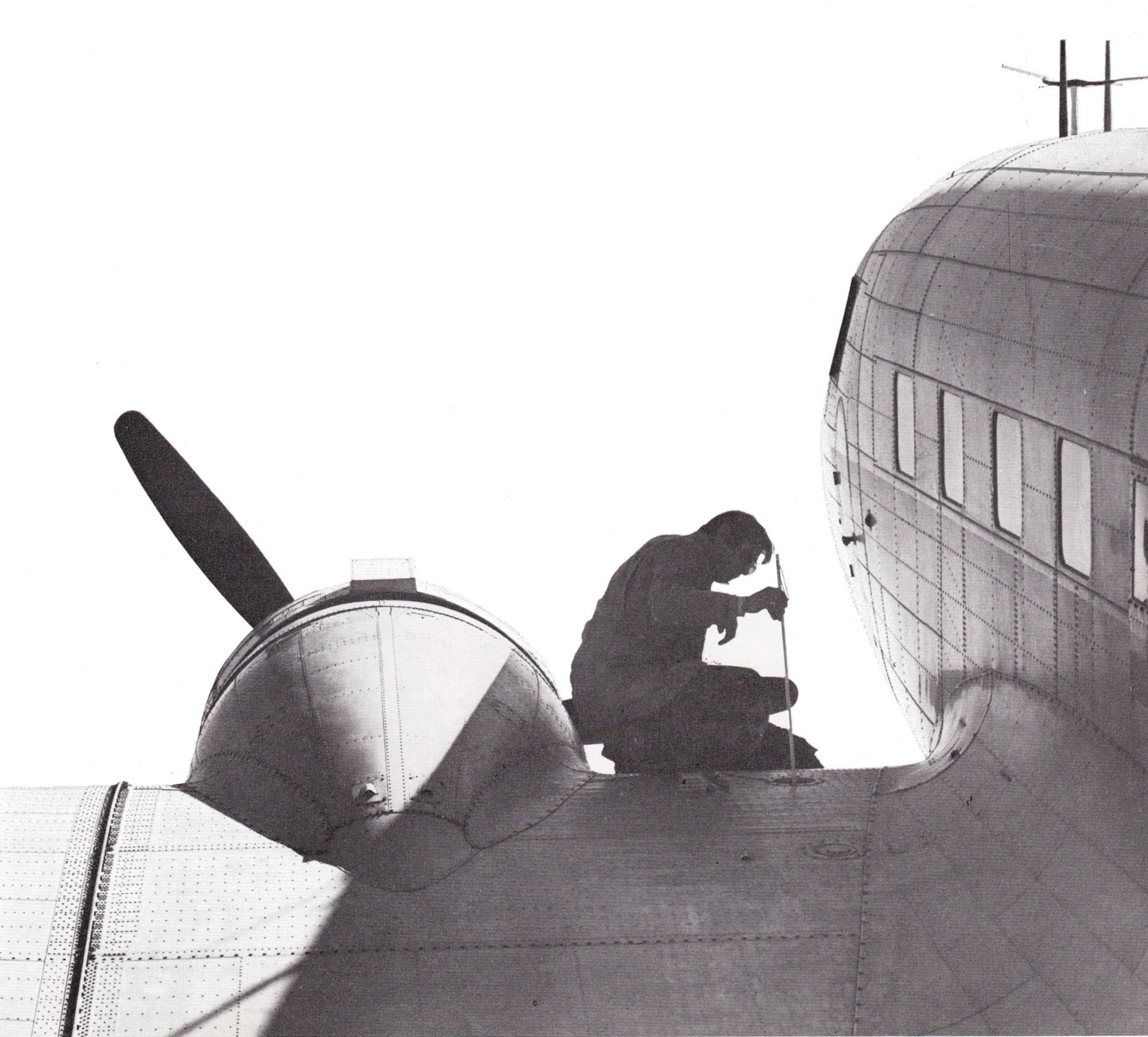

Fuel level check. Note the characteristic flat side of the original Douglas transports fuselage


For the early 1930s, the DC-2s cockpit was a masterpiece of ergonomic design. The modern engine control quadrant aligning throttles, mixtures and prop speeds has yet to appear, and pride of place among the flight instruments still goes to the turn-and-slip. Note the unique windshield defrosting blowers


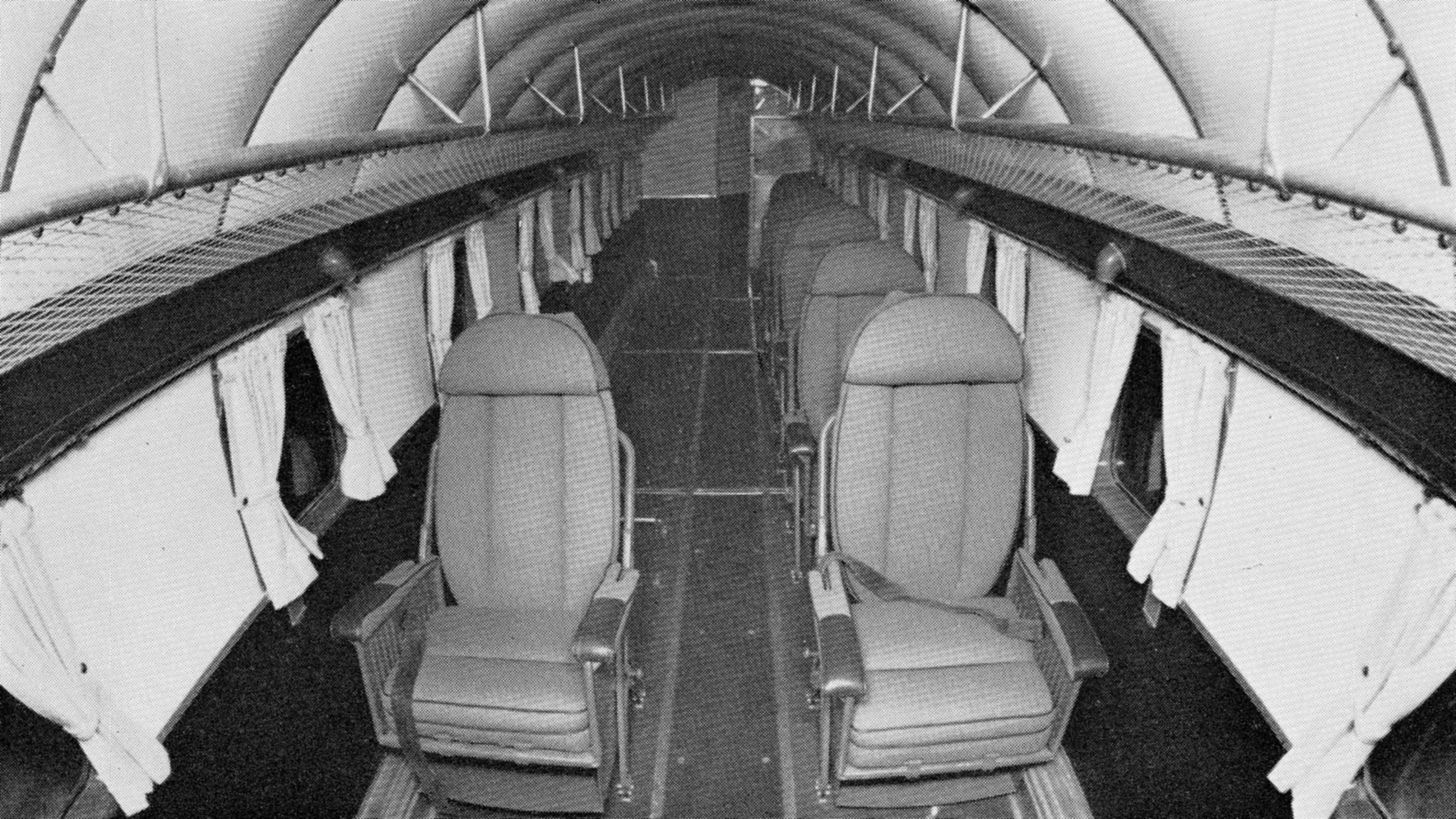
Cabin height of more than 6ft allowed passengers for the first time to walk full length of the aisle without bending. Every passenger had a window. The six original reclining, bedford-uphostered seats now fitted are exceptionally comfortable, but a lengthy search has failed to reveal eight more


There followed a period of almost a year. Wright 1820-52s had never been used in a civilian aeroplane, but after the war, as the demand for Douglas SBDs subsided, these engines were plentiful and cheap. About this same time, spares for the original 875 HP 1820s had gotten pretty scarce, so it was just common sense to switch to the -52s rather than try to rebuild the original engines. This was done in the early 1950s. Now, fifteen years later, parts for the -52s were also scarce, but Steward Davis said they thought they could do it.

Two quick change units were bought from a local junk dealer and sent over to Steward Davis. These engines were new in the sense that they had never been used, and it seemed possible to get two zero time engines simply by disassembling, cleaning, inspecting and reassembling the quick change units.

No such luck! They were too rusty inside to rebuild, but did furnish a few parts. I have no idea where the rest of the parts came from, but somehow Steward Davis managed to assemble two zero time 1820-52s. With these engines and rebuilt accessories, the DC-2 was new, fire wall forward . . .!

Privations

The trip home was made in February. About an hour out of Long Beach, it was clear that the heater wasn’t going to work. This wasn’t the original steam heater, but a fancy gasoline burner. No one had thought to check it. Who needs a heater in Long Beach?

After a stop for lunch and gas and a few more hours of that stark, arid, south western scenery, the lights of El Paso appeared on the horizon. That seemed as good a place as any to spend the night.

The next day was much colder and the wind was blowing so hard it picked up sand. It was impossible to fly. The following day was better, but colder. A local reporter came out to see the DC-2 and take some pictures. The engines took an inordinate amount of priming, but eventually, they caught. No oil pressure on the right engine! Shut down and try to find out why. After much discussion, we decide to bypass the fire wall shut-off on the theory that congealed oil can’t get through it. That kills the rest of the day.

The next day is cold, windy and overcast. After an hour’s struggle, the engines finally come to life. My fingers are sore from holding the primer switch. The oil pressure reluctantly climbs up into the green arc. Ten minutes later it is clear that we can fly. The tower says go and we begin our climb to the east. The air is rough. The whole aeroplane shakes and quivers and lurches from side to side. I look out the side window and back at the left engine. It sits there on the wing, nodding up and down. The wing flexes too. Is it supposed to do that? Is a motor mount broken? It doesn’t seem to be getting any worse. Would it get worse slowly? This is a 1935 aeroplane.


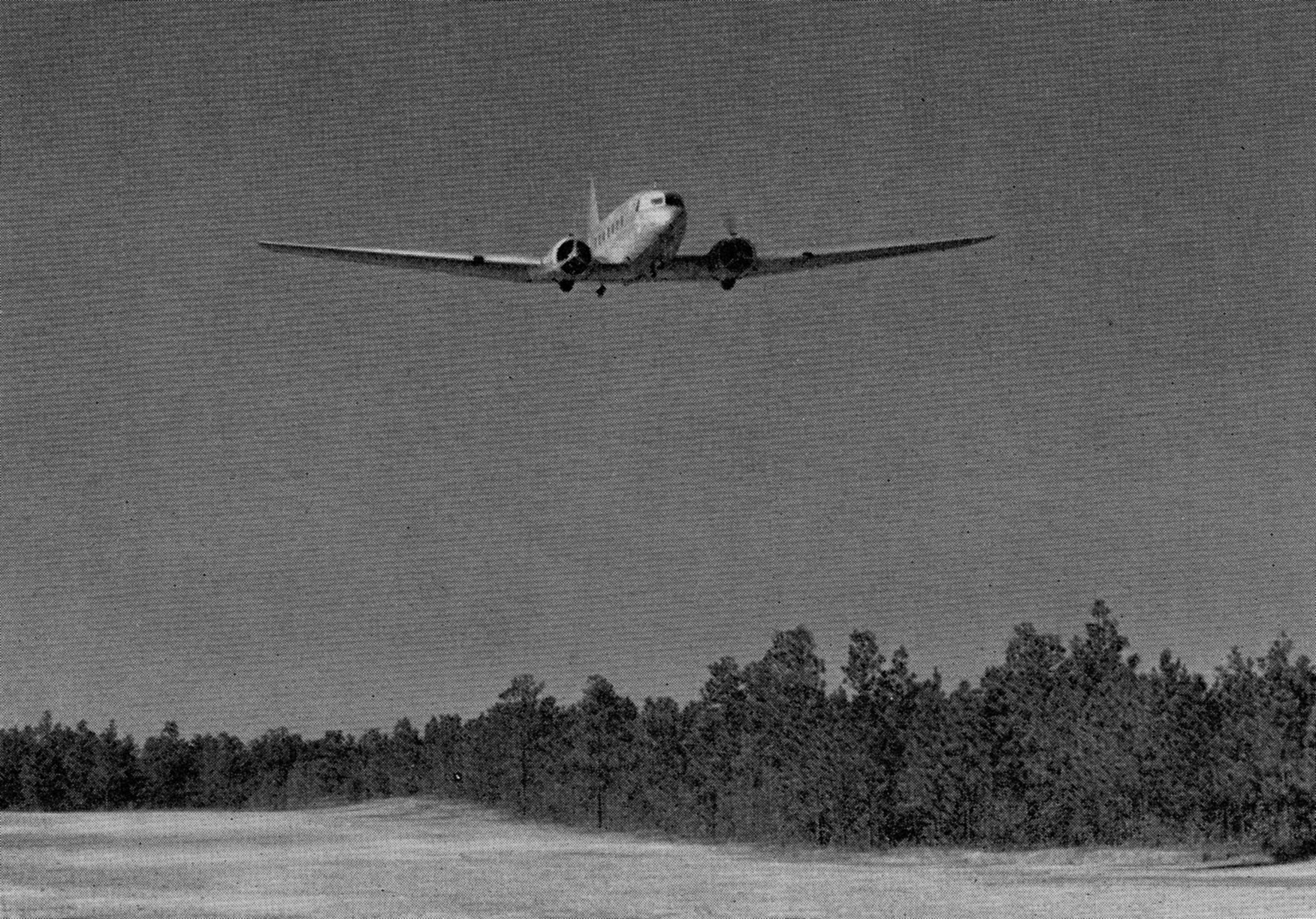
The rumble of Wright radials near the author’s home in South Carolina. Clean lines and efficiency are epitomised by this last airworthy example of one of air transport
s classics


The omnis aren’t receiving anything any more. The overcast seems to be getting lower and it is cold as bloody hell, but the visibility is reasonably good and the country is flat. I turn on the ADFs. One is green and the other is red. The knobs are painted accordingly and the dials were once too. They are just a bit faded now. A huge, 400 cycle inverter lets out a shriek that can be heard over the wind and engine noise. I switch to the spare. Maybe I can get a station between here and Amarillo, with luck, a BC station and the news. Nothing but crackle.

We drone on this way for an eternity or ten minutes. The left engine keeps nodding as if to say, ‘You’re going in the right direction’. I don’t know what the right one is saying because I can’t see it, but it agreed a few minutes ago. I watch the left prop hub to see if there is any sign of reduced oil consumption. The shimmering mist around the hub is coming from the engine crank case. The prop shaft is hollow and is the breather for the crank case. The mist is oil vapor and products of combustion that get by the piston rings. When the rings seat, the mist should abate, but there is no sign of this yet.

I play with the ADFs again and pick up a station just this side of Amarillo. Suddenly the cockpit seems a bit warmer, and I take an interest in everything around me, check the ammeters, hydraulic pressure, fluid level, note that the landing gear has fallen down a bit and give it a shot of fluid. I try tuning the omnis again. I even change the height of the seat.

I also notice the visibility has decreased enormously. The overcast extends to the ground except for a small patch directly under the aeroplane. It isn’t fog and it isn’t rain. There is no mistaking rain, it’s like standing in front of a lawn sprinkler. Snow! Yes, snow, that’s it! It makes horizontal lines out of the window but doesn’t get anything wet.

Amarillo reports nothing impressive and mentions snow showers, but seems bored with working that day.

Eventually the airport appears ahead and we land to spend the night.

‘A DC-3 ?’

‘No, a 2.’

‘A 2?’

‘Yes, a 2.’

‘Uh-uh, OK.’

It was a lot harder to get out of Amarillo than it was to get in. The next day was clear, but colder than hell, and of course the engines didn’t want to start. It took three hours of priming, cranking, and going in to get warm. The trouble was the primer. It dumped gas into the blower case instead of shooting it at the intake valves, so most of it just ran out on the ground. The cylinders weren’t getting any fuel. One of the guys running the APU finally came up with the solution, and it is truly remarkable what a little ethyl ether will do to breathe life into a balky engine!

Nothing much happened on the rest of the way home. I remember landing at Wylie Post airport because the wind was so strong. It was coming right down the runway and smooth, so you didn’t notice it until it was time to turn off and taxi cross wind. Then it took both feet on one rudder pedal to keep the rudder straight! I think that was where I finally broke down and bought some blankets to wrap up in for the rest of the trip, and a couple of plastic bags to put around my feet.


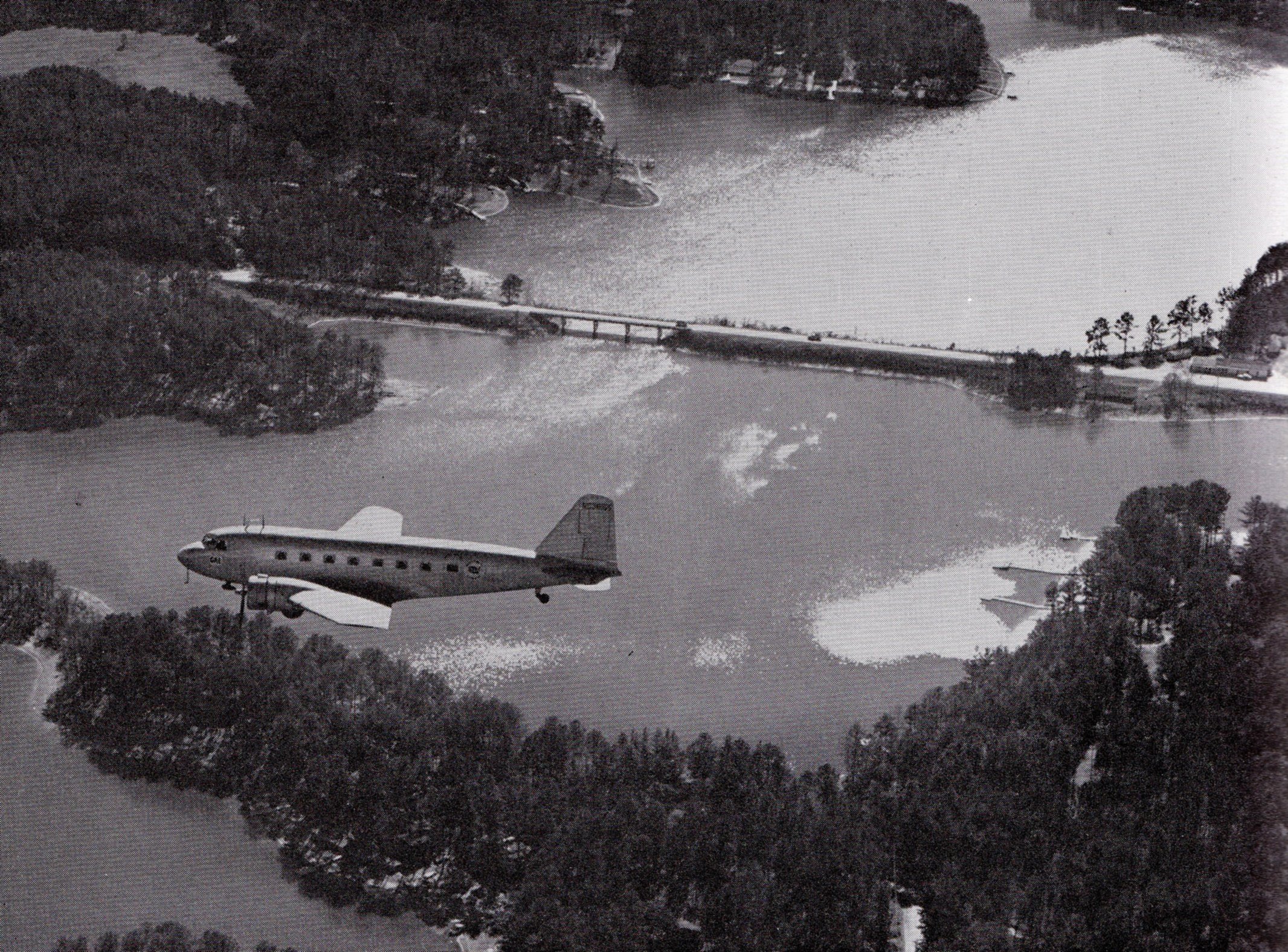
Airborne over Lake Murray, near Columbia in South Carolina


Recurring cycle

Well, all that was ten years ago, and since then the DC-2 has been leading a comfortable life in retirement. No schedules to meet, just a trip now and then for the fun of it to an antique aeroplane club get-together.

People often ask me what one does with a DC-2. It is not an easy question to answer. Most of the time it just sits in the hangar on jacks, but every two or three years the urge to fly builds up to the point where something has to be done about it. Then the process of relicensing starts all over again.

Even when the ‘Two’ is in license, getting it ready for flight kills the better part of a day. Simply pulling it out of the hangar can take three people three hours. That is because cars, mowers, tractors and other aeroplanes are packed in all around it and they have to be gotten out first.

Once out of the hangar, the engine starting ritual can begin. This time it is not cold weather that causes the trouble, but hydraulic locks and dry master rods. Both problems are overcome at the same time. The front row of plugs are removed and oil is forced into the oil pump with a feathering pump. At the same time the engine is rotated with the starter motor. Rotating the engine with the plugs removed gets rid of the oil that has accumulated in the cylinders, the hydraulic lock. The oil being forced in at the oil pump makes its way through all the normal lubricating channels in the engine and lubricates the master rod. This process is kept up until pressure shows on the oil pressure gauge.

After replacing the front spark plugs and priming, the engines can be started. This is the impressive part of the show. It begins with a few innocent puffs of blue smoke, and develops rapidly into a deafening roar with clouds of smoke and a bath of oil—something that has to be seen and heard to be appreciated!

There remains only the job of gunking down the engines, landing gear, and the parts of the wings and belly that are dripping with oil. The rest is pure pleasure.

We taxi out to the far end of the runway. All the familiar sounds are there, the intermittent whine of the hydraulic pump, the steady hum of half a dozen dynamotors, and the buzz of poorly filtered DC in the earphones. The smell of oil permeates everything.

At the end of the runway we make a few final checks, with the aid of a check list, of course. Prop feather, mag check at field barometric pressure, hydraulic pressure, generators, everything’s on go.

We move into takeoff position. Tail wheel locked, seat belt sign on, fuel pumps on. The engines begin to bellow as the throttles move forward. Thirty-seven-and-one-half-inches and 2300 rpm! The DC-2 shudders and rolls forward over the uneven ground. The tail comes up on its own and with one last bounce we are airborne. The noise of the engines is painful. 80, 90, 100 knots, gear up!

The last flying DC-2 is in the air once again.


Colgate Darden turns over port engine with the starter motor to pre-lubricate before starting up, while Walt Willis stands by. This procedure, followed by the delicate operation of towing the old aircraft onto the ramp, can take many hours and exemplifies the dedication that goes into operating a DC-2


About the author

Born in 1930, Colgate Darden III was a graduate of the University of Virginia and later physics professor at USC from 1964-1994. A qualified pilot, Prof Darden owned and operated this vintage Douglas DC-2 airliner in the 1960s and 70s. During this time he was commissioned by Shell Aviation News to write this article about the DC-2. He died in 2009.