It would be presumptuous in me to attempt to interest professional musicians, who naturally know already all that I have been able to put together, and much more; and in a more complete and accurate manner.
Some readers of these imperfect remarks may possibly wish to pursue such investigations farther; and I therefore will give the names of the principal books which I have found useful in my studies: -
If, in addition to the above, there could be published photographic fac-similes of the autographs of the Symphonies of which autographs exist, everyone would virtually have in his hands Beethoven's own MSS., which would be invaluable. The beautiful fac-similes lately published of his Sonata in A flat, Op. 26, by Dr. Erich Prieger (Bonn: F. Cohen, 1895), and the specimens of Bach's handwriting which form Vol. 44 of the edition of the Bach-Gesellschaft (Leipzig, 1894), show what excellent work can be done in this direction, and I am not without hope that the proposal which I made in 1891, and which was so warmly received, may still be carried out.
I am anxious to express my obligations to several friends who have kindly given me their valuable help in my work, besides those whose assistance is acknowledged in the course of the volume. To Mr. Edward F. Pember, Q.C., Dr. F. E. Gladstone, Mrs. Victor Henkel, Mr. F. G. Shinn, Mr. F. G. Edwards, Mr. S. P. Waddington - to all these and others I am under a deep debt of gratitude, of which this expression is a very inadequate equivalent.
29th February, 1896.
The early demand for a Second Edition has given me the opportunity of correcting a few errors of the press, and some inaccurate references, which had escaped me before, as well as of adding an Index.
3rd June, 1896.

The Symphony is written for the following instruments, which, in this and all the other cases, are given in the same order as in the original score, beginning at the top of the page.

The score is an 8vo of 108 pages, published by Simrock in 1820. '1re Grande Simphonie en Ut majeur (C dur) de LOUIS van BEETHOVEN. Oeuvre XXI. Partition. Prix 9 Frs. Bonn et Cologne chez N. Simrock. 1953.' The parts were published by Hoffmeister & Kühnel, Bureau de Musique (now Peters), Leipzig, end of 1801.
In hearing this Symphony, we can never forget that it is the first of that mighty and immortal series which seem destined to remain the greatest monuments of music, as Raffaelle's best pictures are still the monuments of the highest point reached by the art of painting, notwithstanding all that has been done since. Schumann has somewhere made the just remark that the early works of great men are to be regarded in quite a different light from those of writers who never had a future. In Beethoven's case this is most true and interesting, and especially so with regard to the First Symphony. Had he died immediately after completing it, it would have occupied a very different position from what it now does. It would have been judged and loved on its merits; but we should never have guessed of what grander beauties and glories it was destined to be the harbinger, or have known the pregnant significance of its Minuet.
The autograph of the Symphony is lost, and no evidence is known to exist by which the date of its completion can be determined. Probably it is only mislaid, and some day will be revealed with that of Schubert's Gastein Symphony, Beethoven's own Eroica, and other such treasures. Meantime sketches for the Finale are found among the exercises which Beethoven wrote while studying counterpoint under Albrechtsberger in the spring of 1795. One of these is quoted by Nottebohm, in his edition [1] of Beethoven's studies, as occurring, with sketches for 'Adelaide,' amongst the fugues alla decima and duodecima; and they probably show how the impatient student relieved his mind when the counterpoint became too tiresome for him. It was five years later before the Symphony came to a hearing; since it was first performed in public in 1800, on the 2nd April, at a concert given by its author in Vienna. It is not only the first Symphony which he performed or published, but apparently the first which he completed. Its date brings home to us in an unmistakable manner the deliberate progress of Beethoven's creations. In 1800 he was thirty years old, and it is startling to recollect that at that age (in 1786) Mozart had written the whole of his Symphonies save the three masterpieces; and that though Schubert was but thirty-one when he died, he left a mass of compositions, including certainly nine, and probably ten Symphonies behind him. The work is scored for the usual orchestra of Haydn and Mozart, with clarinets in addition, which they very rarely employed in their Symphonies, but the use of which Beethoven probably learned from Mozart's operas. The ease with which he handles the orchestra in this his first large work is somewhat remarkable. His only orchestral practice before it would seem to have been his two Cantatas, written in 1790 on the death of Joseph II. and the accession of Leopold II.; the first movement of a Violin Concerto in C, and his two Pianoforte Concertos, in B flat [2] and in C. The Symphony is dedicated to the Baron van Swieten, a friend of Beethoven's, when a stranger in Vienna, as he had been of Mozart's (who spells his name Suiten) and Haydn's before him. This, however, is on the Parts, which were published by Hoffmeister and Kühnel (now Peters), of Leipzig, at the end of 1801. In the earliest score, that of Simrock (8vo, No. 1953, published in 1820), the Baron's name is omitted. What honorarium his patron may have bestowed is not known; but in the list of compositions offered by Beethoven to Hoffmeister (1801) the Symphony figures at the modest price of 20 ducats, or £10.
I.
The work commences with a very short
introductory movement, Adagio
molto. In his 2nd, 4th, and 7th Symphonies Beethoven has
shown how
extended and independent such Introductions can be made; but the
present one, like many of Haydn's, is only twelve bars in length, of no
special form, and merely serving as a prelude to the work. Though short
it is by no means without points of historical interest.
The opening
may not seem novel or original to us, but at that date it was
audacious, and amply sufficient to justify the unfavourable reception
which it met with from such established critics of the day as Preindl,
the Abbé Stadler, and Dionys Weber, some of whom established a personal
quarrel with the composer on this ground: -

That a composition professing to be in the key of C should begin with a
discord in the key of F, and by the third bar be in that of G, was
surely startling enough to ears accustomed to the regular processes of
that time. Haydn has begun a Quartet (in B flat, Pohl, No. 42) with a
discord of 6-4-2; and John Sebastian Bach, who seems to have
anticipated everything that later composers can do, begins his
Church-Cantata 'Widerstehe doch der Sünde' [3]
with the
formidable discord of 7-5-4-2 on a pedal. Beethoven was thus not
wanting in precedents, if he had known them, which he probably did not.
The proceeding, at any rate, evidently pleased him, for he repeats it,
with even an additional grain of offence, in the Overture to his Ballet
of Prometheus in the following year. Another of his compositions
beginning with a discord is the Pianoforte Sonata in E flat (Op. 31,
No. 3). We shall see that the 'Eroica' Symphony was originally
intended to open with a discord, a chord of the 6-5 on D; but this, it
is hardly necessary to say, was abandoned. The opening of the present
work was an experiment; the sharp staccato chords in the strings, which
never can be effective, even in the largest
orchestra, when overpowered by loud holding notes in the wind, he
abandoned in the Prometheus Overture; and when he again employs them
(in the opening of the Fourth Symphony) the wind is carefully hushed,
and marked pp.
The interest of the discord resides in the fact that
Beethoven was even then sufficiently prominent to put such Fathers of
the Church as the critics named on the qui vive for his
heresy.
In
the Allegro
which succeeds this Introduction there is not
much to
call for remark. The leading theme is as follows - three four-bar
phrases in the strings, artfully protracted by two bars of wind -

And here again - in the transition from C to D (bar a) - there is a
likeness to the first subject of the Prometheus Overture, with
which
indeed the whole of this movement has much in common. The same
transition will be found in the opening subject of the String Quintet
in C (Op. 29), a work of the year 1801, and in the fragment of a Violin
Concerto in C major, dating from about the same time. The general form
of the figure, and the repetition a note higher, have been followed by
Schubert in his Symphony in B flat (No. 2), and by Weber in his
Overture to 'Peter Schmoll.'
There is another fact about this first subject which should be noticed - its determination to mark the key, a great characteristic of Beethoven. In many of the Sonatas and Symphonies (No. 2, the 'Eroica,' No. 8, No. 9, &c.) the chief subject consists, as it does here, of little more than the notes of the common chord of the tonic repeated; 'so that,' in the words of an eminent musician [4] of the present day, 'the principal key shall be so strongly established that even the most stupid persons shall be able to realise it.'
The
second subject, in the 'dominant' - key of G - according
to rule, is very melodious and agreeable, and the arpeggio
accompaniment in the strings, borrowed from bar 4 of the first theme
(see No. 2), and the broken accents in bars 5 and 6, make it very
continuous and lively -

It again is akin to the analogous subjects in the Overture to
Prometheus and the C major Quintet; and all these are of the type which
was given by Mozart in his Overture to the Clemenza di
Tito. (See Jahn's Mozart,
Transl. iii., 293.)
A
very effective and original passage - almost to be called an
episode
- arises out of this theme; where the bass has a portion of the
subject in the minor, with a separate melody above it, first in the
oboe and then in the oboe and bassoon in octaves. It is preceded by an
emphatic bar closing in G major; and the contrast
of the sudden pianissimo and the change of mode is both effective and
characteristic -

The modulations - G minor, B flat, B minor, and G major - are
worthy of notice.
The
first part of the Allegro
ends with a short Coda
of nine bars,
containing a new phrase -

and a passage for the wind alone. The first part is then repeated,
according to the excellent rule laid down by Haydn. In the
'working-out,' which follows the repeat, there is not much to call for
remark, except the prevalence of imitative progressions, which would
have pleased his master, Albrechtsberger, but which Beethoven soon
moderated when left to himself. Of these we may quote one or two, which
will be recognised in the course of the working-out -

and this: -
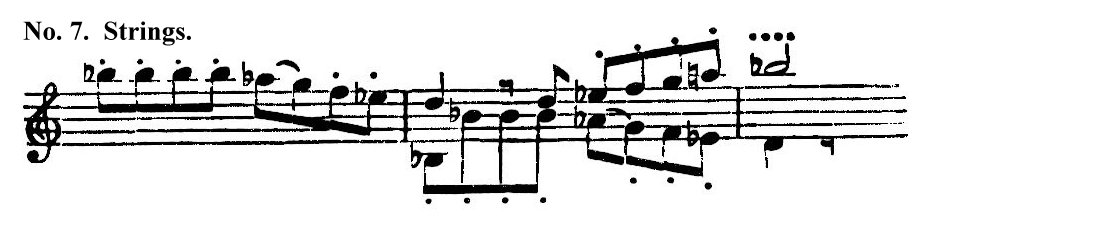
Another refers to the principal subject (see No. 2), and is admirably
divided among the wind instruments -

The recapitulation is shortened, and shows great differences in the instrumentation. The Coda which closes the first movement, after repeating in the tonic the phrase already quoted as No. 5, combines the wind instrument passage with the first subject (No. 2), and goes on for forty bars in all. It is an early and good example of a feature which, though not Beethoven's invention (see, for instance, the Finale to Mozart's 'Jupiter' Symphony), was but rarely used by previous writers of Symphonies, and first became a prominent characteristic in his works.
II.
The second movement, Andante cantabile con moto,
which
begins as
follows -
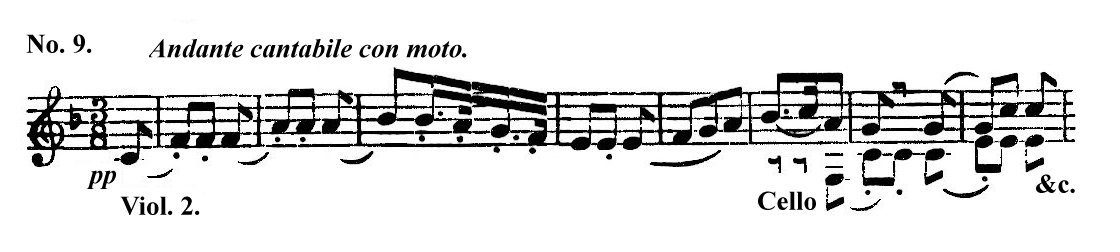
is an old and well-known favourite. Here again we have occasionally to
remark passages which recall the strict contrapuntal school of
Albrechtsberger. On the other hand, there is an elegance and beauty
about it far above any school, and worth any amount of elaborate
ornamentation; as well as continual little sallies of fun and humour.
The beginning of the second part of the movement is a perfect example
of this.
After
the last quotation is completed the theme is continued
In this
elegant style -

An
original passage will be noticed in which the drum has an
independent solo part -

The passage comes over three times, first on G, with the trumpets in octaves, as the pedal bass to the Coda of the first section; next on C, at the close of the working-out, immediately before the recapitulation; and again, on C, in the passage analogous to the first occurrence. In order to carry this out Beethoven, probably for the first time in the annals of the orchestra, has tuned his drums, not according to practice in the key of the movement, which being F would require F and C, but in the key of the dominant, C - namely, in C and G. This passage foreshadows his remarkable individual use of the drums and other instruments in his subsequent orchestral works. It is the direct parent of the drum solos in the Andante of the Fourth Symphony, the Finale of the Fifth Pianoforte Concerto, the opening of the Violin Concerto, &c. The recapitulation itself is prepared for by seven elegant bars of dotted semiquavers in the first violins (soli), and two calls in the clarinet and bassoon, of charming effect. The dialogue-passages, in short phrases, between the bassoon, oboe, and flute, in the second portion of this beautiful Andante, will not escape the listener. They might be the parents of Schubert's performances in this direction; and a lovely echo of them will be found in Brahms's First Symphony. How such short phrases can be so beautiful will always be astonishing. - Otto Jahn in his Mozart (Transl. i., 325) draws attention to a likeness between the close of this movement and a passage in the corresponding movement of a Pianoforte Concerto of Mozart's in E flat, dated 1777; but I have not been able to compare them.
III.
The Minuet
and Trio
form the most
original portion of the
work. And they are original in every sense of the word. In the former,
though he entitles it Minuet,
Beethoven forsook the spirit of the
minuet of his predecessors, increased its speed, broke through its
formal and antiquated mould, and out of a mere dance-tune produced a
Scherzo,
which may need increased dimensions, but needs no increase of
style or spirit, to become the equal of those great movements which
form such remarkable features in his later Symphonies. The change is
less obvious because Beethoven has adhered to the plan and measure of
the old Minuet and Trio, instead of adopting others, as Mendelssohn did
in his Scherzos,
and he himself in at least one instance, the
Allegretto vivace
of the Sonata in E flat, Op. 31, not to speak of the
Trio of the Ninth Symphony, both of which are in 4-4 time. But while
listening to this movement we have only to bear in mind the best
Minuets of Haydn or Mozart to recognise how great is the change, and to
feel that when Beethoven wrote this part of his First Symphony, he
'took a leap into a new world' [5].
The movement begins as follows -
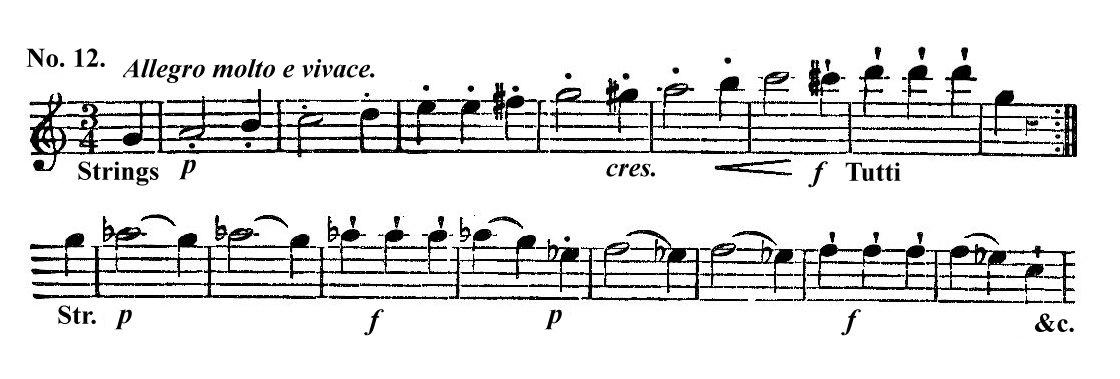
Some of these phrases are actually used in the Scherzo of the
Seventh Symphony
-

and they maintain in a very material way the connection
between the 'Minuet' of Beethoven's First Symphony and the gigantic
movements which fill its place in the latest ones. Indeed it may be
said that we should never have known the full meaning of this Minuet
unless we had the Scherzo
of the Seventh Symphony to interpret it by.
It
is the second portion of this 'minuet,' beyond the double
bar, that
Beethoven has made most use of in the bold modulations and shifting
colours with which he develops his idea, until the small canvas glows
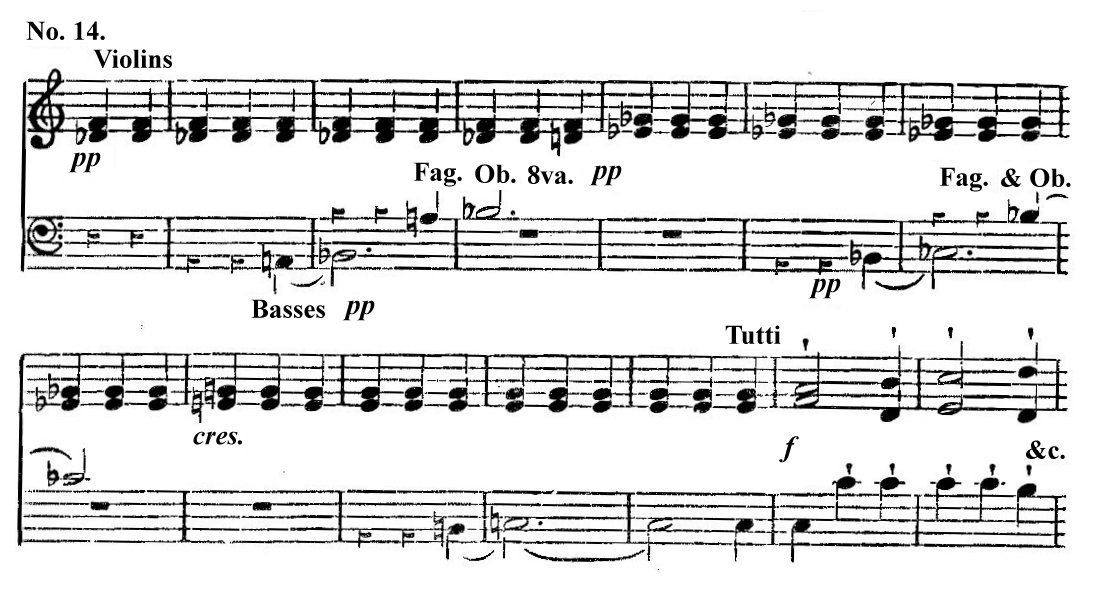
with the vigorous and suggestive picture. The modulation into B flat
minor, and the unexpected and masterly escape back to C major and the
original theme, though familiarly known to musicians, may well be
quoted here. The characteristic way in which Beethoven has emphasized
this modulatory passage by accompanying it with two notes out of the
theme itself is very interesting -
This movement was a distinct novelty in 1800.
When some one
was discussing with Haydn a rule of Albrechtsberger, Beethoven's
master, that in strict composition all fourths should be absolutely
banished, the old composer - with characteristic combination of sense
and daring, qualities in which he almost equalled his great successor -
broke off the conversation with the words, 'What nonsense! how much
more to the purpose it would be if someone would show us how to make a
new minuet' (Griesinger, p. 114). Here, if he had ever heard it, he
would surely have found the new minuet he sought for! Would he have
approved of it when he did hear it?
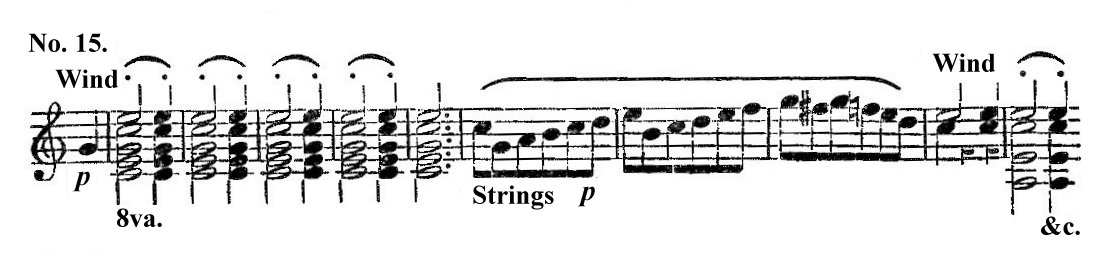
The
Trio,
or intermezzo between the so-called Minuet and its
repetition, departs a long way from the original plan, under which the
Trio was
only a second minuet. It is here a delicious dialogue between
the wind and stringed instruments -
A similar alternation of wind and strings will be found in the
Trio of the
Fourth Symphony, though in a more ethereal style than here.
IV.
The Finale
is throughout as bright as bright
can be, but it must be
confessed that it is more in the sprightly vein of Haydn than in that
of the Beethoven of later years. The humorous and coquetting passage,
for instance, Adagio
and six bars in length, with which the movement
starts, and which leads up to the first theme -
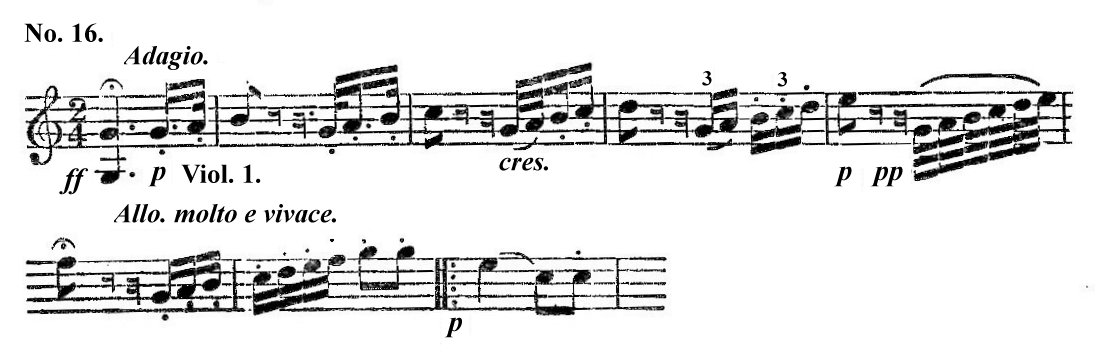
is, both in itself and in the manner of its recurrence, quite
in the vein of the 'Father of the Orchestra.' - Among the curious
stories told of the treatment of Beethoven's Symphonies by conductors,
not the least curious is the fact that Türk, a considerable musician,
when director of the Musical Society at Halle in 1809, always omitted
this passage because he felt sure that it would make the audience
laugh! Strange impertinence on the part of Türk! If Beethoven wanted
us to laugh, why should we not? Its author had certainly no such
feeling towards the passage, for he has introduced a similar one into
the Cadenza
which ends the Allegro
in the Finale
of his C minor
Concerto (Op. 37), which was completed in 1800: -

The
first theme itself is in two portions, each of eight bars -

In the sketch of the Finale
alluded to in the opening of these
remarks the subject appears in the following form -

The
phrase of accompaniment quoted at a,
No. 18, is used
in 'double counterpoint' - that is to say, it changes place with the
melody above it, and becomes itself the tune. This gives rise to much
imitation and repetition of recurring passages.
The short interval between the first and second subjects is not yet
treated in that organic way which Beethoven afterwards employed, but
remains, as in Haydn and Mozart, a mere interpolation. It contains a
passage on the descending scale -
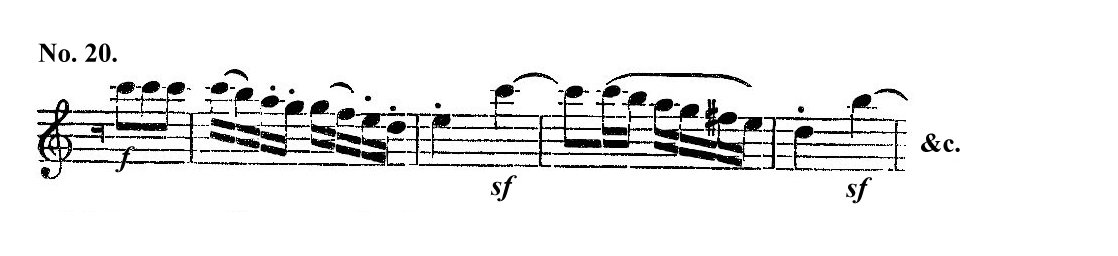
which recalls a similar figure in the Finale of Mozart's
so-called 'Jupiter' Symphony, in the same key, and which indeed may be
found in
analogous places in the works of many composers, including Brahms's
First Symphony. The second subject, running spontaneously out of the
preceding, is introduced by a pretty figure in the first fiddles -

and
accompanied by a lively moving bass, as follows -

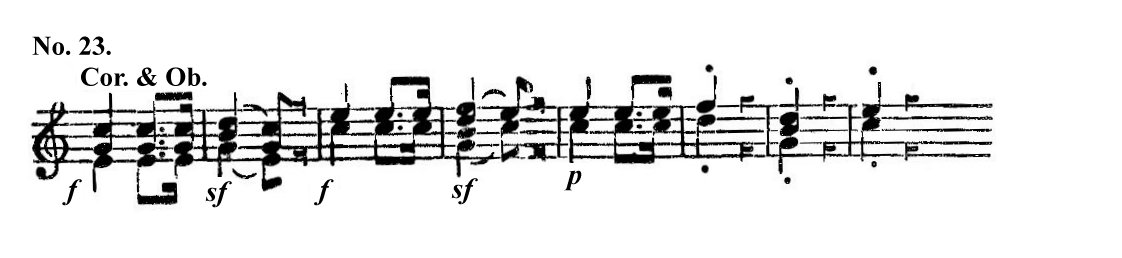
The Coda
is again of
considerable length, but with the
exception of an alteration of the introductory passage, and the
following short phrase in the wind instruments, it contains nothing of
importance -
Nothing can be more full of movement and spirit than the
whole of this
Finale. It
never hesitates from beginning to end. Still it is
unquestionably the weakest part of the work, and its frequent
imitations, and progressions of scale-passages, give it here and there
an antiquated flavour of formality or over-regularity which is not
characteristic of our Beethoven, and is strangely in contrast with the
novelty of the third movement. We have remarked the same thing, though
in a less degree, in the opening Allegro.
The finish and care observable throughout the work are very great. Beethoven began with the determination, which stuck to him during his life, not only of thinking good thoughts, but of expressing them with as much clearness and intelligibility as labour could effect; and this Symphony is full of instances of such thoughtful pains.
Besides the offence given by the discord of the opening, which has been already noticed, the work in general did not escape some grave censure. Thus, in an early notice [6], the Symphony and the three Pianoforte Trios of Op. 1 are treated together. The Trios are mentioned with good-natured contempt as 'confused explosions of the overweening conceit of a clever young man.' But a firmer tone is taken with the Symphony, which is denounced as 'a caricature of Haydn pushed to absurdity.' In spite of such nonsense the work quickly became a great favourite, and is spoken of in terms which now seem extravagant. Thus the Allgemeine musikalische Zeitung, Feb. 13, 1805, p. 321, describing a performance at Vienna, calls it 'a glorious production, showing extraordinary wealth of lovely ideas, used with perfect connection, order, and lucidity.' Even C. M. von Weber, always a keen critic of Beethoven's Symphonies, calls it feurig strömend. In the notices of the Philharmonic performances in the Harmonicon from 1823 to 1826, it is 'the brilliant Symphony' - ' the great favourite,' and so on.
Beethoven's principal compositions in the key of C major, besides the Symphony, are as follows: -
Mass, Op. 86; Overtures to 'Prometheus,' 'Leonora' (1, 2, and 3), Op. 115, and Op. 124; Pianoforte Concerto, No. 1; Triple Concerto, Op. 56; String Quintet, Op. 29; String Quartet, Op. 59, No. 3; Sonatas, Op. 2, No. 3, and Op. 53; 33 Variations, Op. 120.
Shortly after the appearance of the Symphony an arrangement of it was published without any indication of its being an arrangement, and this drew forth the following protest from the composer, which was inserted in the Wiener Zeitung of October 30, 1802 [7].
'NOTICE.
'I think it due to the public and myself to state that the two Quintets in C and E flat - of which one, extracted from a Symphony of mine, is published by Herr Mollo, of Vienna, and the other, extracted from my Septet (Op. 20), is published by Herr Hoffmeister, of Leipzig - are not original quintets, but only adaptations [translations - übersetzungen] of the publishers' doing.
'Arrangement is a thing against which now-a-days (in times so fruitful - of arrangements) a composer has to strive in vain. But one has at least the right to demand that publishers should state the fact on the title-page, so that the composer's honour may not be endangered or the public deceived. This, therefore, it is hoped may be guarded against for the future.
'I desire at the same time to mention that a new original Quintet of my composition, in C major, Op. 29, will very shortly be issued by Breitkopf and Härtel, of Leipzig.
'LUDWIG VAN BEETHOVEN.'
This protest Beethoven shortly followed by a complaint with reference to the last-mentioned work, in a letter which appeared in the Wiener Zeitung of January 22, 1803 [8].
'TO AMATEURS OF MUSIC.
'While informing the public of the appearance of my original Quintet in C, Op. 29, so long announced, through Messrs. Breitkopf and Härtel, of Leipzig, I also wish to explain that I have no concern with the edition of that work which was issued at the same time by Messrs. Artaria and Mollo, of Vienna. I am specially driven to this explanation by the fact that the edition is so faulty and inaccurate as to be of no use to players, while, on the other hand, all has been done by Messrs. Breitkopf and Härtel, the rightful proprietors of the quintet, to make their edition as perfect as possible.
'LUDWIG VAN BEETHOVEN.'
Not long before this Beethoven had discovered four bars which had been quietly inserted by the publisher in the proof of his great Sonata in G (Op. 31, No. 1), fortunately in time to be corrected before publication. Ries [9] has given an amusing account of the occurrence. The passage - which is still to be found in editions of authority - formed bars 28 to 31 before the end of the first movement.
Truly composers had much to suffer in those days from the publishers!

The first score is an 8vo of 162 pages, published in 1820. 'IIme. Grande Simphonie en Ré majeur (D dur) de LOUIS van BEETHOVEN. Oeuvre XXXVI. Partition. Prix 14 Frs. Bonn et Cologne chez N. Simrock. 1959.' The parts were published March, 1804, by the Bureau d'Arts et d'Industrie (now Haslinger), at Vienna.
The Second Symphony appears to have been completed by the close of the year 1802, and is thus separated from the First by an inconsiderable interval. Having once broken the ice, Beethoven advanced rapidly on the new current. It is interesting to observe, in these great masters, when once they have tasted the sweets of orchestral composition, how eagerly they rush into that great career. Schumann's first Symphony was delayed till he was thirty-one, and the second was produced during the same year. So, too, Brahms, having delayed the completion of his first Symphony till his forty-fourth year, composed and produced the second in little more than twelve months [1]. The summer of 1802, from May to October, was passed by Beethoven at his favourite resort of Heiligenstadt, near Vienna; and the 6th of October in that year is the date of the despairing letter to his brothers, usually known as 'Beethoven's Will,' which bewails his deafness in the most tragic manner, and was evidently written under the influence of one of those fits of depression to which, as his life advanced, he too often became a prey, and in apparent expectation of speedy death: - 'As the autumn leaves fall and wither, so have my hopes withered. Almost as I came, so I depart; even the lofty courage, which so often inspired me in the lovely summer days, has vanished.' 'With joy I hasten to meet death face to face.' Such is the tone of the whole document. Similarly, his intimate friend Breuning, writing to Wegeler, says, 'You could not believe the indescribable, I might say horrible effect, which the loss of his hearing has produced on him.' [2] No such feeling, however, can be traced in the Symphony. On the contrary, there is not a single desponding bar in the whole work; it breathes throughout the spirit of absolute confidence and content; not the brilliant exhilaration which distinguishes the Fourth of the Nine, or the mighty exuberant fun of the Seventh and Eighth, but the gaiety and satisfaction of a mind thoroughly capable and content with itself. Strong as were the feelings which dictated the 'Will,' they could not last. At that season of life grief is rarely permanent. Beethoven escaped from the demon of despondency as soon as he began to compose, the inward voice calling so loudly and so sweetly as to make him forget his deafness to the outer world, and the isolation which distressed his affectionate and genial heart when he had time to brood over it.
Important sketches for the Symphony are found in a notebook which was included in the sale of Beethoven's effects, and came afterwards into the possession of Herr Kessler of Vienna. These note-books, of which fifty-one were dispersed at the sale referred to, at prices varying from 1.25 to 3 florins, usually consisted of one or two quires of large oblong music-paper, as gray and coarse as a grocer's wrapping paper, roughly sewn together. In these every musical idea as it occurred to the composer was jotted down, often only to be scratched out again, and re-written in an altered, though probably slightly altered, form. It was a 'bad custom,' to use his own words [3], which he had followed from childhood. It was a very fortunate custom for us, who love to investigate the procedure of this great inventor. But, whether a bad or good habit, it is most characteristic of Beethoven, and completely contradicts the popular idea of him as a writer who dashed down everything as it occurred to him - who wrote, as someone has said, 'by flashes of lightning.' In fact, so tentative was he that he might have been the inventor of the proverb, 'Second thoughts are best.' The quantity of music contained in the sketch-books is enormous. 'Had he,' says one who knew them well, 'carried out all the symphonies begun in these books, we should have at least fifty.' And the same is true of Concertos, Sonatas, Overtures, and other forms of piece. A Pianoforte Concerto in D (1815), an Overture on the name of Bach (1822), music to 'Macbeth' (1808), may be named among the treasures which advanced far beyond the embryo stage, and barely escaped coming into the world. But to return to Symphony No. 2, which happily was completed. The sketches are intermingled with others for the well-known set of three Sonatas for piano and violin (Op. 30); for the three noble Pianoforte Sonatas which form Op. 31; for the Trio, 'Tremate' - published many years later as Op. 116 - and other less important works. This very book has been printed and published entire, with elucidatory remarks [4], by Herr Nottebohm, the great Beethoven investigator, who has done so much to familiarise us with the contents of the composer's sketch-books, and with the history of his works and their connection with each other; and it supplies an insight into Beethoven's habit of working at several things at once, as well as his general method of composition, which is most interesting and instructive to all students of his music. 'I live only in my music,' says he, in a letter of 1800 to his early friend Wegeler; 'and one piece is hardly down before another is already begun. As I am now writing, I often make three and four pieces at once.' For this habit Beethoven was remarkable among composers, especially when the exhaustive nature of his treatment is considered. How different in this respect was he from other great writers! We are familiar with Macaulay's confession: 'It is one of my infirmities, that I cannot heartily and earnestly apply my mind to several subjects together,' and he often bewails it. Goethe, too, says much the same: - 'If you have a great work in your head nothing else thrives in its vicinity.' On the other hand, Mr. Watts, the eminent painter, has, we believe, in a general way, several pictures on hand at the same time; and takes them up at will, one after the other, without the slightest break of continuity in conception. So with Beethoven, each work, great or small, seems to thrive quite independently of the others. The sketches of the Symphony contained in the book alluded to appear to have been made in the early part of 1802, and are chiefly for the Finale. They occupy eleven large and closely written pages, and, besides scattered sketches and memoranda, contain three long drafts of the movement - two of the first portion only, but the third of the entire Finale. The differences in these three are very interesting in themselves, and still more interesting as a token of the gradual, laborious, and pertinacious process, often to be referred to in these notices, by which this great genius arrived at the results which appear so spontaneous and bid fair to be so enduring [5].
Ferdinand Ries, Beethoven's pupil, in his Biographische Notizen, furnishes us with an interesting anecdote, à propos of this Symphony, illustrating the extreme care which his master bestowed on every note. Speaking of the Larghetto - which, by the way, he calls Larghetto quasi Andante - Ries says, what everyone will agree with, that it is so lovely, pure, and cheerful in tone, and the motion of the instruments so natural, that it is difficult to conceive its having ever been different to what it is at present. 'And yet,' he continues, 'an important part of the accompaniment near the beginning has been altered both in the first violin and viola, though so carefully that it is impossible to discover the original form of the passage. I once asked Beethoven about it, but could only get the dry reply, It's better as it is.' Ries is here possibly referring to the exquisite figures with which the violin and viola accompany the theme on the repetition of each portion by the clarinets, in the early part of the movement - an accompaniment which may well have suggested to Schubert the analogous figures in the Andante of his great Symphony in C. But this is mere conjecture.
The late Mr. Cipriani Potter, who, if not a pupil of the great composer, spent some months in his company at Vienna in 1817, was fond of stating that Beethoven made no less than three complete scores of the Symphony before he could please himself. These are all lost; and not even the last one, the final result of so much labour, though formerly in the possession of Ries, is known to exist. But remembering the two scores of the Leonora Overture (Nos. 2 and 3) and the evidence of Beethoven's many note-books, it is easy to believe Mr. Potter's statement, and equally natural to infer that Beethoven often re-wrote his great works, even though the trial copies have by accident or design vanished. Accidents were frequent in the establishments of composers in those days. Three of Schubert's large works were used by the maid to light fires; and Beethoven himself, after many searches and much not unnaturally bad language, discovered, just in time, that large portions of the manuscript of his Mass in D had been used to wrap up boots. Much nearer to our own times, and in the hands of a far more careful person than either Beethoven or Schubert, the autograph and only manuscript of the imprinted first volume of Carlyle's 'French Revolution' was torn up day by day to light the fire!
The Second Symphony is a great advance on the First. In the first place it is longer. Compared with the First Symphony, the Introduction is thirty-three bars long instead of twelve, and the Allegro con brio 328 instead of 286; the Larghetto is one of the longest of Beethoven's slow movements - and so on.
The advance is more in dimensions and style, and in the wonderful fire and force of the treatment, than in any really new ideas, such as its author afterwards introduced and are specially connected in our minds with the name of Beethoven. The first movement always more or less gives its cachet to a Symphony; and here the first movement is distinctly of the old world, though carried out with a spirit, vigour, and effect, and occasionally with a caprice, which are nowhere surpassed, if indeed they are equalled, by Haydn or Mozart. Nor is there anything in the extraordinary grace, beauty, and finish of the Larghetto to alter this; nor even in the Scherzo and Trio, which, notwithstanding their force and humour, are scarcely so original as the Minuet of No. 1; nor in the Finale, grotesque and strong as much of it is: it is all still of the old world, till we come to the Coda, and that, indeed, is distinctly of the other order.
Another characteristic which seems to mark the historical place of the Second Symphony is that, in the slang of modern criticism, it is 'pure music.' No one, to our knowledge, has ever suggested a programme or image for any of its movements, nor is anyone likely to do so, except for the conclusion of the Finale, and in hearing that images certainly do crowd irresistibly on the mind. This Symphony is, in fact, the culminating point of the old, pre-Revolution world, the world of Haydn and Mozart; it was the farthest point to which Beethoven could go before he burst into that wonderful new region into which no man had before penetrated, of which no man had even dreamed, but which is now one of our dearest possessions, and will always be known by his immortal name.
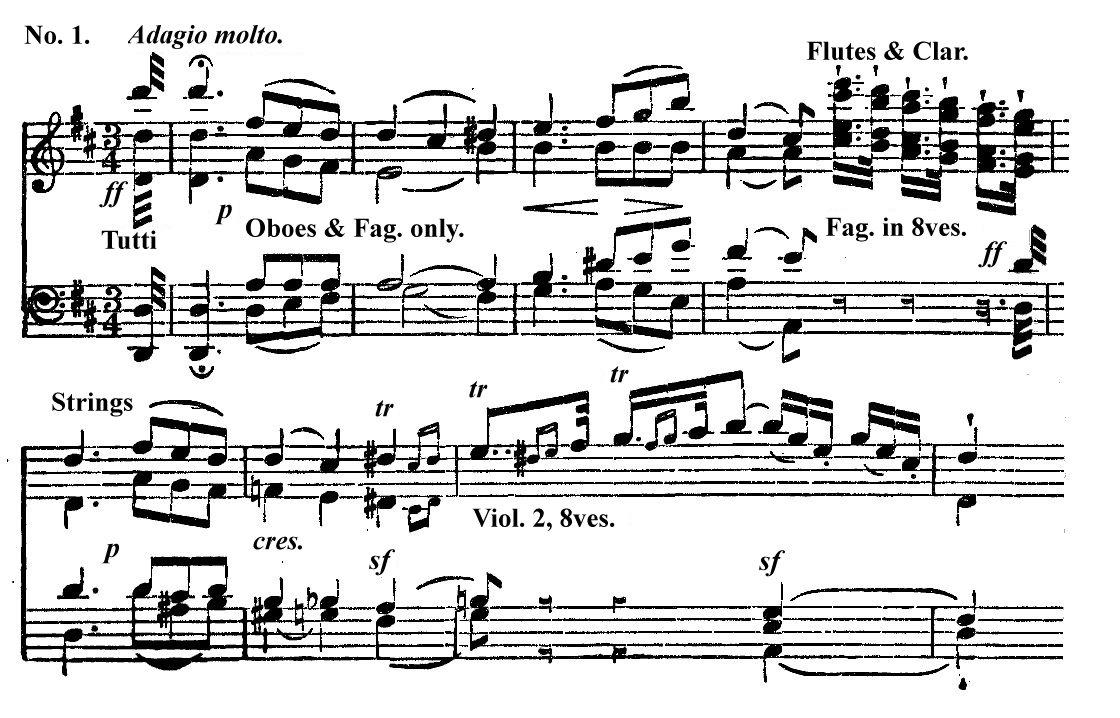
I. The Introduction, Adagio molto, though nearly three times the length of the last, is still too short to admit of any development. It opens with a great unison D, and a melodious passage in four-part harmony for the oboes and bassoons, given, on repetition, to the strings, with delightful changes both of melody and harmony: -
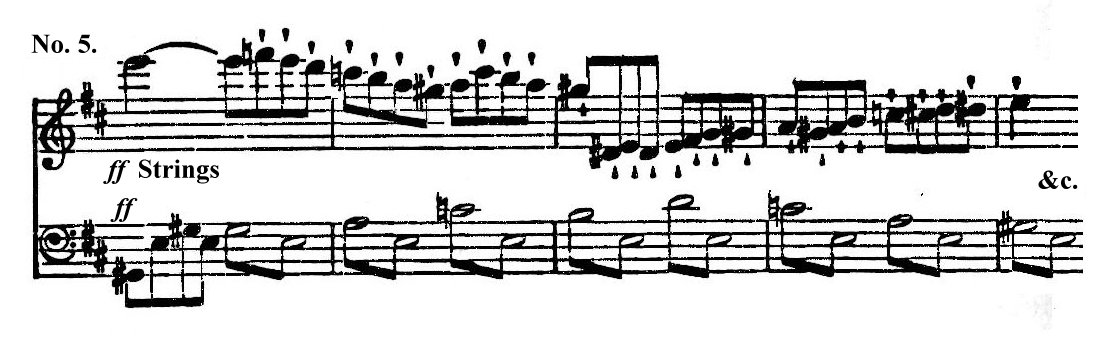
The rest consists of passages of imitation between bass and treble, and of good modulation, all couched in beautiful and melodious forms, and ending with a very graceful passage in double counterpoint over a pedal of ten bars' length on A, resolving into the tonic on the first note of the Allegro con brio:

It is strange at this early date to meet with the arpeggio of the chord of D minor, in a shape which almost textually anticipates the Ninth Symphony -

The opening of the principal theme of the Allegro is one of the passages just alluded to as belonging to the old school in the distinct definition and regularity of its construction -

But though square in cut it is by no means wanting in spirit; and the fiery flash of the fiddles in the interval between the two sections of the subject (bar 4 of the quotation) is splendid, and gives a good specimen of the extraordinary energy which imbues that seraphic instrument throughout the entire work.
The passage which connects this theme with the second, though broad and free, has not entirely lost the character of 'padding,' which these connecting links too often bear in the Symphonies of the earlier masters; and does not spring out of the vital material as it does in Beethoven's subsequent work -
The
second theme itself -

has a certain precise military air about it, but is full of vivacity,
and is wonderfully set off by the energetic brilliancy of the violins,
which here (bar 8), as in the first theme, rush in between the strains
of the subject.
On the repetition of the subject in the flutes, clarinets, horns, and bassoons, it is accompanied by the strings in a delightful tremolo, a figure which is quite a characteristic of this Symphony -

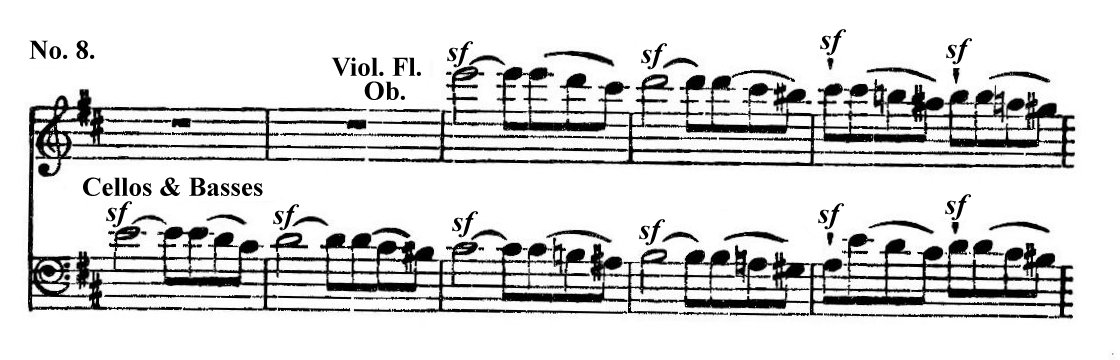
The
passage which follows the second subject is cast in a
quasi-canonical form -
smacking strongly of the old school, and not founded on the materials
already quoted. It is after eight bars of this connecting matter that
the capricious passage occurs, to which allusion has been already made,
and which is the more interesting because it seems to act as a warrant
for something similarly wilful in others of the Symphonies. Beethoven
is about to close in the key of A, is, in fact, within one chord of so
doing, (*) when it occurs to him suddenly to interrupt the close by the
intrusion of ten bars -

made up from a characteristic figure in the first theme (see No. 4),
and of excellent effect, but still absolutely capricious in their
introduction here, and doubtless a great puzzle to the hearers of 1803.
The working-out is masterly, not only for its contrivances - canon, double counterpoint, modulations, &c. - but also for its effects of instrumentation, beautiful solo use of the wind, brilliant figures for the violins, and new accompaniments to the subjects - witness especially the triplets which accompany the second subject in a passage shortly before the reprise. In the reprise itself a good deal of condensation occurs. The Coda, though brilliant and effective, contains no new or very striking features.
II.
The Larghetto,
in its
elegant,
indolent beauty - which is seriously
impaired if the movement is taken too fast - is an absolute contrast to
the sharp, definite, somewhat peremptory tone of the Allegro. Its
repetitions are endless, but who ever wished them curtailed?
That strain
again - it had a dying fall.
It
is in A, the dominant of the original key, and is couched
in the ordinary 'first movement' form. Its principal theme is in two
strains of eight bars each, each strain given out by the strings and
then repeated by the wind, with exquisite enrichments in the violins
-
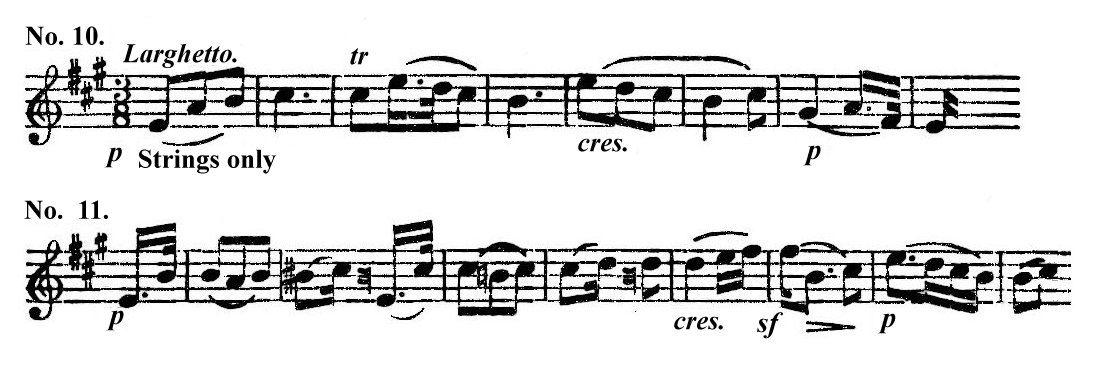
In
a book of sketches in the Bibliothek at Berlin, Mr.
Shedlock has recently discovered the following fragment apparently a
very early draft of this beautiful melody (the signature of A major
must be understood) -

That given by Thayer, in his Thematisches
Verzeichniss (No.
103), and by Nottebohm, in his publication of the Sketch Book of 1802,
already spoken of, would seem to be rather aimed at the slow
movement of Symphony No. 5 -
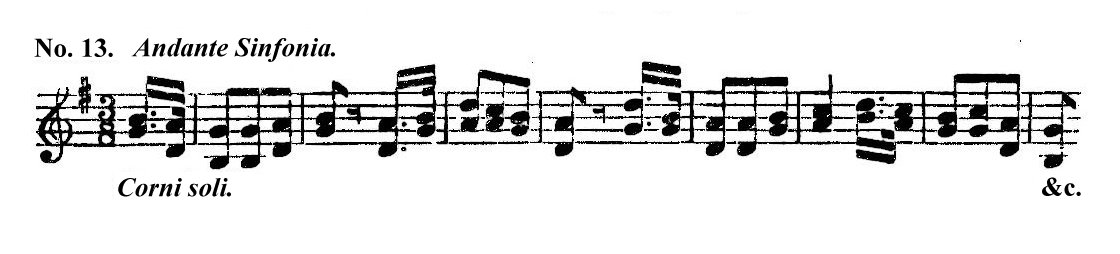
It may have been intended for this Symphony, but can hardly be
a sketch for the present Larghetto.
After
the repetition of the strain quoted as No. 11, a
continuation is afforded by the following melody, alternating between
wind and string -

Upon this follows the second theme proper of the movement, in
the orthodox key of E major; a theme which maintains the same
character as the foregoing, with a certain pleasant, lazy grace
inherent in its syncopations, both of melody and bass, which will be
noticed in the Adagio of the Ninth Symphony. It is given first plain
-
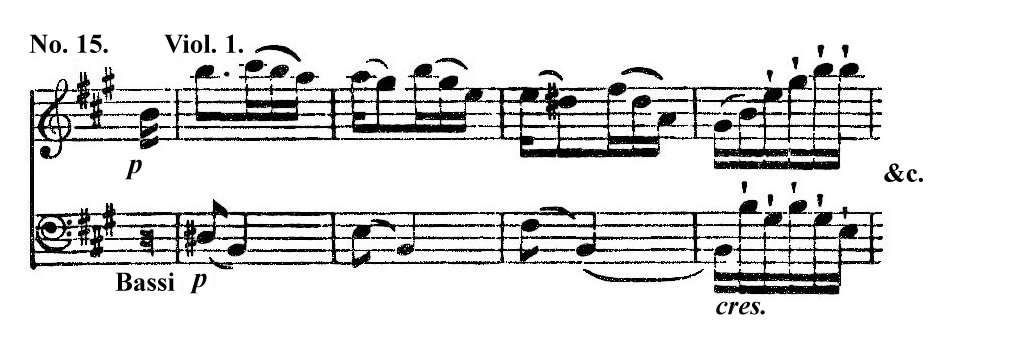
and then in florid form. And this leads to a short passage of close
harmony (the origin of which may perhaps be traced in a Quartet of
Haydn's - No. 9 in Peters's Collection, '15') - as follows:
-

though Beethoven has added a point in the cross accents. He
gives the passage first with the strings alone -

and then with the full band. Eight bars of fanciful drollery
(anticipating the demisemiquavers of the next quotation) lead into the
key of E, and to the following beautiful passage, which is worthy to be
the second chief theme of the movement, though technically it is
merely the development of the ordinary coda-figure. This is given out
by the cellos, with second violins in octaves -

Its quaint grace, the contrast of legato
and staccato
and the
air of quasi-mystery that pervades it - as if the cellos were
communicating some segreto
d'importanza in a stage-whisper - are
full of inimitable though quiet humour.
This ends the first section of the Larghetto and completes the materials of the movement. But Beethoven (with a curious contrast to the rough bluntness of his manners) seems bent on showing us with what minute refinement he can set off, adorn, and elaborate the lovely ideas which he has thus laid before us in their simple form. The labour and pains involved in the process must have been immense; but, here as elsewhere, he never spared himself, and never relinquished a passage till it was as good as he could make it; and hence one great part of the secret of the immortality of his music.
The
working-out section begins at once with a modification of
the initial theme (No. 10) in the minor, thus deliciously introduced -
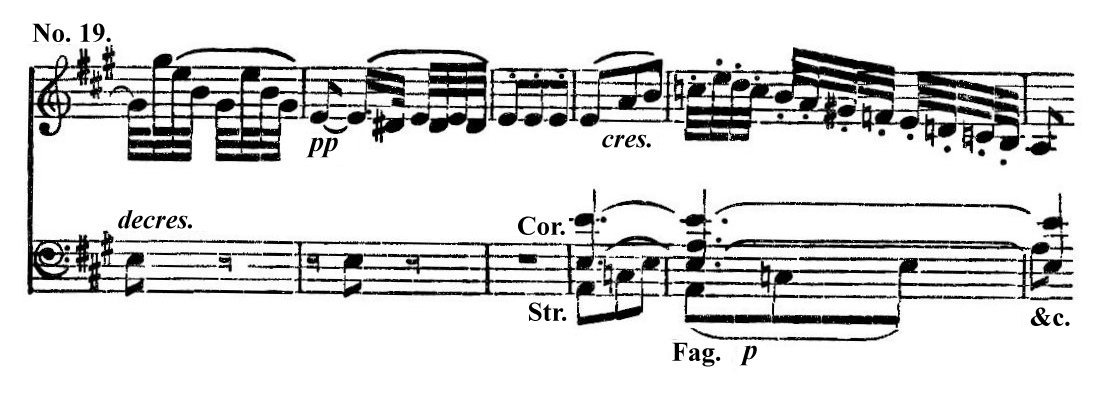
and developed for some considerable time with consummate
skill, great beauty of modulation, and continual variety of nuance.
As
the working-out proceeds the ornamentation grows more and
more rich, delicate, melodious, and fanciful. Here is a specimen of
imitation, bar by bar, between the oboes in octaves, with bassoon a
further octave lower, and the basses, with an elegant figure in the
first violin, and an exciting iteration in the violas and cellos
-

The figures are so clearly and craftily designed, and the
instrumentation is so thin and so nicely calculated, that there is no
difficulty in following it all in performance. These airy and refined
ornaments may well have been Schubert's models for the similar
enrichments which so greatly adorn the Andante of his
great Symphony in
C. We know, at any rate, that the movement now before us was especially
dear to him, from the fact that he has followed it (down even to
details) in the slow movement of his Grand Duo (Op. 140) for the
pianoforte in C major [6].
And
doubtless he 'heard the angels singing' in
the Larghetto
of Beethoven's Second Symphony, as we know that he did in
the Trio of Mozart's G minor.
So flowing and vocal throughout is this beautiful movement in its subjects, their developments and ornaments, that it is not surprising that it has been frequently arranged for voices and for instrumental chamber music. Of the former, one, which still commands a certain sale, dates from as early as the year 1831, and is a duet for two sopranos, with piano accompaniment, arranged by Professor Edward Taylor, and inscribed to Mr. Thos. Attwood, one of the leading musicians of the day. Another, published in Germany, is for soprano solo, to words by Silcher, of equal significance.
III.
The Scherzo,
in D, is
more
individual and original than
either of
the preceding movements - though still below the level of the Beethoven
whom we know. Its picturesqueness and force, the humorous alternations
of soft and loud, and of dashes and dots (too much neglected in the
recent editions), and the directness of the means for producing them,
are remarkable. It opens thus -

and after sixteen bars comes the double bar, and then the
following piquant tune, and wild solution (again with the rushing
fiddles) -

This is worked for some little time with a kind of obstinate
monotony, and then repeated, till at length the first tune returns,
this time in oboe and bassoon, heralded in the most saucy manner by the
alternate play of the two violins -
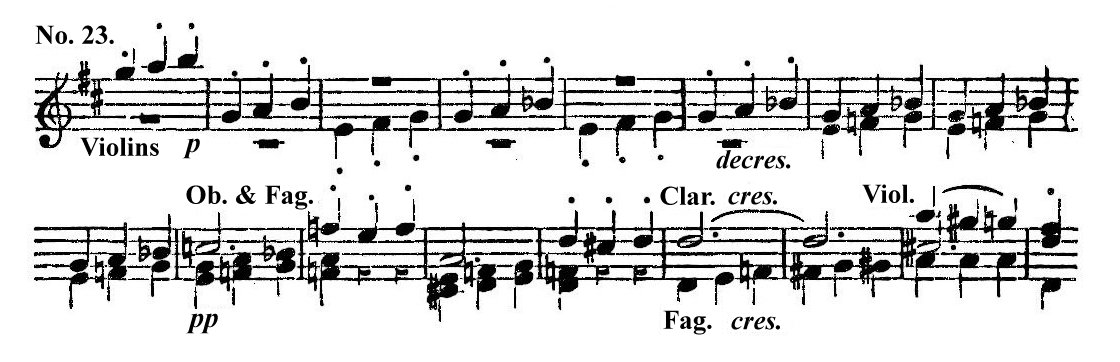
Nothing more picturesque and seizing can well be imagined.
The
Trio
- still in D, and wanting no subtle change
of key to make it interesting - begins with the following melody
harmonized in four parts for oboes and bassoons, reinforced at the
sixth bar by the horns -

This is repeated, making sixteen bars in all. We are then,
without an instant's warning, plunged head over ears into F sharp
major, and, as it were, held there till the water runs into our eyes
and ears -

then as suddenly back again into D, fortissimo -

The spirit and vigour of these two little movements are really
astonishing. The music seems sometimes almost to fly at your throat.
Note the constant sudden contrasts both in amount and quality of sound.
In amount we find f, p,
ff, pp
alternately almost throughout. In quality
we have first the full orchestra, then a single violin, then two horns,
then two violins, then the full orchestra again, all within the space
of half-a-dozen bars. But the end is chiefly gained by all kinds of
unexpected changes of key, not mere senseless freaks, but changes both
sudden and suitable, such as at once to rouse the attention,
and, with all their oddity, to convince the reason and satisfy the
taste. We start in D; then in a moment are in B flat, then in A, then
in D, then in F. Then there is the change already noticed in the Trio,
into F sharp, and back at a blow into D!
Such changes of key and tone were too abrupt for the older composers. The musicians of the eighteenth century were too commonly the domestic servants of archbishops and princes, wore powder, and pigtails, and swords, and court dresses, and gold lace, passed their time bowing and waiting in ante-rooms, dined at the servants' table, [7] and could be abused and even kicked out of the room, as Mozart actually was, and discharged at a moment's notice like ordinary lackeys. Being thus forced to regulate their conduct by etiquette, and habitually to keep down their emotions under decorous rules and forms, they could not suddenly change all their habits when they came to make their music, or give their thoughts and feelings the free and natural vent which they would have had, but for the habits engendered by the perpetual curb and restraint of their social position. In this light one can understand the jovial life of Mozart, the skittles and the suppers, and all the rest. It was his only outlet, and must have been necessary to him - vital. But Beethoven had set such social rules and restrictions at naught. It was his nature, one of the most characteristic things in him, to be free and unrestrained. Almost with his first appearance in Vienna he behaved as the equal of everyone he met, and after he had begun to feel his own way, as he had in this Symphony, his music is constantly showing the independence of his mind.
It
is remarkable that nearly twenty years later, in the
composition of the Trio
of the Ninth Symphony, Beethoven should have
returned to so early a work as this. The following sketch, however,
probably of 1818, is quoted by Nottebohm [8]
-

It shows, at any rate, that a moving bass, which forms so
conspicuous a feature in the actual Trio of No. 9, was
originally
intended to be a feature of the movement.
IV. But to go back to the work itself, it possesses what the First Symphony did not exhibit to the same degree, but what is so eminently characteristic of all the other eight - individuality. It may be possible - if a mere amateur can be allowed the confession - to confound for a moment in recollection the first movement of the First Symphony with the Overture to 'Prometheus,' or its Finale with one of Haydn's Finales. But with the Second Symphony this is not possible. Each one of its four sections is perfectly distinct and individual in its own proper character, and cannot be confounded with any other movement in any Symphony or other composition, of Beethoven or of any one else. The very terms in which it is spoken of by the early critics show how astonishing it was to the public of that day. The first Allegro and the Scherzo were the favourite movements. The Allegro is constantly termed 'colossal' and 'grand,' words which now could scarcely be applied to it with propriety. The Larghetto, strange to say, is hardly mentioned; in fact, in Paris they had - so Berlioz tells us [9] - to substitute the Allegretto from the Seventh Symphony in order to make the No. 2 go down at all. But the Finale puzzled everybody; it was so harsh (grell), wild, bizarre, and capricious. It was this oddity in the Finale - this want of decorum, rather than any obscurity arising from depth of thought - and the difficulty felt by the performers in mastering the technique of the entire work (which is always spoken of as extraordinarily hard to play), that were the two main complaints in the notices of the early performances. We may be thankful that we now feel neither of these drawbacks, and that our only sentiment is amusement at the humour and personality of the music, delight at its grace, and astonishment at its energy and fire. Beside the Finales to Beethoven's Fourth, Fifth, Seventh, and Eighth Symphonies, with which we are all so familiar, that of No. 2 finds a lower level; but at that date those great works were non-existent. The Finale to Mozart's G minor was the most fiery thing in that line that the world then possessed. But the Finale of Beethoven's No. 2 has got all the fire of that, with an amount of force, humour, and abruptness that even Mozart never evinced, and that must have taken everyone by surprise in 1803, and have compelled them into listening to it, against their will, against their aesthetic judgment and sense of propriety, and everything else.
It
is in the form called a Rondo (though not strictly that)
and starts
in the most abrupt fashion and very fast (Allegro molto) -
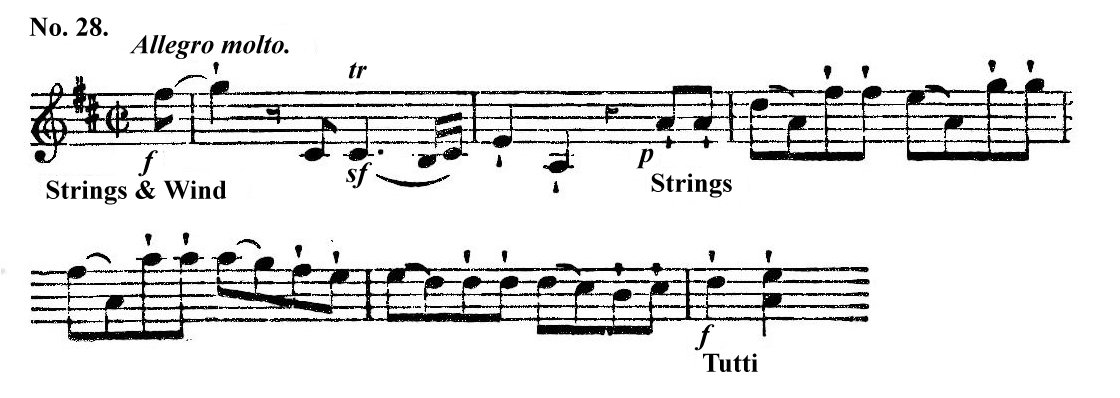
Then comes a passage which can hardly be called a subject
or episode -

but its high spirits are in excellent keeping with that which precedes
it, and it leads well into the second subject, which, though not
extraordinary in itself, is most spontaneous, and very pleasant in
sound, with its vocal passages for oboe and bassoon, and would be well
calculated to allay the fever with which its predecessor started if its
lively accompaniment were not too full of motion (notice here again
especially the fiery intrusions of the violins) -
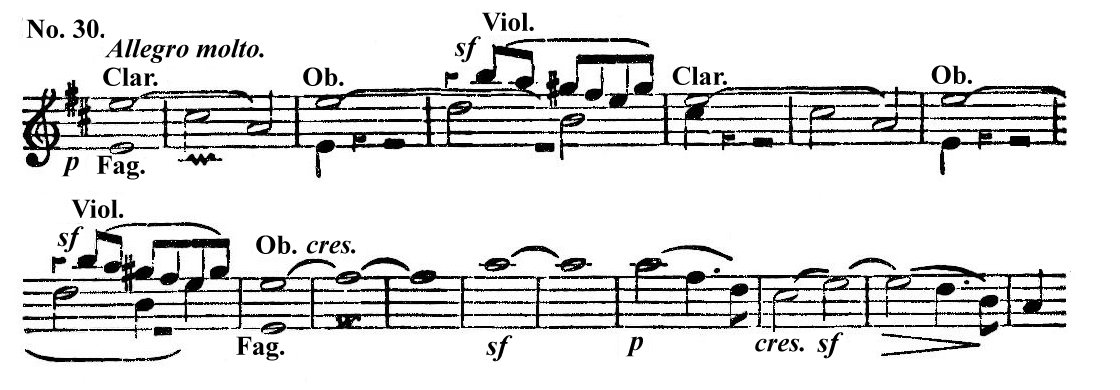
Long
as this subsidiary theme is - unusually long for
Beethoven - it is immediately repeated in the minor; and then, after a
passage of padding, comes the repetition of the opening subject, led up
to by a phrase formed out of its two initial notes, and accompanied by
the bassoon in arpeggios. This leads into a working-out, with a great
deal of humorous play, before the reprise
of the original material is
reached. In the reprise
the second subject (No. 30) is repeated in D,
and this again is followed by a long and very original Coda. This
begins with the opening subject (No. 28), but soon comes to a pause,
first on the chord of A, with the dominant seventh on G sharp, and then
on the chord of F sharp upon A sharp. And now begins the most
individual and Beethovenish part of the entire work. It is as if, after
the chord of F sharp, we had passed through a door and were in a new,
enchanted world. All that we have heard before vanishes. Earth is
forgotten, and we are in Heaven. The rhythm changes; the bass goes
down octave after octave pianissimo,
distinctly heard through the thin
scoring -

a fresh subject comes in in the wind; the opening theme is
once more alluded to, but only to lead into an entirely new thought
- a
magic shimmering, impressive as the evening sun shining broad and low
on the ocean; a lovely flowing melody in the oboe and bassoon,
accompanied in notes of equal value by the basses, and with a pedal D
through three octaves in the horns and violins. The beauty of this
passage words cannot describe; it is pure Beethoven, a region full of
magic and mystery, into which no one before ever led the hearers of
music. After further working we arrive at another pause, this time on F
sharp itself; a short resumption of the former new rhythm follows,
intensified by the bass being pizzicato;
but it does not last; a rapid
ending, and the whole is over!
Such
is this beautiful work as it was
given us by its author ninety years ago, at his concert on the Tuesday
in Holy Week, 1803. And even now, after nearly a century of progress in
music, of infinitely greater progress than that in any other art -
after
Beethoven's own enormous advance, after Schumann, Brahms, Wagner - even
now, what can be newer or pleasanter to hear than the whole Symphony?
What more delicious than the alternate lazy grace and mysterious humour
of the slow movement, the caprice and fire and enchantment of the
Finale? To
this very day the whole work is as fresh as ever in its
indomitable fiery flash and its irresistible strength. Were ever
fiddles more brilliant than they are here? more rampant in their
freaks and vagaries, bursting out like flames in the pauses of the
wind, exulting in their strength and beauty - say between the sections
of the opening theme in the first Allegro
-

or between those of the second theme in the same movement -

or in a similar position in the Finale
-

or in the Larghetto
-

Had ever the bassoon and oboe such parts before? and so on
throughout. Listen to it, and see if it is not so.
In
connection with the violins, I may be pardoned for
mentioning a fact
which, remembering Beethoven's minute attention
to such points, must surely have some intentional significance - I mean
the prominent occurrence in every movement of a tremolo figure -

in the fiddles. It is found in the Allegro
con brio, in the brilliant
passages accompanying the first subject, in the equally brilliant
figures accompanying the second subject, and in the working-out of the
same movement. In the Larghetto
it frequently occurs; also in the F
sharp passage in the Trio,
and in the most characteristic part of the
Coda of the
Finale it
is peculiarly effective. It might almost be taken
as a motto for the work. We shall encounter it again in the Fourth
Symphony.
In some respects the Second Symphony is, though not the greatest, the most interesting of the nine. It shows with peculiar clearness how firmly Beethoven grasped the structural forms which had been impressed on instrumental music when he began to practise it; while it contains more than a promise of the strong individuality which possessed him, and in his works caused him to stretch those forms here and there, without breaking the bounds which seem to be indispensable for really coherent and satisfactory composition. 'The same structure,' says Wagner [10], 'can be traced in his last sonatas, quartets, and symphonies as unmistakably as in his first. But compare these works one with another, place the Eighth Symphony beside the Second, and wonder at the entirely new world in almost precisely the same form.'
It
has been well said that
Two worlds at
once they view
Who stand
upon the confines of the new;
and taking our stand in the beautiful work which
we have just been endeavouring to trace, or rather perhaps in the Coda
of
its Finale,
we can survey at a glance the region which lies behind -
the
music of the eighteenth century, at once strong, orderly, elegant,
humorous, if perhaps somewhat demure; and that more ideal region of
deeper feeling, loftier imagination, and keener thrill, radiant with
'the light that never was on sea or land,' a region which was opened by
Beethoven, and has since been explored by his noble disciples, not
unworthy of so great a master.
The Symphony was first performed on the Tuesday in Holy Week ('Char-Dinstag'), 5th April, 1803, at a concert given by Beethoven in the 'Theater-an-der-Wien,' Vienna, when the programme included also the Oratorio 'The Mount of Olives,' the First Symphony, and the Piano Concerto in C minor [11]. The date of the earliest edition is March, 1804 - that is, the parts; the score does not appear to have been published till 1820, by Simrock, of Bonn. The work was dedicated to Beethoven's very good friend Prince Charles Lichnowsky. It was arranged by the composer himself as a Trio for pianoforte and strings, which is published in Breitkopf's complete edition, No. 90.
The orchestra is the ordinary Haydn-Mozart one - without trombones, but with the addition of clarinets, and the orchestral effects are often strikingly like those in Mozart's operas, that of 'Figaro,' for instance.
We have now endeavoured to trace the two first steps in Beethoven's Symphonic career. The next we shall find to be a prodigious stride.
He was always on the advance. Even in 1800, in forwarding 'Adelaide' to Mathison the poet, he says: 'I send the song not without anxiety. You yourself know what change a few years make when one is always advancing. The greater one's progress in Art, the less is one satisfied with one's earlier works.' And he put this maxim into practice with characteristic energy. The famous Septet, which at its first performance in April, 1800, when Haydn's oratorio was all the fashion, he jokingly called his 'Creation,' and which is now a greater favourite than ever with musicians and amateurs alike, he afterwards detested, and would have annihilated if he could. 'What is that?' he said, on one occasion in his later life to the daughter of his friend Madame Streicher, as she was playing the well-known ever green Thirty-two Variations in C minor, so beloved by Mendelssohn in his late years. 'What is that? Why your own!' 'Mine? That piece of folly mine?' was the rejoinder; 'Oh, Beethoven, what an ass you must have been!' In 1822 a conversation is recorded with a Madame Cibbini, very touching when one thinks of this great master, whose artistic life had been one upward progress since the days when he began to compose. The lady said that he was 'the only composer who had never written anything weak or trivial.' 'The devil I am !' was the retort; 'many and many of my works would I suppress if I could.'
Bearing this in mind, it is easy to appreciate the story of his biographer, Schindler, who informs us that in the year 1816, after the performance of the Seventh and Eighth Symphonies, a proposal was made to Beethoven by a resident in Vienna [12] to write two Symphonies in the style of his first two. No wonder that the suggestion made him furious. Translate the story into a literary form, and imagine Shakespeare being asked, after he had produced 'Othello' and 'Hamlet,' to write a play in the style of the 'Two Gentlemen of Verona' or 'Love's Labour's Lost,' and the absurdity of this well-meaning amateur will be apparent to everyone.
A still more curious instance of the same mistake is afforded by a writer in the Musical World of May 6, 1836 (p. 118), a musician, and an eminent one too, who, in his anxiety to make the Ninth Symphony better known, seriously proposes that a Symphony of ordinary length should be made by taking the first and third movements of No. 9 and combining them with the last movement of No. 2 as a Finale! Absurd indeed; but we may be thankful that, owing to the lapse of time, such a mistake is not possible for us. On its first performance at Leipzig the work evidently caused much agitation. It was received by the Zeitung für die elegante Welt [13] 'as a gross enormity, an immense wounded snake, unwilling to die, but writhing in its last agonies, and bleeding to death (in the Finale).' Such, however, was not the general opinion, though the work is always spoken of more or less with hesitation, and as not so safe as No. 1.
In France it had to be considerably reduced before it could be put into the programme of the Concerts Spirituels of 1821, and, as already mentioned, the Allegretto of No. 7 was substituted for its own slow movement. The Allegretto was encored, but the rest of the work proved an absolute failure!
In England it seems to have formed part of the répertoire of the Philharmonic from its foundation in 1813, though, as the Symphonies were not at that time particularised on the programmes by their keys, it is impossible to be quite sure. In 1825 the Harmonicon, with a ridiculous tone of patronage, says that it was 'written when his mind was rich in new ideas, and had not to seek novelty in the regions of grotesque melody and harshly combined harmony' (p. 111). 'The Larghetto (encored) speaks a language infinitely more intelligible than the majority of vocal compositions.' Next year, however, the critic is so much excited by the music as to wish for 'a repose of at least a full half-hour' after it (1826, p. 129).
The key of D major was employed by Beethoven for some of his finest works: amongst them the Missa Solemnis; the Violin Concerto; the Trio for pianoforte, violin, and cello, Op. 70, No. 1; a Quartet, No. 3 of the first set of six (Op. 18); two remarkable Pianoforte Sonatas, Op. 10, No. 3, and Op. 28, usually, though inaccurately, called 'Sonata Pastorale'; and also the noble Andante Cantabile of the great Trio in B flat, Op. 97.
The following is the document mentioned earlier. The italics are Beethoven's own.
O you
my fellow-men, who take me or denounce me for
morose,
crabbed, or
misanthropical, how you do me wrong! you know not the secret cause of
what seems thus to you. My heart and my disposition were from childhood
up inclined to the tender feeling of goodwill, I was always minded to
perform even great actions; but only consider that for six years past I
have fallen into an incurable condition, aggravated by senseless
physicians, year after year deceived in the hope of recovery, and in
the end compelled to contemplate a lasting
malady, the cure of which
may take years or even prove impossible. Born with a fiery lively
temperament, inclined even for the amusements of society, I was early
forced to isolate myself, to lead a solitary life. If now and again I
tried for once to give the go-by to all this, O how rudely was I
repulsed by the redoubled mournful experience of my
defective hearing; but not yet could I bring myself to say to people
'Speak louder, shout, for I am deaf.' O how should
I then bring myself to admit the weakness of a sense which ought
to be
more perfect in me than in others, a sense which I once possessed in
the greatest perfection, a perfection such as few assuredly of my
profession have yet possessed it in - O I cannot do it! forgive me
then,
if you see me shrink away when I would fain mingle among
you. Double pain does my misfortune give me, in
making me misunderstood. Recreation in human society, the more delicate
passages of conversation, confidential outpourings, none of these are
for me; all alone, almost only so much as the sheerest necessity
demands can I bring myself to venture into society; I must live like
an exile; if I venture into company a burning dread falls on me, the
dreadful risk of letting my condition be perceived. So it was these
last six months which I passed in the country, being
ordered by my sensible physician to spare my hearing as much as
possible. He fell in with what has now become almost my
natural disposition, though sometimes, carried away by the craving for
society, I let myself be misled into it; but what humiliation when
someone stood by me and heard a flute in the distance, and I heard
nothing, or
when someone heard the
herd-boy singing, and I again heard
nothing. Such occurrences brought me nigh to despair, a little more and
I had put an end to my own life - only it, my art, held me
back. O it seemed to me impossible to quit the
world until I had produced all I felt it in me to produce; and so I
reprieved this wretched life - truly wretched, a body so
sensitive that a change of any rapidity may alter my state from very
good to very bad. Patience - that's the word, she
it
is I must take for my guide; I have done so - lasting I hope shall be
my
resolve to endure, till it please the inexorable Parcae to sever the
thread. It may be things will go better, may be
not; I am prepared - already in my twenty-eighth year [16] forced -
to turn
philosopher: it is not easy, for an artist harder
than for anyone. O God, Thou seest into my inward part, Thou art
acquainted with it, Thou knowest that love to man and the inclination
to beneficence dwell therein. O my fellow-men, when hereafter you read
this, think that you have done me wrong; and the unfortunate, let him
console himself by finding a companion in misfortune, who, despite all
natural obstacles, has yet done everything in his power to take rank
amongst good artists and good men. - You, my brothers Carl
and ,
as soon as I am dead, if Professor
Schmidt is still alive, beg him in my name to describe my illness, and
append this present document to his account in order that the world may
at least as far as possible be reconciled with me after my death. - At
the same time I appoint you both heirs to my little fortune (if so it
may be styled); divide it fairly, and agree and help one another; what
you have done against me has been, you well know, long since forgiven.
You, brother Carl, I especially thank for the attachment you have shown
me in this latter time. My wish is that you may have a better life with
fewer cares than I have had; exhort your children to virtue, that alone
can give happiness - not money, I speak from experience; that it was
which upheld me even in misery, to that and to my art my thanks are
due, that I did not end my life by suicide. - Farewell, and love each
other. I send thanks to all my friends, especially Prince Lichnowski
and
Professor Schmidt.
I want Prince L.'s instruments to remain in the safe
keeping of one of you, but don't let there be any strife between you
about it; only whenever they can help you to something more useful,
sell them by all means. How glad am I if even under the sod I can be of
use to you - so may it prove! With joy I hasten to meet death
face to face. If he come before I have had opportunity to unfold all my
artistic capabilities, he will, despite my hard fate, yet come too
soon, and I no doubt should wish him later; but even then I am content;
does he not free me from a state of ceaseless suffering?
Come when thou wilt, I shall face thee with courage. Farewell,
and do not quite forget me in death, I have deserved it of you, who in
my life had often thought for you, for your happiness; may it be yours!
Heiligenstadt [17], 10th October, 1802. So I take leave of thee [18] - sad leave. Yes, the beloved hope that I brought here with me - at least in some degree to be cured - that hope must now altogether desert me. As the autumn leaves fall withered, so this hope too is for me withered up; almost as I came here, I go away. Even the lofty courage, which often in the lovely summer days animated me, has vanished. O Providence, let for once a pure day of joy [19] be mine - so long already is true joy's inward resonance a stranger to me. O when, O when, O God, can I in the temple of Nature and of Humanity feel it once again. Never? No - O that were too cruel!

The orchestral parts were published in October, 1806, Vienna, Contor delle arti e d'Industria. The score is an 8vo of 231 pages, uniform with those of Nos. 1 and 2, and was published in 1820. The title-page is in Italian, as given above. . . . 'Partizione. Prix 18 Fr. Bonna e Colonia presso N. Simrock. 1973.'
A special interest will always attach to the Eroica apart from its own merits, in the fact that it is Beethoven's first Symphony on the 'new road' which he announced to Krumpholz in 1802. 'I am not satisfied,' said he, 'with my works up to the present time. From to-day I mean to take a new road'. This was after the completion of the Sonata in D (Op. 28), in 1801 [1]. Great as is the advance in the three Piano Sonatas of Op. 31, especially that in D minor, and in the three Violin Sonatas of Op. 30, especially that in C minor, over their predecessors, it must be confessed that the leap from Symphony No. 2 to the Eroica is still greater. The Symphonies in C and D, with all their breadth and spirit, belong to the school of Mozart and Haydn. True, in the Minuet of the one and the Coda to the Finale of the other, as we have endeavoured to show, there are distinct invasions of Beethoven's individuality, giving glimpses into the new world. But these are only glimpses, and as a whole the two earlier Symphonies belong to the old order. The Eroica first shows us the methods which were so completely to revolutionise that department of music - the continuous and organic mode of connecting the second subject with the first, the introduction of episodes into the working-out, the extraordinary importance of the Coda. These in the first movement. In the second there is the title of 'March,' a distinct innovation on previous custom. In the third there is the title of 'Scherzo,' here used in the Symphonies for the first time [2], and also there are the breadth and proportions of the piece, hitherto the smallest of the four, but now raised to a level with the others; and in the Finale, the daring and romance which pervade the movement under so much strictness of form. All these are steps in Beethoven's advance of the Symphony; and, as the earliest example of these things, the Eroica will always have a great historical claim to distinction, entirely apart from the nobility and beauty of its strains.
Another
point of interest in the Symphony is the fact that it
is the
second of his complete instrumental works which Beethoven
himself allowed to be published with a title [3];
the former one being the
'Sonate pathetique,' Op. 13. How the Symphony came by a title, and
especially by its present title, is a remarkable story. The first
suggestion seems to have been made to Beethoven by General Bernadotte
during his short residence in Vienna, in the spring of 1798, as
ambassador from the French nation [4].
The suggestion was that a Symphony
should be written in honour of Napoleon Bonaparte. At that date
Napoleon was known less as a soldier than as a public man, who had been
the passionate champion of freedom, the saviour of
his country, the restorer of order and
prosperity, the great leader to whom no difficulties were obstacles. He
was not then the tyrant, and the scourge of Austria and the rest of
Europe, which he afterwards became. He was the symbol and embodiment
of the new world of freedom and hope which the Revolution had held
forth to mankind. Moreover, no De Remusat or Chaptal had then revealed
the unutterable selfishness and meanness of his character. Beethoven
always had republican sympathies, and it is easy to understand that the
proposal would be grateful to him. We cannot suppose that a man of
Beethoven's intellect and susceptibility could grow up with the French
Revolution, and in such close proximity to France as Bonn was, without
being influenced by it. Much of the fire and independence of the first
two Symphonies are to be traced to that source. The feeling was in the
air. Much also which distinguishes his course after he became a
resident in the Austrian capital, and was so unlike the conduct of
other musicians of the day - the general independence of his attitude;
the manner in which he asserted his right to what his predecessors had
taken as favours; his refusal to enter the service of any of the
Austrian nobility; his neglect of etiquette and personal rudeness to
his superiors in rank - all these things were doubtless more or less
due to the influence of the Revolutionary ideas. But he had not yet
openly acknowledged this in his music. Prometheus was a
not unsuitable
hero for a work that may have been full of revolutionary ideas, though
invisible through the veil of the ballet. Perhaps the melody which he
employed in this Finale,
and elsewhere twice outside his ballet, may
have had to him some specially radical signification. At any rate, his
first overt expression of sympathy with the new order of things was in
the 'Eroica.' And a truly dignified expression it was. We shall have
an opportunity, in considering the Ninth Symphony, of noticing how
carefully he avoids the bad taste of Schiller's wild escapades. Here we
only notice the fact that the 'Eroica' was his first obviously
revolutionary music. He was, however, in no hurry with the
work [5],
and it seems not to
have been till the summer of 1803 that he
began the actual composition at Baden and Ober-Döbling, where he spent
his holiday that year. On his return to his lodgings in the theatre
'an-der-Wien' for the winter, we hear of his having played the Finale
of the Symphony to a friend [6].
Ries, in his Biographische
Notizen,
distinctly says that early in the spring of 1804 a fair copy of the
score was made, and lay on Beethoven's work-table in full view, with
the outside page containing the words - at the very top,
'Buonaparte,' and at the very bottom, 'Luigi van Beethoven,' thus: -

How the space between the two illustrious names was to be filled in no
one knew, and probably no one dared to ask. Another copy it would
appear had gone to the Embassy for transmission to the First Consul [7].
Meantime, however, a change was taking place in Napoleon, of which Beethoven knew nothing. On May 2nd, 1804, a motion was passed in the Senate, asking him to take the title of Emperor, and on May 18th the title was assumed by him. When the news reached Vienna it was taken to Beethoven by Ries, and a tremendous explosion was the consequence [8]. 'After all, then, he is nothing but an ordinary mortal! He will trample all the rights of men under foot, to indulge his ambition, and become a greater tyrant than any one!' And with these words he seized his music, tore the title-page in half, and threw it on the ground. After this his admiration was turned into hatred, and he is said never again to have referred to the connection between his work and the Emperor till seventeen years afterwards, when the news of Napoleon's death at St. Helena (May 5, 1821) reached him. He then said: 'I have already composed the proper music for that catastrophe,' meaning the Funeral March, which forms the second movement of the work - if indeed he did not mean the whole Symphony. In this light, how touching is the term sovvenire in the title! The great man, though emperor, is already dead, and the remembrance of his greatness alone survives!
The
copy of the Eroica which is preserved in the Library of
the 'Gesellschaft der Musikfreunde' in Vienna is not an autograph,
though
it contains many notes and remarks in Beethoven's own hand [9]; and it is
not at all impossible that it may be the identical copy from
which
the title-page was torn off [10].
It is an oblong volume, 12¾ inches by 9½, and has now the
following title-page -

The original title would seem to have consisted of lines 1, 3, 4, 5, 8; lines 2, 6, 7 (all three in pencil) having been afterwards added, 6 and 7 certainly, 2 possibly, by Beethoven himself. Line 2 is now barely legible. The copy appears thus in the catalogue of the sale of Beethoven's effects: 'No. 144. Fremde Abschrift der Sinfonie Eroique in Partitur mit eigenhändigen Anmerkungen.' It is valued at 3 florins, and it fetched 3 fl. 10 kr.; which, at the then currency, was worth about 3 francs. The copy then came into the possession of Joseph Dessauer, the composer, of Vienna, and is now in the Library of the 'Gesellschaft der Musikfreunde.'
The title just given is obviously an intermediate one between Beethoven's original and that prefixed to the edition of the Parts published in October, 1806, and to Simrock's edition of the Score, No. 1,973, published 1820.
But there is no reason to suppose that beyond the title-page the work was altered. It is still a portrait - and we may believe a favourable portrait - of Napoleon, and should be listened to in that sense. Not as a conqueror - that would not attract Beethoven's admiration; but for the general grandeur and loftiness of his course and of his public character. How far the portraiture extends, whether to the first movement only or through the entire work, there will probably be always a difference of opinion. The first movement is certain. The March is certain also, from Beethoven's own remark just quoted; and the writer believes, after the best consideration he can give to the subject, that the other movements are also included in the picture, and that the Poco Andante at the end represents the apotheosis of the hero. But, in addition to any arguments based on consideration, there can be no doubt that it was the whole work, not any separate portion of it, that Beethoven twice inscribed with Bonaparte's name [11]. It has been well said that, though the Eroica was a portrait of Bonaparte, it is as much a portrait of Beethoven himself. But that is the case with everything that he wrote.
Certain accessories to the music seem to testify to some anxiety on Beethoven's part in regard to his new work. The long title and the two prefatory notices, without a parallel in his works for their length, all seem to have a significance. The title is given at the head of these remarks. The notices, affixed to the first editions of both parts and score, are as follows - he was quite aware of the unusual length of his work: 1. Questa Sinfonia essendo scritta apposta più lunga delle solite, si deve eseguire più vicino al principio ch' al fine di un Academia, e poco doppo un Overtura, un' Aria, ed un Concerto; accioche, sentita troppo tardi, non perda per l' auditore, già faticato dalle precedenti produzioni, il suo proprio, proposto effetto. (This Symphony, being purposely written at greater length than usual, should be played nearer the beginning than the end of a concert, and shortly after an Overture, an Air, and a Concerto [12]; lest, if it is heard too late, when the audience are fatigued by the previous pieces, it should lose its proper and intended effect.) 2. A notice to say that 'the part of the third horn is so adjusted that it may be played equally on the first or second horn' [13]. This notice points to the only difference between the orchestra of this Symphony and that of the preceding one - viz., the third horn. A third horn does not seem to have been used in the orchestra till this occasion. There are no trombones in any of the movements.
With these introductory remarks we pass to the analysis of the work itself.
I.
The first subject of the opening
Allegro con brio,
the animating
soul of the whole movement, is ushered in by two great staccato chords
of E flat from the full orchestra, in which all the force of the entire
piece seems to be concentrated: -



The
main theme itself, given out by the cellos alone, is but
four bars long; the exquisite completion by the fiddles (from a) is
added merely for the occasion, and does not occur again; for even at
the reprise
of the subject in the latter half of the movement this part
is essentially altered (see
No. 21)
-

How broad and gay, and how simply beautiful and dignified! All, too, virtually in the notes of the tonic chord, as so often is the case! Surely no one ever made such openings as the openings to these Symphonies. Well might Schumann say [15], alluding to Brahms, 'He should be always thinking of the beginnings of Beethoven's Symphonies, and try to make something like them. The beginning is the great thing: once begin, and the end comes before you know it.'
How
pregnant are these great themes! How everlasting, not
only in the never-ending delight which the hearing of them gives, but
in the long chain of followers to which they give birth! In Beethoven's
Ninth Symphony we shall see the influence which the subject of the
Finale had
on Schubert, and how beautifully he modified one of its
phrases for the expression of thoughts and feelings all his own, much
as Shakespeare did with a phrase of Marlowe. And as with that glorious
subject, so no less with this. The first theme of the Eroica is surely
the parent of the first theme of Brahms's fine Symphony in D -


These are among the links which convey the great Apostolic Succession of Composers from generation to generation. Handel builds on a phrase of Carissimi or Stradella, and shapes it to his own end - an end how different from that of his predecessor! Mozart does the same by Handel; Mendelssohn goes back, now to the old Church melodies, now to Bach, and now to Beethoven. Schumann and Wagner adopt passages from Mendelssohn. Beethoven himself is not free from the direct influence of Haydn, and even such individual creators as Schubert and Brahms bind themselves by these cords of love to their great forerunner; and thus is forged, age by age, the golden chain, which is destined never to end as long as the world lasts.
A second theme of much greater length follows, containing in itself two sections. The first, an absolute contrast to No. 1, flowing spontaneously out of the preceding music, is simplicity itself - a succession of phrases of three notes, repeated by the different instruments one after another, and accompanied by a charming staccato bass, its first group emphasised by dots, the second by dashes, in the original score [16]: -

The
next section is a connecting passage of lively character -
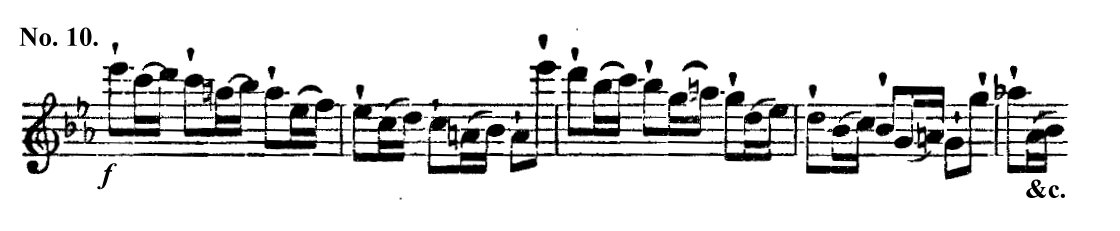
couched in an ordinary figure. The 'second subject' proper arrives
unusually late, but when at length it appears, in the key of B flat, it
is a passage of singular beauty - more harmony than melody,
and yet who shall say? - a theme which, with its yearning,
beseeching wind instruments, and the three wonderful pizzicato notes
of the basses, goes to the inmost heart like a warm pressure of the
hand -
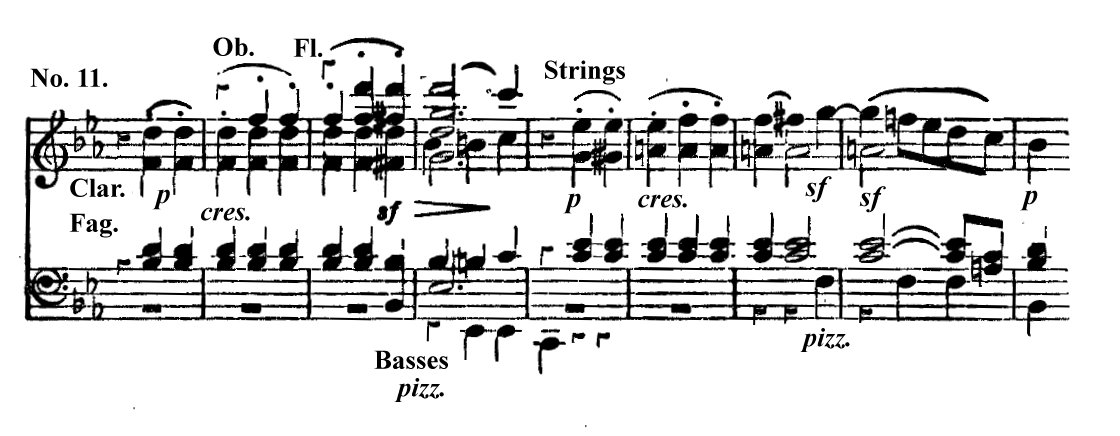
Strangely little use is made of this beautiful passage in the working-out. In fact, touching as it is, it only re-appears in its place in the due course of the reprise.
After
the second subject we have a phrase in the rhythm of No.
1,
though with different intervals and a different accent -

And, lastly, nine bars of discords given fortissimo on the
weak beats of the bar, and with all possible noise from the brass
-

There we have the chief materials of the first half of the
Allegro!
But the way they are expressed and connected; the sunlight
and cloud, the alternate fury and tenderness, the nobility, the beauty,
the obstinacy, the human character! Certainly, nothing like it was
ever done in music before, and very little like it has been done in the
ninety years since 1803.
A great deal of the inspiration for this remarkable fire and variety must, as has already been said, have been supplied by the unprecedented circumstances of the time. A far calmer spirit than Beethoven [17] has said of the same period -
Bliss was it in that dawn to be alive,and the music shows how those exciting circumstances acted on the impressionable mind of our great composer.
Eight
bars before the double bar we have a prediction of the
tremendous Coda
which closes the entire movement. Then comes the
'working-out,' which begins the second half of the movement, and is
made
out of the material already quoted. But here again nothing is the same.
The fragments of the first theme (No. 3),
which occupy the first twelve
bars of this portion, are absolutely transformed in character. The
subsidiary theme (No.
9) is
altered by the addition of a forcible
initial note, and a run of great beauty -

- the freakish passage (No.
10)
is harmonised by the
first subject, escaping from the tonic chord of C sharp minor into D
minor
by one of Beethoven's astonishing transitions -

Four notes of No. 9 are made the motive of a passage of
imitation, which might be intended to show how well Beethoven could
write a fugue -
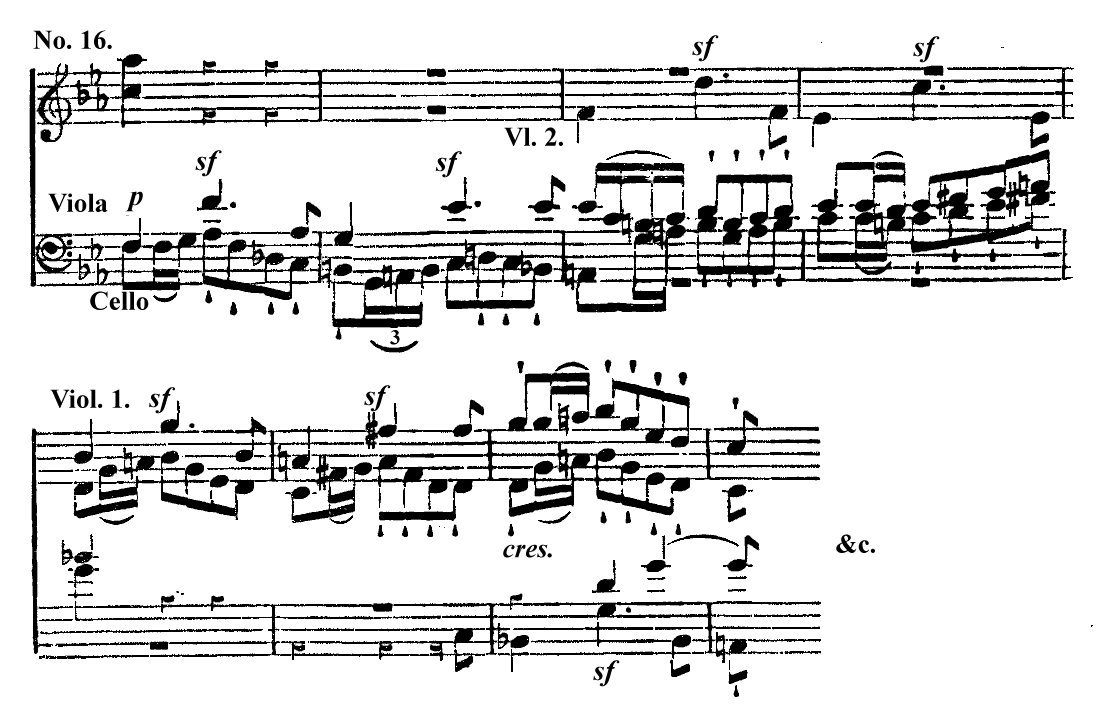
if we did not soon discover that he is in no humour for such
displays. Later on in the work he may have leisure
to bring his counterpoint into play, but here his mood is too
imperative. His thought is everything to him, the vehicle nothing.
This quaintly promising little bit of counterpoint is crushed by an
outburst of rage, which forms the kernel of the whole movement, and in
which the most irreconcilable discords of the harmony and the most
stubborn disarrangements of the rhythm unite to form a picture of
obstinacy and fury, a tornado which would burst the breast of any but
the gigantic hero whom Beethoven believes himself to be pourtraying,
and who was certainly more himself than Bonaparte [18]. This
passage, thirty-two bars long, is absolute Beethoven; there is nothing
like it in the old music, and it must have been impossible for critics,
who looked to the notes alone and judged them by the mere rules of
sound, without thinking of the meaning they conveyed, ever to be
reconciled to it. But the tumult suddenly ceases, as if from
exhaustion. A few crisp bars in the strings lead into a perfectly new
and fresh passage in the remote key of E natural minor, in which the
oboes, fining down to piano,
deliver an exquisite melody, accompanied
by one almost as exquisite in the cellos -

This is what is
technically termed an episode; that is, a melody or theme which has
not been heard in the former section, and has, therefore, as it were,
no right to appear in the section devoted to the discussion of the
previous materials. With Beethoven, however, everything was more or
less an open question, and in the present case he has pleased to will
otherwise.
After
a short interval the melody last quoted returns, this
time in E flat minor, with touching imitations between the various
instruments -
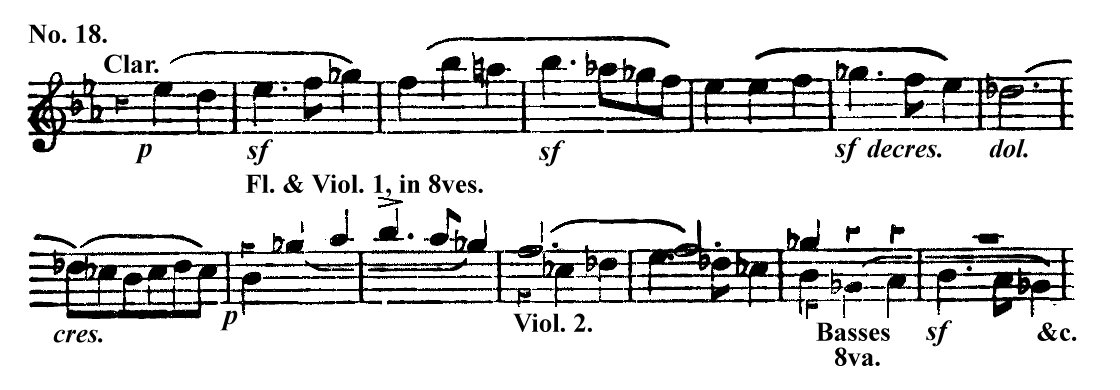
and with a little quaver figure in the eighth bar, which
might serve to
remind us, if we could ever forget it, how constantly Beethoven is on
the watch to introduce a graceful turn, however severe his mood may
be. He knows nothing of ugliness in music, even to express ugly
thoughts.
And
now again another new feature - a wonderful staccato bass
accompanied by the original theme (No. 3),
stalking over the world as
none but a hero can stalk, and making us feel like pigmies as we listen
to his determined and elastic footfalls -
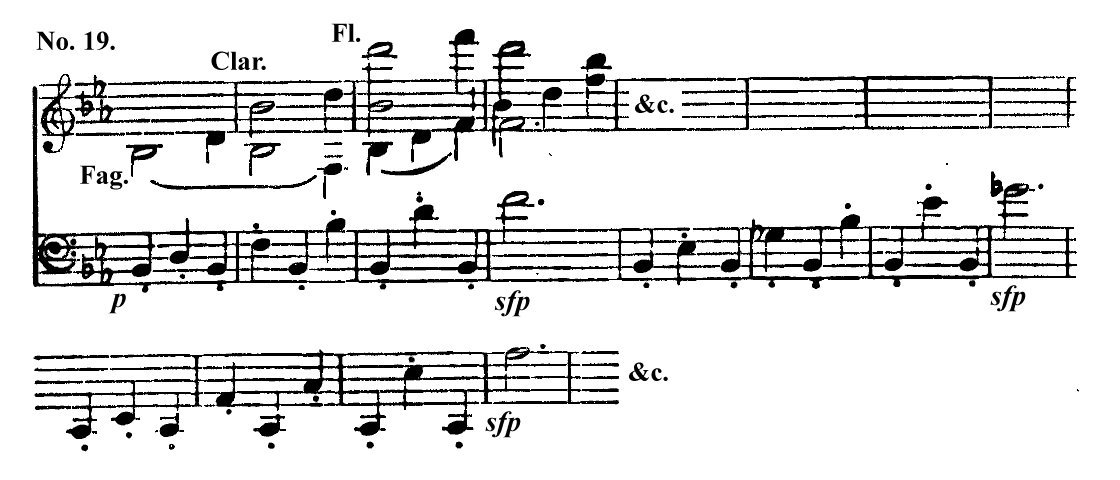
The phrase goes through the
successive keys of E flat minor, D flat major, and E flat minor, and
ends with a fine climax of four bars in the trumpets and drums.
We are now near the end of the working-out, but one more surprise awaits us, shortly before the return to the opening theme of the work, at the place often selected for a passage of pathos or sentiment. This is, if possible, more original than anything that has preceded it, and is certainly quite different from anything else. So unexpected is it that Ries, standing by his master's side at the first rehearsal, thought the horn-player had come in wrong, and narrowly escaped a box on the ear for saying so [19]. It is the well-known and often-quoted passage in which the horn gives out the first four notes of the chief subject in the chord of E flat, while the two violins are playing B flat and A flat, thus accompanying the chord of the tonic by that of the dominant - a practice of Beethoven's which M. de Lenz has dubbed 'le sourire de la Chimère' -

At
that time, all the rules of harmony were against
it [20];
it
was
absolutely wrong - as wrong as stealing or lying - and
yet how
perfectly right and proper it is in its place! And how intensely
poetical! The 'heroic' movement of the basses (No. 19) has ceased,
leaving us in strangely remote regions; the tumult of the day has
subsided, and all is gradually hushed; the low horns and other wind
instruments add to the witching feeling, and a weird twilight seems to
pervade the scene. At length the other instruments cease their
mysterious sounds, and nothing is heard but the violins in their
softest tones, trembling as if in sleep, when the distant murmur of the
horn floats on the ear like an incoherent fragment of a dream. It is
one of those departures from real life which never trouble us in our
sleep. But it is enough to break the spell; the whole changes as if by
a magic touch, and the general crash restores us to full daylight, to
all our faculties, and we find ourselves at home in the original
subject and original key (see No.
3).
Here Beethoven strangely makes
the music modulate so as to close not in E flat, as before, but most
unexpectedly in F, with a shake, and a lovely close it is -
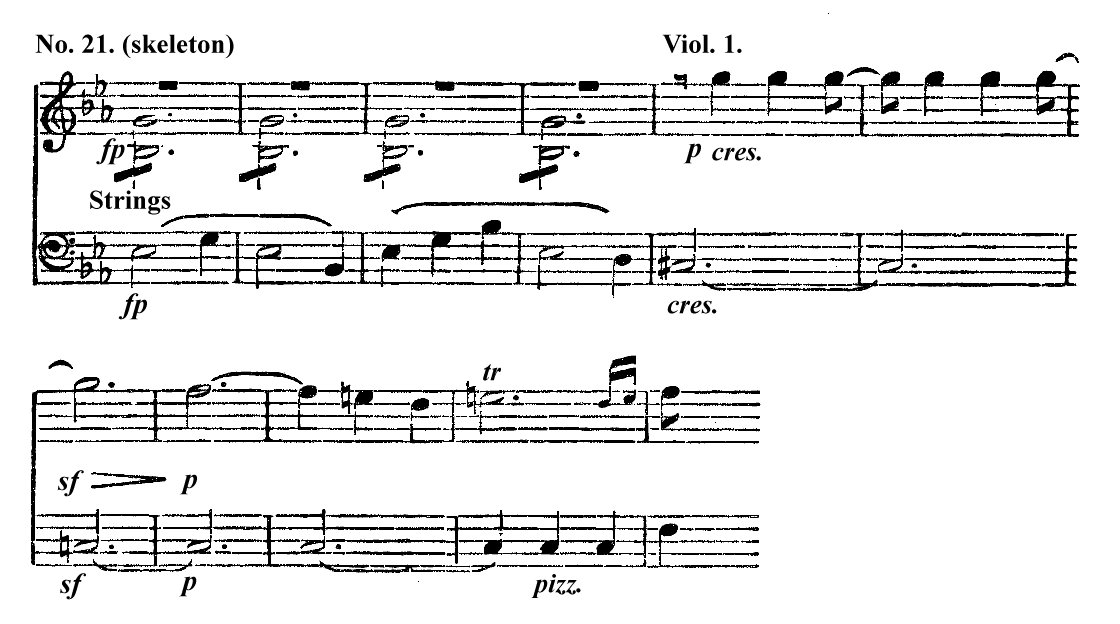
and
this enables him to give the horn an ample and delicious revenge for
the interruption he has just suffered. (Note the expression given by
the reiteration of the note C in bar 5) -

and also the easy
and masterly turn by which the strain goes from F to D flat. The
transition by a semitone is the same, though in a different part of the
key, as in No. 3,
bar 8.
After this we have a recapitulation of the first section of the movement, only with serious differences; and then comes a Coda, 140 bars long, and so magnificently fresh and original as almost to throw all that has gone before it into the shade. The beginning of this Coda is one of the most astonishing things in the whole musical art; and think what it must have been in the year 1805, when even now, familiar as it is, and after all that Beethoven himself has written since, all that Schubert, Mendelssohn, Schumann, Wagner, and Brahms, it still excites one's astonishment for its boldness and its poetry. This Coda is no mere termination to a movement which might have ended as well without it. No; it is an essential part of the poem, and will be known as such. It is one of Beethoven's great inventions, and he knows it, and starts it in such a style that no one can possibly overlook what he is doing. He has given a hint of it before the double bar; now he develops it at full length. As in his G major, and still more in his E flat Concerto for the piano, he begins the work not with the usual long orchestral passage, just as a Symphony or Overture might begin, but with a passage for the piano, that no one may mistake the nature of the work he is going to hear, so here he treats the Coda as a definite, recognised, important section of the movement, and announces it with so much weight and force as to compel attention to the fact that something serious and unusual is going on. Here is a skeleton, to show the daring style of the progressions and contrasts - from E flat to D flat, and from D flat to C major. Note too the introductory quavers, where he retains the three crotchets of the subject -

And this again is followed immediately by another entirely new device; the old subject in the second violins, harmonised by the basses, and with the gayest melody running its free course above, in the first violins -
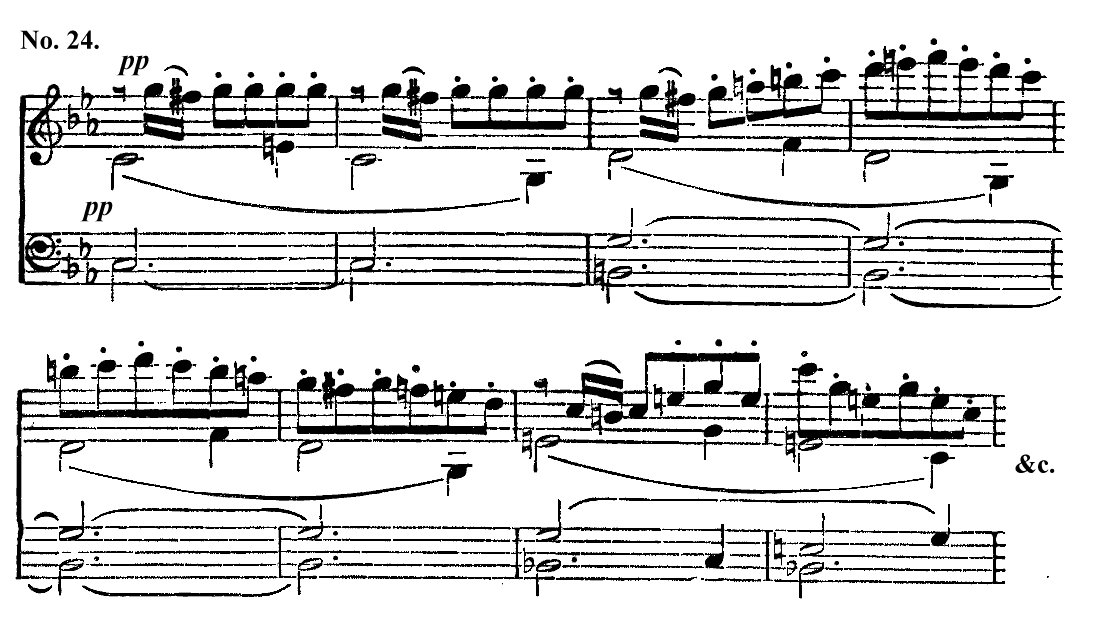
Another new passage, in the freakish figure which was employed before (see Nos. 10 and 15), equally gay, and equally grounded on the original subject, this time in the horns, is as follows -

Between the two passages last quoted is a cello solo, which might have given Mendelssohn the cue to those which he is so fond of introducing into his Symphonies -

One might go on commenting on this Coda for an hour, but it is time to stop. After all is said, the music itself, as Schumann is so fond of insisting, is the best and only thing; at any rate, the sole end of these remarks is to make that more intelligently heard and better understood.
II.
The second movement [21],
very slow, Adagio assai,
is in
the form of a funeral march,
and bears the title of Marcia
funebre - the very title itself an
important innovation on established practice [22]. And a
March it is,
worthy to accompany the obsequies of a hero of the noblest mould, such
a one as Napoleon appeared to his admirers in 1803, before selfishness,
lying, cruelty, and just retribution had dragged him down from that
lofty pinnacle. The key of the March is C minor. It commences sotto
voce with the following subject in the strings -
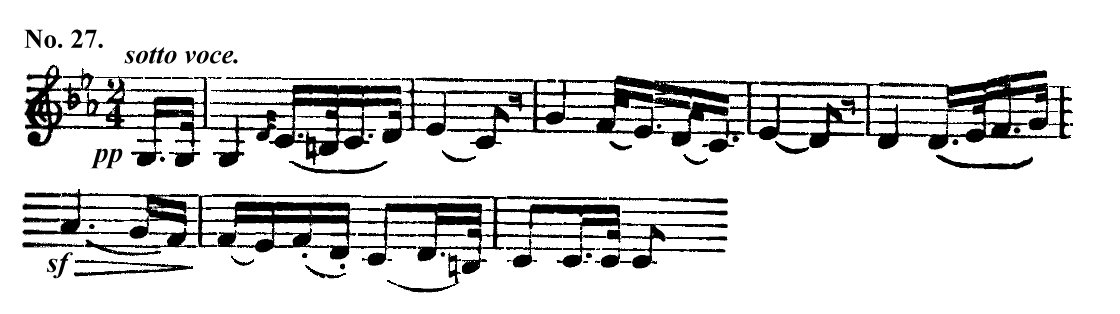
harmonised in a
wonderfully effective way. The melody is then repeated in the poignant
tones of the oboe, with the rhythm strongly marked by the horns and
bassoons, and with an accompaniment in the strings of this nature -

which recurs more than once, and forms a characteristic feature of
the movement. This is succeeded immediately by a second theme - if it
be not the second strain of No. 27 - a broad melodious subject,
beginning in E flat major -

promising for the moment consolation and hope, but quickly relapsing
into the former tone of grief, and ending in a phrase in the cellos -

expressive
of vague uncertainty and walking in darkness. These materials are
employed and developed at length, and with the richest and most solemn
effect, to the end of the first portion. The poet Coleridge is said to
have been once taken to hear this Symphony at the Philharmonic, and to
have remarked to his friend during the March that it was like a funeral
procession in deep purple; and the description is not an inadequate
one of the first portion, before the grief becomes more personal and
diffuse; but Coleridge must surely have said something equally
appropriate of the point farther on, where, for what may be called the
Trio of the March, the key changes from C minor to C major, and a
heavenly melody brings comfort and hope on its wings, like a sudden ray
of sunlight in a dark sky -

This delicious message (which Beethoven resorted to again in the Scherzo of his Symphony in A, ten years later) is here divided among the oboe, flute, and bassoon in turns, the strings accompanying with livelier movement than before. The melody has a second strain (in the violins) well worthy to be a pendant to the first -

After
the welcome relief of this beautiful
Intermezzo
the orchestra returns to the minor key, and to the opening
strain of the March. It does not, however, continue as it began, either
in melody or treatment, but, soon closing in F minor, goes off into
something like a regular fugue, with a subsidiary subject (a) -
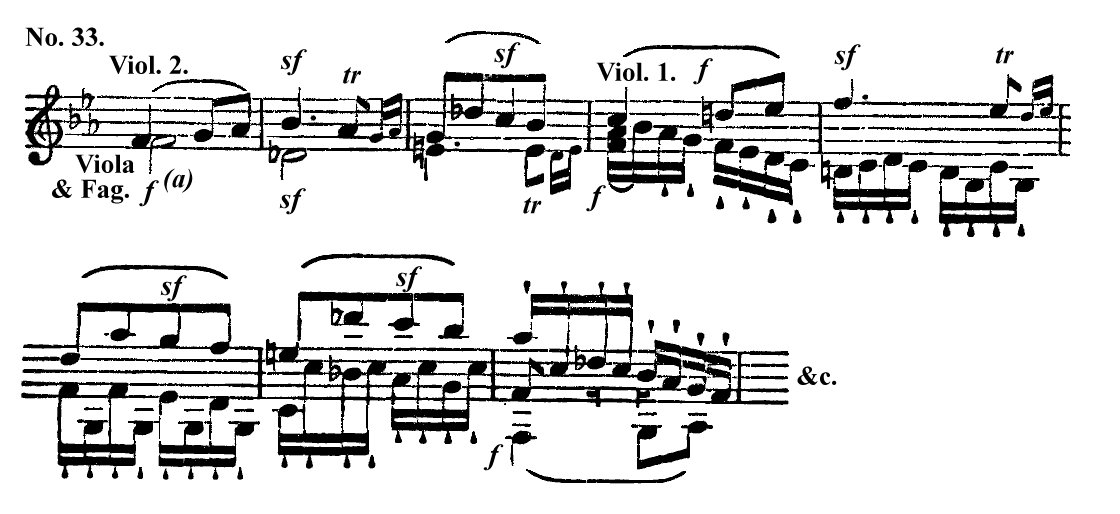
-
which is pursued at some length, the full orchestra joining by degrees
with the most splendid and religious effect [23]. In this
noble and
expressive passage of fugal music we might be assisting at the actual
funeral of the hero, with all that is good and great in the nation
looking on as he was lowered into his tomb; and the motto might well be
Tennyson's words on Wellington -
In the vast
cathedral leave him,
God
accept him, Christ receive him.
Then occurs a passage as of stout resistance and determination, the trumpets and horns appealing against Fate in their loudest tones, and the basses adding a substratum of stern resolution. But it cannot last; the old grief is too strong, the original wail returns, even more hopeless than before; the basses again walk in darkness, the violins and flutes echo their vague tones so as to aggravate them tenfold, and the whole forms a long and terrible picture of gloomy distress -
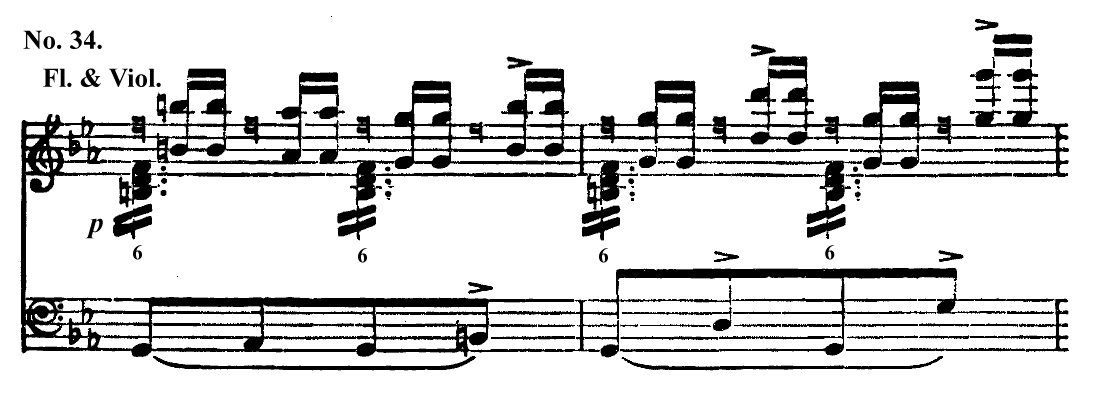
But here again our great teacher does not leave us; even here he has consolation to give; though in a different strain than before. The steady march of the strings (at the beginning of the Coda, repeated from the tenth bar of the 'Maggiore,' No. 27) seems to say 'Be strong, and hope will come'; and hope comes, in the voice of the first violins, if ever there was a speaking phrase in which to convey it -
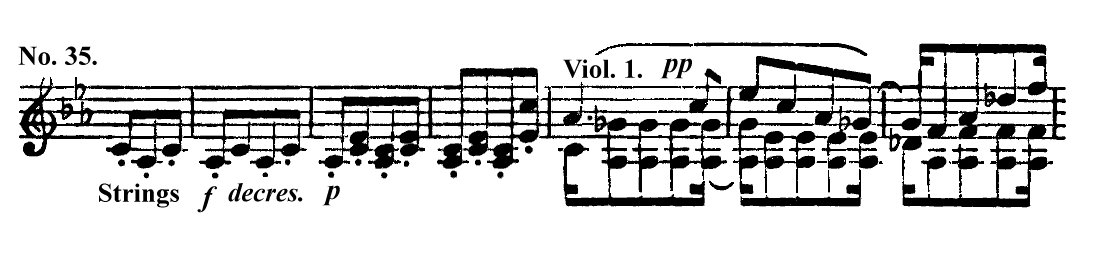
This was the passage which occurred to the mind of Moscheles as he stood by the death-bed of Mendelssohn, and caught the last pulsations of the breath of his friend [24]. It is the beginning of the Coda, and it may be well to recollect as the movement ebbs away that we are really listening to the music written by Beethoven in anticipation of the funeral of Bonaparte.
III. For the Scherzo we return to the key of E flat; and it is impossible to imagine a more complete relief than it presents to the March. It begins Allegro vivace, sempre pianissimo e staccato, and, after a prelude of six bars in the strings, the oboes and first violins join in this most fresh and lively tune -

This
has been supposed by Mr. A. B. Marx to have been
adopted from a soldier's song -

but he
himself, later in
his book [25],
admits, on the
authority of the accurate Erk, that it dates
from the period between 1810 and 1826. Indeed the song is more probably
founded on the Scherzo
than the Scherzo
on the song.
On further repetition the tune is continued in sparkling repartee
between violin and flute as follows -

and at length a charming climax is made by a loud
syncopated passage in unison for the whole orchestra (twice given), in
which the accent is forced on to the weak parts of the bar -

and the
first part of the Scherzo
ends with a Coda
containing
delicious alternations of the strings and the wind and a passage of
unequalled lightness and grace.
The
Trio,
or alternative to the Scherzo,
is mainly in the
hands of the
horns, the other instruments being chiefly occupied in interludes
between the strains of those most interesting and most human members of
the orchestra. And surely, if ever horns talked like flesh and blood,
and in their own human accents, they do it here. Beginning in this
playful way - sportful, though hardly in allusion to 'field sport,' as
some critics have supposed -

they rise by degrees in seriousness and poetry till the reach an
affecting climax, fully in
keeping with
the 'heroic' character of the poem [26]
-

What is it makes these last few notes so
touching, so almost awful? There is in them a feeling of infinitude or
eternity such as is conveyed by no other passage even in Beethoven's
music. To the writer the notes speak the lofty, mystical, yearning tone
of Wordsworth's beautiful lines [27]:
-
Our destiny, our being's
heart and home,
Is with infinitude, and
only
there;
With hope it is,
hope that
can never die,
Effort, and
expectation, and desire,
And something
evermore about to
be.
And yet this very
passage is selected by a critic of the time for special disdain!
After
the Trio,
the first part of the Scherzo
is repeated, but
not
exactly; it is considerably reduced at the beginning and end, and an
excellent effect is produced, where the previous effect seemed hardly
to admit of improvement, by giving the second of the two syncopated
passages already quoted (No.
39)
in duple time, instead of syncopated
triple time -

with greatest emphasis, and enforced by the full
orchestra, drums and all. The sound of this dislocating interruption
might be described as Beethoven himself described the name of
Gneixendorf, his brother's property. 'It sounds,' he says, 'like the
breaking of an axle-tree.'
This
is the earliest of those great movements which Beethoven
was the
first to give to the world, which are perhaps the most Beethovenish of
all his compositions, and in which the tragedy and comedy of life are
so startlingly combined. A symphony without a Scherzo would now
be a
strange spectacle. As Tennyson says
Most can raise the flowers
now,
For all have got the seed.
But before Beethoven's time, indeed before this particular Symphony,
the Scherzo,
in its full sense, was unknown to music. His original
intentions on this occasion were, as usual, very wide of the result. He
has got the tune, but the manner of reaching it is very different to
what it afterwards became.
In the first sketch
discoverable, he heads
his notes with M. for minuet, and starts as follows (see
Nottebohm, Skizzenbuch
aus 1803, p. 44 - the signature of three flats must be
understood) -
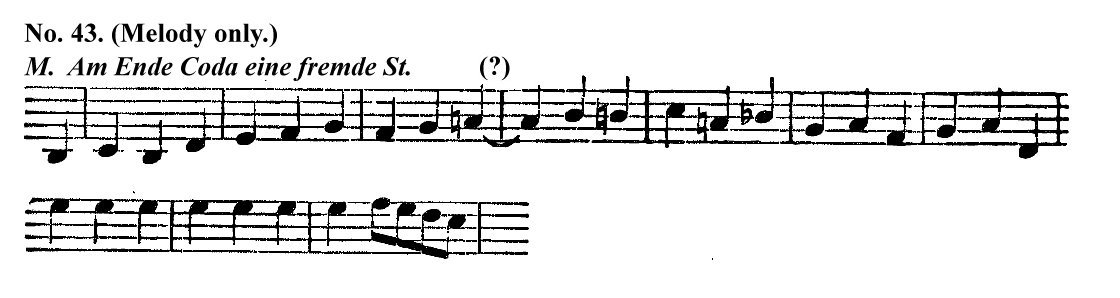
Farther
on still more progress has been made -

At length
the ultimate idea for the commencement, and the pace of Presto make
their appearance [28]
-

and then the rest of the movement soon
follows.
The
original form of the Trio,
however [29]
-

(the signature
of three flats must still be understood) - is very remarkable in its
strong resemblance to the principal theme of the
first movement, of which it is possibly meant to be a
repetition. This,
however, was quickly abandoned; three sketches follow which show no
likeness to the present Trio; but in the fourth an approach is made to
it, and then the piece advances rapidly to its ultimate shape.
IV. The Finale has often been a puzzle. Some have thought it trivial, some laboured, others that its intention was to divert the audience after the too great strain of the earlier movements. 'The Sinfonia Eroica of Beethoven,' says the best English musical writer of his day, on a performance at the Philharmonic, in April, 1827, 'most properly ended with the Funeral March, omitting the other parts (meaning the Scherzo and Finale), which are entirely inconsistent with the avowed design of the composition.' We surely might have more confidence in Beethoven's genius, and in the result of the extraordinary care and consideration which he applied both to the design and details of his compositions! No one who hears the Finale through, and allows it to produce 'its own proper and intended effect' upon him [30], need be in doubt as to its meaning, or hesitate to recognise in it characteristics as 'heroic' as those of any other portion of the work, though clothed in different forms. The art and skill employed throughout it are extraordinary. But Beethoven never used these powers for mere display. He must have written it because he had something to say about his hero which he had not said in the other three movements. Surely that 'something' becomes gloriously evident in the Poco Andante near the close, which forms so grand a climax to the work; and to which the pages that precede it, with all their ingenuity and beauty, act as a noble introduction, rising step by step until they culminate in the very Apotheosis of the Hero.
The movement consists entirely of a set of variations, thus early anticipating so far the method adopted in the vocal movements of Beethoven's latest Symphony, 'The Ninth,' twenty years later. The subject chosen is an air in the Finale of his own 'Prometheus music,' where it stands, as far as melody, bass, and key are concerned, as follows -

In our ignorance of the libretto of the Prometheus music, it is impossible to say whether this theme was not there identified with that ancient 'hero,' and whether that fact, or some subtle connection, may not have induced Beethoven to choose it for the Finale to his Symphony on Bonaparte. At any rate, the theme must have been a special favourite with its composer, since he has used it four times - in a Contretanz, in the Prometheus music, as the theme of a noble set of Variations for piano (Op. 35), and here in the Symphony.
The
method which Beethoven
has adopted in the treatment of this air as
the theme of the Finale
is very ingenious, and, as far as I am aware
(though the Variation literature is of such enormous extent that it is
impossible to be sure), entirely original. After a short introductory
passage of eleven bars to fix the key, ending with a pause on the
dominant seventh
of E flat, the strings, in octaves and pizzicato, give out
the bass
of
the melody. (In the Piano Variations, Op. 35, this is labelled 'Con
basso del Tema'; but here there is no such indication.) The first eight
bars of this are repeated to allow Beethoven to display his humour by
making the wind echo the notes of the strings, at short distances -

In
Variation 1 this theme (in minims instead of staccato quavers) is given
to the second violin, while the first violin and the bass have an
independent accompaniment, thus -

In Variation 2 the first
violin has the same theme, with a triplet accompaniment in the other
strings. In the third Variation, the melody itself (all the
more
welcome for its contrast with the somewhat formal bass theme) enters in
the oboes and clarinet, harmonised with its natural bass, and with a
brilliant semiquaver accompaniment in the first violin, which last in
its turn takes up the melody with the concurrence of the whole
orchestra. The next feature is a serious fugato (a form
beloved of
Beethoven, and already used most happily in movements 1 and 2 of this
Symphony), commencing in C minor
as follows -

This is prolonged to great length, contains a sequence with some remarkable discords, and ends with a very effective and ingenious introduction of the melody; in which an accidental F sharp is made to lead directly into a new key -

With this the flute takes up the running, and concludes with a passage of semiquaver arpeggios and scales. This leads to a new theme, a regular 'second subject' for the movement (though in G minor instead of B flat, as might be expected), led up to by a wild rush in the flutes, oboes, &c, and harmonised emphatically by the bass of the original melody in minims (see No. 49) -

The
second strain of the new theme is of the same
rough character as the first, and has the same bass for four bars -
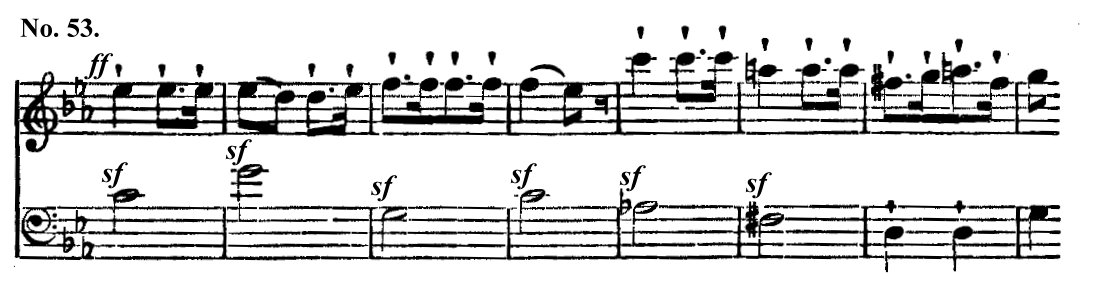
It is somewhat prolonged, and the whole second subject might be
the dance of a band of Scythian warriors round the tomb of the 'hero'
of their tribe.
After
this rough strain the melody (No.
47) returns with
heavenly
effect, dolce
in C major (the modo
lascivo of the mediaevalists), with a
beautifully varied bass. Then it is sportively given in the minor by
the second violins, violas, and basses alternately, accompanied
throughout by the first violins in Beethoven's favourite tremolo, of
which we noticed such fine examples throughout Symphony No. 2. But
Beethoven has not yet appeased his contrapuntal appetite, and we
have some bits of double counterpoint, in which the melody and the bass
theme change places. Then the fugato
returns, the
subject inverted and accompanied in semiquavers by the first violin -
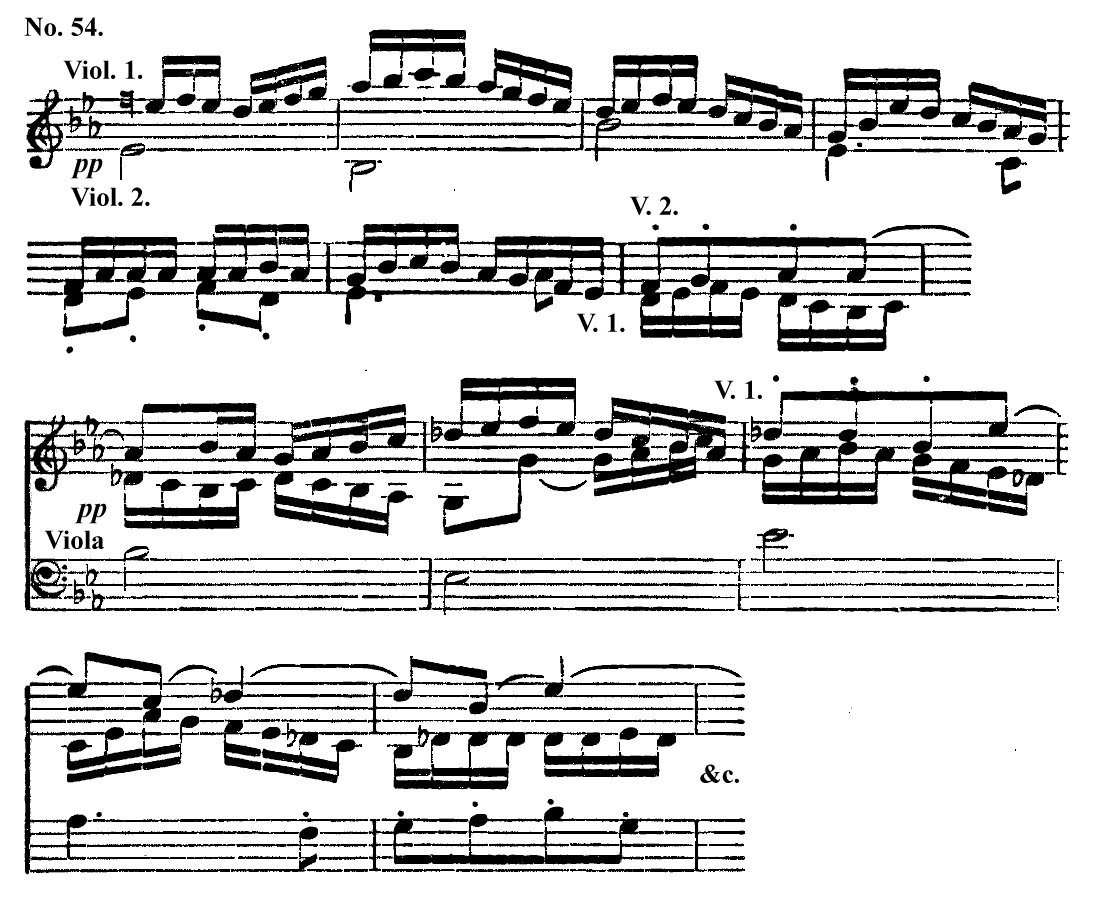
The development of this fugue is elaborate; the original melody is
introduced in the flute in a syncopated fashion -

the bass subject is used both in its original form and inverted
at the same time, and the whole rises to a noble climax on a
tremolo pedal
note (on B flat and A natural), anticipating the
similar effects which Beethoven was to make with even greater grandeur
in the Seventh and Ninth Symphonies. At length the orchestra again
pauses on the chord of the dominant seventh on B flat; and the pace
slackening to Poco
Andante, a new version of the original melody is
introduced, to which, as already remarked, the whole preceding portion
of the movement seems like a mere prelude -
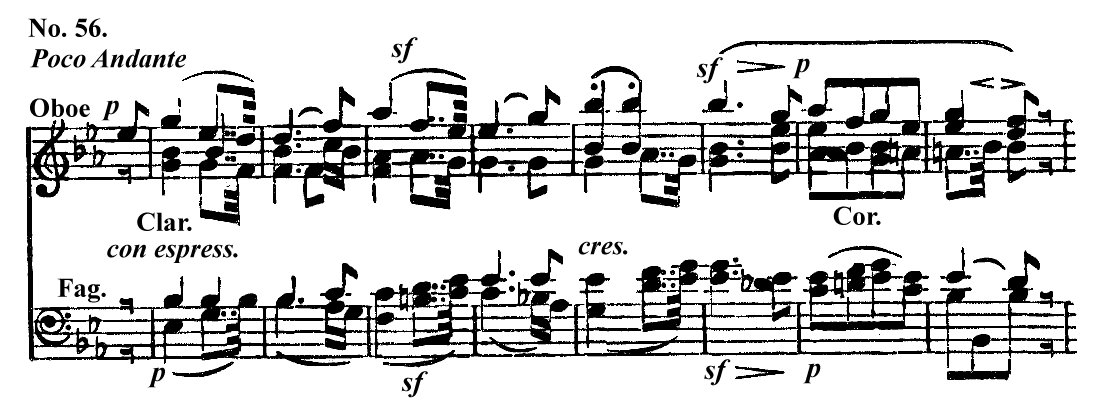
This is given to the oboes, richly harmonised by the clarinets and bassoons, with a full and grand effect.
It
has a second strain, a long and entirely new
melody of very great beauty -

given to the oboe, and repeated,
after the quotation, in a most graceful syncopated form. The theme
gradually spreads to the entire orchestra, and forms a splendid passage
of full and heavenly harmony, set off with every orchestral device, and
producing the noblest and most 'heroic' impression. The air last
quoted is beautiful enough to convey any holy or heavenly message. It
might even appropriately be what M. Gounod makes it when, in his
'Redemption,' he adopts a similar progression as the 'melody typical ol
the Redeemer' -

He could not have made a better choice. Beethoven
himself used a somewhat similar melody two or three years later than
this Symphony. It is this theme -

the
treatment of which sheds such a lustre on the working-out of the great
Overture to Leonora, No. 3, and for the insertion of which its author
sacrificed a fine, long, and characteristic portion of the so-called
No. 2.
Beautiful as is the air quoted in No. 57, the harmony and instrumentation which accompany it are no less so. Every instrument in the score is employed for some pages; the drum-rhythm is specially observable, but there is no noise, and the presence of the melody, No. 47, in the double basses and bassoons, effectually connects this with the preceding portion of the Finale. The close of the Andante is especially pathetic, and in its march-rhythm and other features irresistibly recalls the style of portions of the Funeral March. Indeed, the inference is tempting that a connection between the two movements is intended. Whether this be the case or not, the March may well represent the death of the hero, and the interment of his mortal part. The Poco Andante is his flight to the skies.
A short Coda, Presto, in which the old melody is clung-to almost to the very end, finishes this most extraordinary and impressive work.
The Symphony was purchased by Prince von Lobkowitz, one of the three noblemen who, to their lasting credit, combined in 1809 to give Beethoven an income for the rest of his life; and as we saw at starting, the Prince's name stands on the title-page as dedicatee of the work. The date at which it actually became his property, and the period for which he acquired it, are not known, but the first accessible performance appears to have taken place towards the end of January, 1805, in a half private fashion, at one of the concerts given at his own house by Herr von Würth, a wealthy banker [31]. The first really public performance was given on Sunday evening, April 7, in one of Clement's series of concerts in the an-der-Wien theatre. On the occasion it was announced as a 'new grand Symphony in Dis' (D sharp, the Viennese nomenclature at that time for E flat) and Beethoven himself 'was so good as to conduct.' Other private performances took place in the Lobkowitz palace in Vienna; and at one of these, Beethoven conducting, at the syncopated passage in the working-out of the Allegro, managed to throw out the orchestra so completely that they had to begin again [32].
An interesting anecdote is told about the Symphony during the first few months of its existence, of which even the accurate Thayer 'sees no reason to doubt the truth' [33]. Prince Louis Ferdinand of Prussia, a remarkable musician and composer, whose piano-playing Beethoven placed above that of Himmel, and whom the great composer complimented as 'not playing at all like a royal person, but like a solid pianist,' was on a visit to Prince Lobkowitz early in 1805, at his castle at Raudnitz, in Bohemia. Desiring especially to honour his illustrious guest, Lobkowitz arranged for a performance of the new Symphony by his orchestra, which always attended him. The two princes took their seats, and the great work was played through. Louis Ferdinand listened with the utmost interest, and at the close of the performance entreated for a repetition, which took place. He was then so fascinated as to beg for a third, on the ground of his departure early the next morning. 'Willingly,' said Lobkowitz, 'if we may first give the band some supper.' The supper was accordingly given, the two princes, let us hope, taking part with the players, and then the immortal Symphony was once more played over. After this we may doubt the truth of the saying that it is possible to have too much of a good thing.
The first report of the music, that of the concert at Herr von Würth's, in January, 1805, is in the Vienna letter of the Leipzig paper, the Allgemeine musikalische Zeitung, for February 13, 1805 [34]. After an extraordinary eulogy of Beethoven's Symphony in C major, whether played at the same concert as the Eroica or at a previous one is not clear - as 'a glorious art-creation,' . . . 'an extraordinary wealth of lovely ideas treated in the most splendid and graceful style, with coherence, order, and clearness reigning throughout' - the correspondent goes on to the new Symphony, 'not to be confounded with No. 2,' which had recently been published. He describes it 'as virtually a daring, wild, fantasia, of inordinate length and extreme difficulty of execution. There is no lack of striking and beautiful passages in which the force and talent of the author are obvious; but, on the other hand, the work seems often to lose itself in utter confusion. It begins,' he continues, 'with a powerfully scored Allegro in E flat, followed by a Funeral March in C minor, treated fugally towards the end. The Scherzo and Finale are both in E flat. The writer belongs to Beethoven's warmest admirers, but in the present work he finds very much that is odd and harsh, enormously increasing the difficulty of comprehending the music, and obscuring its unity (Einheit) almost entirely.' He then goes on to praise a Symphony of Eberl's in the same key with the Eroica, and evidently much more to his taste.
The report of the performance of April, 1805 - in the same volume, p. 501 - is even more unfavourable. The writer finds no reason to modify his former judgment. 'No doubt the work displays bold and great ideas, and that vast power of expression which is the property of the composer; but there can also be no doubt that it would gain immensely if Beethoven would consent to shorten it (it lasts a full hour [35]) and introduce more light, clearness, and unity, qualities which, with all possible wealth of ideas and variety of instrumentation, are never absent from Mozart's Symphonies in G minor and C major, Beethoven's own in C and D, or Eberl's in E flat and D.' Allowance must be made for those who were hearing so original a work for the first time, and had no scores to follow it on; but the accusation of want of unity is strange when one remembers the persistent way in which the characteristic portion of the principal subjects of each movement keep recurring - no less than thirty-seven times in the first Allegro, for instance. Judging by one's present feelings and the evidence of fact, it is the last blame that could be urged.
Beethoven's old enemy, Dionys Weber, whose denunciations of the opening of the First Symphony we have already mentioned (see earlier comment), was by this time head of the Conservatorium at Prague, and took every opportunity to depreciate and injure the new work. Schindler (i., 111) says that it was held in horror at the Conservatorium as a 'dangerously immoral composition' (sittenverderbendes Werk). This did not prevent a splendid performance at the 'Amateur Concerts' in Prague, amid the greatest public enthusiasm [36].
It is pleasant to turn from such absurdities to the very different spirit which prevailed at Leipzig when the Symphony was brought forward there at the famous Gewandhaus Concerts on January 29, 1807, under the conductorship of J. G. Schicht (poor Schicht!). On that occasion an unusual innovation was adopted. Special attention was called to the new Symphony in the posters; and in a bill or programme distributed in the room a short description of the work was given, probably for the first time in the history of such performances. This is quoted in the excellent history of these renowned concerts [37], compiled by Herr Alfred Dörffel to celebrate the 100th anniversary of their foundation, on November 25, 1881, and is as follows: -
'Grand heroic symphony composed by Beethoven, and performed for the first time in Leipzig. (1) A fiery and splendid Allegro; (2) a sublime and solemn Funeral March; (3) an impetuous Scherzando; (4) a grand Finale in the strict style.'
The good effect of such a course was proved by the fact stated in the Festschrift, that there was an unusual assemblage of amateurs and musicians at the Concert; a deep interest and stillness prevailed during the performance; and the committee were besieged with requests for a repetition, which took place a week later, on the 5th February, and again on the 19th November of the same year - three performances in ten months.
In England the first performance by the Philharmonic Society was at the second concert of the second year - Monday, February 21, 1814 - when it was announced as 'Sinfonia Eroica (containing the Funeral March) [38] . . . Beethoven.' After this it appears to have taken its place in the regular répertoire of the Society, though this is difficult to affirm, from the fact that till the third concert of 1817 the Symphonies are rarely specified by key or name. Six performances were given in the ten years 1824 to 1834. In 1823 the Harmonicon was established as a monthly musical paper, under the charge of Mr. Wm. Ayrton, and regular notices of the concerts are given. Ayrton was a good musician, and in many respects liberal and advanced for his time. But his animosity to several of Beethoven's Symphonies is remarkable. Each successive mention of the 'Eroica' is accompanied by some sneer at its length, or the want of connection of its movements. 'Three-quarters of an hour is too long a time for the attention to be fixed on a single piece of music; and in spite of its merit the termination is wished for some minutes before it arrives' (1824). 'A very masterly work, though much too long for public performance' (1825). 'The Symphony ought to have ended with the March, the impression of which was entirely obliterated by the ill-suited Minuet which follows' (1827), and so on. These absurdities, we may be thankful to say, are now at an end, as far as Beethoven is concerned, though they still linger elsewhere.
In France the 'Eroica' does not seem to have made its appearance till about 1825, and then only through a stratagem of Habeneck, the illustrious conductor of the Opera or Académie Royale de Musique. His experiences with the Second Symphony had warned him of the necessity of caution, and accordingly he invited the principal members of his band to dinner, and 'to make a little music,' on St. Cecilia's Day. The 'little music' consisted of the Eroica and No. 7 Symphonies, which seem to have been introduced to these gentlemen on that day ('the better the day the better the deed') for the first time; and, thanks to the opportune time of the ruse, to have produced a favourable effect on the band. 'Under these new conditions we found,' says one of the orchestra [39], 'that these two Symphonies contained some tolerable passages, and that notwithstanding length, incoherence, and want of connection they were not unlikely to be effective.'
Besides the 'Eroica,' Beethoven's compositions in the key of E flat are numerous; we can only give the principal. The Septet; Pianoforte Concerto, Op. 73; Pianoforte Sonatas, Op. 7, Op. 31, No. 3, and Op. 81a; Trio for Piano and Strings, Op. 70, No. 2; String Quartets, Op. 74 and Op. 127; 'Ah, perfido!' and the 'Liederkreis.' The passionate slow movement of the Fourth Symphony must not be omitted.
Note. - Since this previous page was in type, it has occurred to me that Beethoven may have heard Mozart's operetta at the Elector's National Theatre at Bonn when a boy. The lists of pieces for 1781-3 and 1789-92, given by Mr. Thayer at i., 72, 73, and 193 of his valuable work, show that the répertoire embraced everything high and low, and it may not be quite impossible that this little work was performed at some time, as Mozart's Entführung was in 1782, '89, and '92. Mr. Thayer, however, does not agree with me in this.
The following ingenious remarks on the 'Eroica' Symphony have been communicated to me by my friend, Dr. Charles Wood: -
The principle of a definite idea, or ideas, pervading a work, which nowadays we are accustomed to call the principle of 'Leitmotif,' though not unused before Beethoven's time, and hardly recognisable till that of Weber and Mendelssohn, has become common enough since, more especially in opera.
The idea cannot have been unknown to Beethoven. Even if he knew nothing of Bach's 'Passion' he must have heard and known Mozart's 'Don Giovanni,' in which the trombones are sounded on the appearance of the Commendatore, and this employment of a theme in connection with a certain character can hardly have failed to strike him.
We know that Beethoven, when composing, had a picture in his mind. In certain cases he gives us a clue - e.g., the Pastoral Symphony and the Sonata entitled 'Les Adieus,' &c. As the Eroica Symphony was professedly a work inspired by Napoleon, it is hardly an injustice to the composer to try and discover his intentions.
The
first thing which arrests attention is that the principal themes of the
work are constructed on the intervals of the common chord. The first
four bars (a)
of the first subject (the second five bars (b) will be
referred to later) of the first movement: -

may therefore be taken
as the 'motto' of the whole work - in other words, the
Napoleon-motif. In the first movement its dominating influence is
obvious, in the Marcia
Funebre the minor common chord is the groundwork
of the principal theme, though here it is varied by auxiliary and
passing notes, and, curiously enough, when the first two bars, divested
of ornaments, are read backwards we get the 'motto.' The Maggiore
likewise is founded on the notes of a triad. The main idea of the
Finale is
also based on the same material. It is in the Scherzo,
however, that one is most tempted to attempt to supply the 'picture'
which was in the mind of the composer. The following explanation of
this movement may not be untenable. A crowd, full of pent-up
excitement, is awaiting the 'hero.' His approach is welcomed by a
sudden (one-bar crescendo)
shout of twenty-two bars ff,
and he makes
his appearance in as revolutionary a style as Beethoven could well make
him assume: -

(Note the sudden quiet of the crowd.) His object in
coming is explained in the Trio.
This is an address to the people,
founded, like the other principal themes of the work, on the common
chord. Three horns, not two as in earlier works, are used to give
greater force and dignity. The speech is received with marks of
approval and cheers, founded on the 'motto.' For structural reasons the
Scherzo is
repeated, and a short Coda
completes the movement. This is
founded on a striking phrase, apparently new: -

but its connection
with the 'motif' of the work is made clear by a reference to the
second half (b) of the principal theme of the first movement, D flat,
instead of C sharp, being here written for convenience.
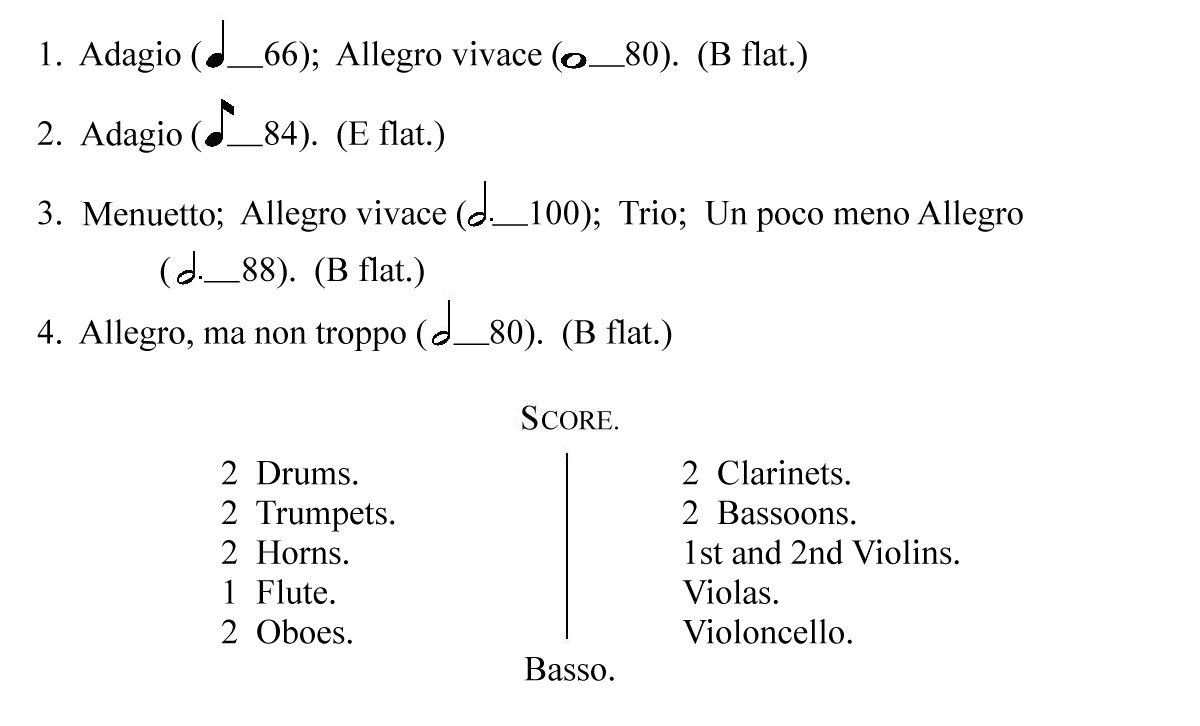
One flute only is used throughout the Symphony. Beethoven employed one flute in his Pianoforte Concertos in B flat and C, in the Triple Concerto (Op. 56), in the Andante of Symphony No. 1, and in the Violin Concerto, as well as in this Symphony.
The score is an 8vo of 195 pages, uniform with those of Nos. 1, 2, and 3; and was published in 1821. The title is as follows: - '4me Grande Simphonie en Si bémol majeur (B dur) composée et dediée à Monsr. le Comte d'Oppersdorf par LOUIS van BEETHOVEN. Op. 60. Partition. Prix 16 Fr. Bonn et Cologne chez N. Simrock. 2078.'
The orchestral parts were published in March, 1809, by the 'Bureau des Arts et d'Industrie' (now Haslinger), at Vienna and Pesth.
The Fourth Symphony has been, like the Eighth, more or less under a cloud. Of its history less is, perhaps, known than that of any other of the nine. No sketches for it seem as yet to have been found, and the investigations of Mr. Nottebohm and Mr. Thayer disclose but little. It is the only one which has not a review in the Allgemeine musikalische Zeitung, and it has met with scant notice in some of the most prominent works on Beethoven. The original MS. was formerly in the possession of Felix Mendelssohn, and is now the property of his nephew, Mr. Ernst Mendelssohn-Bartholdy, together with those of the C minor and A major Symphonies, and the other treasures which are preserved in the Mendelssohn family-house in the Jägerstrasse, Berlin. The MS. bears the following inscription in Beethoven's own hand, at the top of the first page: -
Sinfonia 4ta
1806 - L. v. Bthvn.
An interval of two years thus separates the completion of the Fourth Symphony from that of the Third. We know that it was Beethoven's intention to follow the Eroica by the C minor, and that the first two movements of that great work virtually date from 1805. The circumstances which led to the C minor being for the time suspended have been succinctly narrated by Herr W. J. von Wasielewsky, in his work on Beethoven (ii., 233) [1], as follows: 'Count Franz von Oppersdorf was a great amateur of music, and resided at his castle near Glogau. In the autumn of 1806 he paid a visit to Prince Lichnowsky, where he found Beethoven, and heard his Symphony in D performed by the Count's private band. On this occasion, or shortly after, Beethoven was requested by Oppersdorf to compose a Symphony for him for a fee of 350 florins. Beethoven accepted the offer, and designed to fulfil his engagement with the C minor Symphony. But in the end, with a vacillation not unfrequent in this portion of his work, he found himself compelled to dedicate the C minor and Pastoral Symphonies jointly to Prince Lobkowitz and Count Rasoumoffsky; and on November 1, 1808, he wrote to Oppersdorf as follows: - 'Bester Graf, - Don't look on me in a wrong light; the Symphony which I had intended for you I was compelled by want to sell with a second one to someone else. But be assured that you will very soon receive the one which I design you to have.' This explanation is clear enough as to the external facts, but it gives no explanation of the difference between the two works - why it is that the C minor, in the composition of which some progress had already been made, should be superseded by a work so entirely different in character as the No. 4. It is impossible not to remark that after the first two the Symphonies as they succeed one another are very much in contrast: the D major is followed by the Eroica, that by the B flat, that by the C minor, and that again by the Pastoral, the Pastoral by the gigantic No. 7, No. 7 by the humorous and autobiographical No. 8, while the crown of all is the colossal Choral. Perhaps Beethoven's instinct showed him that it would be an artistic mistake to follow so very serious a Symphony as the Eroica by one equally earnest and profound. There certainly were more personal considerations, to be alluded to presently, which made it impossible for him to write in any other vein. At any rate, the B flat Symphony is a complete contrast to both its predecessor and successor, and is as gay and spontaneous as they are serious and lofty. And this, perhaps, is one reason for the fact that No. 4 has never yet had justice done it by the public. As No. 8 lives in the valley between the colossal No. 9 and the almost equally colossal No. 7, so No. 4 is equally overshadowed by the Eroica and the C minor. By the side of the tremendous questions raised by their prodigious neighbours, the grace and gaiety of No. 4 and the impetuous humour of No. 8 have little chance of appreciation.
Schumann has spoken of the No. 4 as standing between its companions 'like a slender (schlanke) Greek maiden between two Norse giants.' But humour is hardly the characteristic of a Greek maiden, and when we recollect the humour which accompanies the grace and beauty of the Fourth Symphony, and is so obvious in every one of the movements, it must be admitted, though with great respect, that the comparison loses something of its force.
At the same time no expressions of Schumann, or Berlioz, or any other worshipper of Beethoven, can be too strong for this beautiful work. There is something extraordinarily entrainant about it throughout; a more consistent and attractive whole cannot be. In the Eroica some have complained of the Funeral March as too long, some of the Scherzo as inappropriate, or of the Finale as trivial; but on the No. 4 no such criticisms are possible; the movements fit to their places like the limbs and features of a lovely statue; and, full of fire and invention as they are, all is subordinated to conciseness, grace, and beauty. We may use regarding it the droll Viennese expression which Beethoven employs in sending his Pianoforte Sonata in the same key (Op. 22) to Hoffmeister, the publisher, in 1801: - 'Diese Sonate hat sich gewaschen, geliebtester Herr Bruder!' - or, to use a parallel English expression, 'This Sonata will wash.' [2]
Oulibicheff
would have us believe that it might have called
forth the
sincere compliments of Haydn, who was still alive when it was produced.
But, remembering that Haydn found the Trio in C minor (Op. 1, No. 3)
too strong for him, it is difficult to think that he would have been
pleased with the Symphony. Others are fond of regarding it as a pendant
to No. 2; but, beyond the fact that in composing both Beethoven was
happy, the two have really nothing in common. No. 2 is charming, and
stands at the head of the period which it
illustrates. But in No. 4 we have
An ampler ether, a diviner
air,
with a humour, a poetry, a pathos, a romance, and a
maturity
of style that are, indeed, predicted in the Coda to the Finale of No.
2, but of which the body of that Symphony has few traces. Where, for
instance, shall we look in No. 2, or, indeed, in the Eroica itself, for
the romantic passion which inspires the slow movement of No. 4?
The most obvious characteristic of the work, that which distinguishes it throughout, is its unceasing and irrepressible brightness and gaiety, and the extraordinary finish of the workmanship. If we except the transient gloom of the introductory Adagio, and a rough burst or two in the Finale, there is hardly a harsh bar. Well might Mendelssohn choose a piece so contagious in its gaiety for his first Programme as Director and Conductor of the Gewandhaus Concerts of Leipzig, on October 4, 1835. Beethoven must have been inspired by the very genius of happiness when he conceived and worked out the many beautiful themes of this joyous composition, and threw in the spirited and graceful features which so adorn them. The work is animated throughout by a youthful exhilaration more akin to that which pervades Mendelssohn's Italian Symphony than anything else we can recall - in the Adagio by real passion. Such times were rare in Beethoven's life, and we are fortunate in having so perfect an image of one of them preserved to us.
Widely
different as the Fourth Symphony is from the Third, it
is not
less original or individual. It is lighter and less profound than the
Eroica, but there is no retrogression in style. It is the mood only
that is different, the character and the means of expression remain the
same. In fact, the structure perhaps obtrudes itself on the hearer less
in the present work than it did in the former. Beethoven's life was
one continual progress in feeling, knowledge, and power; and in time
everyone will acknowledge, what those competent to judge have already
decided, that the later the work, the more characteristic is it of the
man. The capricious humour which we found manifesting itself in the
twelve bars inserted in the
Allegro of
the Second Symphony is strongly in force here. In fact,
there is a passage in the 'working-out' of the Adagio [3]
and another in
the corresponding section of the first Allegro [4]
which are in this
respect close pendants to that referred to. The working-out section of
the first Allegro
is full of such drolleries, which must have been
simply puzzles and annoyances to those who first heard them. How worse
than odd, how gratuitously insulting, for instance, must the following
long scale, from the working-out, apparently à propos to
nothing, have
seemed to many a hearer in 1806, when its connection with the subject
was not known: -

though to us so natural and admirable.
Indeed the Symphony was not allowed to pass unchallenged by the critics at the time of its first appearance. Carl Maria von Weber, then in his hot youth, was one of its sharpest opponents, and in a jeu d'esprit in one of the journals of the period - if that can be so called which exhibits neither jeu nor esprit - has expressed himself very bitterly. It is supposed to be a dream, in which the instruments of the orchestra are heard uttering their complaints after the rehearsal of the new work. They are in serious conclave round the principal violins, grave personages whose early years had been spent under Pleyel and Gyrowetz. The double bass is speaking. 'I have just come from the rehearsal of a Symphony by one of our newest composers; and though, as you know, I have a tolerably strong constitution, I could only just hold out, and five minutes more would have shattered my frame and burst the sinews of my life. I have been made to caper about like a wild goat, and to turn myself into a mere fiddle to execute the no-ideas of Mr. Composer. I'd sooner be a dancing-master's kit at once, and earn my bread with Müller and Kauer' - the Strausses of the day. The first violoncello (bathed in perspiration) says that for his part he is too tired to speak, and can recollect nothing like the warming he has had since he played in Cherubini's last opera. The second violoncello is of opinion that the Symphony is a musical monstrosity, revolting alike to the nature of the instruments and the expression of thought, and with no intention whatever but that of mere show-off. After this the orchestra-attendant enters and threatens them with the Sinfonia Eroica if they are not quiet, and makes a speech in which he tells them that the time has gone by for clearness and force, spirit and fancy, 'like those of Gluck, Handel, and Mozart,' and that the following (evidently an intentional caricature of the work before us) is the last Vienna receipt for a Symphony: - First a slow movement full of short disjointed unconnected ideas, at the rate of three or four notes per quarter of an hour; then a mysterious roll of the drum and passage of the violas, seasoned with the proper quantity of pauses and ritardandos; and to end all a furious finale, in which the only requisite is that there should be no ideas for the hearer to make out, but plenty of transitions from one key to another - on to the new note at once! never mind modulating! - above all things, throw rules to the winds, for they only hamper a genius. 'At this point,' says Weber in his own person, 'I woke in a dreadful fright, lest I was on the road to become either a great composer or - a lunatic.'
How odd it all sounds; Pleyel and Gyrowetz great men; Cherubini the author of sensation-music! Beethoven a poor mountebank! and Gluck, Handel, and Mozart his rivals! For Weber there is no excuse, but something may be said for the imperfect appreciation of the ordinary critics of those days. Scores were not then published for years after the production of a new work [5]; nor were there pianoforte arrangements by which it might be studied; analyses were unknown; the performances were few, and took place for the most part in private houses or palaces, to which access could not be obtained by payment. The critic had therefore a difficult task, and his shortcomings may be to some extent excused.
I.
The Fourth Symphony, like the first,
second, and seventh of the
nine, opens with an Introduction, Adagio,
to the first movement proper,
Allegro vivace,
an Introduction as distinct in every respect from its
companions as if it were the work of another mind. It commences with a
low B flat pizzicato
and pianissimo
in the strings, which, as it were,
lets loose a long holding-note above and below in the wind, between
which the strings move slowly in the following mysterious phrase, in
the minor of the key: -
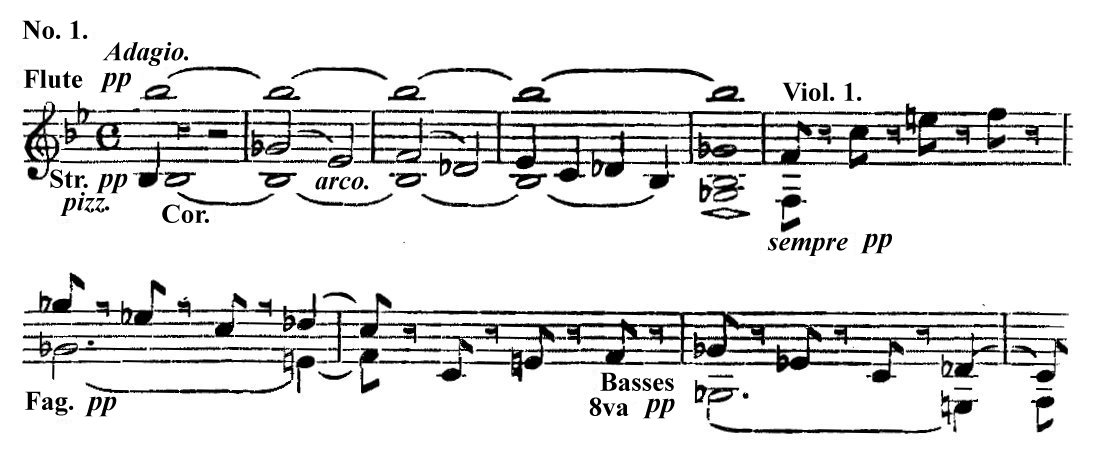
- the bassoon and basses answering at a
bar's interval.
Three bars later the strings again emit the pizzicato note (B flat), and the slow unison phrase is repeated, this time leading enharmonically from G flat into F sharp: -
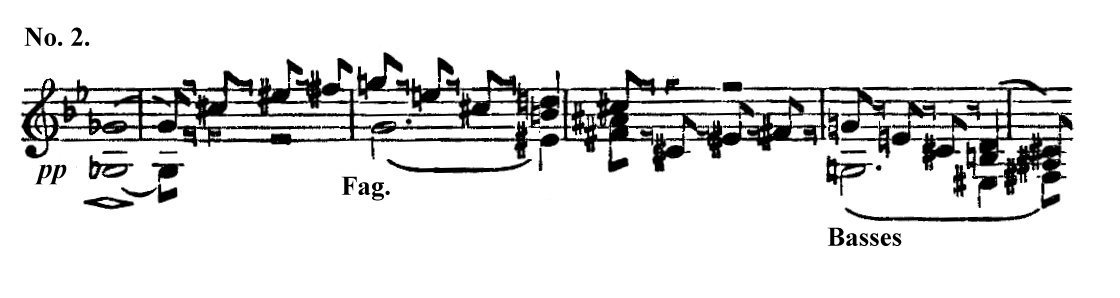
A third time the pizzicato note is heard, now leading into a solemn progression of the basses, marching on like Fate itself: -

II.
The Introduction is thirty-eight bars
long, and as its
close
is approached the tone brightens, and the Allegro - the first
movement
proper, after being, as it were, lashed by the preceding chord
(of F)
[6] in a
truly sportive manner
(not without recalling the introductory
passage in the Finale
of No. 1) - bursts forth brilliantly in
B flat major. This portion of the work is of the most bright and
cheerful character throughout - the principal subject, in staccato
notes - but how different from the staccato notes
of the Introduction! - alternating with a smooth passage for
the wind, and ending with a burst on the final
chord. We quote three bars before the change of
pace; and the subject, which begins at bar eight of the quotation -
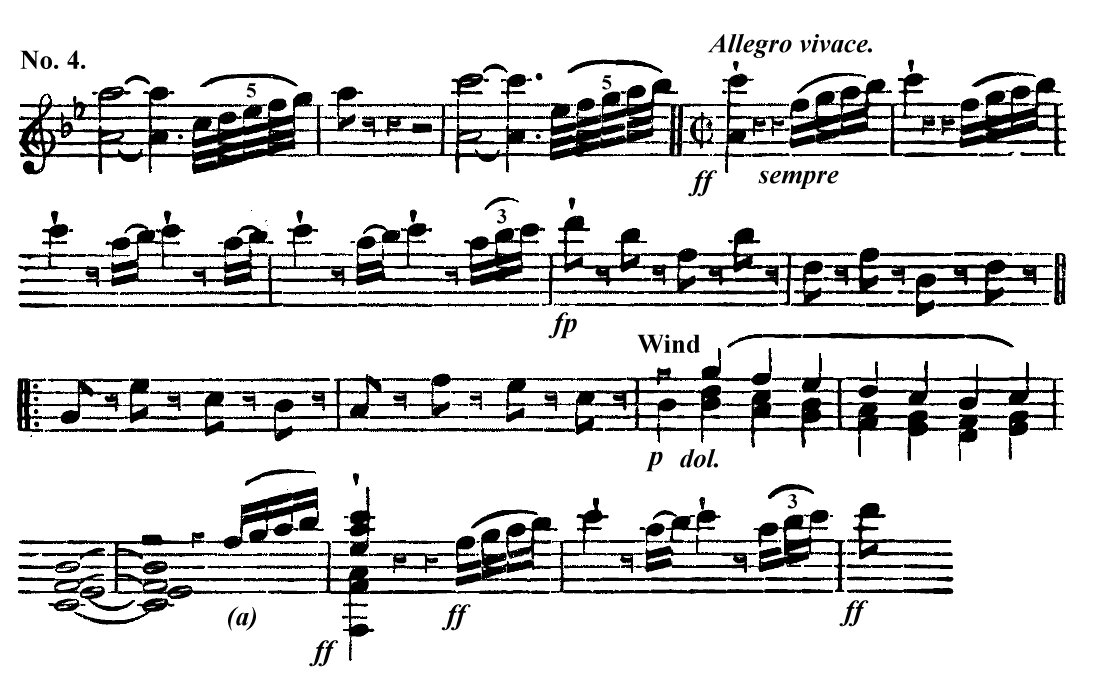
is gaiety itself, and most original gaiety.
The connecting portion between the first and second subjects is delightfully spontaneous. The staccato arpeggio figure of the former (No. 4, bar 8) is kept constantly in view, and great freedom and life are given to it by the stimulating tremolo figure of the violins, of which we have spoken under Symphony No. 2 (see earlier), and of which the present work contains abundant and delicious specimens -

At
the end of this section we have a taste of the
syncopations which give such a flavour to this and other movements of
the work - [7]

the notes
seem almost to be tumbling over one another
in their eagerness to get to the second subject, or rather the group of
melodies which form it. The sportive conversation of the bassoon, oboe,
and flute -
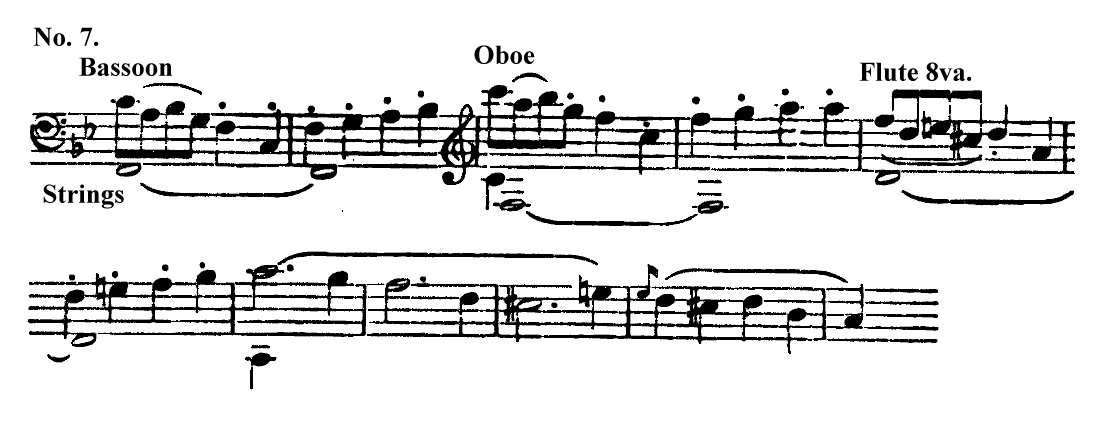
introduced with extraordinary effect by the bassoon -
the equally sportive 'canon' of the clarinet and bassoon, as near
triviality, perhaps, as Beethoven could allow himself to approach -
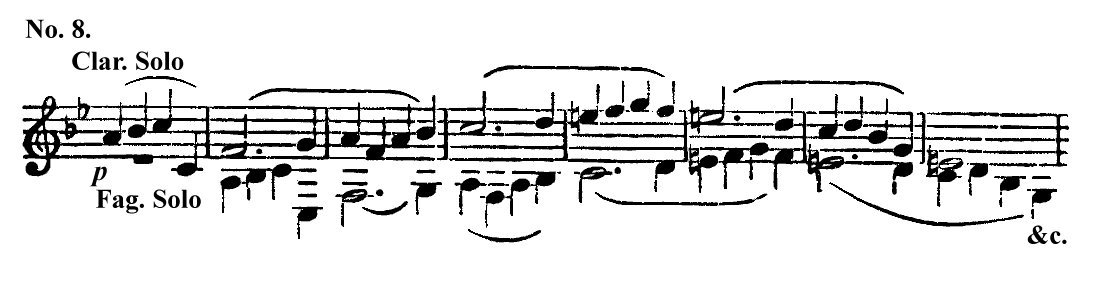
and the strange sequential passage which connects them -
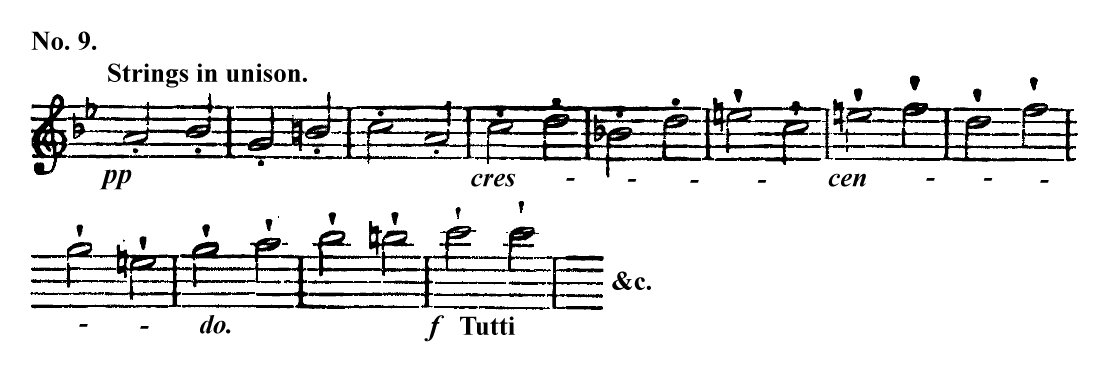
-
and bears a curious resemblance to the 'Quoniam' of
Beethoven's Mass
in C - [8]

- all these,
which form the second subject, are as gay as
gay can be, and the music has not one sombre bar [9].
Interesting
as
the foregoing is, the working-out, after the double bar, is still more
so. It supplies an element of anxiety and suspense which finds no place
in the former portion, and is distinguished by a pathetic spirit, an
ingenuity, and a poetry all its own. The means by which this is
conveyed are eminently original. In the First Symphony we have
noticed how Beethoven
has taken the drum out of the obscurity in which
it previously existed, as one of the merely noisy members of the band,
and given it individuality (see earlier).
In the C minor Piano
Concerto and in the Violin Concerto the drum is again brought into
notice, but in the present working-out and in the next movement
Beethoven goes farther in the same direction, and gives his favourite a
still more important rôle. - We
will endeavour to
trace the course of this working-out. The portion just examined ends in
B flat, and no conspicuous change is made after the double bar, but the
music remains for eighteen bars in F, the phrases employed being those
of the opening of the first subject (No. 4).
There is then a sudden
transition into the key of D, and, after fourteen bars, a close in the
same key. With this change a spontaneous and very engaging tune makes
its appearance as an addition to the arpeggios of No. 4 - so
spontaneous that it has the air of being a merely obvious completion to
the accompaniment -

and is heard successively five times in
different keys and on different instruments, before vanishing never to
re-appear in the piece. The first and second violins then evince a
disposition to have a dialogue between themselves, thus -

This is
at first interrupted by the full band; but at length they accomplish
their desire, and, after au enharmonic change of D flat to C sharp,
dissolve into a lovely soft chord of F sharp given by all the strings,
ppp,
lasting through several bars, and accentuated by two short rolls
of the drum, on B flat taken as A sharp -
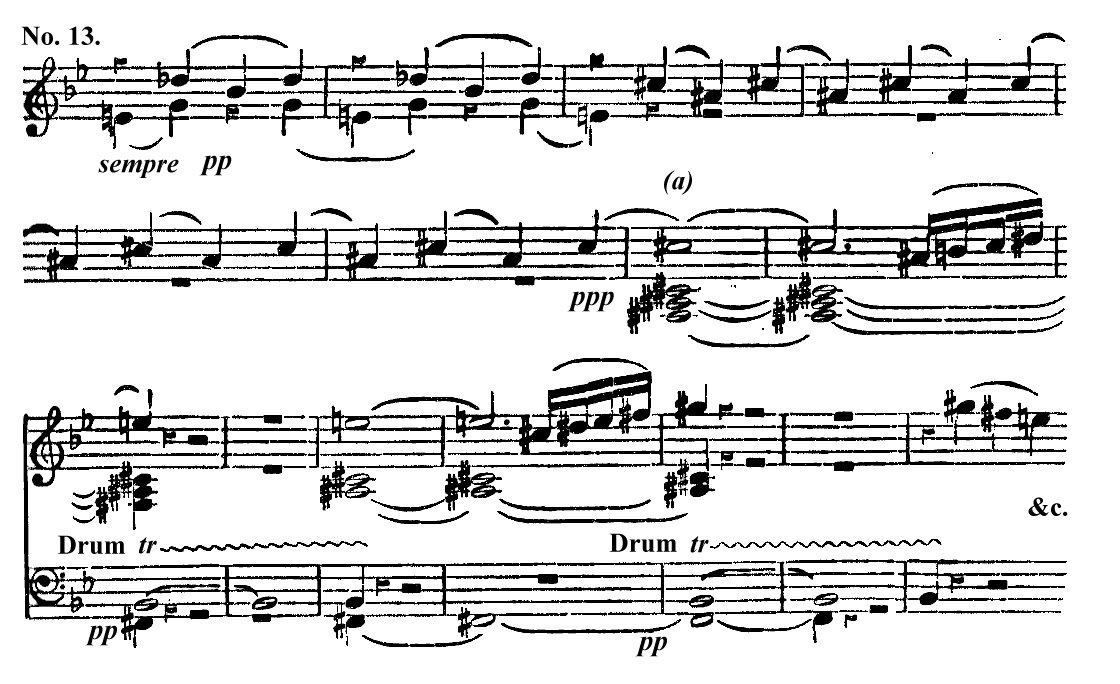
The
phrases have
hitherto been chosen from the cello part early in the working-out (see
No. 15),
but at this point they
change and take up the scale passage of
bar 12 of No. 4 -

for eight bars more. A beautiful change takes us
from F sharp to F natural in the bass, and into the key of B flat. The
drum begins a long roll on the keynote (B flat) which lasts twenty-six
bars, the first eighteen of them being very soft, and the remaining
eight increasing to fortissimo;
and as the climax to this the original
theme (No. 4)
is returned to.
The strange succession of keys in this
passage; the constant piano,
and the vivid contrast when the reprise
is
reached after the long crescendo,
the roll of the drum, the
turn of the phrases, all give this portion of the working-out an
unusual and highly poetical effect. It is interesting to compare it
with the corresponding portion in any one of Haydn's Symphonies, and
see how enormously music had gained, not in invention, wit, or spirit,
but in variety of structure, colour, and expression, during the few
years preceding 1806.
The Coda is short and very spirited, but has no remarkable feature. Schumann (Gesamm. Schriften, iv., 64) has noticed that in the eight bars which terminate the movement fortissimo, one of the first three is redundant. Schumann's fine ear for rhythm detected this, and he is probably correct, but the error, if error it be, is one which few will feel with him.
Before completely quitting the Allegro we must notice an interesting parallel between the final crescendo in the working-out and the corresponding passage in the opening movement of the 'Waldstein' Sonata (Op. 53), where the return to the principal subject is managed in very much the same manner as it is here, and with some similarity in the phrases employed. If 1803 be the correct date of the composition of the Sonata [10], then the passage alluded to may be taken as a first sketch of that in the Symphony. Such parallels are rare in Beethoven, and are all the more interesting when they do occur. In speaking of the Adagio we shall notice another.
The
care with which Beethoven marks his nuances
and other indications for the players is nowhere more conspicuous than
here. Dots, dashes, and rests are anxiously discriminated, and it
almost makes one's head ache to think of the labour that is concealed
in these gay and lively pages [11].
In fact, the details of all kinds in
these immortal works are prodigious. In that respect they are like
Hogarth's pictures, in which every time you look you see some
witty or pertinent point which you had not noticed before. Such a
passage as the following, from the early part of the working-out -

with
its dotted crotchets, its quavers, and then its crotchets again, this
time with dashes in place of dots - almost admits us to the process,
and seems to show the master in doubt as to the exact form of
expression he should adopt. A similar instance is found in the
Introduction, in the alternation of quavers and rests with staccato
crotchets (see No.
3).
Excellent examples of his minute care as to
every detail of execution are given in the 'Twenty-one Cramer's
Studies' which he annotated for his nephew's practice, and which have
been recently published for the first time from the MS. at Berlin, by
Mr. J. S. Shedlock (Augener & Co., May, 1893). One of the
remarkable features in Beethoven's autograph scores is the minute
exactness with which the marks of expression (f, p, sfp, crescendo,
&c.) and other dynamic indications are put in; and the way in
which they are repeated in the MS. up and down the page, so that there
may be no misunderstanding of his precise intention as to every
instrument in the band. A comparison of the scores of Mozart's or
Haydn's Symphonies - in which the expression seems to have been left
almost entirely to the conductor - with those of Beethoven will show
how determined he was to leave nothing to chance, not the
smallest item!
III. The second movement, Adagio, is not only an example of the celestial beauty which Beethoven (the deaf Beethoven) could imagine and realise in sounds, but is also full of the characteristics of the great master. Here we rise from good humour and pleasure to passion, and such a height of passion as even Beethoven's fiery nature has perhaps never reached elsewhere. And this is not astonishing when we consider the occasion which inspired the Symphony. We now know, on evidence that, with some drawbacks of expression, has to unprejudiced minds every appearance of being genuine, that in the May of the year in which Beethoven was occupied over this very Symphony he became engaged to the Countess Theresa, sister of his intimate friend Franz von Brunswick, and that the three famous love-letters which were found in his desk after his death, and have been supposed to be addressed to the Countess Giulietta Guicciardi, were really written to that lady [12]. They are given at the end of this chapter, and if ever love-letters were written these are they - often incoherent in their passion. But the fact is that music was Beethoven's native language [13]; and, however he may stammer in words, in his most passionate notes there is no incoherence. Though he had been often involved in love affairs, none of them had yet been permanent; certainly he had never before gone so far as an engagement, and when writing the Symphony his heart must have been swelling with his new happiness. It is, in fact, the paean which he sings over his conquest. Here then we have the secret of the first movement of the C minor, and an excuse for any height or depth of emotion. The Countess's raptures will be found in the narrative just referred to: Beethoven's are here before us, in his music. But observe that with all the intensity of his passion Beethoven never relinquishes his hold on his art. The lover is as much the musician as he ever was, and this most impassioned movement is also one of the compactest and, at the same time, the most highly finished of all his works. The Adagio, though on a small scale, is broad and dignified in style, and in strict 'first movement' form, except that there is no repeat of the first section. Its first and second subjects are in the due and accepted relation to each other, and are succeeded by a 'working-out,' which, though but twenty-four bars long, contains its special feature, and is long enough to make the return of the first theme welcome. The recapitulation of the previous material is quite en règle, and the whole ends with a Coda of eight bars.
The
movement opens with a figure containing three
groups of notes in
the violins -

which serve as a pattern for the accompaniment of a
great portion of
the movement, and are also a motto or refrain, a sort of catch-word,
which is introduced now and then by itself with great humour and
telling effect - now in the bassoon, now in the basses, now in the
drum, whose two intervals may indeed have suggested its form, as they
not improbably did that of a phrase in the first subject of the opening
movement of the Concerto in C minor. We venture to call it the
'drum-figure.' In its capacity of accompaniment to the heavenly melody
of the principal subject, it is most lulling and soothing; when
employed by itself it is full of humour [14].
The
introductory or motto
bar just quoted is immediately followed by the principal melody -

It will be observed that it is a scale down and a scale up, and
formed almost entirely of consecutive notes, like the melody of the
slow movement in the B flat Trio, two prominent subjects in the Andante
of the 'Pastoral Symphony,' the chief subject of the concluding
movements in the Choral Symphony, and others of Beethoven's finest
tunes. In its close progression it is akin to the picturesque second
theme in the Allegretto
of No. 7. It is accompanied by a figure related
to the 'drum-figure' (No. 16) and by a beautiful counter-melody in
contrary motion in the violas (not quoted). It ends on the fifth of the
key, instead of on the key-note, a fact which 'gives it,' as Sir G.
Macfarren has aptly said, 'an air of inconclusion, as if its
loveliness might go on for ever.'
The
connecting link of eight bars
between the first and second subjects is formed on a phrase -

that
gains a special charm from the electric force with which its principal
note is thrown off. To this its continuing strain is a perfect pendant
-

The
second principal subject, a melody more passionate, though
hardly less lovely than the first, is as follows -

and has a
pathetic second part in the bassoons, re-echoed by the horns, flutes,
oboes, &c. -

on a pedal of four bars of the 'drum figure'
in B flat and F, and with delicious arabesque arpeggios in the violins.
In both subjects, as if the great master knew what beautiful tunes he
had made, he has marked them with the term Cantabile, a word
which he
seems only to employ when it has a special significance [15].
The
working-out, though short, is extremely characteristic. It begins with
the 'drum figure' in the second violins, and in E flat,
exactly as at the opening; then the chief subject, still in E flat, in
a lovely florid form [16],
thus
-

then six bars of the same subject,
but in E flat minor; then comes a capital instance of the droll caprice
to which allusion has before been made, in the interpolation into the
flow of the music of four playful bars of duet for the first and second
fiddles, merely to end as they began. This leads to a short but very
impressive passage, the bassoon coming in for a bar or two in G flat
(bar 6) with a striking and weird effect. We
subjoin a quotation -
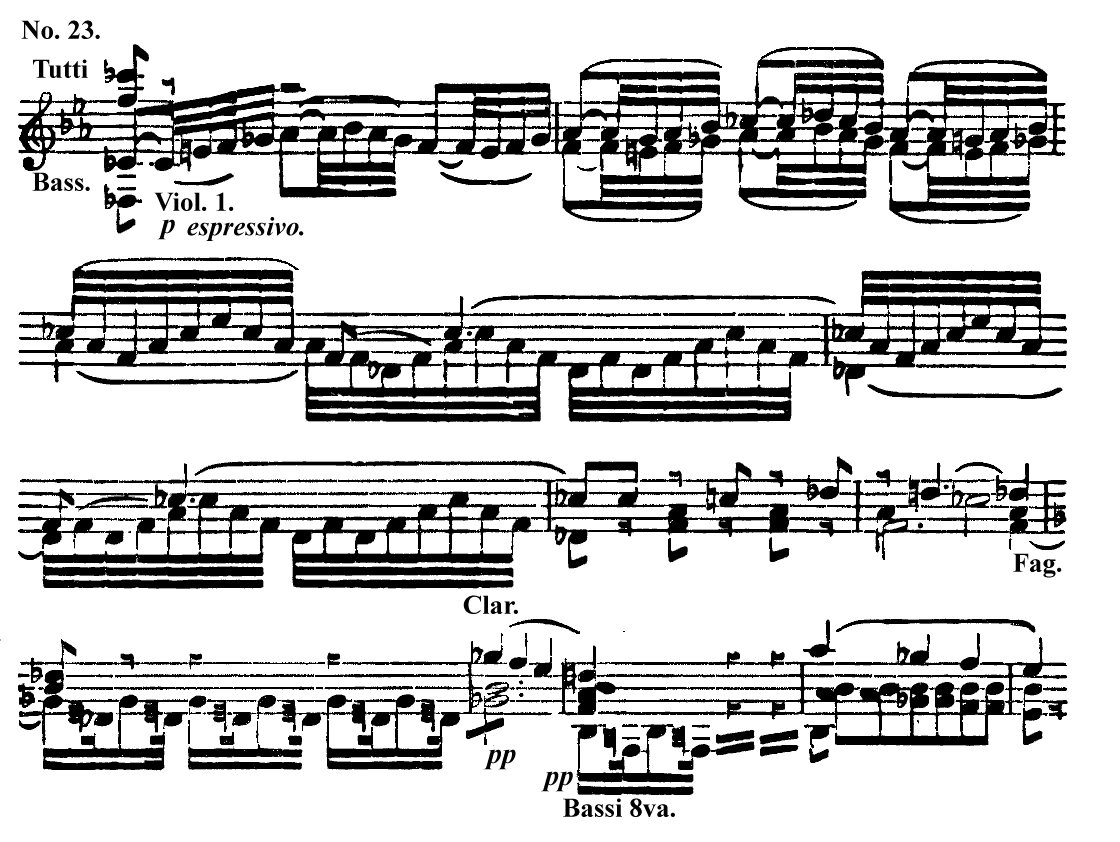
After this the reprise is reached by a scale upwards in the flute, and the principal subject is then given at the same time by the flute and clarinet - by the clarinet in its original unadorned form (No. 17) and by the flute in its florid shape. The recapitulation is shortened by eight bars, then comes the link (No. 18), and then the second principal subject (No. 20), now in the key of E flat, with its second portion this time in the horns; then a few bars' more play on the first subject by way of Coda, with some delightful expressive work in the clarinet and flute, including a touching drum solo given pianissimo, and this truly lovely poem is at an end. The workmanship throughout is masterly in combinations of the instruments, and in imitative passages, and every embellishment possible; while at the same time the effect of the whole is pure and broad, and free from the faintest trace of mesquinerie or virtuosity. 'Believe me, my dear friend,' says Berlioz, who, with all his extravagance, was a real judge of Beethoven - 'believe me, the being who wrote such a marvel of inspiration as this movement was not a man. Such must be the song of the Archangel Michael as he contemplates the worlds uprising to the threshold of the empyrean.'
We
have already
in the first movement noticed a coincidence between the return to the
first subject and the analogous portion of one of Beethoven's
Pianoforte Sonatas. The Adagio
furnishes another coincidence in the
course of the treatment of the second subject; the corresponding
passage being in the Adagio
of his Sonata for Piano and Violin in A
(Op. 30, No. 1), where the detached semiquavers with which, in the
Symphony -

the violins accompany the melody of the clarinet, occur in the solo
violin, with a similar bass. The two movements have other points of
likeness which make them worth comparison by the student, one of the
principal being the employment of a figure of dotted semiquavers akin
to those given in No.
11. The
Sonata was probably composed in 1802; so
that, like the passage in the 'Waldstein' Sonata, already mentioned,
it preceded the Symphony.
IV. Here we return to the key of B flat, and to the term 'Minuet,' which has vanished from the Symphonies since No. 1, though the words Tempo di menuetto, attached to the second movement of the little Pianoforte Sonata, Op. 49, No. 2 (composed in 1802), and the In tempo d'un menuetto, at the head of the first movement of the Sonata in F, Op. 54 (dating from before 1806), as well as the use of the letter 'M' in the sketches of the Eroica Symphony (see earlier) show that the term was still familiar to Beethoven. The Minuet in the Fourth Symphony is, however, still farther removed from the old accepted minuet-pattern than that of the First Symphony was - and still nearer to the 'New Minuet' for which the aged Haydn longed (see earlier).
The
opening section is as follows: -
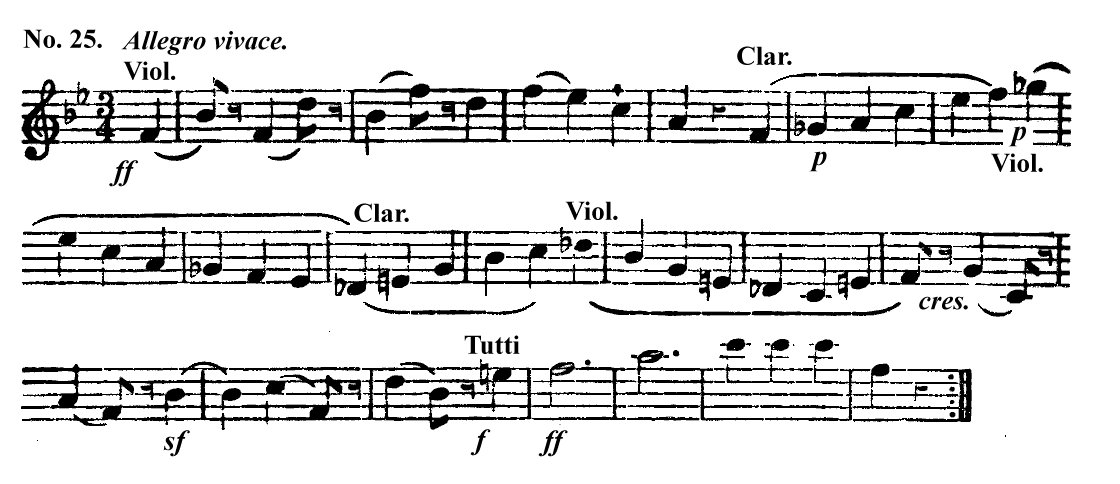
The
autograph shows that the tempo was originally indicated as Allegro
molto e vivace, but the molto has been
effaced.
In
the above passage
three things strike the hearer - (1) the vague uncertain restlessness
caused by the compression of a phrase in common time into triple
rhythm, in bars one and two; (2) following this, the alternations of
wind and strings in a phrase as frankly in triple time as the other was
irregularly so; (3) the sudden change into B flat minor at the fifth
bar. After the quotation and the double bar the same phrases go at once
into D flat. A melodious passage then appears in the bassoon and cello,
as a bass to the others, but this receives no development -

Farther on an excellent effect is produced by an unexpected
sforzando
on the weak note of a bar thus -

The
Trio
- or second
Minuet, for the Trio
was originally only that - is an excellent
contrast to the preceding section. The pace is somewhat slackened, the
music starts in the wind in unmistakable triple time - the smooth
phrases of the oboe, clarinets, bassoons, and horns being interrupted
by the daintiest phrases from the violins -
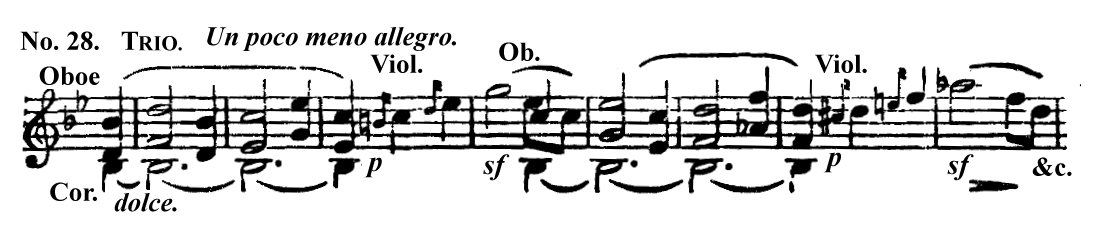
and the whole forming one of the tenderest and most refined things to
be found anywhere.
As
instances of the lovely touches with which
Beethoven could heighten the expression of the tenderness which formed
so large an element in his great heart, and display the interest which
he took in his work, take, amongst many, the following modifications of
phrases already quoted -

and another little passage -

delicate as the song of a robin singing, as robins do sing, over the
departed delights of summer.
After
proceeding in this beautiful
manner for some time, a new feature comes in - namely, the tremolo,
which we have noticed in the first movement, and which here forms a
truly beautiful accompaniment to the main theme. It is almost confined
to the strings, and begins as follows -

Nothing can be
more refined or charming than the effect of this, which lasts for
nearly forty bars and brings back the original Minuet, at the original
pace.
This movement shares with the corresponding portion of the Seventh Symphony the peculiarity that the Trio is twice given and the Minuet repeated each time. Mozart occasionally gives two independent Trios to the one Minuet - a practice in which Schumann followed him in his Symphonies in B flat and C - and in one instance has even three different Trios. But Beethoven appears to stand alone in repeating the single Trio. He has done it in the second of his Rasoumoffsky Quartets - that in E minor, in the Pianoforte Trio in B flat (Op. 70, No. 2), and perhaps elsewhere, as well as in the two Symphonies. In the present case the repetitions of both Minuet and Trio are given each time identically, the only addition being the three bars at the very end, in which, as Schumann says, 'the horns have just one more question to put' -

These three bars are an augmentation of the rhythm of the piece, and as such have been objected to by purists, to whom rhythm and structure sometimes seem to be more than meaning or poetry.
V. - But lively, vigorous, and piquant as are the first and third movements, they are in these qualities surpassed by the Finale, which is the very soul of spirit and irrepressible vigour. Here Beethoven reduces the syncopations and modifications of rhythm which are so prominent in the first and third movements, and employs a rapid, busy, and most melodious figure in the violins, which is irresistible in its gay and brilliant effect, while the movement as a whole is perfectly distinct from that of the first Allegro. It is as much a perpetuum mobile as any piece ever written with that title. On the autograph manuscript, the tempo of the Finale is thus written - Allo. (in ink) ma non troppo (in red chalk), conclusively showing that the ma non troppo was a second thought, a caution on Beethoven's part - 'fast, but not too fast.'
The
figure alluded to rushes off as
follows -

- and is made especially characteristic by the rhythm
of its last notes -

- the last four bars, and especially the
last three notes (a)
of the phrase, having a remarkable way of staying
in one's ear. Besides this subject there is a
second, as follows -

followed by a second strain -

with
alternations of wind and string, and ending in this fresh and sportive
phrase -
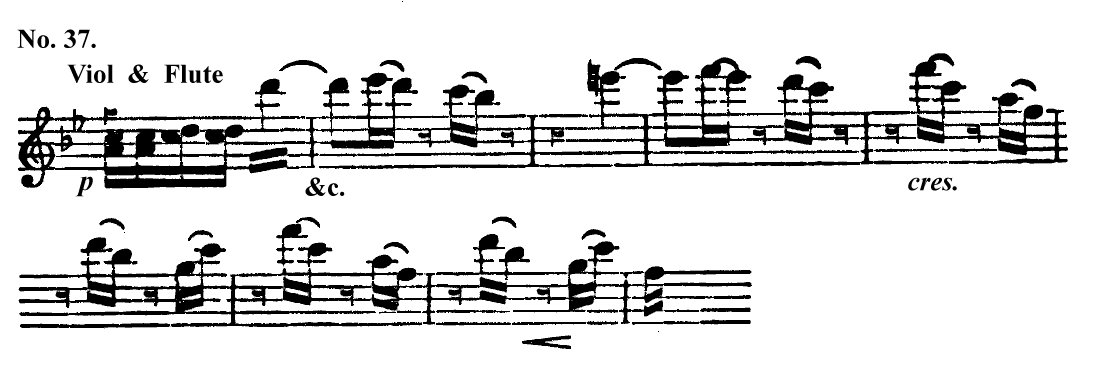
The
working-out is not less lively or humorous than that
of the first movement. It begins with an extension of the semiquaver
figure (No. 33)
crescendo,
which culminates in a tremendous B
natural through three octaves [17]
-

- which has all the air of a false alarm, but does not disturb the
basses
in their business-like pursuit of the
original idea. 'House a-fire,' shouts the
orchestra. 'All right; no
concern of ours,' say the basses. This introduces a little phrase -

on which the bassoon, clarinet, and oboe converse in
charming alternation, with gay sforzandos
from the strings; and the
working-out ends with an irresistible flourish for the bassoon, who can
hold his tongue no longer. But we will not enumerate the many other
features of this beautiful and irrepressible Finale. It must be
admitted that there is some ground for the disgust of the double bass
in Weber's skit (see earlier).
But though full of drollery, Beethoven
is constantly showing throughout how easy it is for him to take flight
into a far higher atmosphere than mere fun. The movement places him
before us in his very best humour: not the rough, almost coarse play,
which reigns in the mischievous, unbuttoned
[18],
rougher passages of the
Finales to
the Seventh and Eighth Symphonies; but a genial, cordial
pleasantry, the fruit of a thoroughly good heart and genuine
inspiration. What can be gayer music than the following passage just
before the Coda
-

or what more touching than the passage in which
he says good-bye in a tone of lingering affection as unmistakable as if
he had couched it in words -
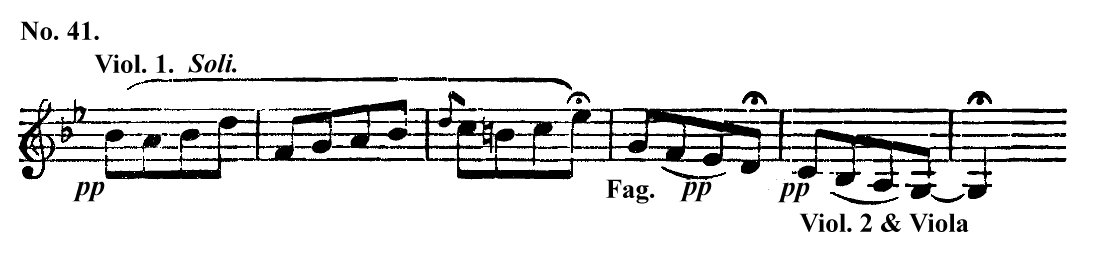
a passage specially interesting
because it is a simple repetition of the first bars of the figure which
opened the movement (No.
33)
put into half the original speed, a device
which Beethoven has used elsewhere - for instance, at the end of the
Overture to 'Coriolan,' and in the oboe passage at the clearing off of
the storm in the Pastoral Symphony - with the happiest effect.
So ends this delightful movement, and in parting from it, it is well to remember that it is the last gay Finale that will be vouchsafed to us. Beethoven was now in his thirty-seventh year. The mutual love which inspired these happy strains, and which threw so golden a light on the future, was soon clouded with obstacles; difficulties of an external and cruel kind set in, ill-health and the constant presence of deafness increased, and life became a serious, solitary, painful conflict. Beauty there will always be, and strength and nobility, but the gaiety is gone. The Finale of No. 5 is triumphant, of No. 6 religious, those of Nos. 7 and 8 romantic, humorous, and rough; but the careless delight of this beautiful movement we shall encounter no more.
Something has been lately said in two sonnets on Beethoven, implying that grief was the prevailing topic of his music [19]. As justly might we call Shakespeare the poet of grief. Both he and Beethoven can depict grief and distress as no one else can; but then they are equally successful with joy, and indeed with every other emotion. They worked in the entire domain of human nature, and gave each department of that nature its due proportion. If a complete answer were wanted to such a criticism it is supplied by the beautiful and exhilarating Symphony which we have been considering. In the slow movement, if anywhere, grief might be expected to find a place. But is it there? Refinement, sentiment, passion there are in highest abundance and constant variety in that enchanting portion of the work; but where is the distress?
The
autograph shows a curious slip of its great
author's. It is in the double bass part, in the fourth bar of the
Finale. The
notes are somewhat blurred, and to avoid mistake he has put
letters under them thus -

- But h is
B natural, not B flat!
The first performance of the Symphony took place at one of two Concerts given in March, 1807, at the house of Prince Lobkowitz. The programmes consisted entirely of Beethoven's compositions, and contained the four Symphonies, the Overture to 'Coriolan,' a Pianoforte Concerto, and some airs from 'Fidelio.' (Journal des Luxus und der Moden, for April, 1807 - quoted by Thayer, iii., 7.) The reporter, while praising the 'wealth of ideas, bold originality, and extraordinary power which are the special features of Beethoven's music,' harps on the old string by lamenting the absence of dignified simplicity, and the undue amount of subjects, which from very quantity cannot be duly worked and developed, and thus have too often the effect of unpolished diamonds!
In England the first performance of which the date can with certainty be named was by the Philharmonic Society on March 12, 1821. It may have been played before that date, but until 1817 the keys or numbers of the Symphonies were not given. At any rate, it was not heard for the four years preceding 1821. From that year to 1893 it has been played by the Society, with few exceptions, every year. At the Crystal Palace, between the years 1855 and 1893, it was performed thirty-three times.
Besides the Symphony, the key of B flat has been chosen by Beethoven for several most important works - such as the great Piano Trio, Op. 97; two Piano Sonatas, Op. 22 and Op. 106, the latter the greatest of all the series. Also the String Quartets, Op. 18, No. 6, and Op. 130 - the Finale of this was written at Gneixendorf, Johann van Beethoven's house, in substitution for a very long and elaborate fugue, which was afterwards published separately as Op. 133. The new Finale was written in November, 1826, five months before the author's death [20]. It was his last composition, and is as light and delicate as if it had been written in perfect health and happiness, instead of having been composed among the privations of a home where his comfort seems to have been cared for by no one but a servant, and where every meal was embittered by the presence of his brother's wife, a woman whom he detested as thoroughly bad, and who was certainly most commonplace and disagreeable (see end of this chapter). Of separate movements in B flat may be named the Allegretto Scherzando in the Eighth and the Adagio in the Ninth Symphonies, the Credo of the Mass in D, 'Adelaide,' and the Prisoners' Chorus in 'Fidelio.' The list, if not long, is a truly splendid one.
The
following letters are very hard to translate adequately. The writer's
emotion runs away with his pen, and especially with his punctuation,
which was always peculiar. The version aims at conveying the intention
of the words without straying farther than is possible from the actual
expressions. But indeed they cannot be properly rendered. - The year is
1806, and the locality is Füred, a bathing-place on the north shore of
the Plattensee, a lake south of Buda Pesth, in Hungary.
My angel, my all, my very self - Only a few words to-day; and those in pencil - your pencil. Till to-morrow I shall not know where I have to live: what shameful waste of time for such a matter! Why be so sorrowful when there is no other course? How is our love to exist but by sacrifices, and by not exacting everything? Can you help the fact that you are not wholly mine, and I not wholly yours? O God! Look at lovely nature and meet the inevitable by composure. Love wants to have everything, and quite right; thus I feel towards you, and you towards me: only you forget too easily that I have to live for myself and for you as well. If we were not absolutely one, you would feel your sorrow as little as I should.
My journey was fearful: there were not horses enough, and I did not get in till 4 o'clock yesterday morning. The post chose another road, a shocking one. At the last stage but one they warned me not to travel at night, and to beware of a certain wood: that only attracted me, but I was wrong - the carriage was bound to break down on this fearful road - a bottomless, rough country track - and but for my postillions I should have been left on the spot. Esterhazy had the same disaster on the ordinary road with his 8 horses that I had with my 4. However I had some enjoyment out of it, as I always have when I overcome a difficulty.
And
now to go at once from these things to ourselves. I
suppose, we shall see one another soon. I can't tell you now of all the
reflections about my life, which I have been making in the last few
days. If only our hearts were always close together, I should probably
not make any of the kind. My heart is full of all it wants to say to
you. Ah! There are times when I find that speech is absolutely no use.
Cheer up. - Remain my true and only treasure, my all in all,
as I am yours. As for other things we may let the Gods decree them and
fix our lot.
You are in trouble my dearest creature! I have only just learnt that letters must leave here very early. Monday and Thursday are the only days on which the post goes to K. You are in trouble. Ah! Wherever I am, too, you are with me. With you to help me, I shall make it possible for us to live together. What a life!!!! - to be like this!!!! - without you - persecuted by the kindness of people here and there, which I feel I do not care to deserve any more than I do deserve it, - the subservience of one man to another - it hurts me; and when I think of myself in relation to the universe what am I? and what is he whom we call greatest? and yet in that very thing lies the divine in man. I could cry when I think that perhaps you won't get any news of me till Saturday. However much you love me, my love is still stronger; but never conceal your thoughts from me. Good night. I am a patient and must go to bed. Oh God, so near and yet so far! Is not our love a truly heavenly structure, as firmly established as the firmament itself?
Good morning, July 7.Even
before I get up my thoughts are rushing to
you, my immortal love - first joyful and then again sad - wondering if
Fate
will be good to us. I must live entirely with you or not at all; nay I
have resolved to remain at a distance till I can fly into your arms,
call myself quite at home with you, wrap my soul up in you, and send it
into the realm of spirits. Yes, alas it must be so. You will be brave,
all the more because you know my affection for you. No one else can
ever possess my heart - never - never! O God, why must one be separated
from that one loves best? And yet my life in W. [21], as
things
are, is a wretched sort of life. Your love has made me at once the
happiest and most wretched of men. At my age I should need a certain
uniformity and regularity of life - can this exist with our present
relationship? Be calm! only by calm contemplation of our existence,
can we achieve our object of living together. Be calm - love me.
To-day - yesterday - how I have longed and wept for you! for you, for
you,
my life, my all - good-bye, oh, go on loving me - never
misunderstand the
most faithful heart of your lover.
Ever yours,
Ever
mine,
Ever each
other's.
L.
The interesting article, of which the following is a translation, was communicated by Dr. Lorenz to the Deutsche Musik Zeitung, a Vienna periodical, of March 8th, 1862.
'Being convinced that the smallest trait which can help us to complete the portrait of our incomparable composer is of interest, I recently asked my old friend K., the medical man at Langenlois, to let me have anything that he could find about Beethoven's visit to Gneixendorf, his brother Johann's country place in lower Austria [23]. Both my friend and the present owner of the property most kindly carried out my wish, and I here give what little I have been able to make out of their casual and fragmentary information.
'1. Johann van Beethoven went one day in company with his brother Ludwig and several other persons from Gneixendorf to Langenfeld to call on Karrer, the surgeon, who lived there and frequently came to the Beethovens' house; Karrer, however, was absent on his professional duties and missed them. Madame Karrer, however, was extremely flattered by the visit of the excellent landed proprietor, and served up a rich repast of whatever was to be had. At length her eye fell on a modest looking sort of man who said nothing, but was lounging on the stove-bench. Supposing him to be a servant she filled a mug with fresh wine and handed it to him saying: "Now then, you must have a drink." When Karrer returned home at night and heard the story he at once divined who it was that had been sitting behind the stove. "My dear wife," cried he, "what have you done? You have had the greatest composer of the century in your house and this is how you mistook him!"
'2. Johann van Beethoven had once to do some business with the Magistrate (Syndicus) Sterz in Langenlois, and Ludwig accompanied him. The interview was a long one, and while it lasted Ludwig remained standing outside the office door without taking any notice. At parting Sterz, however, made him many bows and then asked his clerk Fux - an enthusiast for music, and especially for Beethoven's music - "who do you think that man was who was standing outside the door?" "As you paid him so many compliments," said Fux, "I suppose he must be somebody - but really I should have taken him for an idiot." Fux was tremendously astonished when he heard who the person was whom he had so much mistaken.
'That Beethoven's appearance was by no means always idiotic is plain from what once happened to me. It was in my young days, shortly after my arrival in Vienna from the country, when I had not yet acquired that pliant dancing-master sort of gait which is absolutely necessary in the crowded streets of a Residenz-town. One day in a narrow street I ran against a man who fixed me with a piercing glance before he moved on. The close look which I had into the fiery depths of those eyes I never forgot. He saw my astonishment, and perhaps a certain look of contempt at his shabby appearance, and gave me a glance, half surprised, half contemptuous, out of his small but stormy looking eyes, and then passed on.
'3. Of the servants at the house at Gneixendorf when Beethoven was there, Michael Krenn, the vine-dresser, died only a year ago (i.e., 1861). His three sons are still living; one of them, also Michael by name, was at that time Ludwig's attendant. Michael gave me the following information: -
'Ludwig van Beethoven was once at Gneixendorf - namely in the year 1826, for three months, from harvest to vintage - that is, during August, September, and October - (he really stayed till December 2nd). Michael Krenn was chosen by the lady of the house to be the servant of the composer. In the first part of the time it was the duty of the cook to make Beethoven's bed every morning. One time, when he was sitting at the table, while she was thus occupied, he threw his hands about, beat time with his feet, at the same time singing or growling. At this the cook laughed, but Beethoven looking round by chance saw her laughing, and immediately drove her out of the room. Michael wanted to run out too, but Beethoven dragged him back, gave him three zwangigers (2s.), told him not to be afraid, but that in future he must make the bed and put the room in order. Michael had to come early in the morning, and often knocked for a long time before he could gain admittance. Beethoven generally got up about 5.30, and would then sit down at the table and begin to write, singing, growling, and beating time with both hands and feet. At first when Michael felt inclined to laugh he used to go to the door, but by degrees he became accustomed to it. At 7.30 there was the family breakfast, and after that Beethoven at once went into the open air. There he lounged about in the fields, cried out, threw his hands about, walked fast, very slow, and then very fast, and then, all of a sudden, would stand quite still and write something in a kind of pocket-book. On one occasion, after he had got back to the house, he found that he had lost his book. "Michael," said he, "run and find my book, I must have it at any price" - and it was found. At half-past 12 he came in for dinner, and after dinner went to his room till about 3. Then he went into the fields again till sunset, and after that he never went out. At 7.30 was supper, and then he shut himself into his room till 10, when he went to bed. Sometimes he would play the piano which was in the saloon. No one went into Beethoven's room but Michael; it was the corner room, looking into the garden and the court, where the billiard-room afterwards was.
'While Beethoven was out in the morning was the time when Michael cleaned the room. Several times he found money on the floor, and when he gave it back to Beethoven he had always to show the place where he had found it, and then he got it as a present. This happened three or four times, after which no more money was found. In the evenings Michael had always to sit with Beethoven, and write down answers to his questions; and these generally were as to what had been said about him at dinner and supper.
'One day Johann's wife sent Michael with five florins to Stein to buy some wine and a fish. Michael carelessly lost the money and got back to Gneixendorf after twelve o'clock, quite bewildered. Mrs. Johann asked at once for the fish, and when she found that Michael had lost the money she expelled him from the house. When Beethoven came to dinner he asked at once for Michael, and when he heard what had happened was fearfully angry, gave Mrs. Johann the five florins, and insisted furiously that Michael should at once come back. From this time he would never go to dinner, but had both it and his breakfast brought to his own room. Michael said that even before this occurrence Beethoven never spoke to his sister-in-law, and very rarely even to his brother. Also that Beethoven wanted to take him (Michael) to Vienna, but that after the arrival of a cookmaid who came to fetch Beethoven away, he was allowed to stop.
'4. The present proprietor of Gneixendorf has been good enough to examine two old peasants on the property, and they confirm Krenn's statements of Beethoven's wonderful performances in the fields round the house. At first they fully believed him to be mad, and kept out of his way; but after a time they got accustomed to him, and, knowing that he was the proprietor's brother, forced themselves to salute him; but he was always deep in thought, and rarely took any notice of their courtesy.
'One of these peasants, then quite young, had a little adventure with Beethoven to relate. He and two other lads were taking a pair of unbroken oxen to the brick kiln opposite the château. At that moment up came Beethoven crying out and gesticulating, and whirling his arms about. The peasant called out "a bissl Stada!" (not quite so much noise), but without getting any attention. The bullocks were shy and ran off up a slope. The peasant with some trouble pulled them up, and took them back down the slope to the road. But very soon Beethoven came by again from the kiln, this time also singing and throwing his hands about. The peasant called again and again, and at last off set the bullocks with their tails in the air and ran to the château, where one of the family secured them. When the peasant arrived he asked the name of "the fool who frightened my bullocks," and when told that it was the proprietor's brother - "a precious brother" was all his answer.' So far Dr. Lorenz.
The foregoing fragmentary notices seem to me worth preserving, not because they add one or two to the anecdotes about Beethoven, but because of the light they throw on his character and that of his brother.
Johann's behaviour at Langenlois and Langenfeld gives a striking figure of the want of respect which he showed to his great brother, whom he not impossibly believed, as the peasants did, to be a mere 'fool.' A word from this miserable creature would have been sufficient, either in the house of the surgeon or the office of the Syndicus, to save the great composer from such humiliation. Perhaps the 'land-owner' was afraid of being thrown into the shade by the 'brain-proprietor.'
'The relation between Beethoven and Michael Krenn, however, appears to be of real interest.'

The Piccolo, Trombones, and Contra-fagotto are employed in the Finale only; and make their appearance here for the first time in the Symphonies. N.B. - The Contra-fagotto was first known to Beethoven in his youth at Bonn, where the Elector's orchestra contained one. He has employed it also in 'Fidelio,' in the Ninth Symphony, and elsewhere.
The score is an 8vo of 182 pages, uniform with the preceding ones, and was published in March, 1826 [2].
The title-page runs thus: - 'Cinquième Sinfonie en ut mineur: C moll: de Louis van Beethoven, Oeuvre 67. Partition. Propriété des Editeurs. Prix 3 Thalers. À Leipsic, chez Breitkopf & Härtel. 4,302. The orchestral parts were published by the same firm in April, 1809, and are numbered 1,329.
We have now arrived at the piece of music by which Beethoven is most widely known.
The C minor Symphony is not only the best known, and therefore the most generally enjoyed, of Beethoven's nine Symphonies, but it is a more universal favourite than any other work of the same class - 'the C minor Symphony always fills the room.' And this not only among amateurs who have some practical familiarity with music, but among the large mass of persons who go to hear music pour passer le temps. It is the only one of the nine which is sufficiently well known to have broken the barriers of a repulsive nomenclature, and to have become familiar, outside a certain more or less initiated circle, by its technical name. Certainly the number of ordinary music-goers who attach as definite an idea to the 'C minor' as they do to the 'Eroica,' the 'Pastoral,' or the 'Choral' of Beethoven, is far greater than those who do so to his B flat, his A major, or his D major Symphonies. It is the work which would naturally occur to anyone who was asked to play or to name a characteristic specimen of Beethoven. In fact it is that which Mendelssohn chose for introducing him to Goethe as he sat 'in the dim corner of his room at Weimar like a Jupiter Tonans, with the fire flashing from his aged eyes,' and doubtless not without a certain reluctant conservative doubt, in his mind, as to the worth of the revolutionary extravagances he was about to hear. However, it affected him very much. First, he said, 'That causes no emotion, it's only astonishing and grandiose.' Then he kept grumbling on, and after some time began again: 'How big it is - quite wild! enough to bring the house about one's ears! and what must it be with all the people playing at once?' And at dinner, in the middle of something else, he began about it again [3].
If we ask to what result this is due, the answer must be, to the qualities of the work itself, and to nothing else. It may have 'had a better chance' - in other words, have been oftener performed at Promenade Concerts or by Philharmonic Societies than any other; but then, what has given it that pre-eminence? What could have induced the late M. Jullien - the first to popularise good orchestral music in England, and to whom the musical public of London owes far more than it cares to remember - to insert this entire Symphony, week after week, in the programme of his Promenade Concerts but the fact that 'it drew,' that it possessed a hold on the broad appreciative faculties of the human mind which no other work of its class possesses? It is to the work itself, to the prodigious originality, force, and conciseness of the opening - which, while it copied nothing, has itself never been copied; to the mysticism of the Scherzo, and to the truly astonishing grandeur, impetuosity, spirit, and pathos of the Finale, to the way in which, throughout the work, technicality is effaced by emotion - it is to these things that the C minor Symphony owes its hold on its audience.
The modern Romantic movement, whether called so or not, seems to have taken place earlier in music than it did in literature; and, whoever else may aspire to the honour of leading it, Beethoven was really its prophet, and the C minor Symphony its first great and assured triumph. The end of the Symphony in D, the Eroica, the No. 4, the Overture to 'Leonora' are all essays in the Romantic direction, animated by the new fire; but the C minor is the first unmistakable appearance of the goddess herself in her shining, heavenly panoply. The C minor Symphony at once set the example, and made possible the existence of the most picturesque and poetical music of Mendelssohn, Schumann, Brahms, and Tschaïkoffsky.
This Symphony performed the same office for Beethoven that the Overture to 'Tannhäuser' has done for Wagner; it was the work which made him known to the general public outside his own country, and introduced him to the world. In 1808 Austria was a foreign country to Germany, much as Scotland was to England a century earlier, and the Vienna school of music had a strong character of its own. But, fortunately, there were musicians in Germany at the head of affairs who knew how to welcome merit from wherever it came. We have seen the wise and intelligent greeting which Leipzig gave to the Eroica in 1809 (see earlier). And as they acted towards that masterpiece, so did the conductors of the Allgemeine musikalische Zeitung - the 'General Musical Times' of the same city, the great musical periodical of the day - towards the C minor Symphony. They went out of their way to introduce the new work to their countrymen by a long, forcible, and effective article from the pen of Hoffmann, July 11, 1810; no mere cold analysis like that which had saluted the Eroica, but a burning welcome, full of admiration, respect, and sympathy, and apparently written with the concurrence of the composer himself [4]. And from that time, in London, in Paris, everywhere else, the C minor Symphony has been the harbinger of the Beethoven religion. It introduced a new physiognomy into the world of music. It astonished, it puzzled, it even aroused laughter; but it could not be put down, and in time it subdued its listeners, and led the way for the others of the immortal Nine, and all which were to follow them.
The C minor Symphony is the fifth of the series. It was intended to follow the Eroica, and was begun in the year 1805 [5]. But even in the case of such a Titan as Beethoven, l'homme propose et Dieu dispose. His engagement with the Countess Theresa Brunswick, in May, 1806, intervened, and inspired the record of that lovely time which is given in the B flat Symphony; and the C minor had to wait until that was completed.
The actual dates of the composition of the work seem to be as follows: It was started in 1805; in 1806 it was laid aside for the B flat - the paean on the engagement; it was then resumed and completed in 1807 or early in 1808. It thus covered the time before the engagement, the engagement itself, and a part of the period of agitation when the lovers were separated, and which ended in their final surrender. Now, considering the extraordinarily imaginative and disturbed character of the Symphony, it is impossible not to believe that the work - the first movement at any rate - is based on his relations to the Countess, and is more or less a picture of their personality and connection. In the Pastoral Symphony Beethoven has shown that he could put all disturbing elements out of his mind, and take refuge in the calm of Nature; but in composing a work the character of which is agitation, almost from first to last, it is difficult to believe that he could keep clear of that which must have filled his mind on the least invitation. In fact, the first movement seems to contain actual portraits of the two chief actors in the drama. Read the story of the music-lesson, given in the Countess's own words, at page 25 of the Unsterbliche Geliebte, and the two subjects of the movement seem to stand before us (see later).
Whether these suggestions are allowable or not it was ordained that the C minor should be somewhat postponed, and with the Pastoral Symphony should form a pair, completed at the latest in 1808 [6], and published in 1809, after some vacillation, as Nos. 5 and 6. The first performance took place at Vienna, December 22, 1808; the first performance in England was by the Philharmonic Society, April 15, 1816. At Paris it seems to have been first heard at the third of the Concerts du Conservatoire, on April 13, 1828, under M. Habeneck; but it was played at each of the remaining concerts of that season - four times in all. Since then it has been performed more frequently than any other of the series [7].
The earliest sketches of the work are in a collection of sheets which also contain sketches for the G major Pianoforte Concerto, and appear to have been in the possession of Herr Petter of Vienna. The opening is probably the most famous theme in the world, and Beethoven's first memorandum of it is textually as follows. The theme is merely the four notes: but here we have the manner in which Beethoven first proposed to develop them [8]: -

A second sketch on the same page stands thus -

On the opposite page of the sketch-book are sketches for the G major Piano Concerto, showing that, widely different as the two works are, the rhythm of the subject is the same in each -

The
C minor Symphony is often spoken of as if it were a
miracle of
irregularity, and almost as if in composing it Beethoven had abandoned
the ordinary rules which regulate the construction of a piece of music,
put down whatever came uppermost in his mind, and by the innate force
of genius produced a masterpiece which seized the world with
admiration, and has kept it in astonishment ever since. Even M. Berlioz
speaks of it in terms which might easily be thus
interpreted. M. Fétis goes farther, and characterises Beethoven's
style as a kind of improvisation, rather than composition; meaning
thereby, apparently, some wild lawless mode of proceeding, which,
because he was a transcendent genius, happened to come out all right: -
Like some wild Poet, when
he works
Without a conscience or an
aim.
Such ideas are simply contrary to facts, and are as false as Voltaire's
famous dictum on Shakespeare; as absurdly inaccurate as Fétis's other
assertion 'qu'il n'ecrivait jamais une note avant que le morceau fut
achevé.' Whatever he was in improvisation at the pianoforte,
Beethoven
with the pen in his hand was the most curiously tentative and
hesitating of men. Those who know his sketch-books tell us that he
never adopted his first ideas; that it is common to find a theme or a
passage altered and re-written a dozen or twenty times; that those
pieces which appear to us the most spontaneous have been in reality
most
laboured; that the composition grew under his hand and developed in
unintended directions as it did perhaps with no other composer; and
that it almost appears that he did not know what the whole would be
until the very last corrections had been given to the proof-sheets. So
much for the idea of sudden inspiration. As for that of irregularity,
it may surprise the reader to hear that the C minor Symphony is from
beginning to end as strictly in accordance with the rules which govern
the structure of ordinary musical compositions as any Symphony or
Sonata of Haydn or Pleyel, while it is more than usually symmetrical.
These 'rules' are nothing arbitrary. They are no dicta or fiat of any
single autocrat, which can be set at naught by a genius greater than
that of him who ordained them. They are the gradual results of the long
progress of music, from the rudest Volkslieder,
from the earliest
compositions of Josquin des Prés and Palestrina - gradually developing
and asserting
themselves as music increased in freedom and as new occasions arose, as
instruments took the place of voices, as music strayed outside the
Church and allied itself to the world; but as absolute, and rigorous,
and imperative as the laws which govern the production of an oak or an
elm, and permit such infinite variety of appearance in their splendid
and beautiful forms. In fact, they are not rules but laws, and it is
only an unfortunate accident that has forced the smaller term upon us
instead of the greater [9].
The first movement of Beethoven's C minor Symphony is framed as exactly on these laws as is the first movement of his C major Symphony (No. 1) - as the Trios and Sonatas with which he started on his career before the public. To give an outline of the construction of the first movement. Its structure - in musical language, its 'form' - is as follows. The opening subject is in the key of C minor, and is quickly answered by a second, in the key of E flat, the 'relative major,' in which key the first section of the movement ends. That section having been repeated, we go on to the working-out, by no means long, and confined for its construction almost entirely to materials already furnished. Then comes the reprise of the opening, with the usual changes of key, a short Coda, and the movement is at an end! These sections are all, with a rare uniformity, almost exactly of the same length: to the double bar, 124 bars; the working-out, 123; the reprise, 126 ; and the Coda, 129. In fact, the movement is much stricter in its form than that of the Eroica, which has two important episodes, entirely extraneous, in the working-out, while its reprise is by no means an exact repetition of what has gone before. If all art is a representation - and surely it must be a representation of the idea in the mind of the artist - here we have the most concise representation that has ever been accomplished in music. No, it is no disobedience to laws that makes the C minor Symphony so great and unusual - no irregularity or improvisation; it is obedience to law, it is the striking and original nature of the thoughts, the direct manner in which they are expressed, and the extraordinary energy with which they are enforced and reinforced, and driven into the hearer, hot from the mind of the author, with an incandescence which is still as bright and as scorching as the day they were forged on his anvil - it is these things that make the C minor Symphony what it is and always will be. It is impossible to believe that it will ever grow old.
We are speaking here of the opening movement, which in almost every Symphony, and especially in this one, is the portion which colours and characterises the whole work. It is not perhaps, if an amateur may record his impression, that this Allegro is more impassioned or fuller of emotion than those of the other Symphonies of the series, but that the emotion is more directly conveyed. The expression reaches the mind in a more immediate manner, with less of the medium or machinery of music about it than in those great works; the figure has less drapery and the physiognomy is terribly distinct. We have here no prominent counterpoint or contrivance, not even the fugato which was so dear to Beethoven; but there is the most powerful emotion, and everything else is subordinated to that. Not that there is less of the musician in the piece; on the contrary, so to make the medium disappear, so to efface it before the thought conveyed, requires the greatest musicianship [10]. And accordingly, here, in this movement, perhaps more than in any other, does Beethoven show his relationship to Handel; he, as was said of Handel, 'knows how to draw blood.'
We
have quoted the subject as it first came into Beethoven's
mind. We
now give it in its finished form - a form which, to judge from other
cases where the intermediate steps have been preserved, must have been
the tardy fruit of many attempts and many erasures. The two forms have
hardly anything in common but the rhythm -
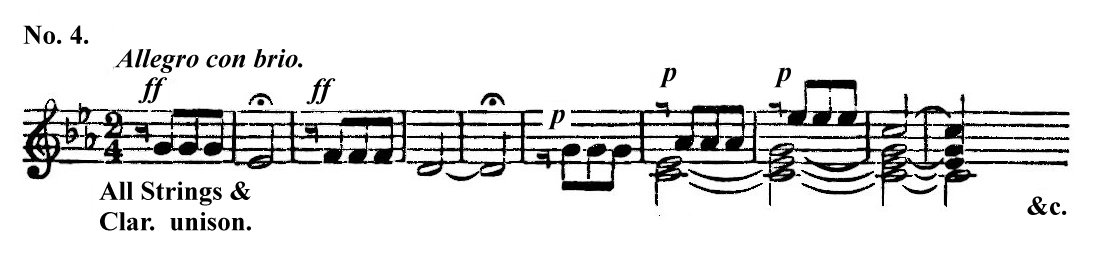
The phrase, as it now stands, with its sudden start, and the roar of
its long holding notes, strikes like thunder [11].
It would be sublime if
there were not too much conflict in it, and if it contained the
religious element [12].
Beethoven said of it, 'So pocht das Schicksal an
die Pforte' - 'such is the blow of Fate on the door' - but indeed no
expression is too strong for the effect of this sudden attack [13]. Wagner,
in a well-known passage in his work on Conducting (Ueber das Dirigiren,
p. 25), thus speaks of it, if a paraphrase of his words may be allowed:
-
'The pause on the E flat,' says he, 'is usually discontinued after a short time, and as a rule is not held longer than a forte produced by a casual bow-stroke might be expected to last. But suppose we could hear Beethoven calling from his grave to the conductor, would he not say something like the following: - My pauses must be long and serious ones. Do you think I made them in sport, or because I did not know what to say next? Certainly not! That full, exhausting tone, which in my Adagios expresses unappeasable emotion, in a fiery and rapid Allegro becomes a rapturous and terrible spasm. The life-blood of the note must be squeezed out of it to the last drop, with force enough to arrest the waves of the sea, and lay bare the ground of ocean; to stop the clouds in their courses, dispel the mists, and reveal the pure blue sky, and the burning face of the sun himself. This is the meaning of the sudden long-sustained notes in my Allegros. Ponder them here on the first announcement of the theme; hold the long E flats firmly after the three short tempestuous quavers; and learn what the same thing means when it occurs later in the work.'
The first phrase is said to have been suggested to Beethoven by the note of the yellow-hammer as he walked in the Prater or park at Vienna; and it agrees with the song of the bird, if not in the interval, in the quick notes being succeeded by the longer one. If Czerny is to be believed, Beethoven not only avowed that he had derived the theme as described, but was accustomed often to extemporize upon it [14]. That subjects were suggested to Beethoven by the most casual accidents is undoubtedly true. That of the Scherzo of the Ninth Symphony is said to have flashed into his mind on stepping out of the house into a bright starlight night. The splendid Sonata, Op. 81a, took its rise from the mere departure and return home of the Archduke Rudolph. The four crotchets which animate the first movement of the great Violin Concerto are said to have been suggested by a man persistently knocking in that rhythm at a door in the dead of the night. So an immortal poem was suggested to Wordsworth by the sight of a mass of daffodils moving in the breeze. If the subject had its origin in the notes of the yellow-hammer, it adds another to the curious difficulties there are in ascertaining the degree of Beethoven's deafness; for the shrill song of a small bird is one of the first things that escapes one in the process of losing one's hearing.
The C minor Symphony, though now known and fixed as No. 5, was not always so. In the programme of the first concert at which it was performed - December 22, 1808, in the Vienna Theatre - it was not only preceded by the Pastoral Symphony, but was given as No. 6; while the Pastoral - now No. 6 - was designated as No. 5. And the same thing was done in Vienna as late as 1813 [15]. The two were composed or completed together, during the summer of 1808 - as the two later and almost greater twins, Nos. 7 and 8, were in that of 1813, and as the third pair would have been in 1817 had they ever come to the birth - had Beethoven's offer to Ries for the Philharmonic Society been carried out. But there is no doubt that the C minor has the priority of the two. True, the autograph manuscript, once the property, like so many of Beethoven's finest autographs, of Felix Mendelssohn, and now safely laid up in the old banking-house in Berlin, bears neither date nor number, and has simply the words -
'Sinfonie da L. v. Beethoven'
scrawled on it in red chalk. But that of the Pastoral Symphony is numbered 6th both in Italian and German, in Beethoven's own hand. And the score and parts of each, the latter published in April, 1809, are numbered as we are accustomed to know them.
The two were brought out together, and each is jointly dedicated to Prince Lobkowitz and Count Rasumoffsky, noblemen who held a high place among Beethoven's patrons. The Prince's name appears on the title-page of the Eroica Symphony, of the first six String Quartets, and of the Quartet in E flat (Op. 74); while the Count enjoys a safe eternity in the three immortal works which will be known as the 'Rasumoffsky Quartets' as long as there are four artists in the world capable of playing them.
Every tiny fact is of interest about these immortal works, and we will therefore mention that in the 'Allo. con Brio,' which heads the first movement on the autograph, a word, possibly molto, has been scratched out after Allo., and con Brio put in with a different pen and different ink. Brio is a good word, but it seems almost to have vanished after Beethoven's time.
So,
then, begins this tremendous composition. The first
fifty-eight
bars of the work do little more than repeat and repeat the astonishing
phrase, both in its interval and its rhythm, as in these passages -

Of modulation there is hardly any, the key does not
change till the end of the passage, and then (bar 59) both mood and key
suddenly alter, the key after a little hesitation to E flat, the mood
to a winning pathos, and after a loud preface by the horns, as if to
emphasise the change as much as possible, the second subject enters in
the voice of the violins, like the sweet protest of a woman against the
fury of her oppressor -

The recurrence of the quavers in the accompaniment keeps the rhythm of
the first subject present, but the music practically remains in E flat
to the very end of the first section, 124 bars, and the fortissimo
passages which occur have nothing of the savage character of their
predecessors.
With
the first note of the working-out, however, the first
theme
returns and resumes all, and more than all, the fury that before
distinguished it and seems inherent in its composition. The gentle
second theme has no place in this terrible display of emotion, which
starts thus -

and the hearer will notice the firmness expressed by the D flat in the
eighth and following bars. The concluding portion of the quotation is a
new phrase, the only material as yet exhibited which is independent of
either the first or second subjects. This phrase is in double
counterpoint - that is to say, it is immediately repeated with the
positions of treble and bass reversed -

the rising scale of the new phrase combining with the descending scale
of the new one to form a very affecting cadence.
Short
as it is - and it is astonishingly short - the
working-out is
most dramatic; a tremendous tragedy is crowded into its few pages.
'Fate is knocking at the door,' as Beethoven is reported to have said
of
the first theme, and does not enter the house without a fearful combat.
Was it the Fate which at that early time he saw advancing to prevent
his union with his Theresa? - to prevent his union with any woman? At
any rate, in this movement he unbosoms himself as he has never done
before. Here, in
Berlioz's language, he
has revealed all the secrets of his being - 'his most private griefs,
his fiercest wrath, his most lonely and desolate meditations, his
midnight visions, his bursts of enthusiasm' [16]
- all these are
there, and all winged by the ardour and anxiety of his newly acquired
love. We hear the palpitating accents and almost the incoherence of
the famous love-letters (see earlier),
but mixed with an amount of fury which is not
present in them, and which may well have been inspired by the advent of
some material difficulties, or by the approaching fear that the
engagement so passionately begun could not be realised. A passage full
of terrors, in the very midst of the working-out, which will be
recognised by the following skeleton of its contents -
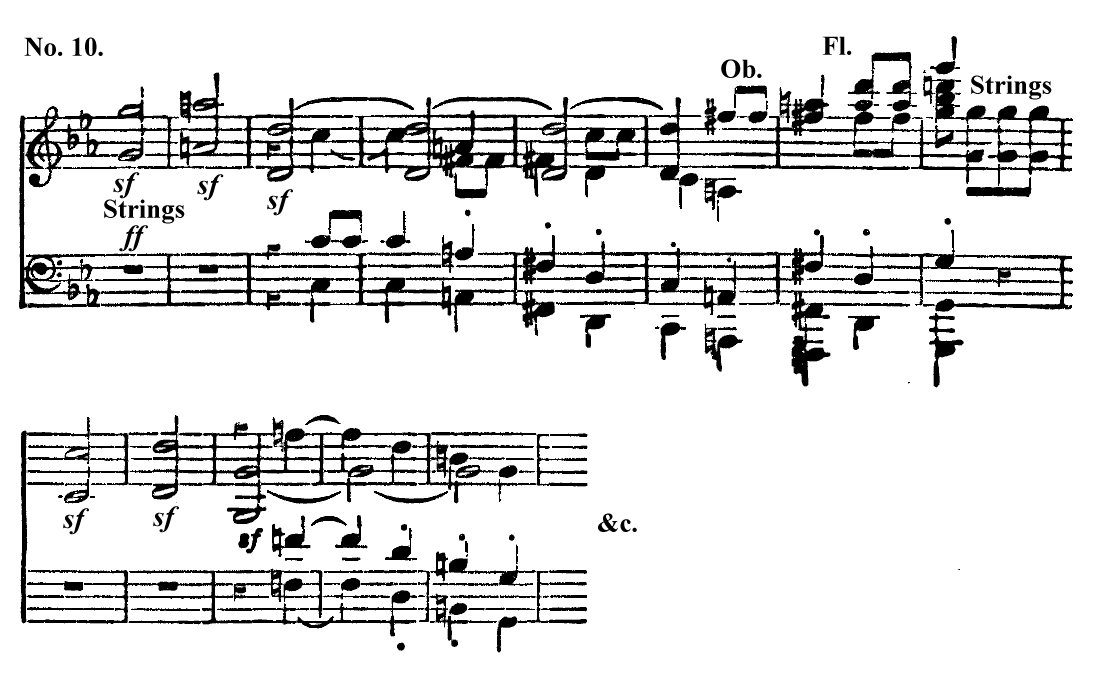
forms the
climax of this struggle. On it follows a passage founded on the fourth
and fifth bars of quotation No. 5 -

alternately given by strings and wind, and at length failing as if
through exhaustion. Then, with the rapid action of the mind, it revives
in fury, to sink again, and to revive once more. After this singularly
dramatic passage, Beethoven returns to the first subject, and the
working-out ends by eight bars in the rhythm of the opening, the
recapitulation of the first section of all being then taken up without
a moment's hesitation. Not, however, a mere repetition; for though the
general lines are exactly followed, the instrumental treatment is
occasionally altered. One change, though all will notice it, must be
specially alluded to, as an instance of the extraordinary poetry and
refinement which were always in wait to show themselves even in
Beethoven's sternest moods. I allude to the pathetic unbarred phrase
for the oboe solo -

a beautiful blossom, springing out as it were
from the bud of the pause which occurred at bar twenty-one of the first
section, and like a flower of gentian spreading its petals on
the edge of the glacier. At the end of the recapitulation
there is a burst into C major, which forms a fine beginning to a
triumphant and dramatic Coda
[17].
The only passage which need be quoted in the Coda is the new
theme
which is introduced -

and which, both in itself and in its development, forms a very striking
feature.
The following passage from Beethoven's unsterbliche Geliebte, page 25, the work already alluded to in connection with the preceding Symphony, seems, as already hinted, to throw a direct light on the movement. The story is told by the chief sufferer herself.
'One fearful winter's day in Vienna, in 1794, the snow standing deep and still falling fast, and traffic almost entirely suspended in the streets, Countess Theresa Brunswick, then a girl of fifteen, was waiting for Beethoven's arrival, to give her her pianoforte lesson. Weather never stopped him; but when he appeared it was obvious that as great a storm was raging in his mind as in the streets. He entered with hardly a motion of his head, and she saw at once that all was wrong.
'Practised the Sonata?' said he, without looking. His hair stood more upright than ever; his splendid eyes were half closed, and his mouth - oh, how wicked it looked! In reply to his question, she stammered out 'Yes, I have practised it a great deal, but -'
'Let's see.' She sat down to the piano and he took his stand behind her. The thought passed through her mind, 'If I am only fortunate enough to play well!' But the notes swam before her eyes, and her hands were all of a tremble. She began in a hurry: once or twice he said 'Tempo,' but it made no difference, and she could not help feeling that he was getting more impatient as she became more helpless. At last she struck a wrong note. She knew it at once, and could have cried. But then the teacher himself struck a wrong note, which hurt his pupil both in body and mind. He struck - not the keys, but her hand, and that angrily and hard; strode like mad to the door of the room, and from thence to the street-door, through which he went, banging it after him.
'Good God,' she cried, 'he's gone without his coat and hat,' and rushed after him with them into the street. Her voice brought in the mother from her boudoir, curious to see the reason of the noise. But the room was empty, and both its door and the street-door stood open; and the servants, where were they? Everything now had to give way to the shocking certainty that her daughter, Countess Theresa von Brunswick, had actually run out into the street after the musician, with his coat, hat, and stick! Fortunately she was not more than a few steps from the door when the frightened servant overtook her, Beethoven meanwhile standing at a distance waiting for his things, which he took from the man and went off without a sign of recognition to his pupil.'
Are
not these two characters exactly expressed in the above,
the one
by

It surely would be impossible to convey them in music more perfectly -
the fierce imperious composer, who knew how to 'put his foot
down,' if the phrase may be allowed, and the womanly,
yielding, devoted girl.
This was in 1794. The Countess became more and more intimate with Beethoven, and at last, in May, 1806, with the knowledge and consent of her brother Franz, the head of the house, she and he were formally, though secretly, engaged. Honourable matrimony - and that with a woman of position and character - was always Beethoven's fixed desire. For any irregular attachment he had neither taste nor inclination. 'O God,' says he, in one of those passionate entries in his diary, 'let me at last find her who is destined to be mine, and who shall strengthen me in virtue.' The engagement appears to have taken place at Martonvásár, the Count's castle, south of Buda-Pesth. Beethoven shortly after left for Füred, a watering-place on the north shore of the Plattensee, in Hungary, from whence he penned the famous love-letters which were afterwards returned to him by the Countess on the termination of the engagement. It lasted with many fluctuations for four years and was put an end to by Beethoven himself in 1810. There could be no other result.
The Countess was surely right in saying (see p. 64 of the little book), 'It was a wise step for us to part. What would have been the result to his genius, and what to my love, if I had ever been forced to be afraid of him?' These letters are reprinted at the end of Chapter IV. They were the subject of many conjectures, until the matter was set at rest - first, by the acuteness of Mr. Thayer, and then by the independent publication of the book alluded to by 'Mariam Tenger,' which has received the imprimatur of the historian, and is now in its second edition.
II. Andante con moto, in A flat. Beethoven has here forsaken the accepted rule for the key of the second movement, and adopted the key of the submediant, or third below the principal key [18]. After the assaults and struggles and conquests of the first movement, the Andante comes as a surprise. It is a set of variations, beautiful to hear, and with much of the same grace and elaborate finish as the Adagio of No. 4. It also contains excellent examples of the caprice to which allusion has more than once been made. But the Adagio of No. 4, since we know it to be Beethoven's Song of betrothal, has a glorious inner meaning transcending all outward beauties, and this the Andante of No. 5 at present wants. It seems wanting in the spur - the personal purpose or idea which inspires the preceding movement and gives the present work its high position in Beethoven's music. Beethoven, doubtless, had such an idea, he always had one; but he has not revealed it to us. And here it is impossible to resist a strong feeling of regret that in this and others of his Symphonies Beethoven did not give us the clue to his intention, as he has done in the 'Eroica,' and still more fully in the 'Pastoral.' How warmly should we welcome any authentic memorandum or commentary, however short, on these great works of the imagination! Beethoven has not seen fit to vouchsafe them; but it is surely a pity that he has not. How much less should we have been able to enter into the manifold meanings of the Pastoral Symphony, if all that was known about it was that it was 'Symphony No. 6, in F major, Op. 68.' Similarly in the cases of Symphony No. 8, and the first movement of No. 9, how welcome would be any authentic memoranda of the personal circumstances which evidently lie behind their extraordinary autobiographical features. We may admire the spirit, the rich colouring, the romantic and humorous feeling of No. 7 to the very full; but the mind will always crave to know something beyond the mere romance, variety, and brilliancy of the sounds - something which has been withheld from us, something which we have to guess, and in guessing which all attempts must be uncertain - the ideas, the circumstances which were thronging through the mind of the Master when he composed that gorgeous picture, for a picture it must be. This fact is proved, if only by the ridiculous variety of interpretations that have been proposed by the critics. They are quite within their duty, if not always within their taste, in proposing them, because we know on Beethoven's own authority that he 'always worked to a picture.' [19] True, Mendelssohn, in a very interesting letter to his cousin Souchay says that music has a more definite meaning than words [20]. To the composer probably, but certainly not to the hearer, especially if he happen to be an amateur.
But we must return to the Andante. It consists first of a theme containing several sections and extending to forty-eight bars. The first section is played by the violas and cellos in unison, with a pizzicato note here and there in the basses -

If
the form in which
the opening subject of the first movement first appeared in the
sketch-book (No. 1)
was
commonplace, that in which the above beautiful
melody stands there is still more so - [21]

nothing could well be
more tame and unpromising.
A
second melody in the wind instruments, echoed by the
violins, follows
immediately on the foregoing; the unequal length of the two portions
will be noticed -

and then a third - [22]
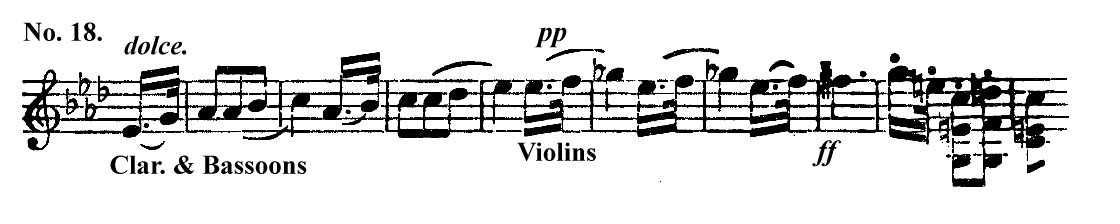
This continues for some length,
passing through the key of C major, and ending with a Coda of great
beauty -
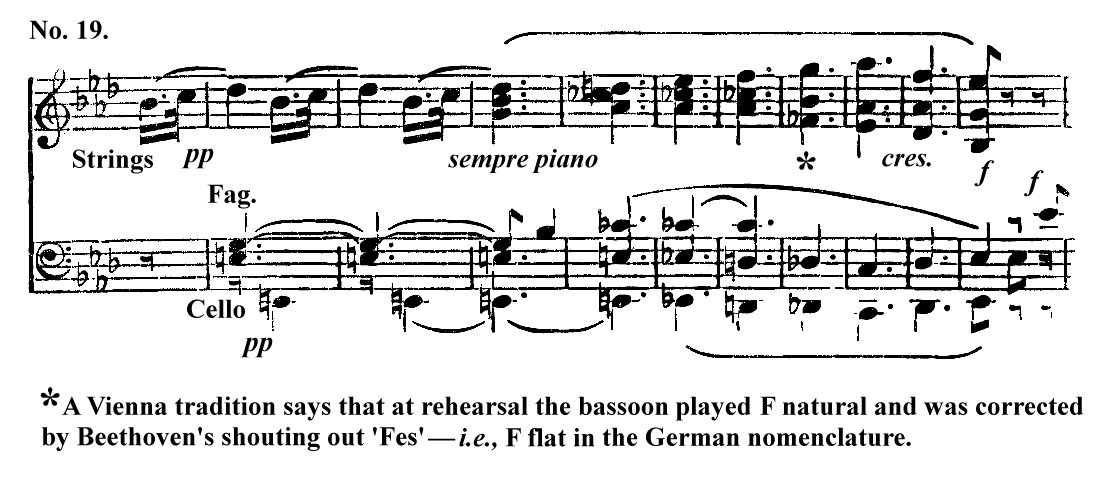
This
first section, as already stated, occupies
forty-eight bars. It is immediately succeeded by a variation of the
whole preceding matter, the variation consisting in giving a semiquaver
form to the melody, and other simple though masterly devices. It begins
thus in the violas and cellos -

and among the devices is the following startling amplification of the
quaver which finishes Example 16, on the recurrence of the passage -

The amount of colour obtained here and elsewhere throughout this movement from the scanty force of wind instruments at Beethoven's command is very striking and very beautiful. His economy is remarkable; a touch here, a short passage there, often produces the most disproportionate and charming effects.
This first variation is followed by a second in demisemi quavers -
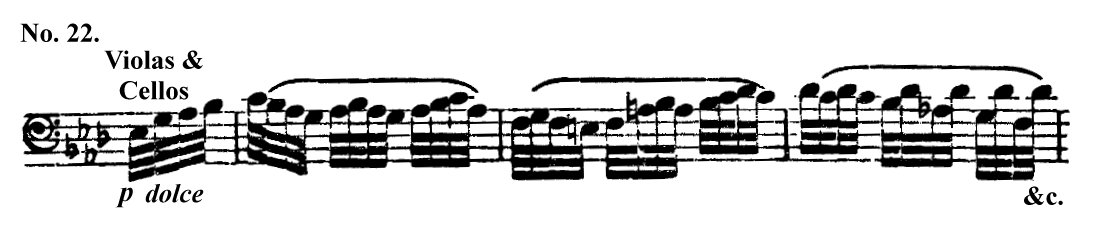
Berlioz [23] tells us that the beautiful high E flat held on by the flute, oboe, and bassoon throughout these bars was corrected to F by Fétis in his score [24] with the impertinent remark, 'this E flat should obviously be F; it is impossible for Beethoven to have made such a blunder.' Fétis must surely have recognised the beauty of the resolution of the E flat into E natural, which follows in the fifth bar; but to him probably a rule was a rule, not to be broken under any pretext.
After this we arrive at a pause, and a succession of chords in the strings, which serve as a basis for a touching little duet between the clarinet and bassoon, with all the air of a farewell, the pace being somewhat accentuated -
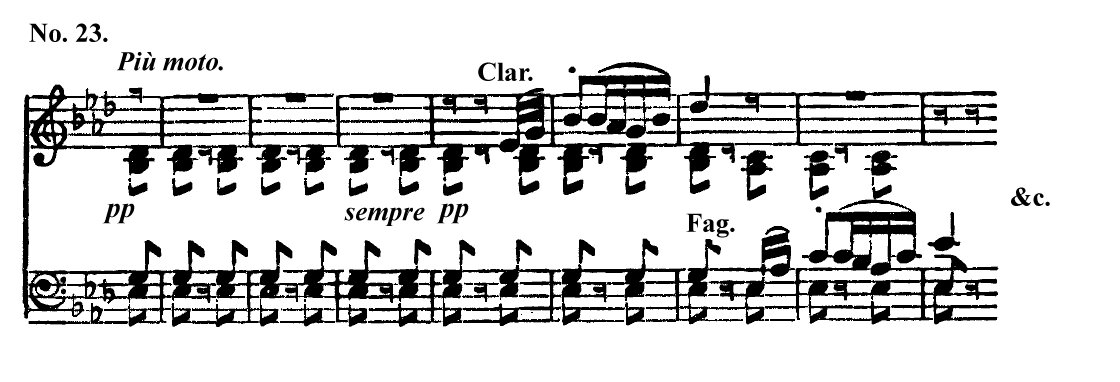
This
is prolonged by the wind instruments in a humorous
passage of
twelve bars [25],
beginning
thus -

humorous because it has all the air of mere wilfulness on the part of
the composer, a determination to do just what he likes, however
inconsequent or unnecessary it may seem to his hearers, or however
repulsive the passing discords may prove to their conservative
ears.
This leads into a repetition of No. 18 in the key of C major, very loud and martial in tone; and this again into a second and still droller passage than the last quotation, where the flow of the melody is stopped for eight bars to introduce a passage of mere pleasantry - or, as it probably seemed in 1808, of mere caprice, though now essential to our pleasure -

The writer was told by the late Sir John Goss that he remembered this very passage having been specially offensive to the older members of the Philharmonic Society at the early performances of the Symphony.
The
remainder of the movement is extraordinarily noble,
pathetic, and
beautiful; and culminates in an extended repetition of the last bars of
No. 17, in which, by an alteration, slight, but of infinite moment, a
most touching effect is produced -

The violin seems almost to go up into heaven; the sforzandos of bars
2
and 3, and the rests in bars 4 and 5 are full of unspeakable emotion;
and the pathos is increased by the last six bars being accompanied in
the clarinets and bassoons by the little Coda figure given
in No. 23.
Immediately after this melting farewell, however, as if ashamed of thus
indulging his emotion, Beethoven urges the basses into crescendo
arpeggios, and the movement ends with a crash.
III. The next movement is the Scherzo, though not so denominated. It is simply marked Allegro. And for it we return to the key of C minor, and to the poetical, ideal character of the first movement; even perhaps to still greater ideality, though the mood be less incisive. It is constructed in the usual form of Scherzos, with a Trio and the ordinary repeats and interchanges; and yet while adhering to these general lines, Beethoven has departed so much from the usual proportions as to show how far such prescribed forms can be modified without interfering with the unity, the symmetry, or the impressiveness of the whole. The most serious innovations are first the connection of the Scherzo with the Finale by a link of great length, so contrived that the one movement passes into the other without any pause, and secondly the introduction of a long portion of the Scherzo - or rather a fresh treatment of its themes - into the working-out of the Finale. But of this more anon.
A
Scherzo,
as its name implies, is
generally a busy, almost bustling piece - witness that of the 'Eroica';
but the expression of the theme in the present case has something
mysterious, almost uncanny about it - in Berlioz's words, 'it is as
fascinating as the gaze of a mesmeriser.' It opens thus, in the cellos
and basses only -

as light and legato
as the bows can make it. On
repetition these eight bars are extended to ten, and these are
succeeded by a second strain, forcible and rhythmic, given out by the
horns, with a loud chord from the strings at the beginning of each
bar -

and then a development of the two themes takes place at
great
length, and full of ingenious modulation and combination. The first
portion of the Scherzo
ends on the note C, with no third, major or
minor. The Trio,
however, which follows on this, though not so called,
is unmistakably in the major of the key: -

The music has abandoned
its supernatural character, and is extremely droll, in the
fugal
form it assumes [26],
in the
almost solo part taken by the double basses,
and other features. The theme, which we already remarked as being in C,
is answered in G. The other two answers are in C
and G.
The
second section of the Trio
is droller still, first in the F
natural, which forms the second note, and next in the false starts,
both dropped in the fugal answer -

The rumble of the double basses, in these false starts and in the
answers of the fugato,
makes, to quote Berlioz again, a confusion 'like the gambols of an
elephant.' The gamesome beast, however, retires
by degrees, the whole dies away in a beautiful soft passage for the
wind, and a few notes pizzicato
in cellos and basses land us back in C
minor and the original mysterious subject of the Scherzo (No. 27).
But with a change of treatment. Formerly all was legato, now the phrases are made more piquant by being given staccato (a crotchet and a rest instead of a minim), thus -

The
return of the Scherzo
is no mere recapitulation. Besides
the prevailing staccato
just mentioned, which takes the place of the
former legato,
the treatment is widely different. Thus the passage
quoted as No. 28, instead of being, as before, loud and aggressive, is
very soft and delicate; the figure is transferred from the horns to
the clarinet, oboe, and first violins; the accompaniment is quite new
and of a charmingly crisp and delicate character; the strings being
used arco
and staccato
at the same time, the lowest nuance
is
maintained, and a mysterious atmosphere seems to descend over all
-
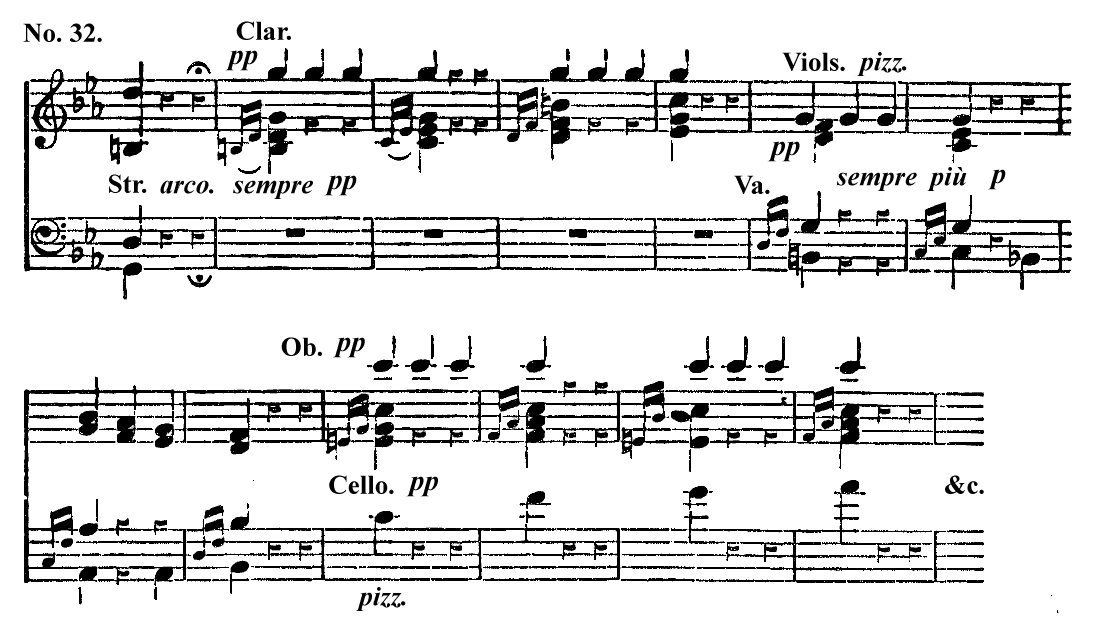
From the rhythmical figure a new melody gradually
emerges -

This goes on for seventy bars, at which point the
basses come on to A flat, ppp,
and the drum begins a pedal on C, with
constant vacillations of rhythm; and with this sudden change - almost
as great as the beginning of the storm in the Pastoral Symphony, though
marked with no double-bar, as that is - we begin the truly
magical passage which links the Scherzo
to the Finale
-
[27]

At the end of
the quotation a slight increase in force
takes place - from ppp
to pp -
and in the bar following the quotation
the basses change their holding note to crotchets and shortly
afterwards leave their A flat; the violin begins a figure taken from
the original theme (No.
27) -
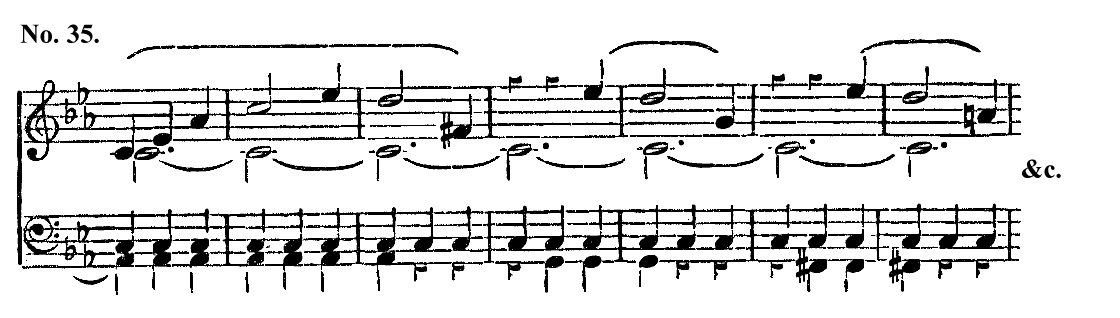
but the drum maintains its
recurring figure and the whole passage its magical quality,
till the mystery ends by the magnificent burst into the Finale -

At this point the whole orchestra, including the three trombones, hitherto silent, the double bassoon, the piccolo, and the drum, all the noisy elements at Beethoven's command in those simpler days, bursts like a thunder-clap into the major key and into a triumphal march, Allegro, minim = 84: -
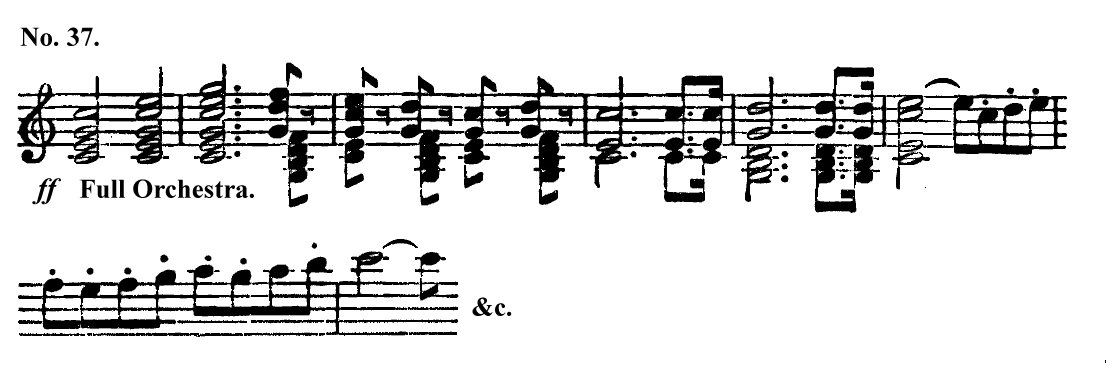
This
subject is twenty-four bars in length, and leads into a
definite
passage for the wind instruments (which, curiously, has the same
intervals and rhythm as the subject of the Andante in Mozart's
'Jupiter ') -
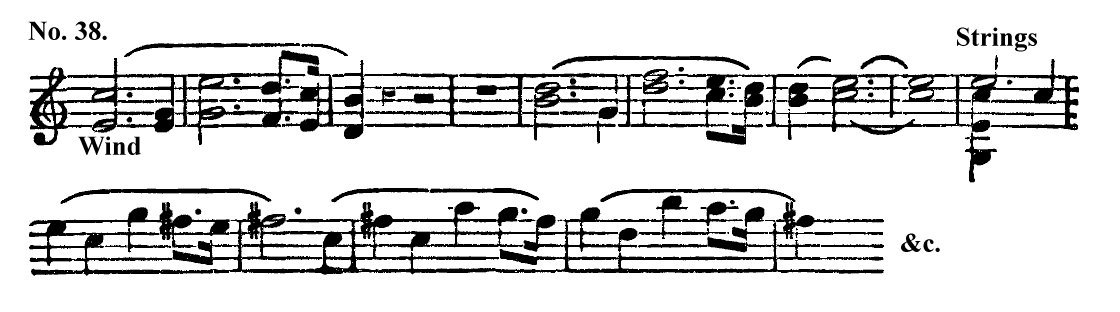
It will be observed that in the latter portion of this subject the
phrases are hurried in time according to a favourite habit of
Beethoven's. This gives rise to another passage of great importance -

not only in itself, but because, in the development of it, an
emphatic phrase occurs in the bass, which is greatly employed in the
working-out of the movement -
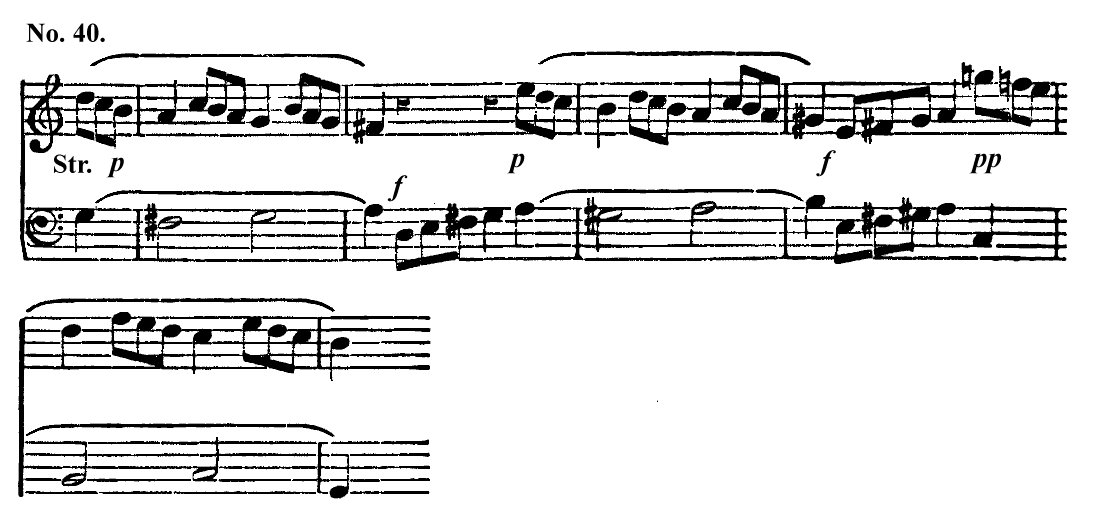
and this at last leads into the
second main subject of the Finale
in the key of G -

After
this we
arrive at the end of the first section. That section (eighty-five bars)
is, strange to say, marked to be repeated, though the instruction is
rarely obeyed [28]. Then
comes the working-out of the matter already quoted. This begins in the
key of A minor, and great use is at once made of the energetic phrase
in the bass of No. 40. It occurs no less than fifteen times, in all
instruments, from the contra-fagotto to the flute, and in various
combinations, and as the vehicle of the most interesting modulations.
In fact it may be said to be the prominent feature of the first portion
of the working-out. This portion, hurrying, loud, and noisy
throughout, ends by a tremendous burst fortissimo on a
pedal G, with
all possible clamour and richness. At this point there is a sudden
lull. The pace then slackens to that of the Scherzo, (dotted
minim =
96), the
time alters to 3-4, the contra-fagotto and piccolo are silenced, the
tone is reduced in the course of a few bars to pianissimo, and the
Scherzo is
re-introduced in the strings, clarinets, oboe, and horn.
This introduction is not, however, the actual recapitulation of any
former portion of the work, but is rather a continuation of the highly
mysterious and touching music quoted in Nos. 32,
33, 34,
35, and
is
remarkable for a lovely new feature in an affecting melody put into the
mouth of the oboe, beginning at bar 20 of the 3-4 time -
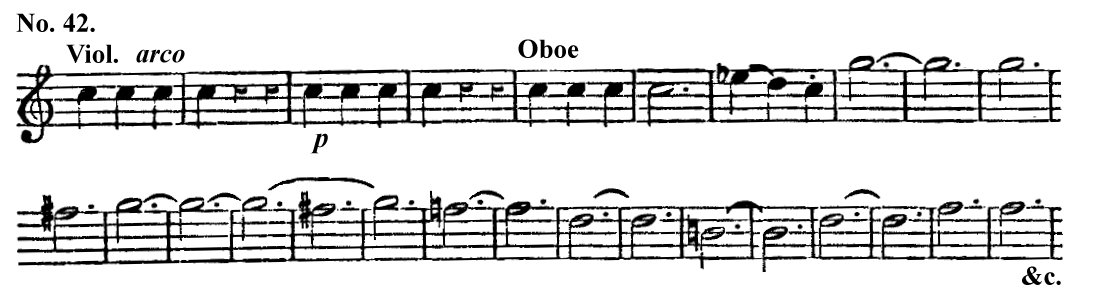
Nothing could possibly be more effective than this beautiful episode in
its astonishing contrast to the brilliant and triumphant strains which
precede and follow it. Effective, and also original; no one who ever
hears it can forget the wonderful impression it makes. Spohr, who
disliked the Symphony and describes the Finale as a mere
'empty
babel,' says that for so happy an idea the composer deserves his
blessing. And Spohr was right. Beethoven has had the blessing not only
of Spohr, the learned musician, but of tens of thousands who are not
musicians, who can feel without knowing why they feel. After this
affecting interruption, the opening of the Finale (No.
37) returns in
full force, and the recapitulation follows with few if any differences.
When this is completed a long and splendid Coda begins, no
less than
150 bars in length, in which much of the previous material is employed.
Its first principal feature is a new treatment of the latter
part of No. 38.
After this is
exhausted, the pace gradually increases
to Presto
on the subject No. 41, and the movement ends with all
possible jubilation in an apparently interminable succession of the
common chord of C, the drum asserting its presence to the very last.
Let us, before we go to the next Symphony, take a farewell look at the complex final movement, or congeries of movements, we have been imperfectly endeavouring to describe - Scherzo, Trio, and Finale all forming one long and continuous piece. First we have the magnetic Scherzo, at once so mysterious and so strong, taking us at a touch out of the almost brutal conflicts of the first movement, and the beautiful but human world of the Andante. Then comes the gamesome humour of the Trio, not unlike the grim banter of the Angels during the battle in 'Paradise Lost.' Next, and most remarkable of all, is the reprise of the Scherzo, where, had he been a mere musician, even of the greatest, Beethoven was bound to repeat the opening of his movement; but where, the poet being too strong for the artist, he has been forced by his genius to throw his former materials into an entirely new form. 'I cast them into the fire,' said Aaron of the ornaments of the Israelite women, 'and they came out this calf.' But what was Aaron's miracle to Beethoven's - when, out of an unpretending little phrase of three notes, he made such an astonishing passage? Great as the music was before, magnetic, poetical, it was only that; it was self-contained and did not imply that anything further was to come out of it; but now we feel that the music is pregnant with a new birth, and has the promise of eternity within its bosom. To hear it is like being present at the work of Creation. Strange, disorderly, almost appalling, as is the rushing surface of the mass, we cannot but feel that a divine power is working under the current; the creative force of law and order is at work there; and at last, out of the suspense and mystery and repetition which have for so long enveloped us, suddenly bursts the new world, radiant with the eternal sunshine, and welcomed by the jubilant sound of those aeonian strains, when all the sons of God shouted for joy. No wonder that the work to which this forms the conclusion should have penetrated more widely and deeply than any other into the minds of men.
Thus started, the Finale goes on its way in all the pomp and circumstance of earthly life. It may be victory or success of some other kind that is depicted, but success it undoubtedly is, and a glorious career; until, as if to enforce the lesson that the ideal is higher than the visible, a part of the Scherzo is re-introduced, and we are made again to listen to a portion of the mysterious strain that was so affecting before. The initial triumphal-march then returns, and the movement finishes in glory. The immense spirit of the Finale is excuse enough for any effect that it may have produced. But there is one anecdote which is particularly interesting. It is said that at one of the performances in Paris, an old soldier who was in the room started up at the commencement of the movement and cried out 'L'Empereur, l'Empereur!' No wonder too if in that strange land, where faith in the Emperor was then nearly the only faith left, it was at one time asserted that this movement was originally intended to complete the 'Eroica,' the Symphony which was actually a portrait of Napoleon. This notion is, however, utterly false. To those who have ears to hear and hearts to feel, the Eroica wants no other Finale than that which it possesses, and always possessed, and the hero of the C minor Symphony was a more ideal person even than Bonaparte - it was Beethoven himself.
At the conclusion of a work so essentially unlike any of its predecessors or successors, it is again impossible not to call attention to the extraordinary individuality which they all manifest, each utterly different from the other in every point - which is really one of the most astonishing things in Beethoven's music. His Symphonies form a series of peaks, each with its characteristic features - its clefts, its glaciers, its descending torrents and majestic waterfalls, its sunny uplands and its shining lakes; and each of these great peaks has its own individual character as much as the great mountains of Switzerland have theirs, and is a world in itself - a world not made with hands, and eternal.
The
wonderful conclusion of the Symphony, impulsive and
spontaneous as
it now sounds, was no fruit of sudden impulse or momentary inspiration.
The original conception was of quite a different order, as we see from
the sketch-books [29],
where it
appears thus -
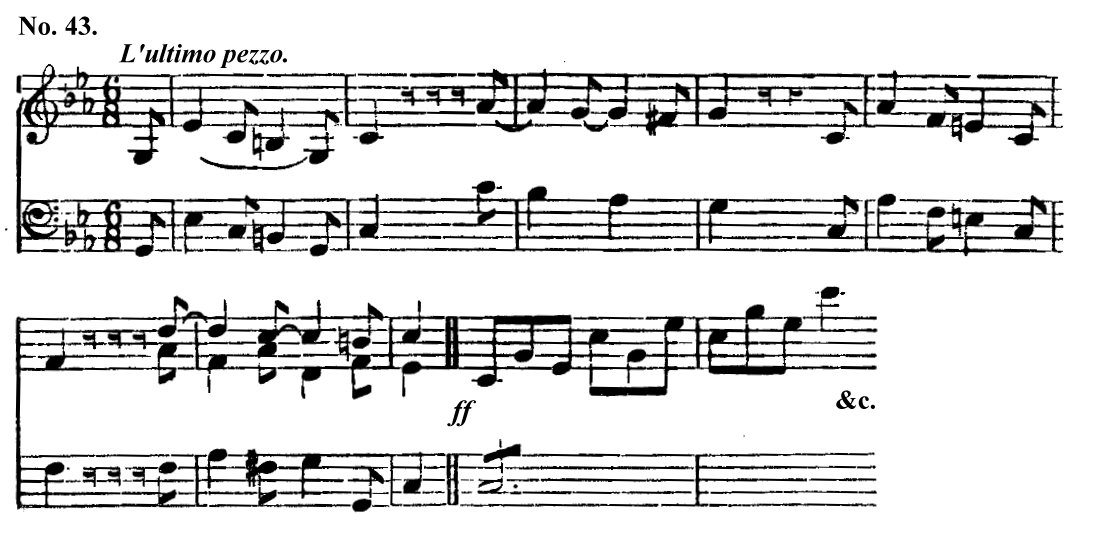
with a certain relationship to the subjects of the
Finales of
the 'Waldstein' and E flat Sonatas.
The subject of the two famous redundant bars, which once formed a part of the Scherzo as performed, is now rarely alluded to; but at one time a strong controversy raged over it, and, before we leave this part of the work, mention must be made of the matter. It is an odd bit of history, and not uninstructive in many ways.
The separate instrumental parts of the Symphony were published by Messrs. Breitkopf and Härtel in 1809. In the autumn of the next year, Beethoven addressed a letter to them dated August 21, 1810, pointing out that the first bars of the repetition of the Scherzo after the Trio were inaccurately printed. His letter is as follows: -
'I
have found the following error still remaining in the
Symphony in C
minor; namely, in the third movement in 3-4 time, where the minor comes
back after the major [30].
I quote the Bass part thus -

The two bars which are crossed out are too many, and must be erased, of
course in all the parts.'
Of this letter no notice appears to have been taken at the time; and, strange to say, when the score was published by the same eminent firm, with that of the Pastoral Symphony, in 1826, the passage appeared as it had always stood in the parts - with the two redundant bars. In 1846 Mendelssohn had to conduct the Lower Rhine Festival at Aix-la-Chapelle. The C minor Symphony formed part of the programme, and the tradition is, though I am bound to say that I cannot obtain any absolute confirmation of it, that he felt unhappy about the passage and made enquiry of the publishers. At any rate, thirty-six years after it was written, Beethoven's letter was produced, and published in fac-simile in the Allg. mus. Zeitung for 1846, p. 461. Mendelssohn omitted the two bars at the performance, but the fact seems almost entirely to have escaped notice. Even the long article on the Festival in the periodical just named (1846, p. 405), by Onslow the composer, does not mention it, and the only notice which I have been able to discover is that of Dr. Ferdinand Rahles in the Musical World, May 26, 1860 [31]. Rahles was present at the Festival, and his statement settles the fact that the two bars were omitted. Still, strange to say, in the teeth of Beethoven's plain words about his own work, thus at length acted upon, the obnoxious bars were clung to and defended in the most vigorous manner. Berlioz, then writing for the Débats, was one of their stoutest champions. He was adhered to by the French in general - tant pis pour les faits. So strong was the feeling in Paris that Habeneck, conductor of the famous Concerts du Conservatoire, told Schindler that he dared not go against the feeling of his orchestra by sacrificing the two bars. There would be a revolt. Touching loyalty on the part of the band! However, 'Time, the healer,' has done his useful work, and the passage is probably now played everywhere as Beethoven intended it to be played, and as he fruitlessly corrected the printed edition so soon after its publication.
The explanation given by the late Otto Jahn, than whom no one is more likely to have known, in his preface to Breitkopf's general edition of Beethoven [32], is that in the copy prepared by Beethoven for the engraver the two redundant bars are marked 1, and the two following ones 2, and that above them is written si replica con trio allora 2 - repeat the Trio and then go to 2. Beethoven therefore wished the whole Scherzo and Trio repeated, and then the Coda - with which the repetition was to end - and this the engraver did not understand.
At the Gewandhaus concerts, at Leipzig, when Mendelssohn was conductor (1835 to 1843), and at an earlier period, it appears, from an inspection of the music, to have been the practice to omit the two staccato bars and play the two legato ones. The same course was adopted by our Philharmonic Society, the result in both cases being that which Beethoven did not want. In the autograph in the Mendelssohn house at Berlin the place has been so corrected by Beethoven, both with ink and pencil, and so many enigmatical marks made that it was impossible for the writer to understand exactly what was meant, especially as the passage occurs at the very end of a right-hand page and the corrections have to be carried over to the next one. It is very curious that in the original criticism by Hoffmann, in the Allgemeine musikalische Zeitung, of July, 1810 (several weeks before the date of Beethoven's letter), the passage is given in its correct form [33]; and this strengthens the suspicion already expressed, that in preparing his article Hoffmann had been in communication with Beethoven, and had obtained his materials, possibly the loan of a MS. score, direct from him.
The only previous instance known of a Finale being interrupted by the introduction of one of the former movements is an early Symphony of Haydn's in B major (No. 14 in the list of Symphonies given in Vol. II. of Pohl's 'Joseph Haydn' 1882). The score was edited by F. Wüllner, and first published by Rieter-Biedermann in 1869. Here the Finale, presto, in B major, in common time, is interrupted within a short distance of the end to admit thirty-four bars in the same tempo as the menuetto (Allegretto); the key is the same as that of the Finale itself, and, as in Beethoven's case, though the phrases are the same as those of the Minuet, they are not an exact transcript thereof, and have a Coda of four bars of their own, after which tempo the former piece returns.
An
interesting fact is disclosed by the sketch-book of the Scherzo,
which otherwise would probably not have been noticed. The first eight
notes of the theme quoted above as No. 27
are the same in intervals as
those of the beginning of the Finale
to Mozart's famous G minor
Symphony, though in tempo
and rhythm quite different -

But the droll thing is that Beethoven must have known what he had done,
for he has copied twenty-nine bars of the melody of Mozart's Finale on
the adjoining page of the sketch-book. This curious coincidence was
first noticed by Mr. Nottebohm, Zweite
Beethoveniana, p. 531.
No Symphony, perhaps no piece of orchestral music, has been the source of so many anecdotes; and though some of these may be mythical, yet they all point to its remarkable arresting and affecting power. It must have been at one of the early performances at the Concerts du Conservatoire, already mentioned, that Lesueur made his experiment in hearing the new revolutionary music, which has been admirably related by Berlioz in his 'Mémoires' (1870, page 75). Lesueur - a considerable and perfectly honest musician of the old school - was then one of Berlioz's masters at the Conservatoire, and notwithstanding the somewhat noisy demonstrations of his pupil in favour of Beethoven, he kept silence on the subject, and so far studiously avoided attending the concerts at which the new music had made so much sensation. Had he gone to them he would have been forced to form and express an opinion on the point, and this he was unwilling to do. However, moved by the strong instances of his enthusiastic pupil, he at length consented to attend a performance of the C minor. It was his wish to form a deliberate and conscientious judgment. 'He therefore seated himself alone in one of the ordinary boxes on the ground tier. After the performance I hastened down from my place upstairs to find out the effect which had been produced upon him, and to learn his judgment on the work. I found him in the passage, as red as fire and walking furiously fast. "Well, my dear master," said I - "Ouf!" was his reply - "I must get out into the air; it is astonishing, wonderful! It has excited and overcome me to that extent, that in trying to put on my hat I could hardly find my head! Don't stop me now, but come to me to-morrow." . . . I had therefore been successful! Early next morning I called on him, and we at once rushed into the subject. For a few minutes he allowed me to speak, and gave only an unwilling response to my raptures. But it was easy to see that since the day before a change had come over him, and that the subject was not altogether pleasant. At length I succeeded in making him repeat the confession of his emotion at the performance; but then, with a violent shake of his head and a peculiar smile, he said: "All the same, such music as that ought not to be made." To which I answered: "All right, dear master, there's no fear of much being made like it."'
When Malibran, the great singer, heard the work for the first time, at the Paris Conservatoire, she was thrown into convulsions, and had to be removed from the room. At another performance by the Conservatoire orchestra occurred the affecting story of the veteran soldier that has been already told.
Spohr has left a strange criticism on the Symphony. It occurs in his Selbstbiographie (i., 228) àpropos to a concert at Munich in 1815. After praising the excellence of the performance and the admirable attention given to all the nuances, Spohr continues as follows: 'The effect was even greater than my anticipations, although I had already frequently heard the work in Vienna, under Beethoven's own direction. Notwithstanding the splendour of the execution, however, I found no reason to depart from my original judgment on the work. With all its individual beauties it does not form a classical whole. In particular the theme of the first movement is wanting in the dignity which, to my mind, is indispensable for the opening of a Symphony. Putting this aside, the subject, being so short and intelligible, is well adapted for contrapuntal working, and is combined with the other chief ideas of the movement in a most ingenious and effective manner. The Adagio in A flat is in parts very beautiful; but the same progressions and modulations recur so often, though each time with more florid expression, that one is at length wearied by them. The Scherzo is most original and thoroughly romantic in colour; but the Trio, with its blustering double basses, is too grotesque (barock) for my taste. The last movement pleased me least of all by its unmeaning babel; but the return of the Scherzo in the Finale is so happy an idea that one cannot but envy the composer for it. The effect is ravishing! Pity that all that empty noise should come back and efface the impression!'
Though the London Philharmonic band, at the first trial in 1814, received the opening with much laughter, apparently thinking it was intended to be comic, yet the C minor soon grew into favour here, and a curious scene, indicative of this, occurred at the York Festival of 1823, when, on account of the non-arrival of some extra parts, an attempt was made to omit the Symphony from the programme, and proceed to the next number, a Scotch ballad! One of the Stewards on this rose in the room, and with stentorian voice exclaimed: 'Symphony, Symphony, I insist on the Symphony being played'! [34] and played at length it was, though with a small number of strings, amid universal applause.
Wagner, conducting a Court Concert at Dresden during the insurrection of 1848, felt his spirits sink as each number of the programme seemed to bring a deeper gloom over the audience, and gradually to extinguish all applause. Leaning down from his desk, he whispered to the leader of the violins, 'What is to be done?' 'Oh! go on,' said the leader, 'there is the C minor coming, and all will be right.' And so it was; for with the magic sound of the opening bars, everyone's spirit revived, applause burst from the benches, and it was as if a bright light shone into the room.
A
circumstance in connection with the Symphony, of which
Beethoven
could hardly have dreamed, is told by Schumann in a letter to Hiller,
April 25, 1853. 'Yesterday for the first time we turned a table. A
wonderful power! Only think! I asked it to give the rhythm of the two
first bars of the C minor Symphony. There was a longer pause than
usual, and then the answer began

- very slowly
at first. But, said I, the tempo
is quicker, my dear table; and then he
gave it right.'
Mr. Nottebohm has given us a few bars of the sketch of a Symphony in C minor, which dates from Beethoven's early Bonn period, say 1785 [35]; and which we greet as a curiosity: -
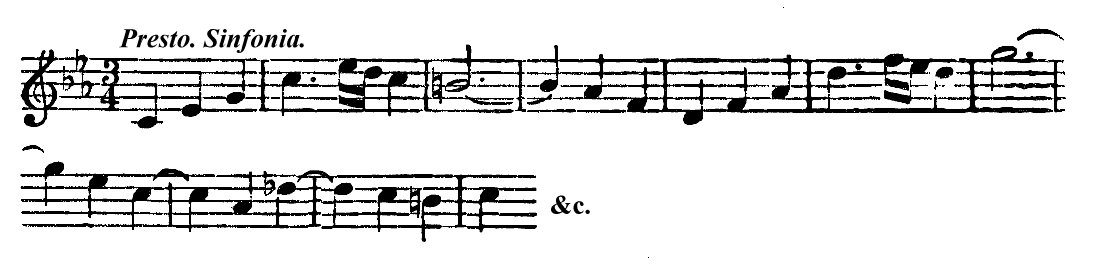
The key of C minor occupies a peculiar position in Beethoven's compositions. The pieces for which he has employed it are, with very few exceptions, remarkable for their beauty and importance. Not to speak more of the Symphony, there are the Overture to 'Coriolan'; the Concerto No. 3, for Piano and Orchestra; the Fantasia for Piano, Orchestra, and Chorus ('Choral Fantasia'); the String Quartet, Op. 18, No. 4; the Piano Sonatas 'Pathetique,' Op. 10, No. 1, and Op. 111 (the last). The fact is more particularly obvious in the three Piano Trios (Op. 1); the three String Trios (Op. 9), the three Sonatas for Piano and Violin (Op. 30), in each of which cases the piece in C minor stands prominently out from the others.

The trumpets and trombones are employed in the Storm and Finale only; the piccolo in the Storm alone. In the Andante there are two violoncellos, solo, muted, the other cellos playing with the basses.
The parts were published by Breitkopf & Härtel in April, 1809. The score, an 8vo of 188 pages, was issued by the same firm in May, 1826, so I am informed by the firm. 'Sixième Sinfonie - Pastorale - en fa majeur: F dur: de LOUIS van BEETHOVEN. Oeuvre 68. Partition. Propriété des Editeurs. Prix 3 Thlr. A Leipsic, chez Breitkopf & Härtel.' [4311.]
If the three preceding Symphonies have been occupied with the workings of the human mind and will, and have, as it were, kept us suspended over the memory of a hero, the rapture of an accepted lover, the conflict of his subsequent joys and sorrows, and the ultimate triumph of his spirit over all obstacles - if this be the case, the next Symphony in the series takes us into an entirely different field. It is as unlike in subject, in treatment, and in result anything that has come before it as if it were the work of another mind. It is as if Beethoven, after all this excitement, had gone off to those scenes where alone his spirit could find rest and refreshment. He is occupied with Nature only, and filled with the calm which is always the result of love for her and affectionate intercourse with her beauties. The Pastoral Symphony gives us the first intimation we have had in all Beethoven's music of that devotion to Nature and outdoor life which, though one of his especial characteristics, would not be inferred from his compositions [1]. Whatever pieces may have been inspired by the country, he has left no music with any avowed connection with Nature but this Symphony, and yet he appears to have loved her with an overwhelming love. Wordsworth himself can hardly have had a more intense affection for Nature in all her forms. A countryman of ours, the late Mr. Chas. Neate, one of the founders of the Philharmonic Society, who lived in intimate friendship with Beethoven in Vienna for eight months in 1815, has given us a remarkable testimony to this fact: he had 'never met anyone who so delighted in Nature, or so thoroughly enjoyed flowers or clouds or other natural objects [2]. Nature was almost meat and drink to him; he seemed positively to exist upon it.' Other friends have recorded the same thing. 'He loved,' says the Countess Theresa, in her high-flown style, 'to be alone with Nature, to make her his only confidante. When his brain was seething with confused ideas, Nature at all times comforted him. Often when his friends visited him in the country in summer, he would rush away from them; and thus it came to pass that he was often at my brother's at Martonvásár.' A Baden tradition, which the writer heard there from Dr. Rollett [3] in 1892, says that on one occasion, on coming to take possession of a lodging which had been engaged for him 'at the coppersmith's,' he refused it because there were no trees near the house. 'How is this? Where are your trees?' 'We have none.' 'Then the house won't do for me. I love a tree more than a man.' He even pushed his devotion to Nature to the pitch of being very wrath with 'the miller' at Baden, who, seeing him coming through the heavy rain, ran to him with an umbrella. He refused it angrily.
Beethoven did not swim or ride as Mendelssohn did, but when living in Vienna he never omitted his daily walk, or rather run, round the ramparts, whatever the weather might be [4]; and the interesting account given by Michael Krenn, his body-servant, of his last summer, spent at his brother's house at Gneixendorf, and given at the end of my remarks on the Fourth Symphony, shows him in the open air, more or less, from six in the morning till ten at night, roaming about the fields, with or without his hat, and sketch-book in hand; shouting, flourishing his arms, and completely carried away by the inspiration of the ideas in his mind. One of his favourite proverbs was 'Morgenstund hat Gold im Mund' - 'The morning air has gold to spare.' His diaries and sketch-books contain frequent allusions to Nature. In one place he mentions seeing day break in the woods, through the still undisturbed night mists. In another we find a fragment of a hymn, 'Gott allein ist unser Herr,' sung to himself 'on the road in the evening, up and down among the mountains,' as he felt the solemn and serene influences of the hour [5]. He addresses 'the setting sun,' on the same occasion, with a fragment of a song, 'Leb' wohl, schöne Abendsonne.' This was in 1818, in the truly lovely (still lovely) environs of Mödling; and the phrases with which no doubt he shouted his emotion into the evening air are thus embalmed in the sketch-book: -

The
most beloved of all these spots, the situation of his
favourite inn
of 'The Three Ravens,' [6]
is more than once referred to by him as the
'lovely, divine, Brühl,' or, in his spelling, 'Briehl' - 'schöne
göttliche Briehl.' Every summer he took refuge from the heat of Vienna
in the delicious wooded environs of Hetzendorf, Heiligenstadt, or
Döbling, at that time little villages absolutely in the country, though
now absorbed in Vienna; or in Mödling or Baden, farther off. To these,
and to the 'cheerful impressions excited by his arrival' amongst them,
he looked forward, as he himself says, and as the first movement of the
Symphony shows, 'with the delight of a child.' . . . 'No man on
earth,' says he, 'loves the country more; woods, trees, and rocks
give the response which man requires.' 'Every tree seems to say Holy,
Holy.' Two little memorandums, written when his delight became too
great to be repressed, have been preserved by Otto Jahn [7]. The first
is
in pencil and has no date; the second was written at the end of
September, 1815: -
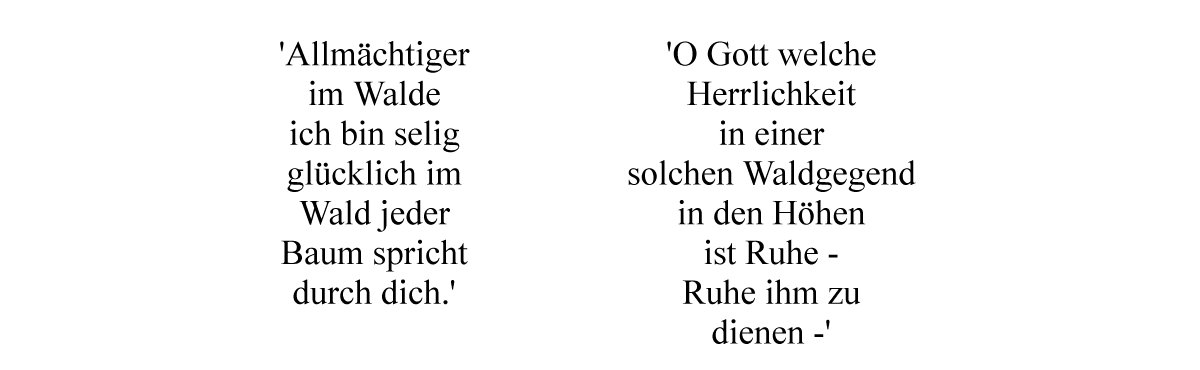
'When you are among those old ruins,' writes he
to a dear friend at Baden, 'do not forget that Beethoven has
often
lingered there [8];
and when you
wander through the silent pine woods, remember that I have often made
poetry (gedichtet),
or, as they say,
composed, there.' In these charming places he would stay out of doors
for hours together, wandering in the woods or sitting in the fork of
some favourite tree; and here his great works, with few exceptions,
were planned and composed, and prepared for putting into score during
the winter in Vienna. Wordsworth's servant said of her master when
asked to show his study: 'This is the library where he keeps his books,
but his study is out of doors'; and so might Beethoven's servant have
said of him. The particular spot from which he drew his inspiration
for the Pastoral Symphony was the Wiesenthal near Heiligenstadt, on
the west of Vienna [9].
This is not Beethoven's first attempt at 'Programme-music' in the widest sense of the word - music in which the endeavour is made to represent a given scene or occurrence, by the aid of instruments only, without the help of voices. The Eroica Symphony belongs to the same category. It is a portrait, but the extent of the portraiture is left so vague that we are driven to be content with little more than the mere fact. In fact, we shall find from several of his entries that Beethoven was always anxious to avoid anything like actual imitation of sounds or sights - anything, in short, like the 'branching' horns of the stag, the tread of 'heavy beasts,' or the undulations of the serpent - in which Haydn indulged in the 'Creation.' The 'Creation' had only been brought out a few years before the date at which we have arrived, and was more talked about in Vienna than any other work, so that it is hardly fanciful to suppose that in the above cautions Beethoven had his eye more or less directly on Haydn's oratorio. But the Pastoral Symphony is a great advance on the vagueness of the 'Eroica'; it is a series of pictures of Nature and natural scenes, so far labelled as to assist greatly in the recognition. That was nearly ninety years ago, and it is still undoubtedly the greatest piece of programme-music yet composed. Titles are now the rule rather than the exception, and we are so accustomed to the 'Italian' and 'Scotch' Symphonies of Mendelssohn; the Overtures to 'A Midsummer Night's Dream,' 'Fingal's Cave,' 'Calm Sea and Prosperous Voyage,' by the same composer; the 'Consecration of Sound' and 'Seasons' Symphonies by Spohr; the 'Lenore' and the 'Forest Symphony' of Raff; the 'Paradise and Peri' Overture of Sterndale Bennett, &c., as to forget how modern the practice is, as applied to the full orchestra - a thing of our own century. Like most musical innovations that have kept their ground, though it did not originate in Beethoven - for instances are found as early as 1545, the date of Jannequin's 'La Bataille,' and many readers will still recollect the 'Battle of Prague' and the 'Siege of Valenciennes' - it was at least first successfully practised by him. Numerous as are the pieces with programmes, dating before 1808, it may be safely said that the Pastoral Symphony is the first which has survived in public taste. But such is the force of Beethoven's genius that after he had once opened the path, there was no help but to follow it. When Frederick Schneider, a stout old musical Tory, was complaining (says Schubring) of the modern tendency to programme music, Mendelssohn maintained that since Beethoven had taken the step he did in the Pastoral Symphony, it was impossible to keep clear of it. And Mendelssohn carried his convictions into practice in the glorious programme-overtures just named, which bid fair to maintain their ground as long as the Pastoral Symphony itself.
In the Pastoral Symphony Beethoven has fortunately indicated the images which were before his mind by the titles prefixed to the movements; though even these, with admirable intuition and judgment, he has restricted by the canon with which he heads the description of the Symphony given in the programme of his concert of December 22nd, 1808, when it was first produced, a canon fixing for ever the true principles of such compositions: 'Pastoral Symphonie; mehr Ausdruck der Empfindung als Malerey' - 'more expression of feeling than painting,' or, to render it freely, 'rather the record of impressions than any actual representation of facts.'
The inscriptions which form so very unusual and important a portion of the work exist at least in four shapes, and give a curious example of Beethoven's vacillation when he had the pen in his hand. Once get him to the piano, and his thoughts seem to have issued through his fingers in the most complete and electrifying manner; but when he had to write it was quite different, and these titles supply a very characteristic instance of the impossibility which he found in putting down his ideas in a shape satisfactory to himself. Litera scripta manet is a maxim which was of terrible force to him.
These precious little documents are found, as has been said, in at least four forms : -
I. In the original MS. of the Symphony, in the possession of Baron J. M. Huyssen van Kattendyke, of Arnhem, near Utrecht, in Holland. Of this I can find no notice beyond that in Nottebohm's Thematisches Verzeichniss of Beethoven's works (1868), page 62: - 'Sinfia 6ta. Da Luigi van Beethoven. Angenehme heitre Empfindungen welche bey der Ankunft auf dem Lande in Menschen erwa - Allo.- ma non troppo - nicht ganz geschwind - N.B., Die deutschen Ueberschriften schreiben Sie alle in die erste Violine - Sinfonie von Ludwig van Beethoven.' These words are apparently copied from the first page of the MS. only.
II. On the back of an original MS. first violin part, preserved in the library of the Gesellschaft der Musikfreunde in Vienna - and which may be supposed to be an exact repetition of the inscriptions on the score, as it is the work of a copyist simply obeying Beethoven's injunction, given in No. I. above - we find as follows. First, as general title: -
'Sinfonia Pastorella. Pastoral Sinfonie oder Erinnerung an das Landleben |: Mehr Ausdruck der Empfindung als Mahlerei :|'; and then over each separate movement: -
1st. 'Angenehme heitre Empfindungen, welche bey der Ankunft auf dem Lande im Menschen erwachen. Allegro ma non troppo.'
2nd. 'Scene am Bach. Andante molto moto quasi Allegretto.'
3rd. 'Lustiges Zusammenseyn der Landleute. Allegro.'
4th. 'Donner, Sturm. Allegro.'
5th. 'Hirtengesang. Wohlthätige mit Dank an die Gottheit verbundene Gefühle nach dem Sturm. Allegretto.'
The above is found in Zweite Beethoveniana, p. 378.
III. As inserted in the programme-book of the first performance, December 22, 1808, and published in the Allg. musikalische Zeitung, January 25, 1809, thus: -
'Pastoral Symphonie (No.5) [10], mehr Ausdruck der Empfindung, als Malerey. 1stes Stück: Angenehmene Empfindungen, welche bey der Ankunft auf dem Lande in Menschen erwachen. 2tes Stück: Scene am Bach. 3tes Stück: Lustiges Beysammenseyn der Landleute; fällt ein: 4tes Stück: Donner und Sturm; in welches einfällt: 5tes Stück: Wohlthätige mit Dank an die Gottheit verbundene Gefühle nach dem Sturm.'
IV. As given on the back of the title-page of the engraved first violin part (No. 1,337), published by Breitkopfs in April, 1809, and quoted by Nottebohm in his Beethoven Thematic Catalogue of 1868, page 62, thus: -
'Auf der Rückseite des Titels der ersten Violinstimme steht: Pastoral-Sinfonie oder Erinnerung an das Landleben (mehr Ausdruck der Empfindung als Mahlerey). 1. Allegro, ma non molto. Erwachen heiterer Empfindungen bey der Ankunft auf dem Lande. - 2. Andante con moto. Scene am Bach. - 3. Allegro. Lustiges Zusammenseyn der Landleute. - 4. Allegro. Gewitter, Sturm. - 5. Allegretto. Hirtengesang. Frohe und dankbare Gefühle nach dem Sturm.' These are translated in the list at the head of these remarks.
V. With the foregoing agree the titles in the 8vo score published by Breitkopfs in 1824 (No. 4,311), except that the general title is altered as given above at the beginning, the important motto omitted, and the inscriptions to the separate movements only given.
These five ultimate expressions of his intentions in words are the fruit of several attempts or offers, which occur in the sketch-books, and are too interesting not to be quoted here [11]. Thus: -
'The hearers should be allowed to discover the situations.'
'Sinfonia caracteristica, or a recollection of country-life.'
'A recollection of country-life.'
'All painting in instrumental music, if pushed too far, is a failure.'
'Sinfonia pastorella. Anyone who has an idea of country-life can make out for himself the intentions of the author without many titles.'
'People will not require titles to recognise the general intention to be more a matter of feeling than of painting in sounds.'
'Pastoral Symphony: no picture, but something in which the emotions are expressed which are aroused in men by the pleasure of the country (or), in which some feelings of country-life are set forth.'
The titles finally given to the movements of the work are curiously similar to - indeed they are virtually identical with - those of a 'grand Symphony' by Justin Heinrich Knecht, a Suabian composer of the last century. This is 'The Musical Portrait of Nature,' published in or about 1784, by Bossier, of Spire, who also issued at the same date Beethoven's earliest productions, the three juvenile Sonatas for the piano. The two works - Knecht's and Beethoven's - were advertised on the same page, and the boy must often have read Knecht's suggestive titles on the cover of his own sonatas. If so, they lay dormant in his mind for twenty-four years, until 1808, when they fructified in the splendid Symphony now before us. Knecht's title-page is as follows: -
'Le Portrait Musical de la Nature ou Grande Simphonie pour, &c., &c. Laquelle va exprimer par le moyen des sons:
'1. Une belle Contrée où le Soleil luit, les doux Zephyrs voltigent, les Ruisseaux traversent le vallon, les oiseaux gazouillent, un torrent tombe du haut en murmurant, le berger siffle, les moutons sautent, et la bergère fait entendre sa douce voix.
'2. Le ciel commence à devenir soudain et sombre, tout le voisinage a de la peine de respirer et s'effraye, les nuages noirs montent, les vents se mettent à faire un bruit, le tonnerre gronde de loin, et l'orage approche à pas lents.
'3. L'orage accompagné des vents murmurans et des pluies battans gronde avec toute la force, les sommets des arbres font un murmure, et le torrent roule ses eaux avec un bruit épouvantable.
'4. L'orage s'appaise peu à peu, les nuages se dissipent et le ciel devient clair.
'5. La Nature transporteé de la joie éléve sa voix vers le ciel, et rend au créateur les plus vives graces par des chants doux et agréables.'
The work is still in existence, and an examination of it shows that beyond the titles there is no likeness between the two compositions.
We may now proceed to the examination of this masterpiece of Beethoven's: -
I. The Symphony opens without other introduction or preliminary than a double pedal on F and C in the violas and cellos - with the principal theme in the violins, as sweet and soft as the air of May itself, with buds and blossoms and new-mown grass: -

This
beautiful subject may almost be said to contain in its
own bosom
the whole of the wonderful movement which it starts, and which is 512
bars long. As the piece proceeds each joint, so to speak, of the theme
germinates, and throws off phrases closely related to the parent stem
in rhythm or interval. It would be difficult to find in Art a greater
amount of confidence, not to say audacity, than Beethoven has furnished
by his incessant repetition of the same or similar short phrases
throughout this long movement; and yet the effect is such that when the
end arrives, we would gladly hear it all over again. The Violin
Concerto gives another example of the same practice. As an instance of
this boldness in repetition in the Symphony, we may quote a phrase of
five notes, formed out of theme No. 1: -

which first occurs at the sixteenth bar, and is then repeated
no less than ten times successively. At the 116th bar a somewhat
similar phrase -

is reiterated for twenty bars. Near the end of the first section are
another twelve -

After the repeat, at bar thirteen of the working-out, another
subject, also formed out of the first theme -
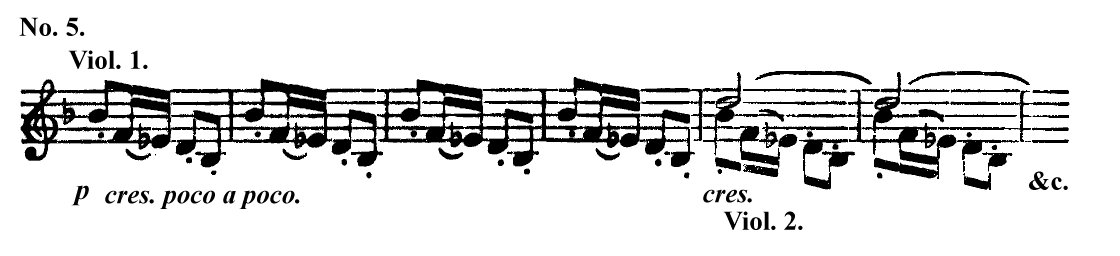
is given out by the violins, is repeated for thirty-six bars,
and is thenceforward almost continually present. (This, by-the-bye, is
quoted by Schindler as being a phrase of national Austrian melody [12].) In
fact, the movement is almost entirely made of short phrases repeated
over and over again. Even so simple a feature as -

is made to recur continually - in fact, something very
like it appears in the first sketch of the music known to
exist [13].
I
believe that the delicious, natural, May-day, out-of-doors
feeling of
this movement arises in a great measure from this kind of repetition.
It causes a monotony - which, however, is never monotonous - and which,
though no imitation,
is akin to the constant sounds of Nature - the
monotony of rustling leaves and swaying trees, and running brooks and
blowing wind, the call of birds and the hum of insects. Of the same
nature is this delicious mockery of the bassoon and the violin in the
working-out section -

Another instance of a similar persistent rhythm is the following subsidiary subject, where the string and wind instruments answer each other in charming soft rivalry -

A
temporary exception
to this recurring motion is formed by the second subject proper of the
movement, given out thus in the cellos -

and then appearing in instruments of higher register -

a subject which, though allied to the others in tone and feeling, is in
different rhythm. The manner in which the long notes of this beautiful
phrase keep building themselves up one over the other, and the monotony
into which it falls at last without power to escape, in the arpeggios,
are too charming. But with all this repetition there is no weariness.
Though he may not have known the axiom of d'Alembert, 'La nature est
bonne à imiter, mais non pas jusqu'à l'ennui,' Beethoven acted on it
thoroughly. Indeed, he is steeped in Nature itself; and when the
sameness of fields, woods, and streams can become distasteful, then
will the Pastoral Symphony weary its hearers.
The
working-out begins with a passage or section of ninety-two
bars,
mainly consisting of the incessant repetition of a phrase taken from
bar two of the original subject No.
1
(see also No. 5)
- or, rather,
of
one passage of forty-six bars, exactly repeated, first in B flat and D,
and then in G and E. Thus the monotony already noticed is still further
ministered to. But this portion is full of fresh beauties, all strictly
in character with the foregoing. Here is a charming change, though
simple enough -

- and here a delicious point -

Then,
after a repetition of the passage last quoted, in the
key of A,
comes a new treatment of bars 9, 10, 11 of the first theme (No. 1),
given successively in the flutes and bassoons (in D), in the violas and
cellos (in A), and next (which we quote) in the first violin only -

In this, by giving the phrase in minor, and by a happy importunity of sforzando at the
beginning of the sections of the
phrase, quite a new character is given to the familiar theme, as it
whispers its tender griefs in graceful iteration. After this we arrive
at the reprise
of the first section of the movement. But this last is
much disguised, and is given - not con alcune licenze
like
the fugue of Op. 106, but with many a license. The key of F is given
with no uncertain sound; but the form of the subject, though
unmistakable, is considerably modified. The theme comes back into the
strings alone, which originally announced it; but the phrase is given
to the second violins and violas (see bar 3 of quotation), while the
first fiddles sustain a high D, then C, and then, descending to G,

execute a delicate passage of staccato notes, thus developing
the pause which, on the first occasion, occupied the fourth bar
of the passage (see No.
1)
into
one of the most charming flourishes
possible, and forming a sort of companion to the unbarred oboe passage,
which we noticed in the working-out of the C minor Symphony as the
development of a previous pause, though of an entirely different
complexion from that striking lament. That was deeply pathetic; this,
on the contrary, though delicate, is jubilant and full of the spring
feeling which animates the whole movement.
The
Coda
(no less than ninety-five bars in length) is of the same
general character as the previous part of the movement, but contains
some new features, such as -

- where the alternations of the B flat and B natural are
charming. This also, a few bars from the end -
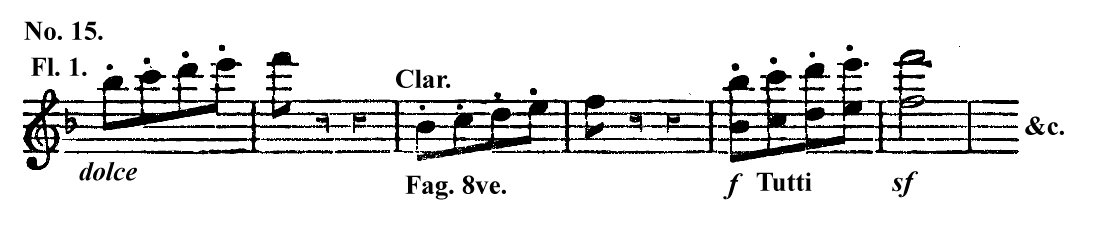
will not escape notice.
Schumann has pointed out [14] a place in the first movement (p. 35 of the original 8vo score, shortly after the reprise) in which he thinks that for three bars in the first violins the preceding triplet figure should continue instead of pausing, simili marks having been mistaken by the copyist for rests. In Breitkopf and Härtel's new complete edition the passage has been accordingly altered (page 16), though without anything to indicate the change which has been made from Beethoven's original edition. This certainly is a regrettable omission. While suggesting the change, Schumann himself makes a pertinent remark. He says: 'How we have gone on hearing the passage for years without altering it, is only to be explained by the fact that the magic of Beethoven is so great as to put our ears and our judgment to sleep.' Someone said a similar thing in regard to the apparent mistake in the score of the Vivace of No. 7, which was announced by Mr. Silas a few years ago (see later).
If Schindler's express statement [15] is to be accepted, Beethoven was driven to the key of F for this work. After distinctly affirming, in words which are evidently intended to be those of the composer himself, that certain keys are inevitable for certain situations and emotions - as inevitable as that two and two make four and do not make five - he goes on to say, with reference to this very work, that in order to obtain the most appropriate sounds for a picture of country life, it would have been impossible to choose any but F major as the prevalent key of the composition. But F major is also the prevalent key of the Eighth Symphony, the scene, circumstances, and tone of which are entirely different from those of the Pastoral. This depicts the quiet of the country; that the noisy intercourse of a crowded watering-place. Moreover, in the few notes which we possess of the sketches for a 'Sonate Pastorale,' already alluded to, the key is certainly not F [16].
Whether Beethoven's words on this interesting subject are to be taken literally, or whether, with characteristic want of the humour in which the composer was steeped, Schindler has omitted something which considerably modified the conversation, cannot now be told. From another part of the same passage it must be inferred that the attributes which Beethoven ascribed to the various keys were independent of pitch. At any rate, from his own written words, we know that his opinions on the subject were very strong. 'H moll schwarze Tonart' - B minor is a black key - which is hardly the characteristic of Schubert's unfinished Symphony. He rebukes Thomson, of Edinburgh, for marking a song in four flats (possibly F minor) as amoroso, and says it should be rather barbaresco. In talking to Rochlitz of his early admiration for Klopstock and his ponderosities, he characterises them as D flat major [17]. 'You're astonished,' says he, 'but isn't it so?'
II.
Andante
molto moto. - 'By the
brook.' This
movement - which is thrown into the same form as the Allegro, except
that there is
no repetition of the first section - is based on a somewhat more
definite picture than the former. That represented in a general manner
the pleasant feelings aroused by the country. This is definitely laid
by the brook-side, and accordingly the murmur of the water, or, rather,
in obedience to Beethoven's canon, the prevailing impression made on
the mind by the sound, is heard throughout almost the entire piece on
the lower strings, either in quavers -

or in semiquavers -

The actual sound of running water, whether the same brook or another, he has recorded in a sketch-book of 1803 [18], at a time when his hearing, though threatened, was better than it became in 1808 - as follows -

It
will be observed that in the
Andante
Beethoven has changed the key of the figure representing the
noise of the water from what it was when he actually observed it. And
this no doubt he has done to avoid anything like actual imitation. The
brook forms the background of the scene; but above and through the
ceaseless murmur of the figures in Nos. 16 and 17 are heard various
motifs,
none of them directly imitative, but all suggesting the
delights of the life of Nature. And beside these Beethoven has managed,
with the most extraordinary skill, to fill his score with an atmosphere
of sound which conveys the glories of summer, and the busy 'noise of
life' swarming on every sense. The first of these motifs - the
principal subject of the movement with which it opens in the first
violins - begins as follows; to end (as Beethoven generally ended) in a
lovely consecutive melody - that of the last three bars of the
passage -
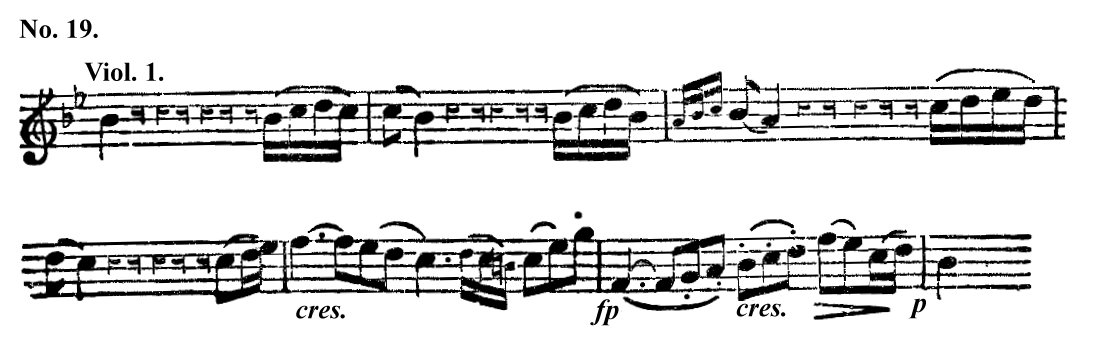
This is supported by the lower strings, in the figure given as No. 16,
and by holding notes of the horns. The melody is then taken
by the clarinet, the lower strings adopting the semiquaver figure (No.
17), while the first violins give a series of shakes on the upper B
flat and C, and the horns a syncopated pedal of a charming vagueness -

both shakes and pedal being prominent features throughout the Andante.
The syncopated notes of the pedal are heard continually through the
movement, in bassoons, oboes, and other instruments successively. The
shakes, and the grace notes in the quotation, bear an important part,
as they somehow suggest heat. It is curious that Gluck in the
beautiful air, 'Quelle belle jour,' in 'Orphée,' sung in the brilliant
sunlight of Elysium, uses a similar expedient, with a similar result.
Next
we have the following elegant phrase, given out, like
those just
quoted, in the first violin -

the graceful and soothing flow of which is immediately repeated by the
clarinet, while an accompaniment is added above for the first violin,
with the bassoon and cello in octaves -

This two-bar
phrase has a highly important part assigned to it at the close of the
movement (see a,
No. 31).
After
four connecting
bars, the first subject
(No. 19) is resumed, but with a delicious difference, as the quotation
(at a)
will show -

For this the music modulates into the key of F,
the syncopated pedal is taken by the horns, bassoons, flutes, and
clarinets, and by the flutes, oboes, clarinets, and bassoons
alternately; and the second part is ornamented with figures, the lazy
grace of which well befits the summer climate that breathes around us,
and seems indeed to hum -
The murmur of a
happy Pan.

These delicious phrases will remind the hearer irresistibly of the similar figures in the Larghetto of the Second Symphony -

Thus
at length, after twelve connecting bars, we arrive at the
second
principal subject of the movement. This is of the same graceful,
deliberate character as the others -
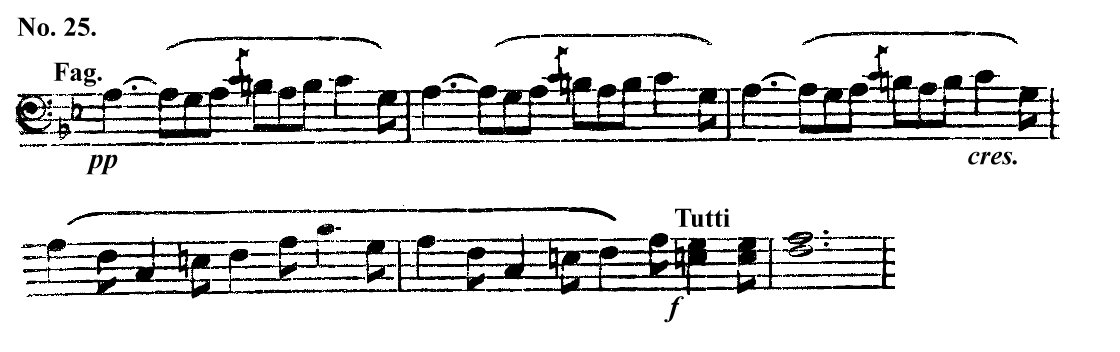
It is brought in first by the rich tone of the first
bassoon - never perhaps to more advantage; it is shortly
strengthened by the violas and cellos, and accompanied by the shakes
which added such a summer feeling to the first subject (see No. 20). It
is then, in a shortened form, repeated by the first violin and
flute with the accompaniment of the initial figure of No. 19 -
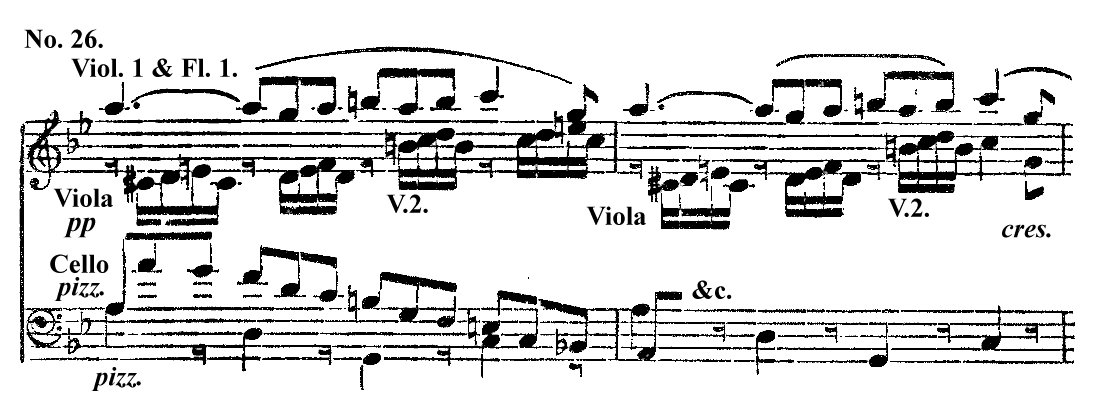
With
two repetitions of the haunting phrase quoted as No.
21 the first
portion of the Andante
comes to an end. The same principle of
reiteration governs this movement that we found prevailing in the
Allegro.
True there are more themes, but they are, as a rule, so alike
in character that they have all the air of repetitions.
The
working-out begins with a repetition of the opening, but
with
considerable differences. The key is F; the undulating figure, which
before formed the accompaniment on the lower strings, is given to the
clarinets and bassoons in octaves, while the lower strings have the
semiquaver version of the same figure, and the characteristic phrase of
the first half of the theme (No.
19)
is enriched in form. This will be
seen from the following quotation -

Next we have a new
phrase in the second violins and violas, repeated by the flute in the
key of G, and with an arpeggio
which is not only lovely in itself and
in the modulation which follows it, but has a special interest of its
own, as will be discovered later (see later):
-

These materials
and the previous themes and phrases are used in the most masterly way,
with great contrivance and combination, and considerable modulation,
through the keys of E flat, C flat, E minor, and B flat, but without
casting the least shadow of labour or science over the natural feeling
of the music. The shakes, to which we have more than once called
attention, lose none of their warm feeling when they are given thus -

With the key of B flat comes the inevitable recapitulation of the
first part of the movement. The melody is now given to
the flute, the accompaniment in the lower strings remains much as
before, but great use is made of the arpeggios in the
first violins and
the wind. There is also much enrichment of the melodies, such as -
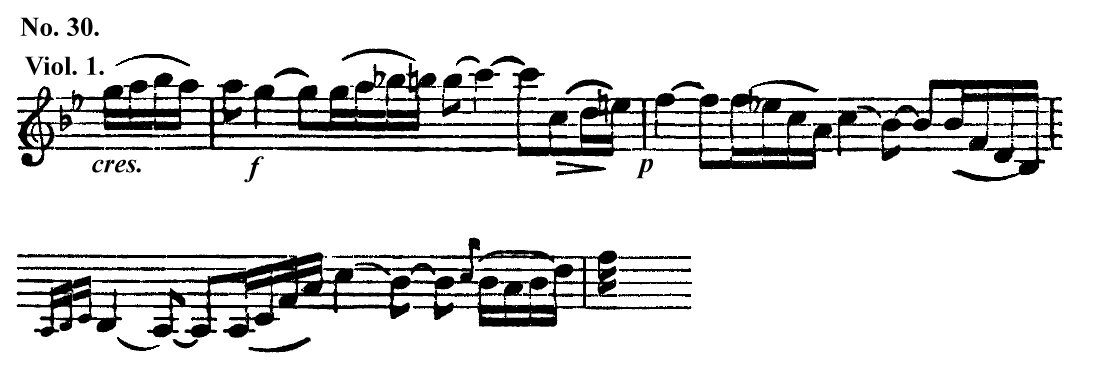
The
second subject (again in the bassoon, but this time in the
key of
F) arrives much sooner than it did before. It is not necessary to go
into further details, everything is in perfect keeping, and to comment
upon such beauty is to gild refined gold. The Coda is not long,
but is
very remarkable. After seven bars occur the imitations, or rather
caricatures, of the nightingale, quail, and cuckoo, which have become
so celebrated, and, with the storm, always form the popular points in
the work. Beethoven would probably be surprised if he could know what
favourites these birds are, and with how many hearers they are more
enjoyed than the other portions of the Symphony, with which they really
hold no comparison. In the programmes of the Conservatoire, at
Paris,
they were, and probably are, called special attention to, and Langage
des oiseaux is added to Beethoven's simple title. He has
himself told
us that the passage is intended for a joke [19].
But it was hardly
necessary to say so. It is obvious that the passage, eight bars in
length - in which they really are only an episode, with no part in the
construction of the movement - is one of those droll capricious
interpolations which we have noticed in each Symphony, from the second
onward, put in in obedience to the promptings of his turbulent humour,
and in defiance of any consideration but his own absolute will. It is
more wilful and defiant here than ever, because it is more strange, and
also because it is more realistic, more in direct transgression of the
canon against mere 'malerei,'
which Beethoven placed at the head of his
work, and which we have already quoted. But surely he may be excused;
the constant intimate contact of his divine strains with Nature may
well have bewitched his judgment, and, as if by mistake, guided his
mind to a too realistic passage, in contravention to the strict
principle he formerly announced. Indeed the parody is of the broadest
and barest description; a practical joke of the most open kind. And
yet how the artist triumphs over the humorist! How completely are the
raw travesties of nightingale, quail, and cuckoo atoned for and brought
into keeping by the lovely phrase (a,
see example 31) with which
Beethoven has bound them together, and made them one with the music
which comes before and after them -

Just so in the equally anomalous arabesques of Oriental and
Renaissance art do the feet and tails of the birds and dragons and
children, which play among the leaves, run off into lovely tendrils,
curving gracefully round, and connecting the too-definite forms from
which they spring with the vaguer foliage all
round. Two of these birds Beethoven has elsewhere imitated - the
nightingale in the opening of his setting of Herder's Song [20], 'Der
Gesang
der Nachtigal,' in
1813, five years after the date of the
Symphony -

To
the quail he has devoted a song, 'Der
Wachtelschlag,' [21]
in which
the bird's note is set to the words with
which it is traditionally associated in Germany - 'fürchte Gott,
fürchte Gott.' Of the cuckoo, nothing need be said. A fourth bird
- the yellow-hammer - has been suggested as taking an
integral part in the second portion of the movement, and this on the
strength of a conversation between Schindler and the composer, reported
in Schindler's biography of Beethoven (i., 158). It occurred in the
summer of 1823, long after the great composer had become entirely deaf,
during a stroll in the wooded meadows between Heiligenstadt and
Grinzing, in the neighbourhood of Vienna, the scene of the conception
of this and many others of his finest works. The passage gives a
touching picture, for which its insertion may be pardoned. 'Seating
himself on the turf,' says Schindler, 'and leaning against an elm,
Beethoven asked me if there were any yellow-hammers to be heard in the
tree above us. But all was still.
He then said, "This is
where I wrote the Scene by the Brook, while the yellow-hammers were
singing above me, and the quails, nightingales, and cuckoos calling all
around." I asked why the yellow-hammer did not appear in the movement
with the others; on which he took his sketch-book, and wrote the
following phrase (see No.
28)
-

"There's the little composer," said he, "and you'll find that he plays
a more important part than the others; for they are nothing
but a joke." And in fact the modulation of this phrase into G major
(after the preceding passage in F - see bars 4 and 5 of No. 28) gives
the picture a fresh charm. 'On my asking,' continues Schindler, 'why
he had not mentioned the yellow-hammer with the others, he said that to
have done so would only have increased the number of ill-natured
remarks on the Andante,
which had already formed a sufficient obstacle
to the Symphony in Vienna and elsewhere. In fact, the work was often
treated as a mere jeu
d'esprit on account of the second movement, and
in many places had shared the fate of the Eroica. In Leipzig they
thought that it would be more appropriately called a Fantasia than a
Symphony.'
But the note of the yellow-hammer, both in England and in Austria, is not an arpeggio - cannot in any way be twisted into one, or represented by one. It is a quick succession of the same note, ending with a longer one, sometimes rising above the preceding note, but more frequently falling. In fact, Schindler himself tells us that it was the origin of the mighty theme which opens the C minor Symphony! Taking these things into account, remembering how irresistible a practical joke was to Beethoven, and how entirely destitute of humour Schindler always shows himself, it is difficult not to come to the conclusion that in this elaborate proceeding Beethoven was hoaxing his humble friend. The reader must judge for himself.
A
large collection of Slavonic tunes, by Professor F. Xaver
Kuhac,
of Agram, recently published in four volumes (Agram, 1878 - 81),
contains some melodies bearing a strong resemblance to the subjects of
some of the music of Haydn and Beethoven. Amongst others is the
following (Vol. III., No. 1,016) -
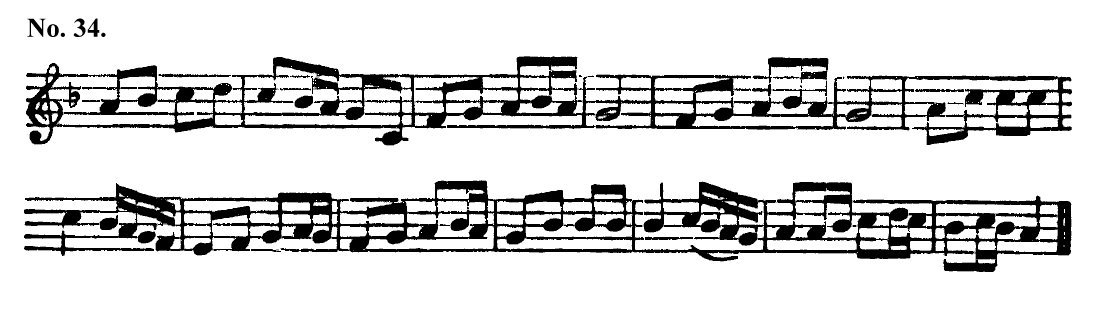
which, it is safe to say, was either borrowed from the first movement
of the Pastoral Symphony or was used by Beethoven in the
composition of that work (compare quotation, No.
1, and notice the
interesting difference in the first three notes); another is quoted à
propos to the Finale,
which we shall notice farther on. A somewhat
similar instance is formed by the Trio
in the Seventh Symphony, the
melody of which is said, on the authority of the Abbé Stadler, to have
been a well-known pilgrims' chant. The Russian themes in the last
movement of the first and second of the Rasumoffsky Quartets are quite
a different matter, as in both cases the theme is marked by Beethoven
as 'Theme Russe.' The subject of the Slavonic tunes has been discussed
by Dr. Heinrich Reimann (Allg.
Musikzeitung for Oct. 6, 13,
20, 1893) and Professor Kuhac himself (Ibid., July 20,
August 3, 17,
1894), as well as in the Musical
Times for November, 1893. The question
is - which is the original, the Symphony or the Volkslied? - and this
does not appear to be yet made out.
Meantime Beethoven does not seem to
have scrupled to use materials
wherever he found them. Attention was called by Mr. C. A. Barry, in the
Beethoven number of the Musical
Times, 1892, to a similarity between a
phrase of Beethoven's and one in the old German Grossvatertanz. It
is
difficult to believe that Beethoven had not seen Mozart's Overture to
'Bastien et Bastienne' before writing the Eroica. Other instances of
similarity between his phrases and those of his predecessors have been
mentioned by Mr. Shedlock in his excellent book The Pianoforte Sonata,
and others are familiar to students of his works. 'While walking one
night with Beethoven in the Mariahilf Strasse (apparently in Vienna),
all at once,' says Glöggl [22],
'he stopped, and I heard through
a window some one playing very charmingly. Beethoven took out a small
note-book and wrote in it, saying, "I like that idea."' On another
occasion he said, 'I quite agree with Cherubini as to his Requiem, [23]
and, if I ever write one, shall borrow much from him, note for note.'
It is hard to say why he should not do so. Handel probably borrowed
more themes than anyone else, and he has shown us over and over again
that it is not the theme that constitutes the value of the
composition, but the way in which it is used.
III.
Allegro.
- 'Peasants' Festival.' So far we have had to do with
Nature; we now turn to the human beings who people this delicate
landscape; the sentiment at once completely changes, and we are
carried from graceful and quiet contemplation to rude and boisterous
merriment. The third movement - answering to the usual Scherzo, though
not so entitled - is a village dance or fair. The wind instruments most
prominently heard are appropriately those of rustic
artists, the flute, the oboe, and bassoon. The strings
begin thus in F, leading into D minor -

but the flute and bassoons
enter after a very few bars, and the oboe shortly after. There is a
delightfully rustic cast about it all - the close of one portion of the
melody -

the false accent with which the oboe starts the second section -

to the quaint accompaniment of the two fiddles [24]
(we seem to see the
village players bowing away) are all in exquisite keeping, and it is
not too much to believe that the whole has a 'foundation in
fact.' Indeed, the very passage just quoted is said to be an
intentional caricature of a band of village musicians
whom Beethoven used to hear in the country; and the irregular halting
rhythm in the bassoon shows how drunk or how drowsy the player was -

while the two notes to which he is confined during this episode prove
how very moderate are his powers.
This party, seven in all (says Mr. Thayer in his Life of Beethoven, iii. 43), had for many years played regularly in the tavern of 'The Three Ravens,' in the Upper Brühl, near Mödling; their music and their performance were both absolutely national and characteristic, and seem to have attracted Beethoven's notice shortly after his first arrival in Vienna. He renewed the acquaintance at each visit to Mödling, and more than once wrote some waltzes for them. In 1819 he was again staying at Mödling, engaged on the Mass in D. The band was still there, and Schindler was present when the great master handed them some dances which he had found time to write among his graver labours, so arranged as to suit the peculiarities which had grown on them; and as Dean Aldrich, in his Smoking Catch, gives each singer time to fill or light his pipe, or have a puff, so Beethoven had given each player an opportunity of laying down his instrument for a drink, or even for a nap. In the course of the evening he asked Schindler if he had ever noticed the way in which they would go on playing till they dropped off to sleep; and how the instrument would falter and at last stop altogether, and then wake with a random note, but generally in tune. 'In the Pastoral Symphony,' continued Beethoven, 'I have tried to copy this.'
The next movement - Allegro 2-4 (answering to the Trio of the Scherzo) - is said to represent a fight among the dancers, though indeed it may just as well be a rough dance. The harmony is of the same simple character as that which form so fine a feature in the opening movement -
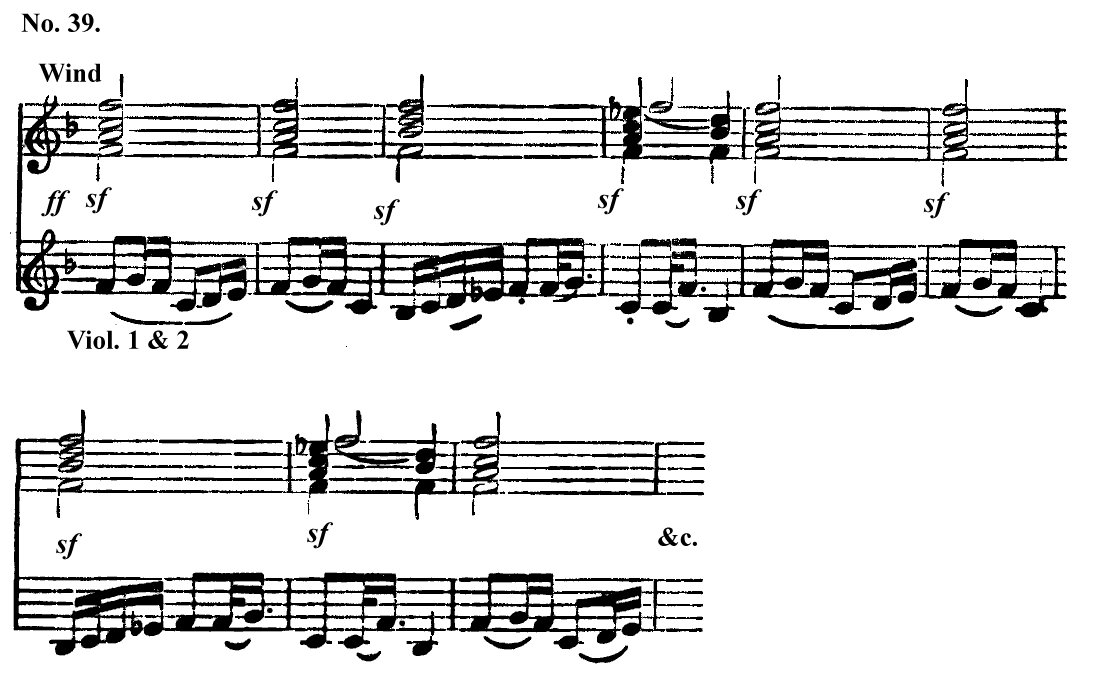
IV. The
Storm which bursts upon the
revels and
quarrels of the peasants
would require a whole pamphlet for its adequate illustration and
encomium. It comes abruptly on the scene. A modern composer would
probably have let us hear the thunder gathering in the distance, and
have given us the gradual dispersal of the dancers, and other
incidents, as the rain came on, and the flashes grew more vivid -
indeed, Knecht in his programme gives some indications of the kind. But
Beethoven - whether because such realistic painting had not yet invaded
music, or because he so willed it - stops the dancing suddenly, draws a
double bar through his page, adds a flauto piccolo to the score, alters
the signature and the time, slackens the tempo, and treats
the storm as
a distinct, new, and independent scene -

It is simple treatment,
but he can do nothing without
significance and effect. The sudden D flat [25]
which begins the
change - like very distant thunder, so soft as to be hardly audible -
is, M. Saint-Saëns remarks, 'really sublime' [26].
This depends on the
interpretation given to that tremendous adjective. But sublime or not,
it is very impressive. It has 'the light that never was on sea or
land,' and throws at once a mystical cast over the rustic gaiety of the
preceding music, much as a dark cloud might do on the actual
field. This 'storm' is as distinct an addition to the usual four
movements of the Symphony as the Cathedral Scene in Schumann's third or
'Rhenish' Symphony is [27]. Fortunately
it needs no commentary,
but is so grandly and broadly written that the hearer has but to
surrender himself to the impressions of the moment as the splendid war
of the elements rages before him. It has no special 'form,' but one or
two favourite passages may be cited, such as the following bold
progression -
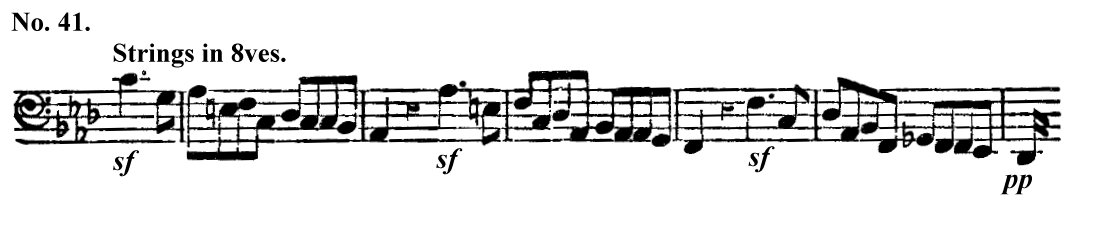
- or this other, in
which the basses virtually go
down through three octaves, with the violins in arpeggios of double
notes above them - curiously simple means for the immense effect
produced!
An
extraordinary effect
is produced at an early period of the tempest
by making the cellos play in groups of five semi-quavers
while the double basses have groups of four -


an
effect specially
noticed
by M. Berlioz. Mention has often been made of the truth to Nature shown
in the mysterious lull before the storm reaches its climax (where the
chromatic scales are first introduced), of the picturesque beauty of
the final clearing off of the tempest (first oboe solo, with second
violin in octaves) -

- which is really the
passage at the
commencement of the movement (No. 40, bar 7), in minims instead of
quavers - and the strip of blue sky (final scale upwards of
the
flute) -

a
feature which is first
found in the second
Finale
to 'Fidelio,' [28]
and which Mendelssohn and Schumann have
not forgotten, the former in the close of the scene on
Sinai in 'Elijah,' the latter in the first movement of his B flat
Symphony, thirty-five bars from the end.
A sketch of this storm will be found in the 'Prometheus' music, immediately succeeding the Overture; and the comparison of the two pieces is most interesting, and will be found to throw great light on Beethoven's modes of procedure in such cases. It is a parallel to the two Overtures to Leonora, where 'No. 2 ' is a 'first edition' of 'No. 3.'
V. The Finale is an Allegretto, a 'Shepherds' hymn of gratitude and thankfulness,' at the passing of the tempest [29]. Between the two there is no pause. Beethoven's original memorandum of the title in his sketch-book ran thus: - 'Ausdruck des Dankes. Herr, wir danken dir,' as if he had a thanksgiving hymn in view. The movement now opens with a Jodel or Ranz des vaches, begun by the clarinet, and repeated by the horn, though the sketch-books show that this Jodel itself is an afterthought, and that the Finale originally began with the melody of the hymn (No. 47). The horn passage may be noticed because it is founded on a solecism in harmony, for which in this and other places Beethoven has been much censured by Oulibicheff, Fétis, and other conservatives of the old school, but which, in the music of our times, has been carried to lengths of which Beethoven himself can hardly have dreamt -
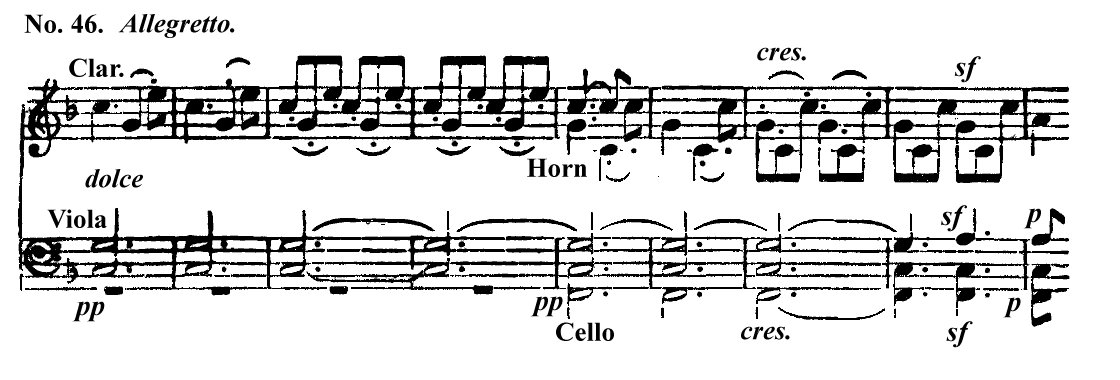
The offence, which Oulibicheff nicknames 'la Chimère,' after the compound monster of classical mythology, consists of his employing the 'tonic' and 'dominant' harmony together, at the same time. In this case the viola holds the bass notes G and C (of the chord of C, the 'dominant' of F), while the violoncello has the notes C and F (of the chord of the ' tonic' F), the horn at the same time sounding the same notes as the viola. Another instance is found in the famous horn passage which finishes the working-out of the first movement of the Eroica. The effect of such combinations depends materially upon the way in which the instrumentation is managed - a strong point with Beethoven; but our ears are accustomed to the combination, and it sounds all right; that is, it conveys the impression which Beethoven intended it to convey, and which is therefore better than that conveyed by the alteration of M. Fétis, who has actually taken upon himself, in print, to improve this passage to suit the ears of his own generation, naïvely remarking that 'with these alterations the effect would be excellent.'
The
ranz des
vaches leads into the first and chief theme of the Finale
- the Hymn of the Shepherds - as follows -

This theme is given out by the first violins, repeated by the second
violins and then by the violas, cellos, clarinets, and bassoons in
unison. It is followed immediately by a short melody of two bars'
length, given alternately by the violas and cellos -

and by the first violins - by the latter in this sprightly form -

and relieved by a charming, subsidiary melody. Then the last
group of the phrase is played with, first as above, and next in a
florid form -

Next comes a new phrase -

leading to an extended repetition of the original jodel in the
violins,
with its 'wrong' harmony supported successively by the flute, oboe,
clarinet, and horn, and diminishing to pianissimo. This
leads back to
the principal subject (No. 47), richly accompanied, and modulating into
the key of B flat, in which key at length the second subject proper
appears in the clarinets and bassoons, and accompanied by the violas in
semiquaver figures -

After the second subject we have a modulation through D flat into C, on
which note there is a pedal for fifteen bars, with the two violins in
semiquaver passages over it, and later still the original jodel returns
in the wind. For the rest of the movement the music consists of
variations of the themes already given - a fugato on the
principal
subject, and a second fugato
with the subject in semiquavers; and a
passage in which the fiddles descend note by note from the high G over
a pedal in the basses, at the same time diminishing from ff to pp, and
recalling a similar passage near the end of the opening movement of the
work; a coincidence which, if intentional, is of rare occurrence in the
Symphonies. The whole ends with a very peaceful Coda, terminating
with
the original jodel
in the horns pianissimo,
which might be supposed to
indicate the retirement of the peasant band to a distance, if we were
not brought to our senses by two very loud and startling chords.
The subject which we have quoted as No. 48 is the second one of the two on which there is so curious a correspondence with the Croatian melodies (see earlier). The Volkslied is given by Professor Kuhac (Vol. III., No. 810) as follows; and, as before, the resemblance is very strong (compare No. 52) -

The Pastoral Symphony was first performed at a concert given by Beethoven on Thursday, the 22nd of December, 1808, in the Imperial private theatre at Vienna. It stood first in the programme, and was described in the announcements as follows: 'Eine Symphonie unter dem Titel: Erinnerung an das Landleben, in F dur (No. 5).' The programme also included the G major Pianoforte Concerto - played by the composer; the Symphony in C minor (given as 'No. 6'); the Choral Fantasia; and other pieces of Beethoven's composition, 'quite new, and never before heard in public.' What a programme! We may well exclaim, 'who is sufficient for these things!' The circumstances of its production make one shudder. Instead of appropriate spring weather the cold was intense, and the theatre appears to have been unwarmed. The audience were very scanty; in the stalls, Beethoven's Russian friend, the Count Vielhorsky, appears to have been the only person [30]; the programme of forbidding length, and the rehearsals but imperfect. Under such untoward circumstances are the regenerators of mankind born into the world!
The confusion between the priority of the C minor and Pastoral Symphonies was in force as late as 1820, as appears from the programme of the Concerts Spirituels of Vienna of that year [31]. A similar confusion of numbers existed between the Seventh and Eighth Symphonies some years later.
It was first publicly performed in London at a concert given for the benefit of Mrs. Vaughan (formerly Miss Tennant), at the Hanover Square Rooms, on May 27, 1811 [32]. Dr. Crotch was 'at the organ and the grand pianoforte' [33]. A fortnight later it was again performed at the concert of Mr. Griesbach, the oboe player, on June 13.
A notice in an early number of the Musical World (June 21, 1838) says that at the first performance of the Symphony in England it was divided into two parts, and that the interval was relieved by the introduction of 'Hush, ye pretty warbling choir,' from 'Acis and Galatea.' I am not able to say if either of the two concerts just mentioned are referred to, or whether it is a confusion with Bochsa's performance (see later) on June 22, 1829.
When performed later by the Philharmonic Society, large omissions were made in the Andante, to make it go down [34]; and yet, notwithstanding this, the ancient members of the profession and most of the critics condemned it. Thus the Harmonicon, the musical periodical of the day - edited by a very intelligent man, and usually a fair critic - is never happy without its fling at the length and the repetitions of this Symphony. 'Opinions are much divided on its merits, but few deny that it is too long. The Andante alone is upwards of a quarter of an hour in performance, and, being a series of repetitions, might be subjected to abridgment without any violation of justice either to composer or hearer' (1823, p. 86). 'Always too long, particularly the second movement, which, abounding in repetitions, might be shortened without the slightest danger of injuring that particular part, and with the certainty of improving the effect of the whole' (1826, p. 130). 'The Pastoral Symphony is too long for the quantity of ideas that it contains. . . . He must be a great enthusiast who can listen to it without some feelings of impatience' (Ibid., p. 106) [35]. In such terms as these did our grandfathers, year after year, receive a work which, with all its repetitions, does not contain a redundant bar, and is now, next to the C minor, the most popular of Beethoven's first eight Symphonies!
Several attempts have been made to perform the Pastoral Symphony with scenery and even action - in other words, to disregard Beethoven's own injunction, and develop his 'expression of emotions' into a definite 'picture.'
1. A performance at the King's Theatre in the Haymarket, on June 22nd, 1829, for the Benefit of Mr. Bochsa, the harp player, a prominent personage of the day. The Symphony was dramatised for the occasion by Monsieur Deshayes and produced under his immediate direction, the principal characters by six French actors assisted by a numerous corps de ballet. It was preceded by a dramatic performance of 'Acis and Galatea,' by eminent singers from the Italian Opera. See The Times of June 24, 1829; the Quarterly Musical Magazine, Vol. X., p. 303; and Moscheles's Life (Transl., 1873), i., 229.
Mr. Bochsa made an experiment in the same direction, at his Benefit Concert on June 23, 1830, by performing Beethoven's Battle Symphony, 'dramatised expressly for the occasion,' with 'Guards from Waterloo on the stage,' &c.
2. 'An Illustration of the Pastoral Symphony,' by the Artists' Club, 'Der Malkasten,' of Düsseldorf, in February, 1863. This had scenery for the background, and groups of reapers, peasants, a village parson, &c., but apparently no action. The original prospectus (February 7, 1863) and an article on the performance by Otto Jahn will be found in the Gesammelte Aufsätze of that eminent critic (1866), page 260, 'Beethoven im Malkasten.' Also see the A. m. Zeitung for 1863, page 293, &c.
3. A performance, with pictorial and pantomimic illustrations, at Drury Lane Theatre, January 30, 1864, as part of the Benefit of Mr. Howard Glover. The scenery was painted by Mr. Wm. Beverley; the action composed and arranged by Mr. Cormack; principal dancers, the Misses Gunniss.
In taking leave of the Symphony it is impossible not to feel deep gratitude to this great composer for the complete and unalloyed pleasure which he here puts within our reach. Gratitude, and also astonishment. In the great works of Beethoven, what vast qualities are combined! What boldness, what breadth, what beauty! what a cheerful, genial, beneficent view over the whole realm of Nature and man! And then what extraordinary detail! and so exquisitely managed, that with all its minuteness, the general effect is never sacrificed or impaired! The amount of contrivance and minute calculation of effect in this Andante (to speak of one movement only) is all but inconceivable, and yet the ear is never oppressed, or made aware of the subtle touches by which what might have been blemishes, had the one necessary hairbreadth been passed, become conspicuous beauties. However abstruse or characteristic the mood of Beethoven, the expression of his mind is never dry or repulsive. To hear one of his great compositions is like contemplating, not a work of art, or man's device, but a mountain, or forest, or other immense product of Nature - at once so complex and so simple; the whole so great and overpowering; the parts so minute, so lovely, and so consistent; and the effect so inspiring, so beneficial, and so elevating.
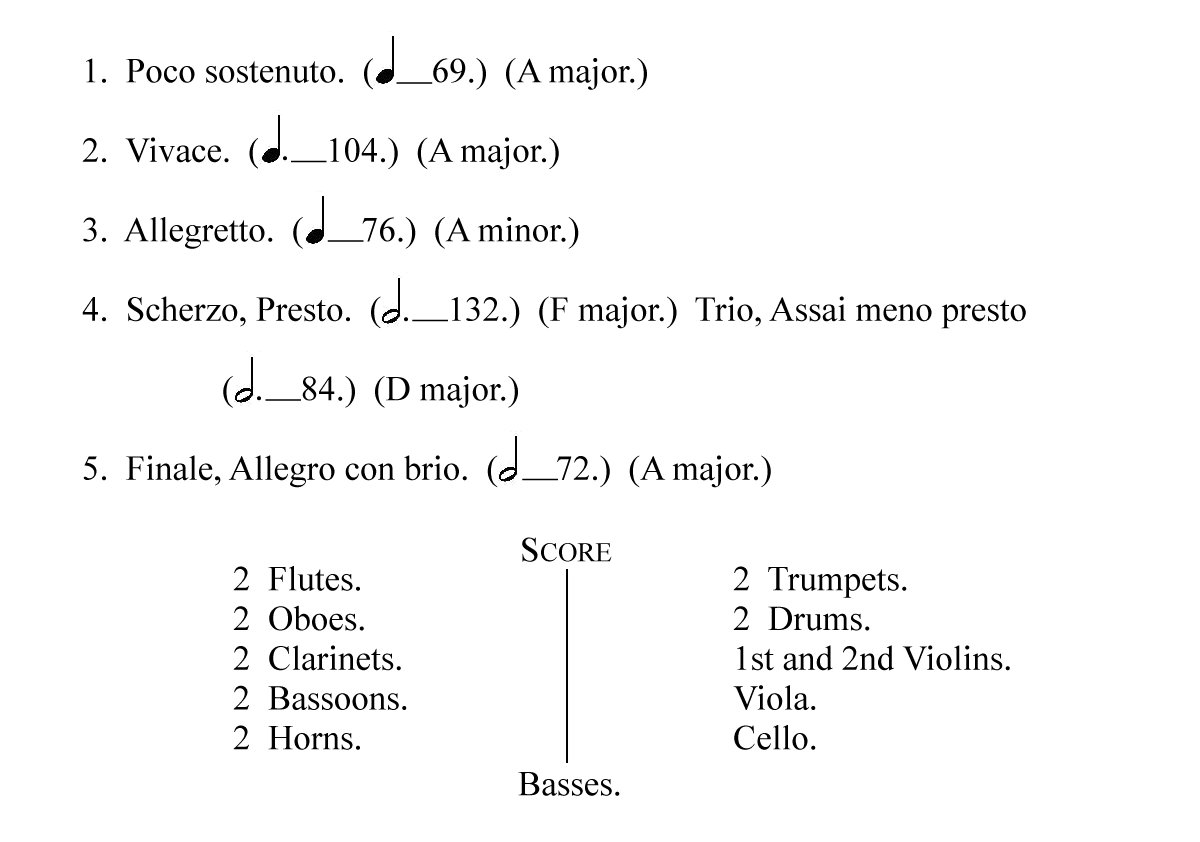
The Drums are tuned in A and E, except in the Scherzo, in which they are in F and A.
The parts appear to have been published on December 21, 1816. The score in a small quarto of 224 pages, lithographed, and published by S. A. Steiner & Co., Vienna. A poor edition. [1]
'Siebente Grosse Sinfonie in A dur von Ludwig van Beethoven 92tes Werk. Vollständige Partitur. Eigenthum der Verleger. Preis 12 Fl. Wien im Verlag bei S. A. Steiner und Comp. So wie auch zu haben,' &c., &c.
[Page 2.] 'Dem Hochgebornen Herrn Moritz Reichsgrafen von Fries, Sr k: k: Apost: Majestät wirklichen Kämmerer, &c., &c., &c., in Ehrfurcht zugeeignet von Ludw: van Beethoven.' No. 2560.
A second and much better edition, folio, 180 pages, engraved, was published by Tobias Haslinger, of Vienna, in 1827.
The Seventh Symphony was completed in 1812, after an interval of four years from the termination of the 'Pastoral.' It was a longer time than had passed between any of the other Symphonies, and much had happened in it [2]. During the period of which we are speaking, though no Symphony was in progress, a large number of scarcely less important works were composed - The String Quartets in E flat (Op. 74) and F minor (Op. 95); the music to 'Egmont,' 'King Stephen,' and the 'Ruins of Athens'; the Choral Fantasia; the Solo-Sonata in F sharp minor, and that called 'Les Adieux, l'Absence, et le Retour'; the Trios in E flat and D (Op. 70); and in B flat (Op. 97); besides the Variations in D (Op. 76); the Fantasia, Op. 77; and the Sonatina, Op. 79.
The Overture in C, originally intended to embody Schiller's Ode, but which we know as Op. 115, was constantly receiving attention during the whole of the time in question, as is shown by the sketch-books [3]. The songs in Op. 75, 82, and 83 are more or less due to this date, and it was in 1810 that he began the numerous arrangements of Scotch, Welsh, and Irish songs for Thomson, of Edinburgh, which occupied him at intervals from 1810 to 1815, and though not requiring the highest flight of his genius, must have been sufficient to give a good deal of employment to so conscientious a workman as Beethoven. Thomson's proposal, made on September 17, 1810, that he should compose a cantata on Campbell's 'Battle of the Baltic,' is an interesting one, and it is a great pity that it was not carried out, as the words are very far above the usual standard of such libretti [4]; and since Beethoven's stipulation that they should not contain anything offensive to the Danes is thoroughly respected, there is every reason to think that he would have composed them con amore [5].
The engagement with Countess Theresa Brunswick, which took place in 1806, had been broken off, though it is impossible to say what way that event, or, indeed, any other event, affected Beethoven as a composer. During the four years a further development of his wonderful powers and equally wonderful style had taken place, another step towards the accomplishment of his great mission of freeing music from dependence on the mechanical structure in which it had grown up, and on the ingenuity of construction which was still considered one of its merits, and making it more and more the expression of the deepest and the most individual emotions of men's nature. Hitherto he had expressed in his Symphonies a very wide range of feelings, but he had not yet attempted what may be called moods and manners. In the opening movement of No. 5 he had shown himself severe and perhaps intolerant - what he did not approve of was crushed on the instant. In the Finale of No. 4 he is thoroughly gay and good humoured. But there was a temper or a mood which he had not yet tried in his compositions, and that is the boisterousness in which, as life went on, he was prone to indulge in his personal intercourse, both in writing and action. His letters always more or less abounded with rough jokes, puns, and nicknames; and similarly his personal intercourse was of a very free 'unbuttoned' [6] description. To name two instances. When he came to dine en famille with his old friend Breuning, as he often did, if he had come through the rain, the first thing to do on entering the dining-room was to take off his broad-brimmed felt hat and dash the water off it in all directions, regardless of the furniture or the inmates. When his brother, shortly after buying an estate, left a card on Ludwig containing the words, 'Johann van Beethoven, Landed proprietor,' it was swiftly returned by one inscribed, 'Ludwig van Beethoven, Brain proprietor': and there are many such instances. But, characteristic as these rough traits are, they had not yet made their appearance in his music. The time was now come; and this constitutes a real difference between his first six Symphonies and the seventh and eighth, inasmuch as these two are more or less permeated by the rough humour which we have just been mentioning, as a part of his nature which was bound to show itself sooner or later, and the occurrences of which we shall point out as they arise. Here it will be sufficient to notice it in a general way, and to say that when this boisterousness is combined with the force and character which are exhibited in the preceding six of these great works, as it is in the Finale of No. 7 and the opening and closing movements of No. 8 - the effect is indeed tremendous. Other occurrences may have some bearing on the increasing joviality of his expression. We must remember that to balance the breach with Countess Theresa in 1810 it was in the same year that he made the acquaintance of Bettina von Arnim, who, with all her exaggeration and false sentiment, evidently made a strong impression on his susceptible nature. 1810, too, was the date of the appearance of Hoffmann's criticism on the C minor, which was perhaps the first piece of reasonable sympathy from the outside world that had reached him, and must surely have affected him considerably.
Beethoven recorded the exact date - probably of his beginning to score the work - on the right-hand top corner of the first page of his manuscript, now in the possession of Mr. Ernst Mendelssohn-Bartholdy, nephew of the composer, who lives in the old family banking-house, 53, Jägerstrasse, Berlin; and if the MS. were still intact there would be no difficulty in ascertaining it. But a wretched binder has cut down the top and front of the page so far that at present the following only can be inferred: - 'Sinfonia. L. v. Beethoven, 1812; 13ten. . . .' Then follows the loop of a letter which may have belonged to either May, June, or July [7]; and this agrees with Beethoven's own statement in his letter from Teplitz, July 19, 1812, to Varena - 'A new Symphony is now ready.' It was Beethoven's habit, as we know, to reduce the materials of his great works to their final form in Vienna, during the winter and early spring months. Their real composition - if one part of so complex an operation can be distinguished from another - took place during the excursions which, with few exceptions, he regularly took in the summer into the country more or less near the Austrian capital. In 1811 he went farther afield than usual. He was kept in town till an unusually late date, but by the end of August or beginning of September he was at Teplitz, a watering-place fifty miles or so North-west of Prague; and there, in the midst of an intellectual and musical society, he seems to have enjoyed himself thoroughly. Varnhagen von Ense and the famous Rahel, afterwards his wife, were there; the Countess von der Recke from Berlin [8]; and the Sebalds, a musical family from the same city, with one of whom, Amalie, the susceptible Beethoven at once fell violently in love, as Weber had done before him; Varena, Ludwig Löwe the actor, Fichte the philosopher, Tiedge the poet, and other poets and artists were there too [9]; these formed a congenial circle with whom his afternoons and evenings were passed in the greatest good-fellowship and happiness; and here, no doubt, the early ideas of the Seventh Symphony were put into score and gradually elaborated into the perfect state in which we now possess them. Many pleasant traits are recorded by Varnhagen in his letters to his fiancée and others [10]. The coy but obstinate resistance which Beethoven usually offered to extemporising he here laid entirely aside, and his friends probably heard, on these occasions, many a portion of the new Symphony which was seething in his heart and brain, even though no word was dropped by the mighty player to enlighten them. In his letters of this time he is, as usual, quite dumb as to what was occupying him. The sketch-book of the Symphony, now in the Petter collection at Vienna, and fully analysed by Nottebohm in the Zweite Beethoveniana, p. 101, &c., gives apparently no information as to date or place; but on this head there need be little doubt.
It is a curious fact that three of Beethoven's great orchestral works should be more or less closely connected with Napoleon Bonaparte. His share in the 'Eroica' we have already described; the piece entitled the 'Battle Symphony' (Op. 91) was written to commemorate one of the greatest defeats ever sustained by Napoleon's army, that of Vittoria; and the Seventh Symphony, if not written with a view to the French Emperor, was first performed in public on December 8, 1813, in the large hall of the University of Vienna, at a concert undertaken by Maelzel for the benefit of the soldiers wounded at the battle of Hanau, October 30, where the Austrian and Bavarian troops endeavoured to cut off Napoleon's retreat from Leipzig. But indeed he made no secret of his animosity towards the Emperor, and Mr. Thayer (ii. 313) has preserved a saying of his after Jena, to the effect that if he knew as much about war as he did about music he would somehow contrive to beat him. Much enthusiasm was felt in Vienna on the subject of the concert of December 8, and everyone was ready to lend a helping-hand. The programme also contained the 'Battle Symphony,' and two Marches, by Dussek and Pleyel, for Maelzel's 'Mechanical Trumpeter,' a strange mixture, though not unsuitable to the occasion.
Beethoven conducted the performance in person, hardly, perhaps, to its advantage, considering the symbolical gestures described by Spohr, since he was then very deaf, and heard what was going on around him with great difficulty [11]. The orchestra presented a striking appearance, many of the desks being tenanted by the most famous musicians and composers of the day. Haydn was gone to his rest [12], but Schuppanzigh, Romberg, Spohr, Mayseder, and Dragonetti were present, and played among the rank and file of the strings; Meyerbeer (of whom Beethoven complained that he always came in after the beat) and Hummel had the drums, and Moscheles, then a youth of nineteen, the cymbals. Even Beethoven's old teacher, Kapellmeister Salieri, was there, 'giving the time to the drums and salvos.' There was a black-haired, sallow, thick-set, spectacled lad of fifteen in Vienna at that time, named Franz Schubert, son of a parish schoolmaster in the suburbs, and himself but just out of the Cathedral School. He had finished his own first Symphony only six weeks before, and we may depend upon it that he was somewhere in the room, though too shy or too juvenile to take a part, or be mentioned in any of the accounts [13]. The effect which the Symphony produced on him is perpetuated in the Finale to the remarkable Pianoforte Duet which he wrote ten years afterwards among the Hungarian mountains, and which since his death has become widely known as the 'Grand Duo, Op. 140.'
It was the good fortune of a young Austrian named Glöggl, afterwards an eminent publisher, to accompany Beethoven from his residence to the concert-room on the occasion of the second performance; and we are able, through his account, to catch a glimpse of the composer in somewhat novel circumstances. Glöggl had made his acquaintance some time before, had been admitted to the rehearsals, and had witnessed a little scene between the fiddlers and the great master. A passage in the Symphony was too much for them, and after two or three attempts they stopped, and were bold enough to say that what could not be played should not be written. Beethoven, wonderful to relate, kept his temper, and with unusual forbearance begged 'the gentlemen to take their parts home with them,' promising that with a little practice the passage would go well enough. He was right. At the next rehearsal it went perfectly, and a good deal of laughing and complimenting took place. But to return to our young Austrian. The tickets for the performance were all sold, and Glöggl would have been shut out if Beethoven had not told him to call at his lodgings at half-past ten the next morning. They got into a carriage together, with the scores of the Symphony and the Battle of Vittoria; but nothing was said on the road, Beethoven being quite absorbed in what was coming, and showing where his thoughts were by now and then beating time with his hand. No doubt he had his unapproachable moments, and Schumann was probably right in thinking that if Weber were in Beethoven's place he would be easier to talk to [14]. Arrived at the hall, Glöggl was ordered to take the scores under his arm and follow; and thus he passed in, found a place somewhere, and heard the whole concert without difficulty [15].
But to go back. The new works were both received with enthusiasm; the performance of the Symphony, says Spohr, was 'quite masterly,' [16] the slow movement was encored, and the success of the concert extraordinary. Schindler characterises the event as 'one of the most important in Beethoven's life, since, with the exception of a few members of the musical profession, all persons, however they had previously dissented from his music, now agreed to award him his laurels' [17]. The concert was repeated on the 12th of December, with equal success, including the encore of the Allegretto; and after this Beethoven showed his gratification by publishing, in the Wiener Zeitung, a long letter of thanks to his 'honoured colleagues' 'for their zeal in contributing to so exalted a result.' The Symphony was played again on the 2nd of January, as well as on the 27th of February, 1814, when it was accompanied by its twin brother, No. 8 (Op. 93, dated October, 1812). The two were published in December, 1816, and the popularity of Beethoven's serious works at this date may be inferred from the fact that these most serious ones were issued in no less than seven different forms [18]. The arrangement for piano solo is dedicated to the Empress of Russia, probably in recognition of the generous support which the Imperial family of Russia gave to the first performance.
Such was the reception of the new work in Austria. Not so in North Germany: when it reached Leipzig a few years later we have the published testimony of Friedrich Wieck, Madame Schumann's father, who was present at the first rehearsal. According to Wieck's recollection [19], musicians, critics, connoisseurs, and people quite ignorant of music, each and all were unanimously of opinion that the Symphony - especially the first and last movements - could have been composed only in an unfortunate drunken condition (trunkenen Zustande); that it was poor in melody, and so on. This, no doubt, was an honest opinion, but the 'whirligig of time brings in his revenges'! - A long respectful review of the work will be found in the Allg. musik. Zeitung, of Leipzig, Nov. 27, 1816 (p. 817), very soon after publication. What happened on its arrival in this country will be found at the close of these remarks.
Weber is said to have expressed his opinion, after hearing the Symphony, that Beethoven was now ripe for the mad-house. I have not been able to discover the reference; but remembering Weber's acrimonious remarks on Symphony No. 4, which have been already quoted à propos to that work, it is not difficult to believe it. In the autumn of 1823 Weber visited Beethoven in Vienna, on the occasion of the production of 'Euryanthe,' and then doubtless there was a rapprochement between the two men. But a Nemesis awaited Weber in reference to the Symphony in A. In 1826 he came to London to bring out his 'Oberon,' and while here had to conduct the Philharmonic Concert of April 3, the first piece in the second part of which was the very work which he had before so contemptuously censured!
À propos to this great composition, an interesting anecdote is given in Hiller's 'Mendelssohn.' Hiller and Mendelssohn, when the latter was sixteen, went to call on André, the well-known collector of Mozart's works, at Offenbach. André was a thorough conservative in music; even Beethoven was a doubtful novelty to him. This was in 1825. The great Viennese soon came on the tapis. 'The worst fault,' says Hiller, 'that André could allege against him was the way in which he composed. André had seen the autograph of the A major Symphony during its progress, and told us that there were whole sheets left blank, to be filled up afterwards, the pages before the blanks having no connection with those beyond them. What continuity or connection could there be in music so composed? Mendelssohn's only answer was to keep on playing movements and bits of movements from the Symphony, till André was forced to stop for sheer 'delight' [20]. It is a pleasant coincidence that Mendelssohn should afterwards have become the owner of the very autograph alluded to. A recent inspection of the manuscript shows that André was right in his statement. Four such blank pages occur in the first two movements - the Poco sostenuto and the Vivace; and there are several instances in the same movements of smaller blanks left in the course of the MS., as if for filling up afterwards, thus differing from Beethoven's usual procedure.
This is the only one of his nine Symphonies for which Beethoven chose the key of A: indeed, it is his only great orchestral work in that key. Mozart, too, would seem to have avoided this key for orchestral compositions, out of his forty-nine Symphonies only two being in A; and of his twenty-three Overtures only one - the 'Oca del Cairo.' Of nine Symphonies of Schubert and five of Schumann (including the Overture, Scherzo, and Finale), not one is in this key. But, on the other hand, of Mendelssohn's five published Symphonies, both the 'Scotch' and the 'Italian' are in A, as is also the 'Walpurgis Night.' Beethoven had his idiosyncrasies on the subject of keys. B minor he calls a 'black key' (schwarze Tonart), and evidently avoided [21]; and he wrote to his Scotch publisher, who had sent him an air in four flats, marked amoroso, to say that the key of four flats should be marked barbaresco, and that he had altered the signature accordingly [22].
In 'form' the Seventh Symphony shows nothing that has not been already encountered in the previous six. The Introduction is more important even than that to No. 4, but it is no novelty here. The Codas to the Vivace and the Finale are hardly more serious than those in former Symphonies. The repetition of the Trio to the Scherzo, which increases the length of the movement to nearly double what it would have been under the original plan, had been already introduced in No. 4. Here, and in the eighth, the sister Symphony to that now before us, Beethoven has substituted an Allegretto for the usual Andante or Larghetto - though beyond the name the two Allegrettos have no likeness whatever. It is not in any innovation on form or on precedent of arrangement that the greatness of the Seventh Symphony consists, but in the originality, vivacity, power, and beauty of the thoughts, and their treatment, and in a certain new romantic character of sudden and unexpected transition which pervades it, and which would as fairly entitle it to be called the 'Romantic Symphony' as its companions are to be called the 'Heroic' and the 'Pastoral,' if only Beethoven had so indicated it - which he has not. In the Finale, as we shall see, this 'romance' develops into a vein of boisterous mirth, of which we have no example in any of the earlier Symphonies.
What the qualities are which give the impression of size in a musical work it is difficult to say; but this Symphony certainly leaves that impression on the hearer, to an extraordinary degree; as much - though the two works are so different - as Schubert's great Symphony in C does. What is it that makes the impression? not the force, for that we have in its utmost in No. 5; nor the dignity, for that is one of the great characteristics of No. 3; nor the passion, for that is the attribute of No. 4; nor the pleasantness of the sound, for in that nothing can exceed No. 6. Whatever it is - and who shall tell? - there is no doubt that the mental image raised by No. 7 is larger than that of any of its predecessors. 'How the orchestra is treated! what a sound it has!' said Mendelssohn, and no doubt that is partly, though not all, the explanation [23].
This noble work opens with an Introduction, Poco sostenuto, far surpassing in dimensions, as well as in breadth and grandeur of style, those of the first, second, and even fourth Symphonies, the only others of the immortal nine which exhibit that feature. In saying this, it is impossible not to think of Schumann's remark. He says, in speaking of Brahms: 'Let him remember the beginnings of Beethoven's Symphonies, and try to do something like them. The beginning is the main thing. When you have once begun, the end comes of its own accord' [24]. His Introductions - like his Codas - are among Beethoven's most remarkable extensions of the plan of the Symphony; and with this particular movement he may be said to have established a proceeding which he had essayed in the first, second, and fourth of his own Symphonies, and which has been since adopted in the splendid introductions to Schubert's C major, Mendelssohn's 'Scotch,' Schumann's C major, and Brahms's C minor Symphonies.
I. The Introduction starts with a short chord of A from the full orchestra, which lets drop [25], as it were, a melodious phrase in the first oboe, imitated successively by the clarinet, horn, and bassoon -

This, after eight bars (by which time it has for a moment entered the remote key of F major), is interrupted and accompanied by a new feature - scales of two octaves in length, like gigantic stairs, as someone calls them, and alternating with the phrase in minims during seven repetitions -

This conducts to a third entirely new subject in the key of C major, given out by clarinets and bassoons thus -

The
dignity, originality, and grace of this third theme,
especially when repeated pianissimo
by the fiddles, with a graceful
descending arpeggio
to introduce it, and a delicious accompaniment in
the oboes and bassoons, as thus -

- are quite wonderful [26].
Beethoven gets
back out of the key of C by one of those sudden changes which are so
characteristic of this Symphony, and the scales (No. 2) begin again in
the treble and bass alternately. They land us in F, in which the third
subject (No. 3) is repeated by both wind and strings; and then, by the
charming phrase which finishes our quotation, the original key is
regained -
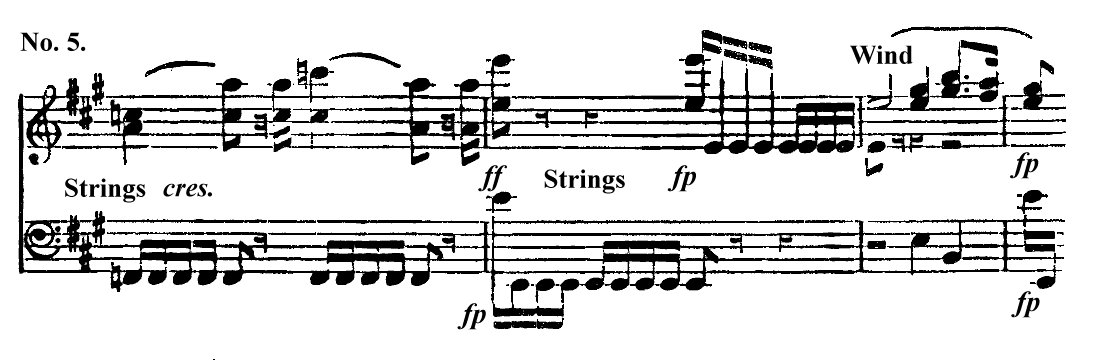
- and in seven bars more the Introduction ends.
Then comes the First Movement proper, the Vivace; and the transition from the Introduction to it, by an E sixty-one times repeated, and echoed backwards and forwards between the flutes and oboes and the violins, mixed with pauses and with groups of semiquavers, for which the last quotation has prepared us - a passage now listened for with delight as one of the most characteristic in the work - was for a long time a great stumbling-block to the reception of the Symphony both in London and Paris. It gave Beethoven some trouble, and sketches for it are quoted in Zweite Beethoveniana, page 106.
II. The Vivace itself, 6-8, into which the passage just alluded to leads, is a movement of wonderful fire and audacity. Berlioz, in his 'Etudes sur Beethoven,' wishes us to believe that it is a Ronde des Paysans, and would have been so entitled if Beethoven had disclosed his intention, as he did in the 'Pastoral.' But this is only another instance of the strange want of accuracy (to call it by no worse name) which detracts so much from the value of Berlioz's interesting comments. The statement is a mere invention of his own, and is entirely destitute of any authority from the composer. The principal theme, in its character and in the frequent employment of the oboe, has no doubt a quasi-rustic air; but, whatever it may be at the outset, there is nothing rustic about the way in which it is treated and developed; on the contrary, the strains confided to it are not surpassed in distinction, variety, and richness in any of Beethoven's first movements. If the oboe was originally a beggar-maid she has here found her King Cophetua, and long before the end of the movement has mounted the throne.
Similarly Wagner calls the whole Symphony 'the Apotheosis (i.e., the deification) of the Dance [27]; the Dance in its highest condition; the happiest realisation of the movements of the body in an ideal form.' But surely this is, to say the least, much exaggerated. Few will not feel indignant at the 'Programme' with which Rubinstein is said to have illustrated the pace and the expression of the different sections of the Funeral March in Chopin's B flat minor Sonata, which was lately revived at a Piano Recital in London: 1. The procession to the grave; 2. (Trio) A hymn sung over the remains; 3. The return of the mourners. But outrageous as this is, it is hardly more outrageous than Berlioz's proposal. All great creations of the intellect, however, whether Shakespeare's or Beethoven's, poems or symphonies, are liable to such vague and violent interpretations as these. A list of nearly a dozen of the interpretations that have been hazarded à propos to this is given by Brenet, and is sufficiently amusing if it do not evoke a stronger feeling of annoyance [28]. But surely some practical clue should be given to the grounds on which such violent attempts are based. For our purpose it is enough to say that the Symphony is throughout perhaps more markedly rhythmical than any other of the nine, and that there is no warrant for any such interpretations.
To proceed with the Vivace. After four preliminary bars the theme is thus given out by the flutes, with an extraordinary elasticity which distinguishes the entire movement -

It
is both difficult and presumptuous for anyone to compare
masterpieces so full of beauty and strength, and differing so
completely in their character, as the nine Symphonies of Beethoven;
but if any one quality may be said to distinguish that now before us,
besides its rhythmical construction, it is perhaps, as has already been
hinted, that it is the most romantic
of the nine, or, in other words,
that it is full of swift unexpected changes and contrasts, exciting the
imagination in the highest degree, and whirling it suddenly into new
and strange regions. There are some places in this Vivace where an
instant change occurs from fortissimo
to pianissimo,
which have an
effect unknown elsewhere. A sudden hush from ff to pp in the full
hurry
and swing of the movement is a favourite device of Beethoven's, and is
always highly effective; but here, where the change from loud to soft
is accompanied by a simultaneous change in harmony, or by an
interruption of the figure, or a bold leap from the top to the bottom
of the register - the most surprising and irresistible effect is
produced. Two such passages may be quoted -

-
and then the following, with its beautiful variant four bars
later: -

In the second example the resolution of the harmony (the F sharp and E in the violins on to F natural) is an invention of Beethoven's, and adds greatly to the effect of the plunge through two octaves, and the sudden hush in the tremolando. (An analogous effect will occur to many hearers in the third Overture to 'Leonora' - a work which surely deserves the epithet of 'romantic' if anything in music does - near the beginning of the Allegro, at an abrupt transition from the key of C major to that of B minor, accompanied with a change from loud to soft.) But, indeed, this Vivace is full of these sudden effects - especially in its second portion; and they give it a character distinct from that of the opening movements of any of the other Symphonies.
What can be more arresting, for instance, than the way in which, at the beginning of the second half of the movement, immediately following the double bar, after a rough ascent of all the strings in unison, fortissimo, enforced in the intervals by the wind, also fortissimo and on a strong discord, and accented in a most marked manner by two pauses of two bars each, as if every expedient to produce roughness had been adopted - the first violins begin whispering pianissimo in the remote key of C major, and the basses, four bars later, continue the whisper in a mystic dance up and down the scale, all soft and weird and truly romantic? None the less so because of the vague chord (a 6-4) on which the basses enter.
We quote a few bars as a guide to the place -
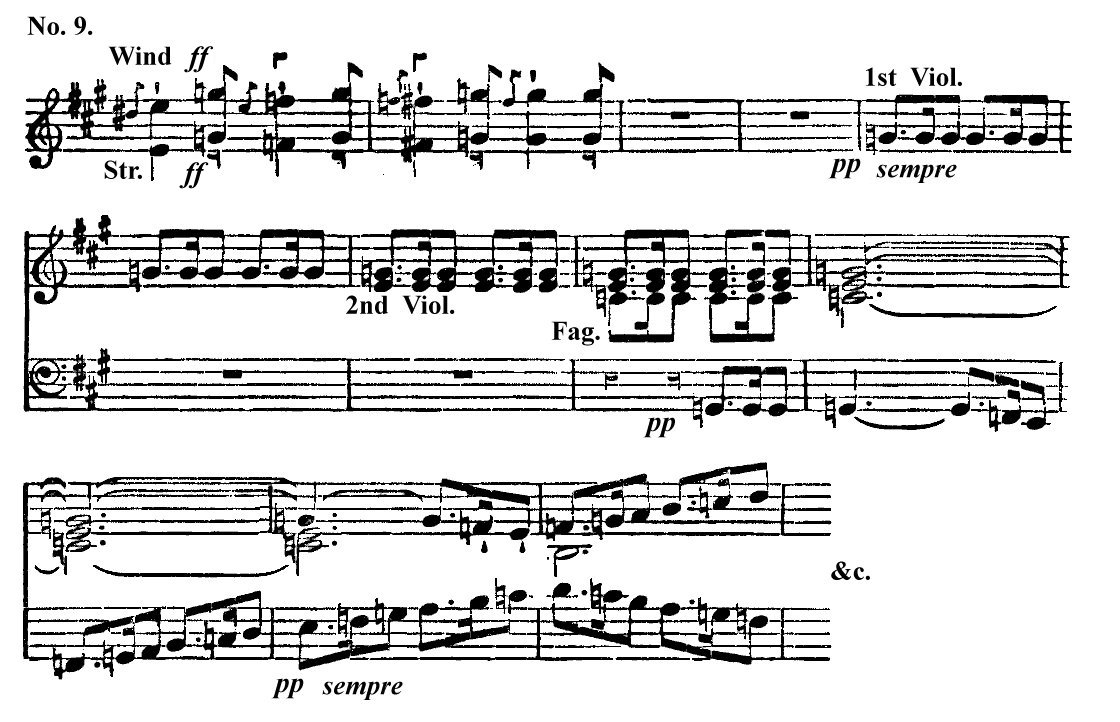
The scale passage is continued in strings, oboe, flute, and bassoon, successively, all pianissimo, with truly delightful feeling.
Another example
of the same arresting
romantic effect is the sudden change from the chord of C sharp minor to
that of E flat, earlier in the movement -

with the subsequent no
less rapid escape into E natural.
Another is the very emphatic passage of the violins, with which the two parts of the 'second subject' are divided; like a blow into which Beethoven has put all his strength -

The
second subject itself begins as follows -

and, recurring to the former rhythm, proceeds -

stamping
itself effectually on the memory by the passage quoted as No. 11. and
by the broad massive phrase (a)
in which the subject itself is
accompanied by the whole of the strings in unison.
The
reprise
of
the first section of the movement, after the working-out (which begins
with our quotation, No.
9),
is
an astonishing instance of variety and
skill. It is the same length as the first section, and the melodies are
mostly the same, but treatment, instrumentation, feeling, all
absolutely different. The same freedom is here shown that has already
been noticed in the analogous portions of No.
5 and No.
6
- the
same
adherence to the broad general lines of the structure with constant
novelty in the details. Thus, at the return to the original key of A,
after the working-out, the four bars of high E's, which at the
beginning precede the first subject, as given in quotation No. 6, are
now occupied by a preliminary offer [29]
at the subject by a playful
scale of semi-quavers in the strings, twice given until the theme
itself is reached: -
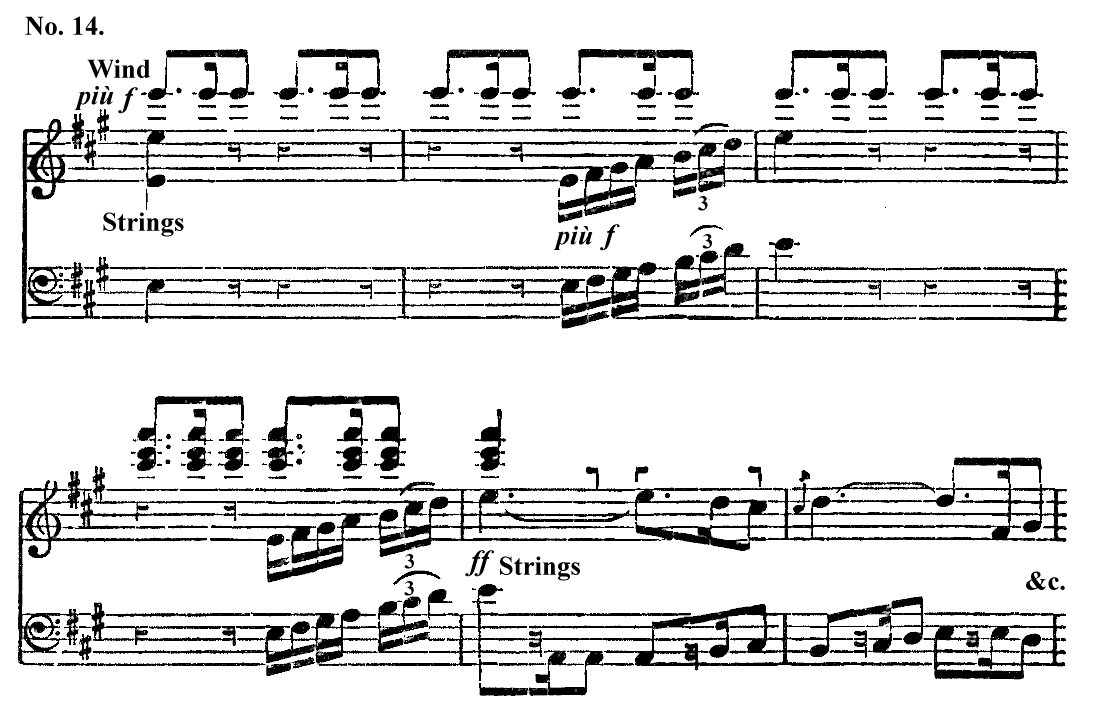
The scales are given again twenty-three bars later in
the oboe alone. This is a specimen of the freedom shown in this
movement and for which the reader must examine the score for himself.
Again, the first Tutti, after the pause, where the violins originally led the entire band, sempre fortissimo (after the end of quotation 6), in the reprise is changed to an oboe solo dolce, with quiet harmonies in the strings, and with imitative accompaniment in the flutes, clarinets, and bassoons, forming, with the silvery tones of the oboe, a combination of extraordinary beauty. And this, again, is followed by a passage of broad chords in the strings, and staccato notes in the bass -
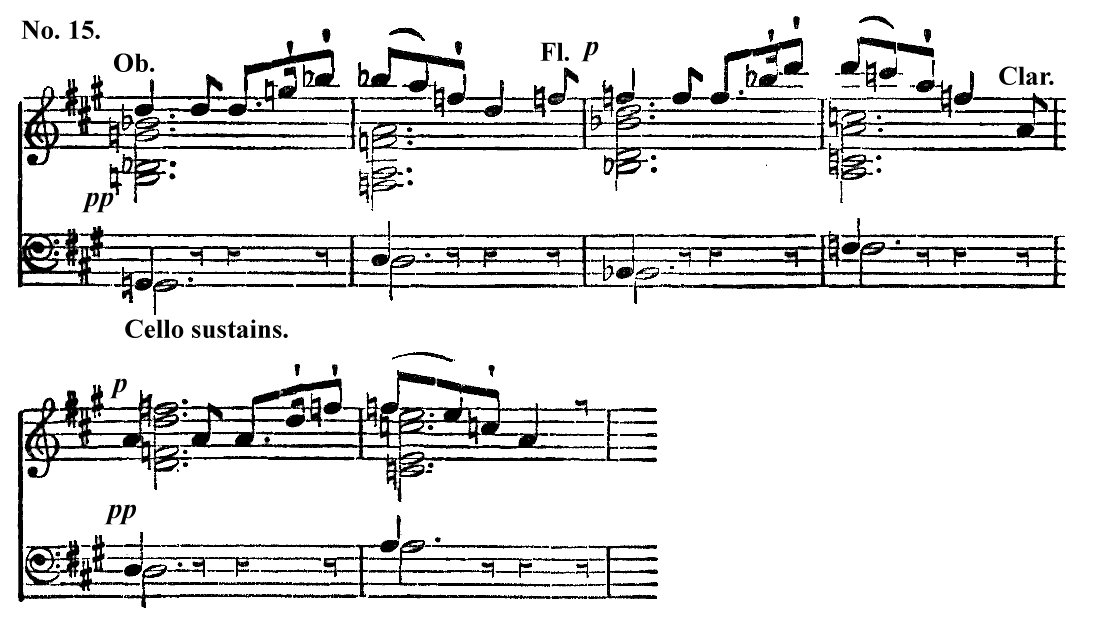
The
rhythm is marked as strongly as possible throughout the
movement, and there is hardly a bar which does not contain its two
groups of dotted triplet-quavers, varied and treated in the most
astonishingly free and bold manner.
When Beethoven does abandon it, in
the Coda
at the close of the movement, it is to introduce the
celebrated passage which at one time excited the wrath and laughter of
the ablest of his contemporaries, though now universally regarded as
perfectly effective, characteristic, and appropriate. In this passage
the violas and basses repeat the following two-bar figure (in the bass)
ten times, for twenty bars -
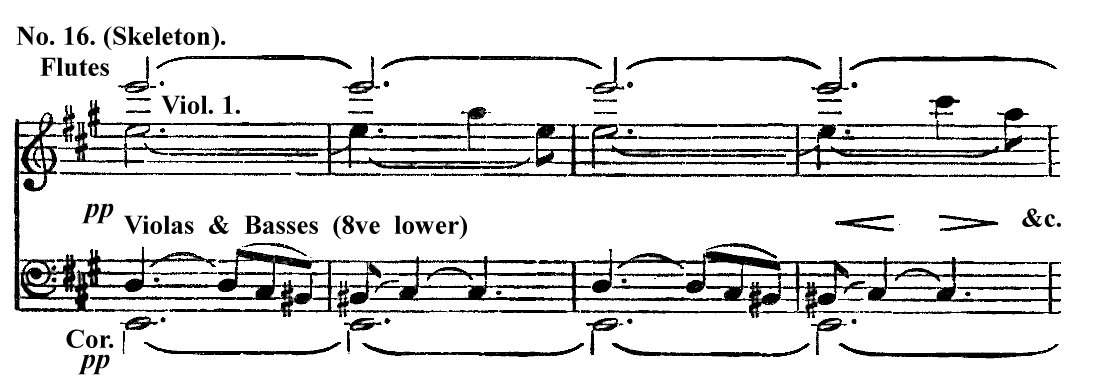
increasing in force throughout from
pianissimo
to fortissimo
- against a 'pedal point' on E in
the rest of the orchestra, four
octaves deep, from the low horns to the
high notes of the flute. It was for this that the great Carl Maria von
Weber is said to have pronounced Beethoven 'fit for a madhouse.' Such
mistakes are even the ablest, best instructed, and most genial critics
open to!
III.
Not less strongly marked or less
persistent than
the Vivace
is the march of the Allegretto,
which is all built upon the
following rhythm -

or, to use the terms of metre, a dactyl and a
spondee

This theme was originally intended for the
second movement of the third Rasumoffsky Quartet - in C (Op. 59, No. 3)
- and is to be found among the sketches for that Quartet
in 1806 [30].
Here, again, there is hardly a bar in the movement in which the perpetual beat of the rhythm is not heard, and yet the feeling of monotony never intrudes itself, any more than it does in the Pastoral Symphony. This is the opening -

The dashes and dots are here given as they are in the MS. at Mr. Mendelssohn's house, and in the edition of Haslinger. In Breitkopf's complete edition dots are substituted for the dashes throughout. Surely this should not have been done without a note to call attention to the change. But to resume.
The
movement is full of melancholy beauties; the vague soft
chord in
the wind instruments with which it both begins and ends; the incessant
pulse of the rhythmical subject just spoken of; the lovely second
melody in accompaniment to that last quoted -

which turns out to
have been concealed under the first subject [31]
- a chain of notes linked
in closest succession, like a string of beauties hand-in-hand, each
afraid to lose her hold on her neighbours; it begins in the violas as
a mere subordinate accompaniment, but becomes after a while the
principal tune of the orchestra. More striking still, perhaps, is the
passage where the clarinets come in with a fresh melody (note the
delicious syncopations), the music changing at the same time from A
minor to A major, the violins to a light triplet figure, and the effect
being exactly like a sudden gleam of sunshine [32]
-
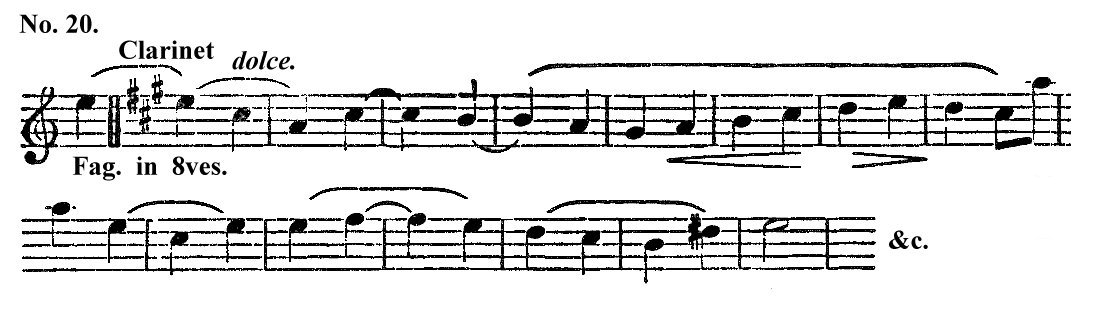
One of the interests of this passage is that it may have suggested a
similar beautiful change (in the same key) in the Andante con moto of
Mendelssohn's 'Italian' Symphony. At any rate, Beethoven himself
anticipated the change seven years before, in the Intermezzo of the
Funeral March in the 'Eroica,' where the oboe preaches peace and hope
as touchingly as the clarinet does here, with a similar change of mode
too, and a similar accompaniment in the strings. Even this short
relief, however (but thirty-seven bars), does not appear to please the
composer: we seem to see him push the intruder away from him with an
angry gesture of impatience -

and almost hear him exclaim, 'I won't have it,' as he
returns to the key of A minor, and to the former melody (No. 18),
given
in three octaves by the flute, oboe, and bassoon, with a semiquaver
accompaniment in the strings. During this, as well as during the truly
heavenly melody which we have been describing and quoting (No. 20), the
bass, with a kind of 'grim repose,' keeps up inexorably the rhythm -

with which the movement started, the
One fatal
remembrance, one sorrow that throws
Its black shade
alike
o'er our joys and our woes, [33]
and maintains it even through the fugato
which so effectively continues
the latter half of the movement -

The fugato is as strict as if its composer had not been Beethoven, but some mediaeval maker of 'canons,' to whom structure was everything and fancy nothing.
No wonder that this Allegretto was encored at the first performances of the Symphony, or that it was for long one of the few of Beethoven's movements that could be endured in Paris. 'La septième symphonie,' says Berlioz, 'est célèbre par son Andante [34]. En parlant de Beethoven en France, on dit l'Orage de la Symphonie Pastorale, le Finale de la Symphonie en ut mineur, l'Andante de la Symphonie en la.' It is even said that Beethoven's Second Symphony in D could only be tolerated when this Andante (or, more accurately, Allegretto) was substituted for its own most beautiful and graceful Larghetto. Very good for those early days, but the Concerts Populaires should have cured the Parisians of such absurdities.
Beethoven appears in the latter part of his life to have been very anxious that this movement should not be taken too fast, and even to have wished that the tempo should be changed to Andante quasi Allegretto. See the subject discussed in Nottebohm's Beethoveniana, page 21. There can be no doubt that we now often play his music faster than he intended, or perhaps than the orchestras of his day could play it.
IV.
The fourth movement, Presto, with its
subsidiary Presto meno
assai
(not entitled Scherzo
and Trio,
though they are so in effect), one of
Beethoven's greatest achievements in a field peculiarly
his own, is no less original, spirited, and entraînant than the
two
which have preceded it. As in No. 4, the Trio is twice given
[35].
The movement opens in the key of F; but before the first twenty bars
are over it is in A, in which key the first division ends -
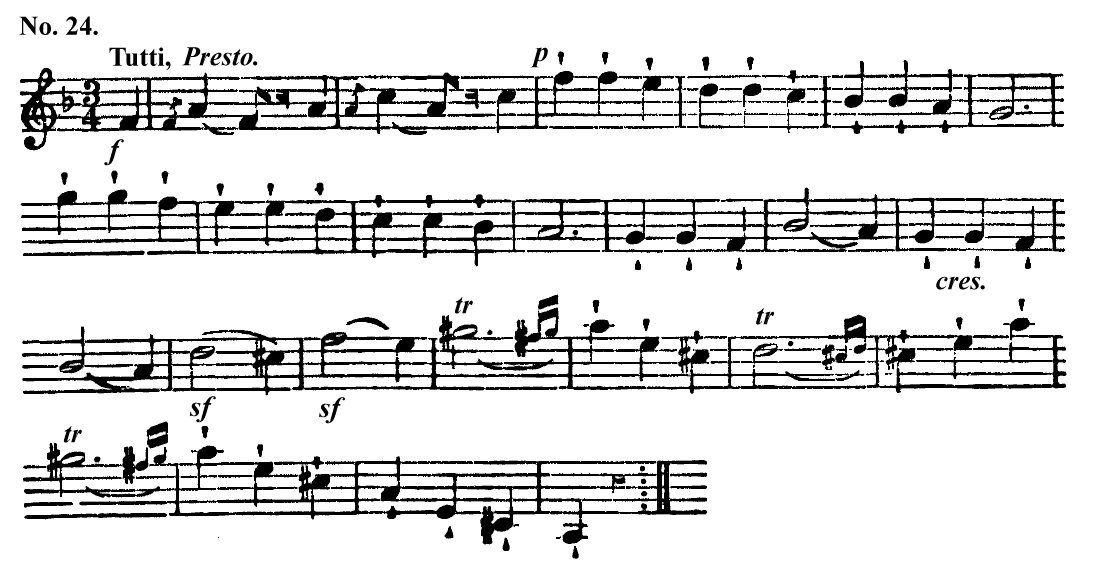
Out
of this region Beethoven escapes by a daring device -

- which
brings him at a blow into C, and pleases him so much that he
immediately repeats the operation in the new key, and so gets into B
flat. The whole of this Scherzo
is a marvellous example of the grace
and lightness which may be made to play over enormous strength, and
also of Beethoven's audacity in repeating his phrases and
subjects.
In analysing Symphony No. 1, in C, and speaking of its so-called Minuet - which is really a Scherzo - we said that it has features which prove its relationship to the Scherzos of the later Symphonies. Here is one of them, as will be seen by a comparison of the following passage from the Minuet of 1800 with the quotation just given -

The Trio - Presto meno assai (slightly slower) - is an absolute contrast to the Scherzo in every respect. It is one of those movements, like the Andante in the G major Piano Concerto of this great composer, which are absolutely original, were done by no one before, and have been done by no one since. It begins with a melody (which it is difficult to believe was not floating in Schubert's mind when he wrote the first phrase of his Fantasie-Sonata in G, Op. 78, for piano solo) in the clarinets, accompanied as a bass by the horns and bassoons, and also by a long holding A in the violins. Of this we quote an outline of the first portion. The key changes from F to D: -

This melody we now know, on the perfectly trustworthy authority of the Abbé Stadler [36], to have been a pilgrims' hymn in common use in Lower Austria, and is an instance of Beethoven's indifference to the sources of his materials when they were what he wanted, and would submit to his treatment. (See earlier). The melody is repeated by the oboes, with a similar accompaniment.
The
second portion of the Trio
is in keeping with the first.
The long
holding A is maintained -
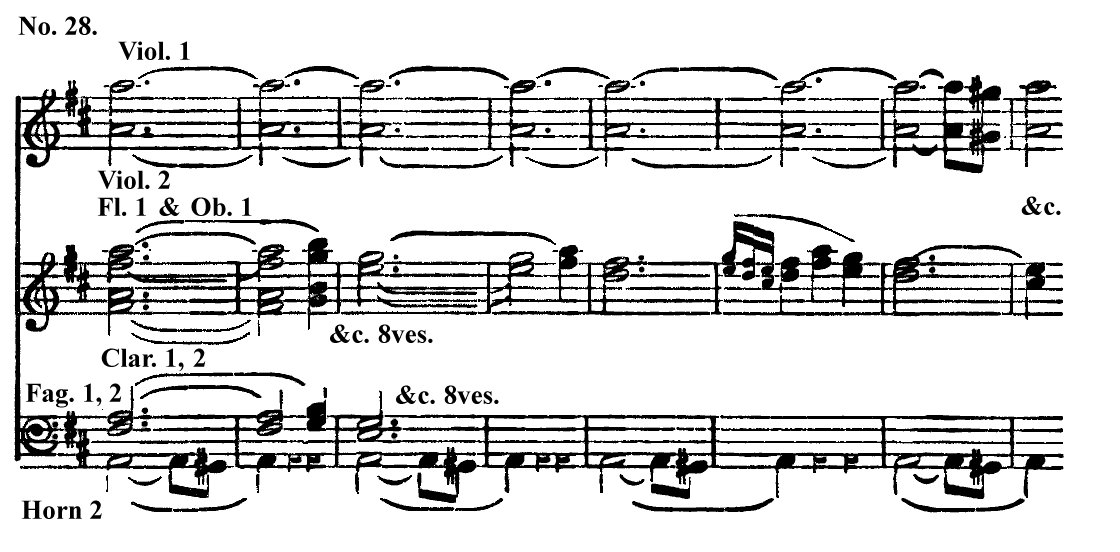
but the horn soon takes a more marked part than before, a 2-4 phrase
forced into 3-4 rhythm, and gradually increasing in
oddness and prominence [37]
- a little less perhaps now than in the days of the old
French horns (when a horn was an individual, a person, and not a mere
orchestral instrument, as the valve-horn is) -

- till it brings back the first portion of the tune, this
time in the
full band. The return from this (key of D) to the Scherzo (key of F),
through a C natural ppp,
is as strong, as affecting, and as 'romantic' a point as can be found
in the whole Symphony -

The music seems almost to go
out, as if it were a flame.
Powerful as he always is, Beethoven is never more a magician than when he has the horns to conjure with. We have mentioned one most touching passage in the Trio of the Eroica; and the horn does miracles in the Adagio of the Ninth Symphony.
V. The Finale forms an extraordinary climax to all that has gone before it. In the second and fourth Symphonies we have called attention to Beethoven's curious wilfulness, and disregard of the conventionalities of others. The Finale of the fourth gives us a fine example of him when overflowing with fun; and the first and last movements of No. 5 show, as nothing else perhaps does, his extraordinary power, majesty, pomp, and strength. But all these are, if we may say so, within bounds. Though strange, they contain nothing which can offend the taste, or hurt the feelings, of the most fastidious. Here, for the first time, we find a new element, a vein of rough, hard, personal boisterousness, the same feeling which inspired the strange jests, puns, and nicknames which abound in his letters, and the rough practical jokes of his later years; a feeling which prompted him to insult the royal family at Teplitz, for no reason, apparently, but to perpetrate a practical joke on the sensitive courtier Goethe; a feeling which may lie at the bottom of the fugues of his later life. For this condition he himself had a special and expressive term - aufgeknöpft, or, as we should translate it, 'unbuttoned'; Schumann calls it hitting out all round, schlagen um sich [38]. 'Here,' says Wagner, 'the purely rhythmical movement, so to speak, celebrates its orgies.' [39]
The
movement shows its quality at the very outset. It is
marked Allegro
con brio, and it opens with four preliminary bars,
containing two great
explosions, thus -

and these are arranged not only so as to give them the most abrupt
effect, but also so as to sound what they are not. They are really the
chords of the dominant of A, whereas they sound as if they were the
tonic of E, and the D natural in the second explosion is, in effect, a
practical joke of the rudest kind. After this comes the first subject
of the Allegro,
strange, furious, and not attractive -
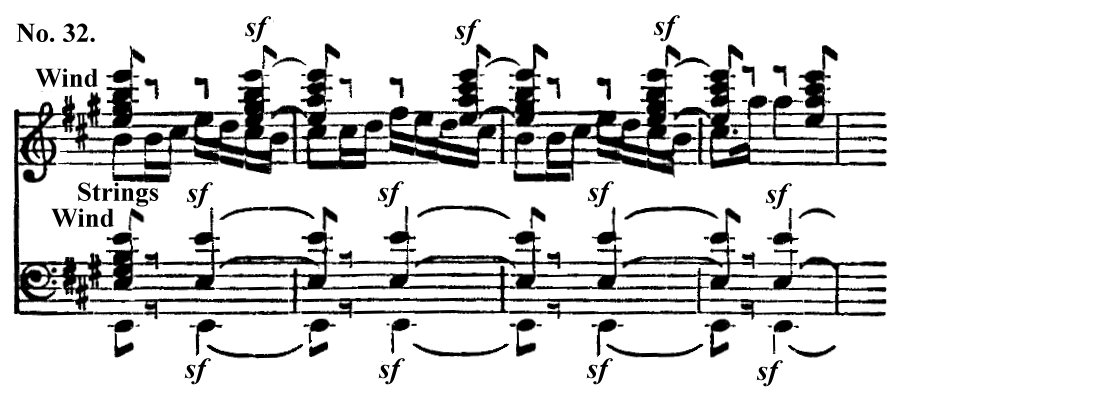
accented on the weak beat of the bar, and accompanied by loud chords,
extending through four octaves of the rest of the orchestra. The
sketch-book contains an early form of the figure [40]
-

and
another one, more like that actually adopted (see No. 32), will be
found in Beethoven's accompaniments to the Irish air 'Nora
Creina' [41]
-
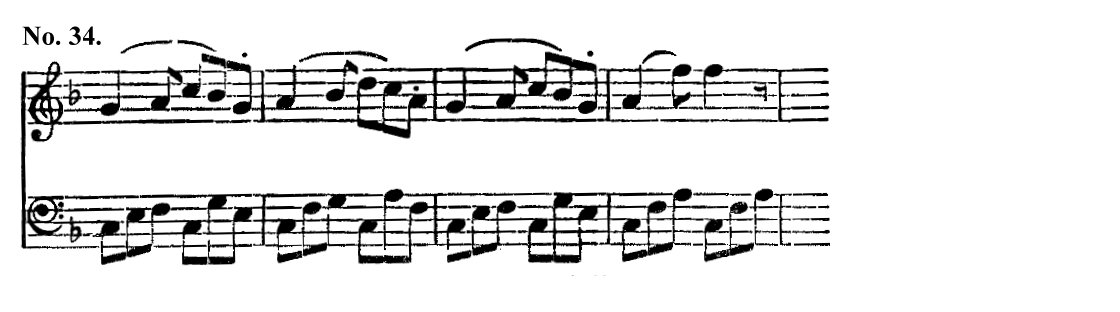
Whether the Song was composed before the Symphony, or the Symphony
before the Song, is a matter of doubt, Mr. Thayer's
chronological list only giving the general date 1810-1815 for
the whole of the national songs [42].
But inasmuch as the triplet figure and
the interval of a minor sixth are integral parts of both, and as the
phrase is so much stronger in the Symphony than it is in the song, the
song is probably the earlier of the two.
Then
after a reference back to the crashing chords of the
initial four
bars of the movement (No. 31), a new subject appears (beginning in the
wind and going on afterwards in the strings in double notes), as harsh
and uncompromising as the first subject (No. 32) -

This leads
into
a modification of the first subject -

which may have been in
Goetz's
mind when composing the Finale
to his Symphony.
This is continued in a series of phrases of dotted quavers, all hard and harsh, and ends in C sharp minor, in which key the 'second subject' proper appears, full of vigour and elasticity, and with more sentiment than the previous portion of the movement would have led us to expect -

Notice the humorous octaves in the bassoon, in bars 5, 7, and 9, and the force obtained by throwing the emphasis on to the latter half of the bar, and taking it off the former, in the last four measures of the quotation. In this rhythm there is some charming capricious work, from top to bottom of the scale among the strings, after which the first half of the Finale ends. The movement is in the ordinary Symphony form; the first portion is repeated, and then the working-out commences; and here the wild humour and fun distance anything that has gone before. The abrupt transitions and sudden vagaries (as in the last line of the next quotation, where the treble laughs at the bass, and the bass laughs back in return), like the rough jokes and loud shouts of a Polyphemus at play, are irresistible, and bring Beethoven before us in his most playful, unconstrained, and 'unbuttoned' state of mind. The force which animates these violent actions is nowhere else so overpoweringly manifested as here, unless it be in some parts of No. 8.

The force that reigns throughout this movement is literally prodigious, and reminds one of Carlyle's hero Ram Dass, who had 'fire enough in his belly to burn up the whole world.'
The state of mind which this movement reveals to us is apparently very characteristic of the extremely free and playful, though innocent, intercourse of the society at Teplitz in the autumn months of 1811. Some evidence of this is given by one of Beethoven's letters to Tiedge, dated Teplitz, 6th Sept., 1811, containing the following odd passage, in which he has curiously confounded his own personality with that of his correspondent. Tiedge had left with the ladies mentioned at the beginning of these remarks: 'And now,' says Beethoven, 'may you fare as well as it is possible for poor humanity to do. To the Countess (Recke) give a very tender but respectful clasp of the hand; to Amalie (Sebald) a very fiery kiss, when there is no one to see us, and we two embrace as men do who have the right to love and honour one another.'
Indeed the place was pervaded by a wonderful atmosphere of unrestraint. Varnhagen and Rahel may have been examples of the high ideal, but the following story admits us to a less formal school of attachment. Ludwig Löwe, the actor, whom we have already mentioned, had fallen in love with Theresa, the daughter of the host of the 'Stern.' The father heard of the attachment and questioned the lover, who thereupon, for the sake of the girl, discontinued his visits; but meeting Beethoven a few days afterwards and being asked why he had given up the Stern, he confessed what had happened, and asked the composer if he would take charge of a note to the young lady. Beethoven at once consented not only to do this, but to bring back the answer, and apparently acted as go-between during the remainder of his visit. The attachment was a perfectly honourable one, but Theresa died soon after Löwe had left Teplitz. . . . The story was told to Mr. Thayer by Marie von Breuning a few years ago [43]. Irregular conduct, no doubt; but such is the natural soil for fine music and poetry.
A
somewhat similar picture to that given in the last quotation
will be
found in the Coda
of the Finale
to the Eighth Symphony, which was
inspired by almost identical surroundings, and breathes throughout the
same spirit of almost reckless joviality. A gigantic, irresistible
humour pervades the greater part of the movement, till the arrival of
the Coda.
This portion of the movement exceeds in length any of its
predecessors. It is 124 bars long, and commences with the same feature
as that on which we commented at the outset of the Finale (No. 31), and
which indeed acts as the harbinger of each of its
main divisions. In this truly noble final section of his work, as the
great composer approaches the close of his labours, he lays aside for a
time his animal spirits and rough jokes, and surrenders himself to the
broader and more solemn impressions which always lay in his mind,
impressions graver even than those which inspired him during the
conclusion of the first movement, in connection with which we have
already referred to the passage we have now to consider. (See earlier.)
This is, like that,
a moving pedal, on E, alternating with D
sharp, and lasting for more than twenty bars. During the whole of
these, and the preceding passage of equal length, where the bass
settles down semitone by semitone till it reaches the low E -

the strings are occupied by imitations and repetitions of the original
figure (No. 31),
and the wind
by long holding notes, the whole forming
a passage of pathos, nobility, and interest rivalled only by the
passage which closes the opening movement of the Ninth Symphony. But
repose is no permanent mood of Beethoven's at this time. Beneath the
surface of this broad noble calm we seem to hear the elements of the
storm still working below in the recesses of the ocean and gradually
forcing their way to the top. The figure so incessantly repeated by the
two violins is in itself an incentive to more violent agitation.
As the
long pedal proceeds the sound rises always louder and louder until at
length it reaches a very unusual pitch of loudness (fff) - a truly
furious burst. The fourteen bars of this furious passage are then
repeated, and the two form an explosion without parallel in Beethoven's
music, or, indeed, in any music since. They fairly lift the hearer from
his seat, and form an unexampled climax to one of the most stupendous
movements in the whole range of music. After this, in a short time, the
Symphony comes to an end.
The entire contrast between the foregoing Symphony and this is truly extraordinary, perhaps the most remarkable that can be found in the whole series. We have more than once insisted on the distinct individuality of these wonderful works, and have drawn attention to the fact that each Allegro, each Andante, each Scherzo, each Finale has not even a family likeness to either of the corresponding eight movements [44]. But that so wonderfully calm and objective a work as No. 6 should be followed by music so vivacious energetic, and personal as that which we have just been attempting to consider, is indeed almost beyond comprehension. For this power no one can compare with Beethoven but Shakespeare.
The publication of the work seems to have caused Beethoven even more than usual trouble. The original edition of Steiner and Co., the quarto of December, 1816, is an ugly production, in every respect inferior to the well-engraved and careful octavos of the first six Symphonies. Nor was it merely slovenly, it was incorrect, and Mr. Thayer [45] has printed a letter from Beethoven to the firm on the subject, which is not pleasant to read: -
The matter of this Symphony is very annoying to me, since it is unfortunately the case that neither parts nor score is correct. In the copies which are already prepared the mistakes must be corrected in Indian ink, which Schlemmer [his copyist] must do; and a list of all mistakes without exception must also be printed and supplied. The score as engraved might have been written by the most clumsy copyist; it is an inaccurate, defective affair, such as has hitherto never appeared of any of my works. This is the consequence of your inattention to the corrections and of your not having sent it me for my revision, or not having reminded me about it. . . . You have treated the public with neglect, and the innocent author suffers in his reputation!
The passage in the Vivace (bar 109 after the double-bar) to which Mr. Joseph Bennett, on the information of Mr. Silas, called attention in the Daily Telegraph of July 22 and 29, 1893, and which was the subject of letters and remarks in the Musical Times of August, September, and October of the same year, is probably one of the passages of which Beethoven complains. In this bar the strings have the chord of A major and the wind that of D major.
The first performance of the Symphony in England took place at the Philharmonic on June 9th, 1817, so that the Society had evidently been on the watch and had procured the score immediately after its publication. There is a very fair notice for those days in the Morning Chronicle of June 16; but excepting the Allegretto, which is qualified as 'one of the most exquisite pieces of music that we know, and a perfect gem,' the work is not, in the opinion of the critic, 'in any way comparable to many others by the same writer.' This is hardly to be wondered at, and is of a piece with the opinions of the Paris critics, and even those of North Germany, which we have already noticed (see earlier). Beethoven was at this and later date much interested in English opinion. At a later date he took the English papers home with him, and read the debates on the slave trade with admiration, and was familiar with the names of Brougham and others. Now he seems to have consulted them only on musical topics. The 'Morning cronigle,' as he calls it, of March 22, 1816, had contained a notice of another of his Symphonies (probably the 'Eroica' or C minor [46]), which was performed at the concert of March 11; and he not unnaturally supposed that this was his No. 7, and wrote to Neate, then in London, on May 15 of the same year, enquiring about it. Neate, however, corrected his mistake [47], and the Symphony did not, as we have said, make its appearance here till the following year. A MS. note on this performance, by the late William Ayrton (one of the Founders of the Philharmonic Society), says: 'All except the movement in A minor (the Andante) proved caviare; but other beauties by degrees became patent, though a curtailment of at least ten minutes would improve it.' And this from a ripe and by no means reactionary musician! Seven years later the following paragraph appears in The Harmonicon, an excellent musical periodical, edited with great care and skill by the same writer: 'Beethoven's Symphony in A has before been mentioned in this work. Frequent repetition does not reconcile us to its vagaries and dissonances, though we admit the movement in A minor to be a chef d'oeuvre, and that which in our opinion alone secures to the other parts of the composition a hearing' (1824, page 122). What musician, now-a-days, would shorten the work by a semiquaver, or express so absurd an opinion as to the proportion of the Allegretto to the other movements?
After 1817 the Symphony does not appear in the Philharmonic programme for some years, and the next performance opened the first concert of 1821, on February 26. In Paris the first performance took place on March 1, 1829, at the second Concert of the Conservatoire for that season. It was repeated four weeks later, and thenceforward appears on the programmes with tolerable regularity.
In this glorious work there is no falling off. It has not perhaps the terrible directness which is characteristic of the C minor; but in variety, life, colour, elasticity, and unflagging vigour it is, if possible, superior to any of its predecessors, while, with all its force, length, and weight, no sense of weariness is produced; but notwithstanding its dimensions, in which it exceeds all but the Ninth, one hears the last bar with regret; it is animated by its wonderful author with that extraordinary and undying life of which he seems so fully to have possessed the secret.
It is a rare thing for Beethoven to mention his compositions in terms of praise or blame, but he has made an exception in favour of this Symphony. He names it twice - first in a letter to Salomon (June 1, 1815): 'A grand Symphony in A, one of my best works'; and again in an English letter to Neate, in which occur the words: 'among my best works which I can boldly say of the Symphony in A.'
N.B. - The two fff's mentioned earlier are given in the first edition (4to, lithographed, 1816), which certainly had Beethoven's full revision; but in the folio (engraved, 1827), of which the same is not so sure, they are given ff.

N.B. - In the second movement the Trumpets and Drums are silent, and the Horns become Corni in B flat basso. In the Finale the Drums are tuned in F, and in octaves.
First Edition, a small 4to, lithographed, a companion to No. 7. 'Achte grosse Sinfonie in F dur, für 2 Violinon, etc., von Ludwig van Beethoven, 93tes Werk. Vollständige Partitur. Eigenthum der Verleger. Wien, im Verlage bey S. A. Steiner und Comp.' 1816.
The parts were published also by Steiner (No. 2,571), in 1816, probably with those of No. 7.
Second Edition, large folio (No. 7,060), 133 pages, engraved, a companion to that of No. 7, published in 1827, by Tobias Haslinger, of Vienna.
The original manuscript of the Eighth Symphony, once in the possession of Herr Carl Haslinger of Vienna, and now in the Royal Library at Berlin, has fortunately escaped the destructive hands of the bookbinder, which inflicted so much damage on that of No. 7. It is inscribed by the composer 'Sinfonia - Lintz im Monath October 1812' - in other words, four months after May, 1812, usually accepted as the date of its predecessor. Beethoven's practice was to sketch his Symphonies during his summer holiday in the country, and to elaborate and score them in town during the winter and spring. He did this with No. 7; but the Eighth Symphony is an exception to the rule. The sketch-books show that it was begun immediately after the completion of No. 7 [1], and the Symphony must, therefore, have been finished in the astonishingly short period of time of four months! Nottebohm's verdict is that it was sketched in the main at the Bohemian baths, and completed at Linz [2].
Beethoven had now been suffering for some time. Of the nature of his ill-health we have no clear accounts. It was probably some aggravated form of indigestion. At any rate, it was now chronic [3], and sufficiently severe to take him again to Teplitz, where he had passed so pleasant a time in the preceding autumn; and there we find him on July 7, 1812, living at the Oak - 'in der Eiche' - whether an inn or a district does not appear - at No. 62 [4].
On his arrival Teplitz was full of people of rank, who had assembled there after the departure of the Emperor Napoleon for Russia [5], to consult over their common unhappiness; amongst them were Beethoven's friends, the Princes Kinsky and Carl Lichnowsky, and - what was of more interest to him - Goethe, Varnhagen von Ense, Bettina von Arnim, her brother Clemens Brentano, and her sister Frau von Savigny.
A
concert for the benefit of the town of Baden, near Vienna,
which had
recently been nearly burnt down, was given at Teplitz on August 6, and
in this Beethoven took much interest. He left before the end of the
month, by his doctor's orders, for Karlsbad. On the
road somewhere he encountered a postillion, whose command over his horn
struck him sufficiently to make him record a passage in his
note-book [6]:
-

At Karlsbad he
apparently met Goethe for the first time, and there he had the
well-known encounter with the Austrian royal family - a freak of
atrocious manners on his part, but probably intended more as a piece of
bravado for Goethe's benefit than for any serious disrespect to his
sovereign, or to rank in general, as it is usually interpreted. On
August 12 we find him at Franzensbad, and as his health did not improve
by the change he returned to Teplitz. There, to his great pleasure, he
found his dear friend of the previous summer, Amalie Sebald; he renewed
his love making, and a series of amusing notes to her have
been preserved, which testify to the unconventional nature of
their
friendship [7].
The attachment,
however, came to nothing, and she ultimately married a Prussian judge.
From Teplitz Beethoven proceeded to Linz on the Danube, a long journey, and on a very singular errand, his object being nothing else than to put an end to the irregular connection between his brother Johann and Miss Therese Obermeyer, a lady with whom Johann had for some time been living in his house there. What right Ludwig had thus to interfere with the most private concerns of his brother - a man nearly of his own age and independent in his circumstances - does not appear. It supplies a warrant for the expression contained in Goethe's letter about him [8], that he was 'an entirely uncontrolled (ungebändigt) person,' whose unexpected bursts - whether of noisy fury or equally noisy fun - must have been perfectly alarming, even to those who, like Zelter, had not so much sensitiveness as Goethe [9]. It is, however, certain that he invoked the aid of the bishop and magistrates of Linz, and that the police were actually authorised to expel the lady from the town. Anyone who recollects Beethoven's impetuosity and the fact that he was at this date extremely deaf, can realise the amount of excitement, wrath, and noise that must have accompanied this singular transaction. It seems to have led, at length, to nothing less than a personal combat between the two brothers. Johann, however, completely checkmated the furious Ludwig by marrying Miss Obermeyer on November 8. Beethoven's animosity to her continued to the end of his days, and 'Queen of Night' was one of the offensive epithets that he used in speaking or writing of her.
These turbulent proceedings did not, however, interfere with the composition of the Symphony, though they no doubt considerably coloured it. The room which he occupied at his brother's was a very pleasant one, commanding a wide view of the Danube and the surrounding scenery; and between this and the eminence called the Postlingsberg there was ample room for the walks which were so necessary to him, both for health and for the maturing of his compositions [10]. They would be enough to account for the boisterous character of the Finale if the music did not, with all its roughness, show an amount of good humour quite at variance with the savage nature of the disputes we have just been describing. But, indeed, it is exceedingly hazardous to attempt to connect Beethoven's music with the simultaneous events of his life. Two instances are enough to show this, and many others might be given. One is the fact that the despair of the letter of 1802, known as 'Beethoven's Will' (see Vol. 1 of 'Beethoven and his Nine Symphonies') was coincident with the satisfied, happy mood depicted in the Second Symphony, of the same date; and the other is the fact that the gay strains of the Finale to the great B flat Quartet (Op. 130) are actually dated with his own hand, 'November 6' (1826), when he was in the midst of most unpleasant surroundings at the house of this very brother at Gneixendorf, near Krems, in constant contact with the woman whom he hated perhaps more than anyone else in the world, and to whose marriage he had endeavoured to put a stop fourteen years before [11]. Inferences drawn from such external facts as to the compositions of the time are, however, as already said, at the best very doubtful. Some pregnant words of Lord Tennyson's, given in a recent work [12], seem to bear on this point - they are to the effect that people in general have no notion of the way in which 'we poets' go to work [13]; and if poets are thus inaccessible, how far more inscrutable must be the still more irritable and unaccountable race of musicians. Handel's bankruptcy and paralysis do not appear to have interfered with the freedom of his strains, any more than did Mozart's constant impecuniosity and other worries with the gaiety of 'Figaro' or 'Don Juan.' In literature we know that Walter Scott dictated some of his most dramatic scenes while rolling on the floor in the agonies of cramp in the stomach, and that he could not, on the arrival of the proofs, recollect at all what he had written with so much power a day or two before.
Beethoven had a great value for this Symphony. True, in writing to Salomon, Haydn's ancient entrepreneur, then living in London, on June 1, 1815, he speaks of it as 'a little one' (kleine Sinfonie in F), to distinguish it from the 'Grand Symphony in A, one of my most important' (grosse Symphonie in A, einer meiner vorzüglichsten), which he mentions with it in the catalogue of the music he had to dispose of. But this obviously refers to its length. 'Little,' perhaps, for indeed it is the shortest of the nine, except No. 1, and that is only a minute and a half shorter in performance; but in any other respect it is vast. It may be said of it, as has been said of Beethoven himself, who was shorter in stature than most men, that 'within that limited space is concentrated the pluck of twenty battalions.' How prodigious a work it is, no one knew better than he did, and his opinion of it may be judged from the words which he let drop after its poor reception (see later). That such appreciation was consistent with genuine modesty on the part of this wonderfully constituted being may well be believed. How truly modest he was at this very time is shown by one or two touching expressions in a letter addressed by him at this date to a very young lady-worshipper, 'Emilie M., from H.,' who, 'with the sanction of her governess,' had ventured to send him a letter-case, worked by herself, with a letter, in which she had obviously compared him to other great composers, to their disadvantage. His answer is one of the many precious relics which we owe to the devotion of Mr. Thayer [14].
'Töplitz, July 17, 1812.
'My dear good Emilie, my dear friend,
'My answer to your letter comes late; a heap of business and constant illness must be my excuse. The fact of my being here for the restoration of my health proves the truth of my plea. Don't take away their laurels from Handel, Haydn, and Mozart; they are theirs by right, but not so mine yet. Your letter-case shall be put by with many other tokens of esteem, which I don't yet deserve by a long way.
'Go on; don't only practise your art, but force your way into its secrets; art deserves that, for it and knowledge can raise man to the Divine. Should you, my dear Emilie, ever want anything, write to me without hesitation. A true artist has no arrogance; he sees with regret that art is limitless; he feels darkly how far he still is from the goal, and though he may be applauded by the public, he knows with sorrow that he is still far from the point where his good genius is shining like a too distant sun. No doubt I would rather come to you and your friends than to many wealthy people, who, with all their riches, can't conceal the poverty of their minds. If I ever am in H., I will come to you and your family. I know no other signs of superiority than those which betoken goodness, and where I find these there I make my home.
'If
you want to write, dear Emilie, address here - where I
shall still
remain four weeks - or to Vienna, it's all the same. Think of me as
yours, and the friend of your family.
At this time of life (forty-two) his love of fun and practical joking had increased so much on him as to have become a habit; his letters are full of jokes; he bursts into horse-laughs on every occasion; makes the vilest puns, and bestows the most execrable nicknames - and all this the most when he was most happy. In fact, he had an express term for this state of things, aufgeknöpft - i.e., unbuttoned - was his own word for it. And as what he had in his mind was bound to come out in his music, this comes out here more than anywhere else; indeed, the work might with propriety be called the Humorous Symphony - often terribly humorous; for the atmosphere of broad rough enjoyment which pervades the first and last movements is in the former darkened by bursts of unmistakable wrath, while every now and then there is a special stroke - such as the octaves of bassoon, drum, &c, in both first and last movements; the bar's rest and staccato notes which usher in the second subject in the first Allegro; the way in which, in the working-out of the same movement, the first subject is persistently shoved away each time it appears; the provoking Italian cadence which finishes up the Allegretto just as we want to hear the legitimate repeat; in the Finale the loud unmusical C sharps; the burst of laughter with which he explodes at the notion of making his Coda, according to practice, out of the previous material, and then goes off into entirely fresh subjects and regions; the way in which the brass pull the orchestra back into F natural when it had got into F sharp. These are some of the droll, comic, points. But there was another humour which was as dear and as natural to Beethoven as fun was - the intense love of beauty; and this is also found in the Allegretto, than which nothing is more lovely in the world; in the Minuet - especially the return to the subject by the bassoon - in the cantabile passages in the Trio, and in the serenely beautiful second subject of the Finale.
The key of this Symphony is the same as that of the 'Pastoral,' which is remarkable when the very great difference in the contents of the two works is considered. Schindler, indeed, states, as if from the mouth of the master himself, that the peaceful atmosphere of the country can only be conveyed by the key of F [15]; but the question of the individuality of keys, and Beethoven's opinion in regard to them, has been already alluded to (see earlier) and cannot be discussed here.
The Eighth Symphony was first performed in the Great Redoutensaal, Vienna, on February 27, 1814, at a concert the programme of which contained - (1) The Seventh Symphony; (2) the Trio 'Tremate,' sung for the first time by Milder-Hauptmann, Siboni, and Weinmüller; (3) the Symphony in F, also for the first time; and (4) the Battle of Vittoria. It was not well received, much more applause being given to the Seventh Symphony, the Allegretto of which was redemanded. The non-success of his pet work greatly discomposed Beethoven, but he bore it philosophically; and, as on the occasion of the first performance of one of his great String Quartets, he simply said, 'It will please them some day,' so now he remarked: 'That's because it's so much better than the other' [16]. It is not even yet appreciated as it deserves, and as it will be hereafter. It is barely noticed by Marx in his elaborate (though often absurd) work. It is held up by Lenz as a 'problem for criticism,' as if in it Beethoven had gone back to his earlier style; the fact being that Lenz is misled by the term 'Minuet,' and that the music is an advance in some respects even on that of No. 7. It is patronised by Berlioz, and abused by Oulibicheff as 'la moins goûtée,' and is less often performed than either of the other Symphonies after No. 2. So much had it faded from the view of the musical public in its native city that Hanslick recalls the significant fact that up to 1850 the Pastoral Symphony was always announced as 'Symphony in F, Beethoven,' as if he had not written a second in that key! [17] It did not appear in the programmes of the Société des Concerts du Conservatoire till their fifth year - viz., on February 19, 1832, even later than the Choral Symphony [18]; and was then announced as 'Symphonic inédite,' though the score had been published since 1816. In England it seems not to have made its appearance till the Philharmonic Concert of May 29, 1826, and its performance was always the signal for sneers by the critic of the Harmonicon, even smaller and nastier than those which he levels at others of those now favourite works. The reason of this, perhaps, may be found in the overflowing fun and realism of the music. The hearer has before him not so much a piece of music as a person. Not only is every movement pervaded by humour, but each has some special stroke of boisterous merriment, which to those whose minds were full of the more dignified movements of the 'Eroica,' the C minor, or the No. 7, may have made it difficult to believe that the composer was in earnest and that his composition was to be taken seriously. We would here call attention to the fact that, though bent on so much exhilaration, Beethoven has confined himself throughout the work to the simplest orchestra - not a single trombone is employed, and in the Allegretto there are no trumpets or drums. In the Finale the drums are - probably for the first time, unless Sebastian Bach has somewhere done it - tuned in octaves.
Instances have already been given of the imaginary and unfounded programmes, so confidently thrust upon their readers by certain critics, in explanation of these great works, especially of the Seventh Symphony. They have not been less at fault in the present case, where they have attempted a similar task. Thus Lenz treats the Seventh and Eighth Symphonies and the Battle of Vittoria as intended to form a 'Military Trilogy' [19]; finds in the Finale of No. 8 a 'most poetical tattoo,' and quotes his favourite authority, the Russian Séroff, for the opinion that the triplet figure so frequent in that movement is 'an idealised roll of the drum.' Oulibicheff again sees in the Allegretto a mere caricature of Rossini. Berlioz, though he tells us that the same movement was composed at a sitting - tout d'un trait - which is absurd - is probably more correct in stating that the opening Allegro was written three times; for though he gives no authority for his statement, it would, at any rate, be in keeping with Beethoven's tentative method of composing. These gentlemen, in their anxiety to form an ideal picture, forget the extraordinary human element in Beethoven's nature. They shut their eyes to the fact that, dearly as he loved to be in earnest, he loved fun quite as dearly; that Shakespeare himself did not revel in jokes, good or bad, more than he did; that he was not always striving his utmost to reach the heights and depths of some lofty and ideal theme. These writers are like the portrait-painters who give us, not his natural expression - would to God they did! - but the expression which they think he ought to have had, when engaged on the subjects they deem appropriate to a great composer. And therefore of the many portraits which exist of him there is not one which is satisfactory or can be accepted, any more than there is a genuine programme of his works except in the rare cases in which he has himself given us one [20]. With regard to programme, Beethoven has told us that it was his custom in composing to write to a picture, and had always a scene before him; but this does not authorise our inventing what we like. Are we sure that in the endless variety of the imagination we should see the picture or event as he saw it? No, unless we have his own assurance on the subject, we must be right to reject all such interpretations as those alluded to. In the present case it is surely enough to have the extraordinary spirit and power which he has put into his notes; the strong logic and persistent common-sense; the health, the humour, or the beauty which animates every page; the admirable combination of instruments and the general consistent purpose which reign and run throughout this astonishing work from end to end, and which, though they may not express themselves in words or visible pictures, military or other, leave an indelible impression. No! No! in the 'Eroica' Beethoven is absorbed by his hero, in the 'Pastoral' by the country, but in No. 8, if we must label this immortal work, it is sufficient to say that, perhaps more than any other of the nine, it is a portrait of the author in daily life, in his habit as he lived; and we may be sure that the more it is heard and studied, the more will he be found there in his most natural and characteristic personality.
The Symphony is now in the key of F. But it is not certain that it was always meant to be so. Mr. Thayer, in his Chronologisches Verzeichniss, No. 170, has quoted from the sketch-book a 'grand introduction of eleven bars in length, beginning in the key of A major and leading to an embryonic version of the present opening in the key of D major. This is, however, unnoticed by Nottebohm in his citations from the same sketch-book (Zweite Beethoveniana, p. 111). He gives the following as an early form of the opening - and it has some slight resemblance to the ultimate shape of the music: -

Twenty-six large pages are occupied with attempts in this direction before the actual present opening passage is arrived at.
In another part of the same sketch-book is a sketch of the subject of the last movement, too remarkable not to quote, since it is one of the many instances which show how different the methods of invention are from our conception of them, and in how crude and flat a shape ideas, which afterwards became most successful, first occurred to the mind of this greatest and most indefatigable of all composers. This is especially the case with the legato passage forming the last half of the quotation.
The sketch: -

The finished composition: -

Other instances, equally remarkable, of Beethoven's gradual improvement of his ideas are found in connection with the Second Symphony (in D), the C minor and the Choral Symphonies, to which attention has already been called. In this, how like to Beethoven was Goethe (usually so unlike), who says of his 'Ballade,' 'I carried it about with me a long time before I wrote it down; there are whole years of thought crammed into it, and I made not less than three or four attempts before I could get it into its present shape.'
I. Whatever may have been the original speculation of the composer, there is now no Introduction to the first Allegro, but the movement opens at once forte with the subject, without even a bar of prelude as in the 'Eroica,' a note as in the 'Pastoral,' or a rest as in the C minor. The following is the melody of the first twelve bars: -

The opening phrase may perhaps have been running in Mendelssohn's head when he wrote his fine early String Quintet in A, which begins with the same intervals, though in different rhythm: -

And here we may stop a moment to point out once more how fond Beethoven is of framing his principal subjects in the notes of the tonic chord, so as to impress the key of the movement thoroughly on the hearer before he begins to modulate. The principal subjects of the first movements of the 'Eroica,' the First and Second Symphonies, and the Choral Symphony, at once occur to the mind. The present is another case.
The
tune of the subject is prolonged as follows for a further
twenty
bars (we have quoted the entire passage): -

and treated with
harmony of strange, humorous temper; till, after an unresolved discord
of eight bars, a bar's rest, and an unexpected but grateful change of
key to D minor, couched in droll staccato leaps, the second principal
subject is brought in by the violins in octaves: -

The very fact of beginning the theme in D and
ending it in C is a stroke of humour, which is brought out still more
by the ritardando
at the sixth bar. The subject itself is full of grace
- in fact, up to this point the leading part has been almost one
continuous melody. It is in the treatment, the harmony and
accompaniments, that Beethoven betrays the uneasy, not to say angry,
condition of his temper at the time.
A staccato character is kept up all through the thirty-five bars which connect the subject last quoted with the next melody. This is of a still more flowing character than the foregoing. It is given out by the flutes and oboes in octaves, with a smooth accompaniment in the bassoons and the rest of the wind, and a very pleasant quaver figure in the strings, and ending with a return to the staccato figures which had preceded it: -

The
flowing grace of the two subjects last quoted is now and
then invaded by a spirit of mischief, as in the delicate passage -

until we reach a more decided outbreak than before, harmonised,
too, in the contrary motion which is so obvious a feature of this
Symphony: -

At length comes a phrase which is a more absolute embodiment of rude fun than anything yet employed: -

Four
bars of this phrase end the first section of the Allegro, and it
is employed to begin the working-out on the farther side of the
double-bar [21]. Beethoven
has so far kept the wrath which seems
to animate him at bay; but whatever the cause it is no longer to
remain in the background; and it comes out with the beginning of the
working-out in very ominous and intelligible tones. The phrase last
quoted is now used first as a prelude and then as an accompaniment to
the group of six notes which open the movement (No. 8); each of
the two is repeated four times consecutively, and then, as it were,
unceremoniously brushed away by a loud 'pooh! pooh!' from the whole
orchestra: -

This occurs three times, arriving at last in D
minor; but now the second of the two phrases (that from No. 1) forces
itself on the attention; and then there is hardly a bar without it, now
in the first part of the bar, now in the last; now low down, now high
up, as thus: -
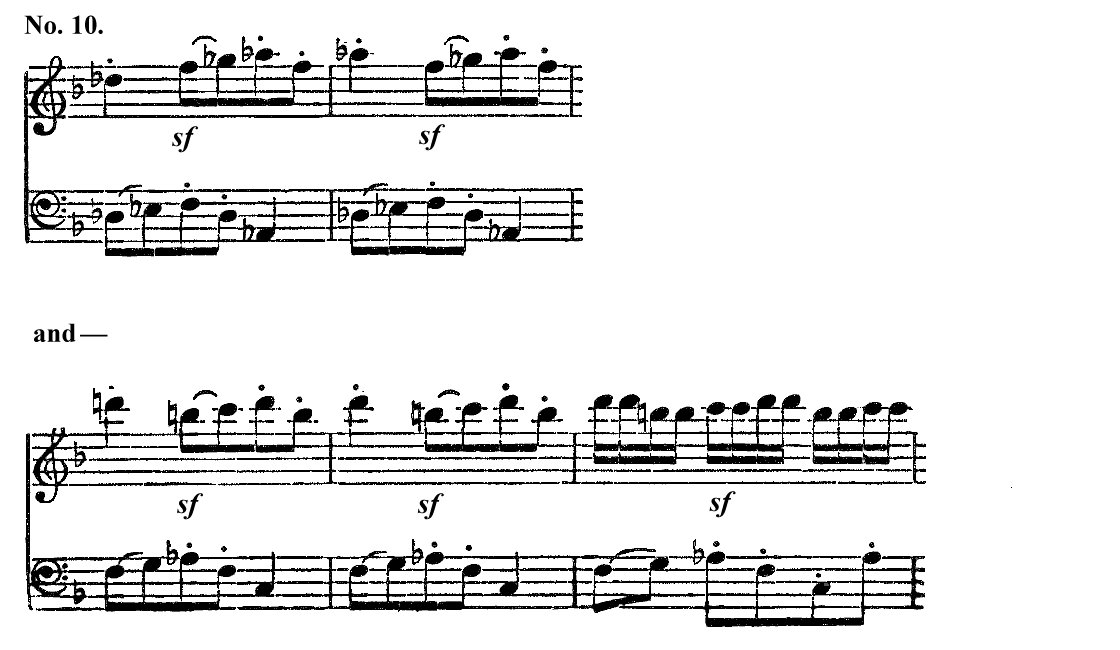
At
length the tension so caused
becomes almost unbearable, and the original subject and key return in a
wild tornado - not in the ordinary way, with the theme in the treble,
as at first, but in the basses, with all the noise possible (even fff,
a mark which Beethoven only very rarely employs [22]),
and with the rest of
the band in long notes in the high regions: -

The
instrumentation of this portion (the opening of the reprise), where the
theme is somewhat overwhelmed by the accompaniments, and not brought
out with Beethoven's accustomed definiteness, is possibly intentional,
but it has been conjectured to be one of the earliest instances of the
effect of his deafness, which by 1812 had become serious, though not so
bad as it was in 1824, when he had to be turned round towards the
audience that he might see the applause which they were bestowing on
his Choral Symphony (see later).
But to return. The reprise
is
treated with the greatest freedom. The same subjects are employed as in
the corresponding earlier portion, but not always in the same
proportions; while the instrumentation and effects are often entirely
changed and the phrases are made more piquant by the use of staccato -
as has been already noticed in the Scherzo
of the C minor Symphony. A
new phrase is introduced as the accompaniment to the subject
quoted as No.
3,
the
phrase being most effectively placed in the
basses: -

The
Coda,
which is long - seventy-seven bars - is most effective. It
begins with the figure in No.
7,
given with irresistible effect to the
bassoon. A new feature of great ingenuity and charm is formed out of
five notes of the quotation No.
1:
-

which are worked in every part of the scale and the bar. The effect is
extraordinarily telling in a pianissimo
passage, full of mystery, with
the phrase in question in the basses staccato. Apart, however, from
individual phrases and modes of construction, or any other such
mechanical points, there is the extraordinary amount of violent emotion
and fury which animates the greater part of the latter portion
of this movement [23].
From the
double-bar onwards Beethoven betrays a
feeling of wrath which I do not remember in any other of his works, or
in any other piece of music - though I am not able to speak of Wagner.
It is not the boisterous fun which we find throughout the Finale. Here
it is edged by a distinct spirit of anger.
After the final explosion,
however - a second fff,
twenty-five bars from the termination - this
disappears, and after a few bars of alternate strings and wind, the
end is reached, with great point, by the soft repetition of the
identical six notes with which it started.
The present length of the Coda is the result of an alteration after the first performance. It was originally thirty-four bars shorter, as is proved by an ancient drum-part used at the first performance, and still surviving [24].
II. After so much commotion and combat, the well-known Allegretto scherzando produces a most remarkable effect. Its grace and elegance would be extraordinary whatever were its surroundings, but in its present position the contrast is of unspeakable relief. Gaiety, grace, rich, though quiet, humour are its characteristics, clothed in a form of indolent, graceful beauty, which is essential to the full enjoyment of this most beautiful piece, and is missed entirely if the pace is taken too fast. Wagner, I know, suggests that the Allegretto should be taken rather quick and the following Minuet slow. He is probably right about the Minuet; but - I say it with deep respect - certainly not as to the Allegretto [25].
The originality and beauty of its opening are remarkable, the melody being in the strings and the accompaniment in the wind instruments, who reiterate their crisp chords with an indescribably charming effect: -

Nothing can exceed the delicacy with which this delicious dialogue is conducted.
Beethoven would have been amused if he could have foreseen that his friend Romberg would adopt this melody for the opening of the Finale, Allegretto, of his Concerto for cello and orchestra, No. 8, in A, [26] but so it is: -

Not
less remarkable is the second subject, as graceful as
before, but
with more obvious humour, and irresistibly suggestive of a sportive
conversation, with muttered objections from the basses, though all with
perfect good nature: -
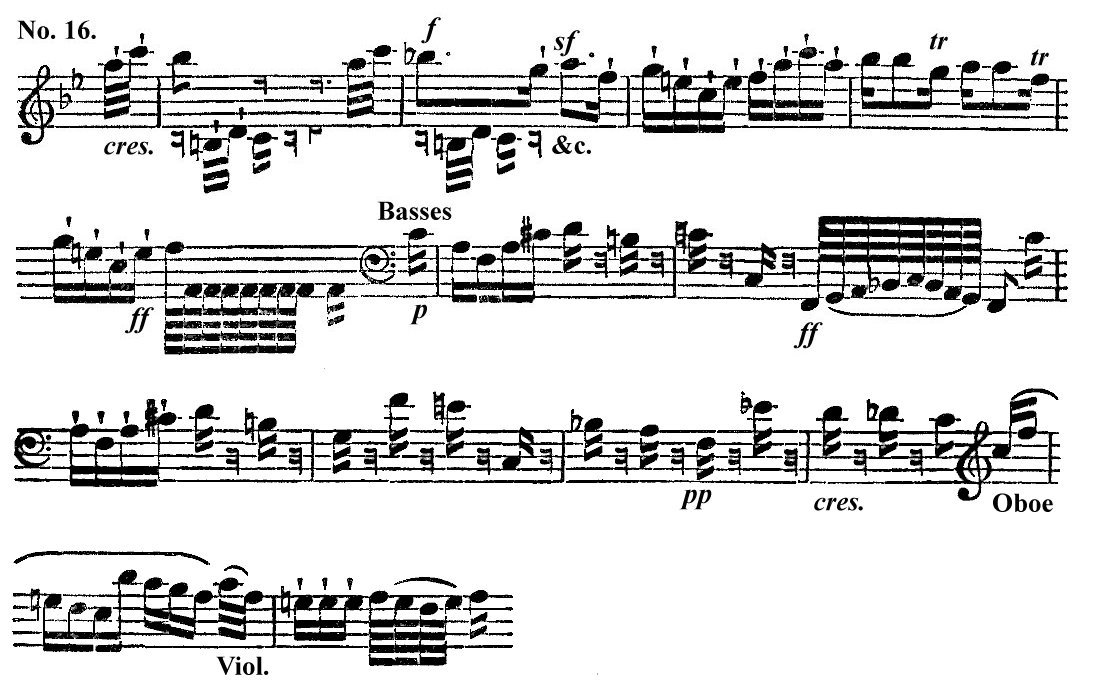
This Allegretto
is the shortest of all the movements in Beethoven's
Symphonies. The abrupt and disappointing close with the commonplace
Italian cadence of tonic and dominant, instead of the expected repeat,
is obviously one of the jokes incidental to Beethoven's frame of mind,
and to which one has to submit. Oulibicheff interprets the movement as
a caricature of Rossini, whose extraordinary popularity in Vienna was
often a subject of remark with Beethoven; but there is no occasion for
this. His spirits are just now so high that everything he touches is
turned to amusement. The lovely opening itself is the embodiment of a
piece of fun. It exists in the form of a Canon extemporised at a supper
in the spring of 1812, and addressed to Maelzel, the inventor of the
metronome (originally called the chronometer), in which the ticks of
that instrument are represented by staccato semi-quavers: -

In of the sketches for the Allegretto [27] the idea
is
differently given: -

The date of the Canon, as written, is
uncertain; it may be later than that of the Symphony [28]; it may
be
earlier.
Berlioz speaks of this Allegretto as having 'fallen from heaven straight into the brain of its author, and been written at a sitting' - 'tout d'un trait' [29]. But this is not a very happy conjecture, for there are apparently about as many sketches for it as this great composer made for any piece of music, great or small, which he undertook [30]. Here, as so often elsewhere, in both literature and art, what appears most spontaneous has been the most laboured. More fortunate was the exclamation which the movement forced from Schopenhauer, prince of pessimists, that it was sufficient to make one forget that the world was full of nothing but misery [31].
III. The Minuet, or, more accurately, the Tempo di Minuetto, though not so sparklingly elegant as the Allegretto, is not less finished, and is a singular union of homely beauty and humour. It begins very energetically with a passage of two bars, somewhat boisterously emphasised by the trumpets, but from which the lovely theme springs in the most spontaneous manner: -
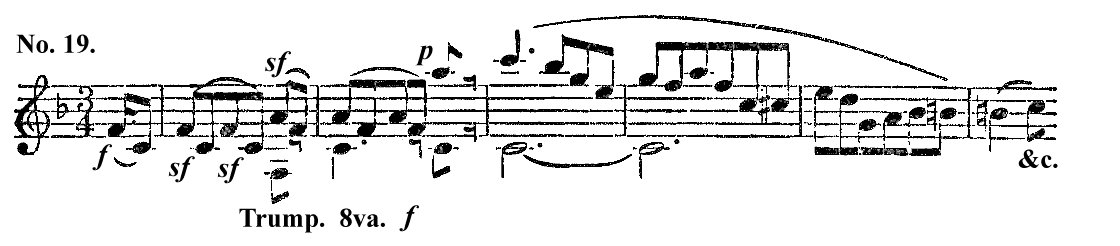
The sketch-book shows that, contrary to his usual fortune, Beethoven found this melody almost at once [32].
The second strain is in absolute keeping with the first. A charming feature of this section is the reprise of the air, in the mellow notes of the bassoon, beautifully led up to. In the first portion of this reprise the ancient ecclesiastical phrase of which Beethoven was so fond appears in the basses pizzicato with the best effect, the notes of the first bassoon (with second bassoon legato) sliding over it like water over a stone in the brook: -

The necessity for keeping down the pace of this movement is strongly insisted on by Wagner, who makes it the subject of a highly characteristic passage in his interesting pamphlet, Ueber das Dirigiren [33]. The remarks are all aimed at Mendelssohn, of whom, as is well-known, Wagner had a poor opinion, and their effect is greatly interfered with by the personal bias which they betray. We should like to know Mendelssohn's reasons for the faster pace which he is said to have adopted and adhered to.
The
Trio
(not so denominated by its author) is as spontaneous
and
graceful as the Minuet.
The subject is given out by the two horns, with
an accompaniment for a somewhat fidgetty cello solo, which, perhaps,
points to some circumstance in the orchestra. We
quote the opening as played: -

The second half of the melody follows in the
clarinet, in the most reposeful and tender strain. There is a
working-out, in which a beautiful effect is made by bringing in the
first bar of the melody (No. 21) in the basses and bassoons staccato
with a light accompaniment over it.
The form of the melody of this Trio is curiously anticipated in a Minuet for two flutes, dated '1792, August 23, abends 12' (12 at night) and given by Thayer in his Chron. Verzeichniss, No. 17: -

A
point in the Trio
can hardly be said to be yet
finally settled. We allude to the third bar of the horn passage (No.
21), which in the original edition (1816) appears thus, in the same
rhythm as the two preceding it: -

In the new 'critical and correct' edition of Messrs. Breitkopf and
Härtel the rhythm is altered, and the bar is given as in our No. 21. No
authority for the change is, however, stated, and the bar does not seem
to be mentioned by Otto Jahn in his well-known article on the edition.
But at a performance of the Symphony at a Philharmonic Concert at
Berlin, on January 21, 1889, under the direction of Dr. H. von Bülow,
the old reading (No. 23) was reverted to [34],
on the ground of a
'correction of Beethoven's own, made in a copy of the four-hand
arrangement in the possession of Brahms.' We must wait for more light
upon the point. The case is probably an instance of the vacillation so
frequent in this great master in fixing his final details. In one of
the sketches the bar in question appears thus - with no dot
at all, as in the early little Minuet
(No. 22) [35]:
-

which looks as if Beethoven, at any rate, wished the rhythm of
this bar to be different from that of the preceding ones.
IV. After the studied grace and homely beauty of these two elegant and soothing episodes, we are hardly prepared for a return of violence and clamour equal to those of the first movement. Beethoven, however, wills it so, and the Finale, Allegro vivace, while it is the greatest portion of this great Symphony - larger in dimensions and loftier in spirit than either of the preceding movements - is also the most humorous, not to say boisterous, of all. It is pure Beethoven, in his most mature, individual, and characteristic vein, full of that genuine humour, those surprises and sudden unexpected effects, those mixtures of tragedy and comedy, not to say farce, which played so large a part in his existence, and which make his music a true mirror of human life, as true in his branch of art as the great plays of Shakespeare are in his - and for similar reasons. The opening theme is one of those slight, trivial ideas which appear to contain nothing, but which, like an ordinary incident or a casual action, may become the germ of the passion and conflict of a life. It is of such as this that Schumann says: 'If you wish to know what can be made of a simple thought by labour and anxious care, and, above all, by genius, then look at Beethoven, and see how he can ennoble and exalt his ideas; and how what was at the outset a mere commonplace phrase shall, before he has done with it, become a lofty sentiment for the world to prize.'
With regard to the instrumentation, let us notice that, though bent on being noisy, Beethoven has included no trombones in his score, and also that the drums are here (perhaps for the first time in musical history) tuned in octaves.
The following is the unpretending way in which this tremendous Finale enters the world: -
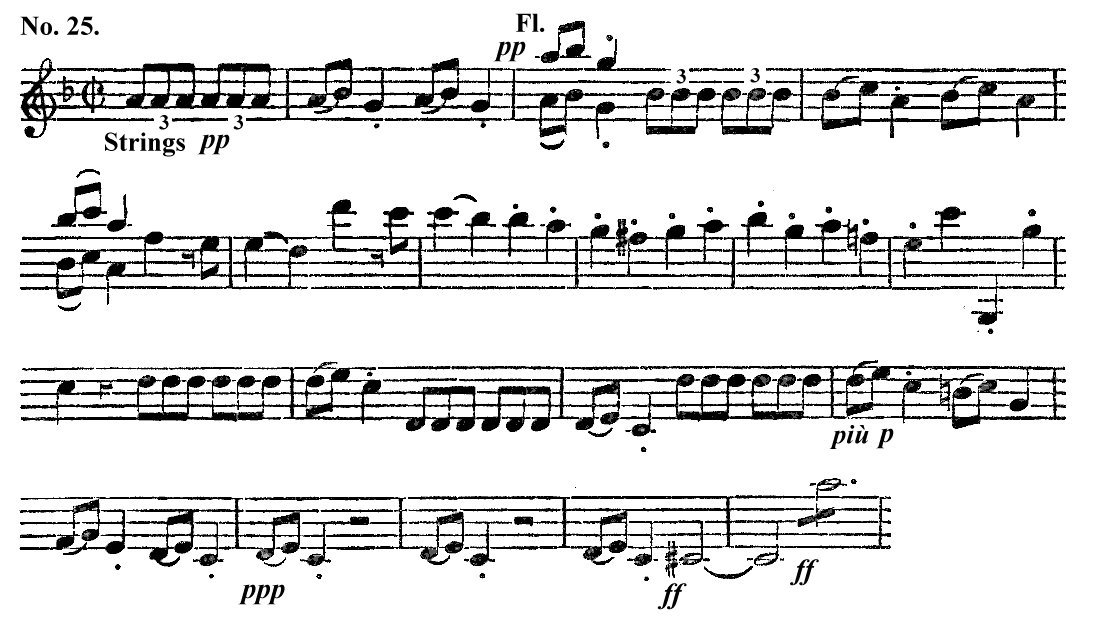
We
have already quoted an early sketch of this theme (see earlier),
and
it is one of the most instructive extant, as an illustration of the
justice of Schumann's remark. No other example of the sketches shows
more strikingly the commonplace nature of Beethoven's earliest
rudimentary ideas, and the patience and success with which he turned
his thoughts over and over till he had got all that could be extracted
from them. If genius has been defined as 'the art of taking pains,'
surely Beethoven is one of the most remarkable exemplifications of the
definition. But this does not exhaust the interest of the theme. It has
been recently pointed out [36]
that it is not improbably an expansion of
the opening of the final Allegro
in a Symphony of Haydn's in G, known
in this country as 'Letter V' [37]
-

Haydn's work appears to have been familiar to Beethoven, inasmuch as he
borrowed from it the melody of the Largo
-

and has employed it
no less
than five times in his music [38].
Such reminiscences, however, as we have already remarked (see earlier), do not detract from the originality of the composer to whom the reminiscence occurs. It is the treatment that reveals the real creator, and in the present case Beethoven has completely vindicated his originality by the tremendous feature which he has attached to Haydn's trivial little phrase. For this innocent, domestic, idyllic theme is interrupted in its happiest and quietest moment by a loud and sudden C sharp, in unison and octaves, given with the whole force of the entire orchestra, following on an unusually soft C natural. The change from natural to sharp, the sudden energy of the fortissimo after the pianissimo, and its occurrence in the weak portion (the 'up-beat') of the bar, all combine to make this huge note as prominent and as unbearable as possible. It comes upon the artless passage, which it so rudely interrupts, like a sudden stroke of fate on the life of some gentle child. Not that this great blow produces more than a transient impression at first; the theme is roused by it only to temporary energy, and soon pursues its course with all its original artlessness. The C sharp has, indeed, both here and on its next occurrence, some pages ahead, no musical significance. It is a mere cry or noise, and does not affect the music, which proceeds after it in the key of F exactly as before. It is not till the Coda that it causes any change in the modulation - any serious effect on the course of the composition - in fact, till then it is a huge joke.
The
'second subject' is of a different character and graver
beauty.
The orchestra is arrested upon a sudden A flat (after G - one of
Beethoven's favourite transitions), and a soft passage begins - a
lovely melody, first in the violins and then in the oboes, one of those
'soft Lydian airs' which truly pierce 'the melting soul,' and 'bring
all heaven before the eyes,' and which then passes, by a transition of
remarkable beauty, into the key of C major, in which it seems to go
straight up to heaven: -

(Bar 7 in the first violin contains
a fine example of what may be called the 'appoggiatura of passion,' a
favourite with Beethoven.) The curious discrepancy between the tonality
of the beginning and end of this theme is itself a bit of humour and
recalls the similar fact already noticed in the second theme of the
first movement (see No.
5).
This
beautiful and dignified melody is repeated immediately in
the wind
with a very full accompaniment in the strings, and then has a Coda or
termination of the following nature - four bars up, and four
down: -

all harmonised in the roughest and most boisterous manner, and
terminating with a loud explosion, exactly as if Beethoven had jumped
out in front of one with a loud and very terrible 'Boh!'
The movement is cast in Rondo form, and thus ends its first portion.
The
second portion answers to the 'working-out' in the form
usually
employed in these Symphonies. It begins at once with a modification of
the opening phrase of No.
25:
-

and proceeds with a somewhat strict treatment of the latter
part of the subject, the bass commencing in similar motion to the
treble, and close imitation, in the following fashion: -
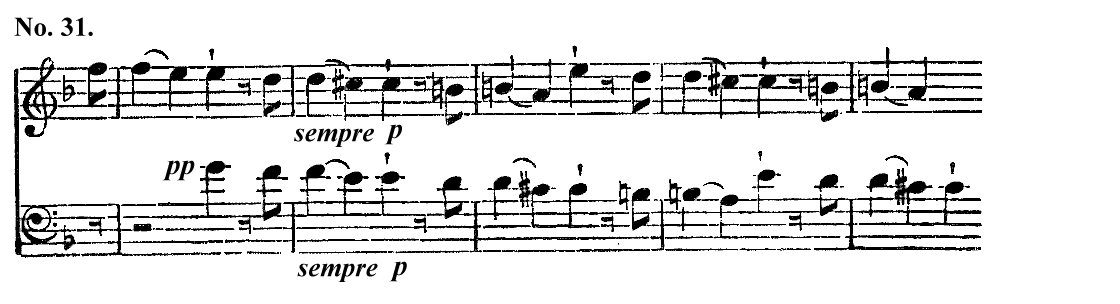
and afterwards going in contrary motion as thus: -
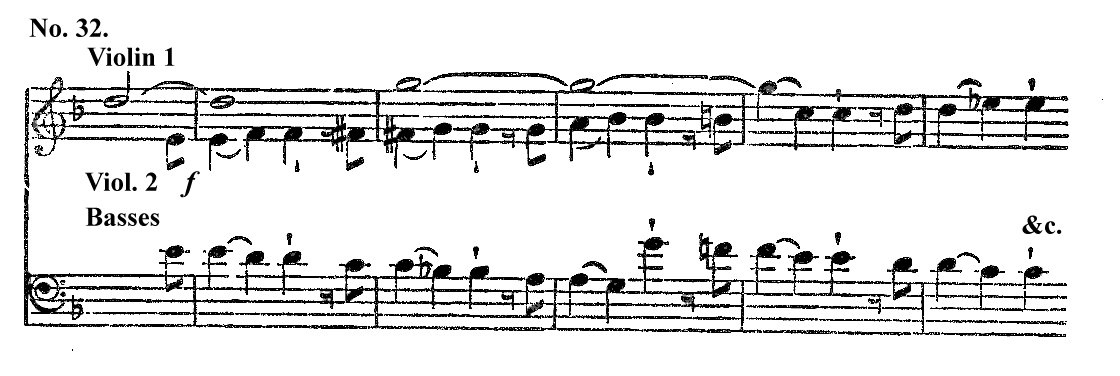
and thus: -
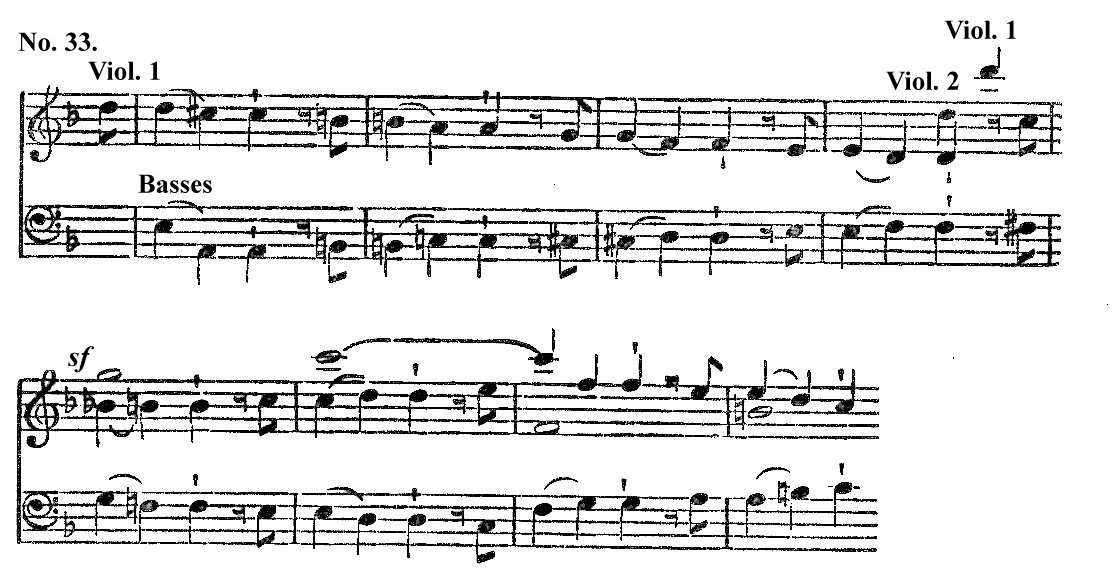
which in the end has the better of the first. The wind is all
through fully employed, in sudden bursts from the brass, answered by
the bassoons and clarinets, and other passages in which every humorous
expedient is employed.
A
phrase of seven notes from bars 7, 8, 9 of the original
subject (No.
25) -

is used again and again with a very abrupt affect.
This
section, though full, is but short, and ends with an astonishing octave
passage -

recalling the octaves in the first movement, though differently
treated.
We now arrive at the third portion of the Finale. This again begins with the initial part of the first theme in the violins, accompanied by the wonderful octaves, just quoted, in the bassoon and drum, a holding F above the tune in the flute and oboe, and with other rich support from the wind. All is hushed and mysterious, full of sly humour, which soon develops in the most telling style by the re-introduction of the terrible C sharp, after a passage gradually diminishing to ppp - like the sudden appearance of some hideous mask. The comedy here is very unmistakable and irresistible. Some passages seem to say, as plainly as possible: 'Look out!' 'I'm coming!' 'I'm dangerous!' The contrary motion already noticed is next used, often with very droll effect. The second subject has a good deal of space devoted to it with its Coda (see No. 29), and the passage again ends with a sudden very startling explosion.
We
now come to the final section of the movement, call it Coda
or by
any other name; and this is the most important of all; nearly 240 bars
in length, and exceeding in humour, and, it must be said, also in
violence, anything that we have yet encountered. It begins once more
with the original triplets very quietly: -

and we might suppose that all was joyous as before. But not at all;
whatever may have been Beethoven's intention, a sudden thought strikes
him as to the absurdity of thus repeating himself. He gives
two hearty laughs: -

(compare the Coda of the Finale of No. 7),
makes a pause, and
goes off with an entirely fresh idea - a succession of scales in exact
contrary motion: -
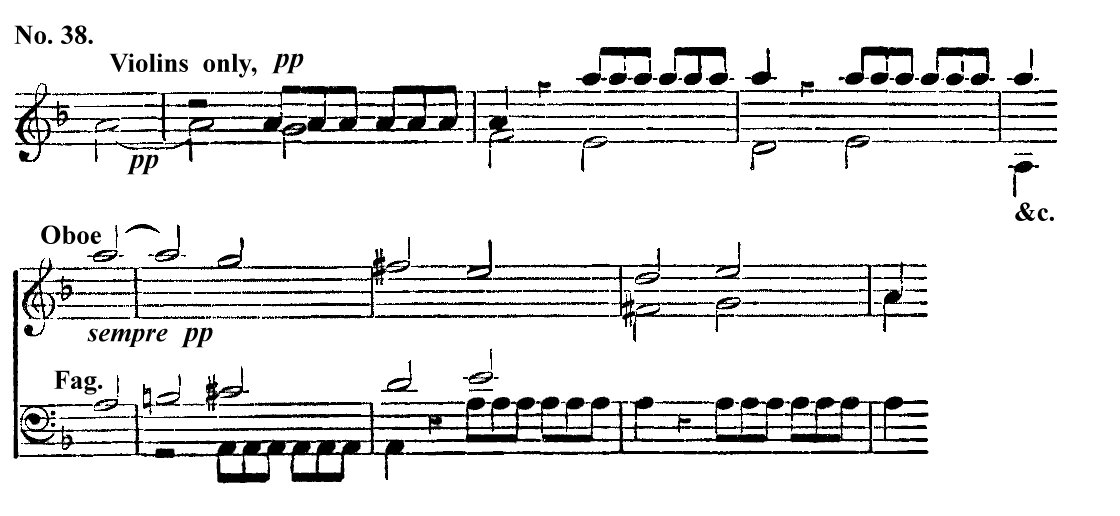
accompanied by the triplets of the original
theme, and producing a most overpowering effect. Here is another
example of a similar passage, the treble and bass being reversed in
position: -
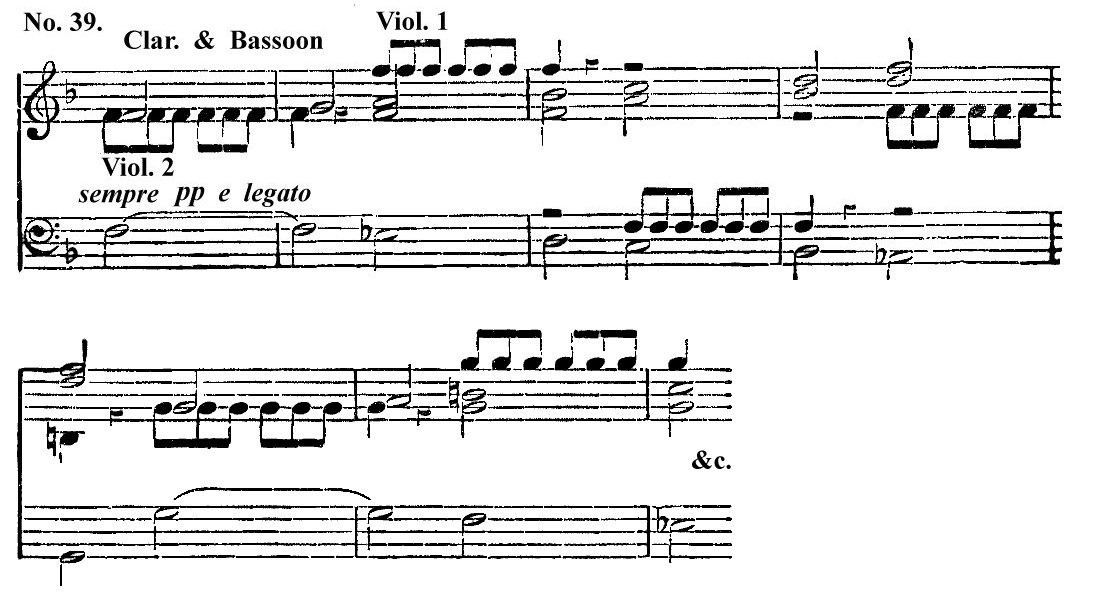
This is the beginning of a section of more than
fifty bars in length, founded on the constant recurrence of the scales
as quoted, modulating into a fresh key at each repetition, until at
length we return to the original key of F and to the octave figure
already quoted, given out as before by the first bassoon and the drums
without any accompaniment, pianissimo,
and the very soul of drollery:
-

Beethoven here gives loose to all the fun and quaint humour with which at this time he was overflowing. He is truly in a most "unbuttoned" frame of mind, full of grotesque joviality. His jokes follow one another with the most comical effect. Such passages as that already quoted (No. 22), and as the foregoing, where surely bassoon and drum were never before at once so simply and so drolly treated - such passages as these are irresistible.
This
soft passage is succeeded by an equally loud one, in
which the
terrible C sharp (No.
25)
makes
its appearance amongst the modest
murmurings of the fiddles with really overpowering force. First it
comes as D flat and then twice as C sharp, each time roaring out its
presence in a truly brutal fashion. Here the intruder is not, as
before, a mere joker, but exercises its due effect on the fabric of the
music. The orchestra has now no alternative but to go entirely into F
sharp minor. From this extreme position, however, they are
rescued by the trumpets and horns, who vociferate their F natural at
the top of their voices until they have again collected the entire
flock: -

Through the whole of this long passage, more than 100 bars in
all, it is difficult to shut out the image of the composer, like
Polyphemus, or Samson, or some other mighty humorist of antiquity,
roaring with laughter at the rough fun which he is making, and the
confusion and disturbance he is inflicting on everyone around him.
Beethoven,
however, is too much an artist and man of sense to
indulge
this mood too long. A milder though still droll humour succeeds, and
the outbreak at length ends by the introduction in the bass - in
keeping with the similar practice already noticed in the earlier
movements - of the dignified and beautiful second subject (No. 28). It
is as if Beethoven could not refrain from making an old friend look
ridiculous, and ridiculous indeed he is made to appear: -

After
this we seem to hear, as it were, a call for a parting toast: -
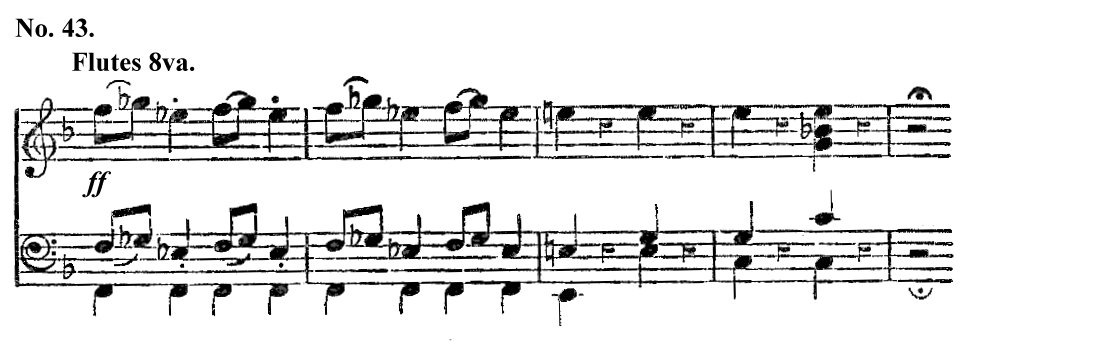
This, however, is the final burst of fun; the mood softens, the boisterous spirits of the great humorist break down, and a softer change comes over the face of his music.
First
we have a pause. Then, in the clarinets and bassoons,
comes a
metamorphosis of the first bars of the opening subject beginning thus:
-

Then first the whole orchestra, through eight bars, in a succession of sforzandos, and
next the wind instruments, through twelve bars, as gentle as
the others were fierce - over a pedal F and a beautiful
string accompaniment -
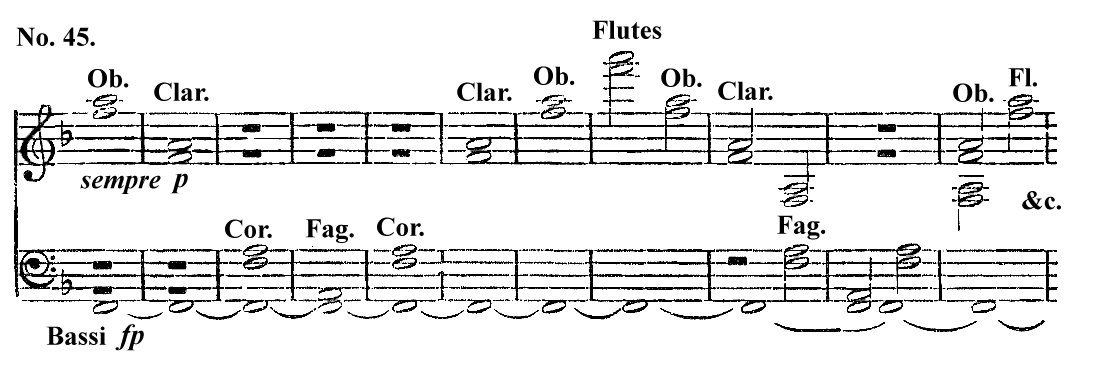
repeat the chord of A F with which the Finale starts, in
their
different registers, one after another, with an enchanting and quite
peculiar effect. Lastly comes a metamorphosis, lovely, but too short,
of bars six and seven of the same theme: -

accompanied by the drums in octaves, as in No.
40, all very soft, and
producing an extraordinarily tender effect, and recalling, as in a
dream, what the same instruments, now so soft, were capable of doing
when urged to excess. Here, however, as at the close of the Andante of
the C minor, the master seems reluctant to allow his emotion to be
seen, and ends with a very noisy passage.
Beethoven
was now forty-two years of age. In all his works
there exists
no other instance of
That child's
heart within the man's
to compare with the
Symphony of which we have just taken farewell. It is surely a matter of
congratulation that on the eve of the long and difficult period of life
on which he is about to enter he should have been permitted to enjoy a
time of such thoroughly hearty and innocent merriment as he has
depicted in his Eighth Symphony.

Four horns are used here, probably for the first time.
To the above are added, in some of the movements, 3 Trombones, a Double Bassoon, a Piccolo, Triangle, Cymbals, and Big Drum.
First Ed., a folio of 226 pages. 'Sinfonie mit Schluss-Chor über Schillers Ode "An die Freude," für grosses Orchester, 4 Solo und 4 Chor-Stimmen, componirt und seiner Maiestaet dem König von Preussen Friedrich Wilhelm III. in tiefster Ehrfurcht zugeeignet von LUDWIG VAN BEETHOVEN. 125tes Werk. Eigenthum der Verleger. Mainz und Paris, bey B. Schotts Söhnen. Antwerpen, bey A. Schott.' [No. 2322.] 1825 or '26.
The earliest copies contain no metronome marks. These were supplied later, but at what date is uncertain.
The Ninth Symphony was not ready for performance until the end of 1823 or beginning of 1824, and it is, therefore, separated from No. 8 by a gap of not less than eleven years. Of the manner in which these long years were filled up in Beethoven's life it will be my endeavour to give a brief account. It appears to me desirable to show what an exceedingly unhappy and disturbed period it was, how filled with events and circumstances which would seem to be in the highest degree inimical to the production of music at all, but to which, nevertheless, are due the Choral Symphony; the Mass in D; 'Fidelio' in its ultimate form, including the gay overture in E; seven prodigious Pianoforte works [1]; the Liederkreis - the earliest example of a 'Cycle of Songs,' and still the finest; and several other works which would be remarkable in any composer but Beethoven.
The Eighth Symphony was finished in October, 1812. After his return to Vienna, at the beginning of December, Beethoven again took up the Sonata for Piano and Violin in G (Op. 96), and finished it, so that it was played by his pupil, the Archduke Rudolph, and Rode on the 4th January, 1813. Beethoven was not pleased with Rode's performance of his work, and in his Bonn dialect he writes to the Archduke that it had even bored him a little - 'schenirte (i.e., genirte) mich doch etwas' [2]. The two new Symphonies appear to have been rehearsed at the Archduke's on February the 20th; but at present there was no public performance of either.
Meantime Napoleon's star was rapidly sinking. We are in 1813. The spring months brought to Vienna the news of Moscow and the destruction of the immense army in the retreat from Russia; the health of the Emperor had never been better [3], but 300,000 French soldiers had perished. The War of Liberation had begun in Germany, and, notwithstanding the defeats of Lützen and Bautzen (May 2nd and 21st), the spirit of the German people was fast rising. On July 13 the battle of Vittoria (fought June 21) was known in Vienna, and by the beginning of November the decisive rout of Leipzig and the gallant attempt of the Austrian and Bavarian troops to cut off the French retreat at Hanau on October 30 were also known. Over this news Vienna was in a state of great excitement. Beethoven was not behind his fellow-citizens. He was at this time on terms of intimacy with Maelzel, a very clever mechanic, not only the inventor of the metronome, but maker of Kempelen's famous chess player, and of two musical automatons, the Trumpeter and the Panharmonicon; and he was induced to set to music a programme of a musical piece representing the battle of Vittoria, drawn up by this clever inventor. This, after being arranged for the barrels of the Panharmonicon, Beethoven scored for orchestra. It occupied him from August to October, 1813, and an occasion for its production was found at the Hall of the University, on the 8th December in that year, when the programme contained, in addition, the Seventh Symphony, for the first time, and two Marches for Maelzel's automaton trumpeter. The Symphony was well received, but the battle-piece took the fancy of the public to an extraordinary degree, and the concert was repeated four days later, on the 12th. The piece, entitled 'Wellington's Sieg, oder die Schlacht bei Vittoria' (Op. 91), is in two divisions: 1st, the Schlacht or Battle, founded on 'Rule, Britannia,' and 'Marlbrouk'; and 2nd, the Sieges-Symphonie or Victory. The score was published in 1816 by Steiner, in the same mean lithographed form as Nos. 7 and 8, and was dedicated to the Prince Regent of England - afterwards George the Fourth. The dedication, however, was never acknowledged [4].
After the concert of December 12 a catastrophe occurred. Beethoven discovered that Maelzel claimed the Battle-piece as his own property in virtue of some money he had advanced. He at once broke with the inventor and, more suo, proclaimed him a rogue. After a time Maelzel made off to Munich, taking with him his Panharmonicon, and also a MS. orchestral score of the Battle-piece, which he had obtained without Beethoven's consent, and caused to be performed in Munich. Beethoven at once entered an action against him in the Vienna courts, which eventually came to nothing; and addressed letters of protest to the musicians of Munich, and of London, whither Maelzel intended to go.
Meantime Beethoven had again given the concert on the same general lines as before, but omitting the Marches for the 'mechanical Trumpeter' - on January 2nd, 1814; and on February 27th he gave a fourth, with the important addition of his Eighth Symphony. All these performances were successful from a money point of view.
Beethoven was not, however, able, with Maelzel's departure, to shake off his unmusical worries. Prince Kinsky, one of the three noblemen who contributed to his income, died on the 3rd November, 1812, without having signed the necessary engagement to maintain the annuity [5]; on which Beethoven commenced a suit against his heirs. The suit was withdrawn two years later, but meantime he was extremely eager about it, and the correspondence and anxiety must have been very trying to him. 'Such things,' said he to his legal adviser, 'exhaust me more than the greatest efforts in composition' [6].
It is pleasant to turn to more congenial subjects. In the spring of 1814 he twice played the piano part of his great B flat Trio (Op. 97) in public, at concerts of his old friend Schuppanzigh; first on April 11th, for the benefit of a military charity, and again a few weeks later. This was his last appearance in public as a piano player [7].
The revival of 'Fidelio' this year must have afforded him much gratification. It was produced in its final shape, in two acts, at the Kärnthnerthor Theatre, on May 23, 1814. The revision of the book had been in progress for some months under Beethoven's old friend Treitschke. It had involved much labour to Beethoven, but he seems to have been very good-humoured over this attempt to 'rebuild the ruins of an ancient fortress' [8]. It necessitated also the composition of the fourth overture - in E; which, however, was not played till the second performance, on May 26. His benefit-concert took place on July 18. A pianoforte score of the opera, prepared by Moscheles under Beethoven's own direction, was published in August. And this gives Moscheles an opportunity for an interesting anecdote [9]: 'Under the last piece of the arrangement,' says he, 'I had written Fine mit Gottes Hülfe - The end, with God's help. Beethoven was not at home when I brought my manuscript to him; and on receiving it back I found the words added O Mensch hilf dir selber - O man, help thyself.'
On April 15 Prince Carl Lichnowsky, one of his earliest, kindest, and (notwithstanding many a needless rebuff) most forbearing friends, died.
August
16, 1814, is the date on the
autograph of the beautiful Solo Sonata, Op. 90, in E minor, written for
Count Moritz Lichnowsky, brother of Prince Carl, by way of sympathy and
expostulation on his attachment to an actress [10].
Schindler tells us that
the first movement was to be entitled 'Kampf zwischen Kopf und Herz'
- Contest between head and heart; and the second (there are only two),
'Conversation mit der
Geliebten' - Conversation with the beloved; and
that such was the composer's own explanation to the Count when he
enquired if the music had a meaning. The piece was accompanied by a
charming letter dated September 21, 1814 [11],
in unusually good spirits,
though coloured by a certain vein of sentiment in a few playful notes
given at the end, on the word 'but' (allein) -

which are a minor version of Paesiello's famous air 'Nel cor più,' on
which he had composed six Variations some twenty years before.
In this Sonata we find Beethoven for the first time writing his directions in German instead of Italian. He had for some time quite a fit of this nature, in which Hammerklavier takes the place of Pianoforte, lebhaft of Allegro, and langsam of Adagio, &c.
A week later died the wife of Beethoven's very good friend, Baron Pasqualati. He commemorated her death soon after in the beautiful 'Elegischer Gesang,' Op. 118, a most characteristic work, evidently inspired by affection.
On October 1 ('Ersten Weinmonath') he completes the Overture in C, Op. 115, a piece which had been in hand since 1809, as the long contemplated embodiment of Schiller's 'Ode to Joy' [12]. All allusions to Schiller's Ode, however, were postponed for the present, and the autograph of the Overture is inscribed as for 'the Name day of our Emperor,' and as 'gedichtet für grosses Orchester' [13].
In April, 1814, Napoleon was banished to Elba, and by the end of September the representatives of the various allied states had assembled at Vienna, though they did not go to business till November. This was the famous 'Congress of Vienna,' an immense collection of royalties and other celebrities. It was, in fact, the first breathing time of Europe after its dozen years of slavery and apprehension under Napoleon's domination. No wonder the plenipotentiaries could not at once settle to work! Notwithstanding the presence of Wellington and Castlereagh progress was so slow and the festivities so gay as to give rise to the well known remark, 'Le congres ne marche pas, il danse.' Beethoven seized the opportunity of performing his new Symphonies, and also of composing some music specially appropriate to so great an occasion. For this he chose a cantata, entitled 'The glorious moment' - 'Der glorreiche Augenblick' [14] - written by Weissenbach; he began its composition for solos, chorus and orchestra in September, and the first performance was given on November 29, in the Redouten-Saal, which had been placed at his disposal for the purpose by the Government. Beethoven was permitted to issue the invitations in his own name - a remarkable tribute to his position in Vienna. The concert was for his benefit; it was announced for the 26th, but postponed to the 29th. The programme contained the Seventh Symphony, the Cantata, and the Battle Symphony. The large room of the establishment was crowded with an audience of 6,000 persons, and in a letter to the Archduke Rudolph, Beethoven describes himself as 'exhausted with fatigue, vexation, satisfaction, and delight' [15].
The programme was repeated on Friday, December 2nd, but with a comparatively poor result. A third performance was intended, but was given up. One of the fêtes provided for the Congress was a Tournament or Carrousel, in the Riding School, on November 23, and it would appear from another letter of Beethoven's to the Archduke [16] that he was composing music for it, which he promises shall arrive 'at full gallop' (mit dem schnellsten Galopp), though nothing of it has yet been discovered [17].
In addition to the profits of the two concerts, and also to his share of those in December, 1813, and January, 1814, Beethoven probably received presents from the various exalted personages - we hear of 200 ducats (£100) being sent by the Emperor of Russia [18]; and there were doubtless others. At any rate, he now found himself able to lay by money, which he invested in shares (Actien) in the Bank of Austria.
To all this rejoicing the sudden news of Napoleon's escape from Elba and arrival in France on the 1st of March, 1815, put an end. Then ensued the Hundred Days, Waterloo, and the occupation of Paris - for which last event Beethoven composed a chorus, 'Es ist vollbracht,' as Finale to a dramatic piece by Treitschke.
It is not generally known that Sir Thomas Lawrence visited Vienna in 1819. He was sent by the Prince Regent to paint the celebrities assembled at Aix-la-Chapelle, and thence he went to Vienna, arriving early in 1819, and remaining there till May 3rd [19]. It is much to be regretted that Beethoven was not included in this commission, as the world would then have possessed a worthy likeness of the great composer, while the honour would have been a pleasant return to him for his dedication of the Battle Symphony to the Prince Regent, for which no acknowledgment appears ever to have been made.
A violent quarrel with Stephan Breuning, which deprived Beethoven for many years of one of his oldest and most faithful friends, occurred some time during the summer of 1815, and was not adjusted till 1826 [20].
Through all this maze of excitement - lawsuits, fêtes, quarrels, concerts, production of the opera, interviews with emperors, &c. - the music that was composed, if small in quantity, was of first-rate quality. True, the two Cello Sonatas which form Op. 102 have never become popular, and the Overture in C (Op. 115) has not obtained the public appreciation which Beethoven's orchestral works usually receive. But the Overture in E, known as 'Fidelio,' and the Sonatas, Op. 90, 96, and 101, stand very high in that class of work. It is impossible not to regret that the Concerto for Piano and Orchestra in D, of which Nottebohm has given so very tempting a description [21], and which that accurate investigator assigns to 1814 and 1815, was not completed. It occupies more than fifty pages in the sketch-books, and thirty leaves (Blätter) of score were begun in June, 1815. The piano was to come in after ten bars of full orchestra.
To the quarrels, excitements, and other unmusical distractions already mentioned as besetting this period, there is, however, one of a still more malignant nature to be added. There was, indeed, a fatal shadow ahead in Beethoven's path. On November 15, 1815, his brother Caspar died, bequeathing to him the maintenance of his son Carl, then a lad of eight. This involved a lawsuit with the widow, who was one of Beethoven's bêtes noires, and endless worries as to the education of the boy, for the details of which we have no room, but which penetrated into the deepest recesses of his life and feeling, and must have given him the keenest and most constant annoyance till January 7, 1820, when the litigation was compromised, and indeed up to the very end of his life [22]. To an irregular, impulsive being, like Beethoven, such occupations as this involved - the writing of long detailed letters, the keeping of appointments - must have been sadly annoying. One quotation from his diaries, expressing his dislike to business matters, has been already given. The following entry is still more touching, and is a good specimen of the way in which his inmost being was rent and racked at this period of his life. It dates from the early part of 1818: - 'God, O God, my Guardian, my Rock, my All, Thou seest my heart, and knowest how it distresses me to do harm to others through doing right to my darling Karl. Hear Thou unutterable! hear Thy unhappy, most unhappy of mortals.' 'I have no friend,' he says to Fräulein del Rio at this time, 'and am alone in the world.' Perhaps, however, we have here the secret of the greatness of the Choral Symphony. For what says Schubert under similar distress [23]? He may almost be said to have formulated this despondent mood in the following entry: 'Grief sharpens the understanding and strengthens the soul: Joy, on the other hand, seldom troubles itself about the one and makes the other effeminate or frivolous.' 'My musical works are the offspring of my genius and my misery; and what the public most relish is that which has given me the greatest distress.'
Who that reads such passionate appeals as those just quoted - and there are many such at this date; or hears the first movement of this Symphony, especially its concluding forty bars, can doubt that Beethoven was then profoundly miserable; that his heart, morbid no doubt, was torn almost beyond endurance by the unseemly, squalid disorder which attended his home-life, and the unavailing anxieties and privations which he endured for his nephew ? Whatever its result upon his music, there could hardly be a dispensation of Providence so destructive of his happiness as that which brought these too incompatible natures together - on the one hand, a wretched, thoughtless, selfish, commonplace ne'er-do-weel, and, on the other, one of the simplest, noblest, most sensitive hearts in the world!
Against a settled habit of despondency, such as henceforth was Beethoven's prevailing mood of mind, external events, however pleasant in themselves, can have had little influence. Such were the bestowal of the freedom of the city of Vienna by the Municipal Council, at Christmas, 1815; the purchase by the Philharmonic Society of London of the Overtures to the 'Ruins of Athens' and 'King Stephen' for seventy-five guineas (July 11, 1815); the gift of a pianoforte from the reigning Broadwood early in 1818; and other similar occurrences. To balance these pleasurable things were the death of his old friend and benefactor, Prince Lobkowitz, on December 16, 1816, and the consequent reduction of his income by a third. It is also astonishing to see from his letters and entries the amount of unnecessary annoyance which he endured during these years from his servants, and from other household matters, notwithstanding the assistance he received from the good Frau Streicher, who was never weary of her endeavours to obtain order in that most disorderly of houses. True, his correspondence was not uniformly occupied with such degrading details. In 1817 several letters passed through Ries (then in London) between Beethoven and the Philharmonic Society, as to his visiting this country in 1818. The project came to nothing, but must have gratified him, even though the letters and the pecuniary proposals, which were gone into with much minuteness, doubtless caused him considerable trouble and filled him with worry.
Through all this runs a stream of the very finest music. In April, 1816, occurs the first sketch of the exquisite Liederkreis, Beethoven's greatest composition for the solo voice (Op. 98) [24]. The same sketch-book contains the passage which ultimately became the theme of the Scherzo of the Ninth Symphony, though originally only noted as the subject of a fugue [25]. This memorable entry stands as shown later. In the winter of 1817 the great Sonata, which became Op. 106, seems to have been begun, though it was not finished till the following summer. But all these works, great as they were, were to be soon overwhelmed by much larger and more elaborate compositions. These were the Ninth Symphony, the first movement of which was seriously begun in 1817 [26], and the Mass in D, which was attacked a year later, after the announcement of the Archduke Rudolph's appointment to the see of Olmütz, in the summer of 1818; which entirely took up the year 1819, and occupied the greater part of his time and energy till the beginning of 1823. Equally great in their own line with both Mass and Symphony, and eminently characteristic of Beethoven's later style and genius, are the last three of his Pianoforte Sonatas, which belong to this period - namely, Op. 109, finished in 1820, concurrently with the 'Credo' of the Mass; Op. 110, dated Christmas Day, 1821; and Op. 111, dated January 13th, 1822 [27]. He was now therefore free to devote himself entirely to the great work before us.
It may be well here to recapitulate the chief developments which Beethoven had already made in the Symphony, since he received it from his great predecessors.
He had increased the Introduction from the twelve bars which it occupied in Haydn's works and in his own No. 1, to the sixty-two of his No. 7. In his hands the Coda had assumed the vast proportions which it takes in the Eroica and No. 8; and in the Eroica, and especially the Pastoral Symphony, he had sanctioned the adoption of programme in music and the attempt to represent external objects. He was now to make a further and most material modification in the same great department of orchestral music, in the choral Finale; and here again the difference was all his own. No example of it is to be found in the works of either Haydn or Mozart, but Beethoven first attempted it in his Choral Fantasia [28]; and hitherto it has been followed - at least with success - only by Mendelssohn, whose Lobgesang, or 'Hymn of Praise,' is a characteristic example of the same class of composition as the Ninth Symphony of Beethoven [29].
Schiller's ode To Joy, An die Freude (1785) - from which the words for the Finale of the Symphony are selected, and which is as characteristic of Beethoven as the more directly devotional text of the Lobgesang is of his successor - was always a favourite with him. It is almost incredible that he started in his musical life with the same intention which he only carried out near its close. And yet we discover in a letter from Fischenich to Schiller's sister Charlotte, written from Bonn [30], the following notice of that intention, when Beethoven, at the age of twenty-two, was just beginning his public career. 'I have preserved,' says he, 'a setting of the Feuerfarbe for you on which I should like your opinion [31]. It is by a young man of this place, whose musical talent is becoming known, and whom the Elector has just sent to Haydn at Vienna. He intends to compose Schiller's Freude verse by verse.' This was in 1793 [32].
The musical theme to which Beethoven at last wedded the words thus fondly cherished by his republican nature for so long was, as usual with him, no sudden inspiration, but the fruit of long consideration and many a trial. Of this his sketch-books contain many evidences. The first time we meet with the sacred words is in a sketch-book of 1798 [33], between memoranda for the Piano Rondo in G, Op. 51, No. 2, and an Intermezzo for the Sonata in C minor, Op. 10, No. 1: -

It is perhaps not safe to find a reference to the Ode in the reiterated use of the word 'Freude' in the poignant postscript of the famous letter of 1802, where die Freude appears twice, once italicised by Beethoven himself (see Symphony No. 2) - 'Lass einmal einen reinen Tag der Freude mir erscheinen - so lange schon ist der wahren Freude innigerer Widerhall mir fremd.'
Then
again some words out of the same Ode are to be found in
1811,
among the sketches for the Seventh and Eighth Symphonies, thus cited by
Mr. Nottebohm [34]:
-

with a memorandum, not very legible, but somewhat as follows [35]:
- 'Finale, Freude schöner Götter Funken Tochter Elisium. The Symphony
in four movements; but the 2nd movement in 2-4 time like the 1st. The
4th may be in 6-8 time - major; and the 4th movement well fugued.'
Then a longer sketch of the same date in the sketches for the Overture in C (Op. 115) [35]: -

Then,
still later, in 1822,
among the 'sketches for the Overture in C (Op. 124), an Overture on the
name of Bach, and the Mass in D, occur other attempts, each in turn
scratched out, with the word 'mellieur' added (Beethoven's French for
meilleur) [36]. Then
comes the
following: - 'German Symphony, either with
variations (the chorus entering), or without them'
-

with another memorandum, 'End of the Symphony with Turkish music [37] and
chorus to the rhythm of three bars in the Gloria.' Then a
variation of the foregoing: -

At length he gets into a new melody, which then occupies his sketch-book, sometimes in triple, sometimes in common time, until at length it issues in the present magnificent tune, a tune surely destined to last as long as music itself.
Beethoven
has not used half of Schiller's words, nor has he
employed
them in the order in which they stand in the poem; and the arrangement
and selection appear to have troubled him much. The note-books already
cited abound with references to the 'disjointed fragments'
(abgerissene Sätze)
which he was trying to arrange and connect - so as
not necessarily to employ the whole of Schiller's long Ode - 'Abgerissene Sätze
wie Fürsten sind Bettler u. s. w. nicht
das Ganze' [38].
In making his
selection Beethoven has omitted, either by
chance or intention, some of the passages which strike an English mind
as most risqués
in Schiller's Ode: such as
Dieses Glas
dem guten Geist
Ueberm
Sternenzelt dort
oben!
Here's a glass
to the good
Spirit
Up above the
stars so high!
and the omissions furnish an example of the taste by which his colossal
powers were, with few exceptions, guided. Another point which puzzled
him greatly was how to connect the vocal movements with the
instrumental ones. His biographer, Schindler, gives an interesting
description of his walking up and down the room endeavouring to
discover how to do it, and at length crying out, 'I've got it, I've
got it.' Holding out his sketch-book, Schindler perceived the words,
'Lasst uns das Lied des unsterblichen Schiller singen' - Let
us sing the song of the immortal Schiller - as a recitative for the
basses, with the words of the Ode itself following immediately for
soprano solo. And though this was altered almost as soon as written
down - the words of the recitative being changed into 'O friends, not
these tones; let us sing something pleasanter, and fuller of joy!'
and the words of the Ode itself being given first to a solo voice - yet
the method of the connection remained the same. How strongly is all
this hesitation corroborated by Beethoven's own words
to Rochlitz in
1822 [39]
-
'You see, for some
time past I have not been able to write
easily. I sit and think, and
think, and get it all settled; but it won't
come on the paper, and a great work troubles me immensely at the
outset; once get into it, and it's all right.'
Of
the instrumental movements, the first trace yet discovered
is (as
has been already said) in a sketch-book of 1815 [40], where,
after
the materials of the Cello Sonata, Op. 102, No. 2, and very definite
memoranda for a Symphony in B flat, we come on four bars of what was
destined several years later to be the germ of the Scherzo of the
Ninth
Symphony. Here it is, a fugue subject: -

- and
a fugue subject it remains until it unconsciously assumes its present
more rhythmical shape. Still, we have here the first memorandum of the
theme of this great movement; and, if Czerny is right in his
anecdote, it suddenly entered his mind as he came out of the darkness
into a brilliant light.
The actual beginning of the composition of the work occurs two years later, in 1817, while he was engaged on the Pianoforte Sonata, Op. 106 [41]. Here the memoranda, entitled 'Zur Sinfonie in D,' are chiefly for the first movement and Scherzo - then given as third movement (though without any sketch of the second). As to the Finale, there is no appearance of Schiller's Ode or any unusual intention.
In 1818 we find the following memorandum, disclosing an intention to write two Symphonies: -
'Adagio Cantique: -
'Religious song in a Symphony in the old modes (Herr Gott dich loben wir - Alleluja), either independently or as introductory to a fugue. Possibly the whole second Symphony to be thus characterised: the voices entering either in the Finale or as early as the Adagio. The orchestral violins, etc., to be increased tenfold for the last movements, the voices to enter one by one. Or the Adagio to be in some way repeated in the last movements. In the Adagio the text to be a Greek mythos (or) Cantique Ecclesiastique. In the Allegro a Bacchus festival.' This dates from the progress of Op. 106, and shows how highly excited Beethoven's imagination must then have been to deal with two such vast compositions at once. Amongst the sketches of this date, evidently for the Scherzo, is found one which is a curious adaptation of the Trio of the early Symphony in D major (1802!). It is transposed into D flat and treated in a different manner from the earlier piece [42].

By
the winter of
1822 the Mass in D was finished, the wonderful chain of Sonatas, Op.
109, 110, 111, and the Overture for the opening of the Theatre (Op.
124), were all out of hand, and the somewhat crude vision of the
religious Symphony - not more crude than Beethoven's first conceptions
usually are, with its strange mixture of Greek myth, German chorale,
and Cantique ecclesiastique - 'Jehovah, Jove, and Lord' - seems to
have retired into the background! [43].
He now speaks of the first
of the the pair (no doubt the 'Ninth') as 'Sinfonie Allemande'
- German Symphony.
'Variations' are
mentioned, and, in addition to recognisable passages of the first
movement, the following most pregnant passage appears: -

A
loose memorandum of this date gives a thematic catalogue of
the whole
except the Adagio
[44], as
far
as the order was then determined on:
-

accompanied by this note, 'also instead of a new
Symphony a new Overture on Bach much fugued, with three Trombones', the
words 'New Symphony' obviously pointing to another one in addition to
that on which he is now so deeply engaged.
Shortly
afterwards
appears the first germ of the present Trio of the Scherzo: -
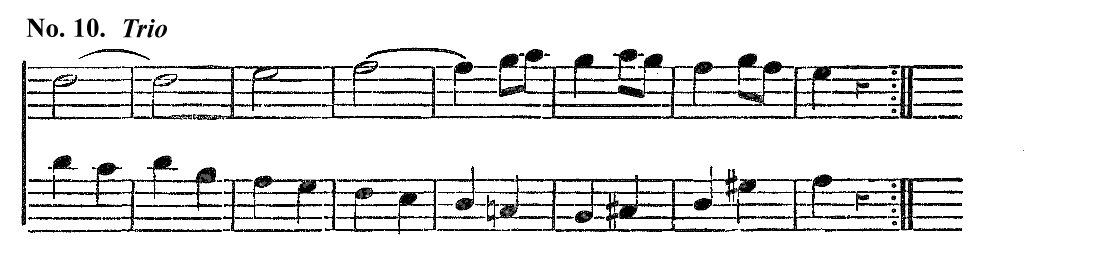
and
a better instance could hardly be found of the elementary shape in
which Beethoven's finest themes often came into his mind for the first
time.
The slow movement was the last to come into existence. Indeed not even the theme had been conceived when the thematic catalogue above quoted (No. 9) was written down.
First
we find the second section of the movement, Andante moderato,
in
the key of A, and designated as Alla
menuetto. The opening theme of the
Adagio
itself first appears in this rudimentary form: -

Then later, somewhat nearer to its ultimate shape (see bars 13,
14): -
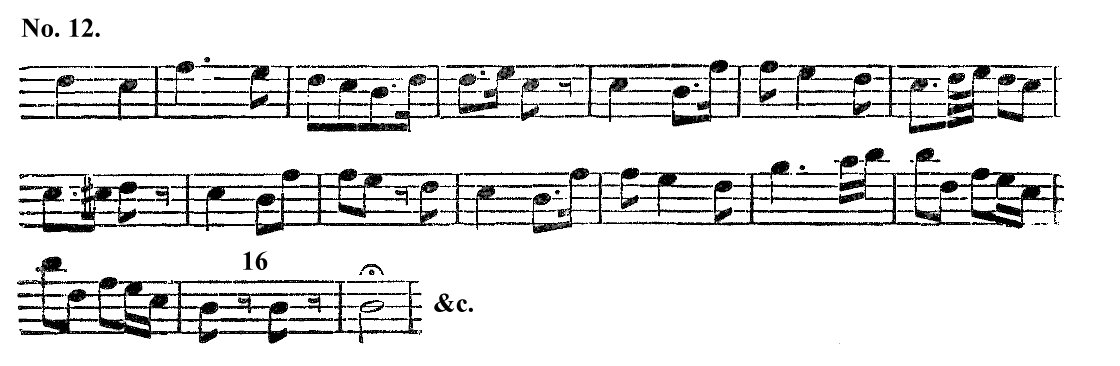
though still without the echoes of each
concluding phrase of the strings by the wind, which form so touching a
feature in the completed work, and no hint of the three crescendo
quavers which produce such an overpowering effect in bars 16 and 21 of
the present Adagio
(see No. 45).
Notwithstanding
his long preoccupation with Schiller's Ode,
and even
after making considerable progress with the present last movements,
Beethoven appears to have entertained the idea of an
instrumental Finale
to the Symphony even as late as June or July, 1823 [45].
This is evident from the following, which is found among
the sketches
of that date, and was afterwards used in another key for the A minor
Quartet, Op. 132 [46]:
-

Indeed so far was this carried that, according to the evidence of
Czerny (as vouched for by Josef Sonnleithner [47]),
some time after the
first performance of the Symphony, Beethoven expressed to a circle of
his intimate friends his conviction that the vocal Finale was a
mistake, and that it was his intention to substitute a purely
orchestral piece for it, for which he already had a theme - namely, the
subject last quoted.
The original MS. of the first three movements of the Choral Symphony, embodying the long and painful elaboration of the materials alluded to, is in the Royal Library at Berlin. Though more orderly than the originals of many of Beethoven's works - indeed, Schindler cites it as a model of neatness and distinctness - it is a rough manuscript, with many a blot and many a smear; not smooth and clean like those of Mozart, Schubert, or Mendelssohn. But it does not appear to contain any afterthought of importance, such as those in the MS. of Schubert's Grand Symphony in C. Neither the well-known oboe passage in the Trio nor the chromatic pedal-bass at the end of the first movement - so wonderfully personal and characteristic of the composer - nor any other of the many individual points in the work, has been interpolated. Each appears in its place from the beginning, after the long continued sifting of his ideas due to the sketch-books.
Here and there a date or a note of place or circumstance is scrawled on the margin, every one of which has its interest; and it is greatly to be wished that these could be inserted in an edition of the score, for the advantage of those who love every trace of the great musician and desire to connect his person with his works down to the minutest detail. A better method still would be to photograph the manuscript in fac-simile, as has been so well done with respect to Beethoven's Op. 26, and in the last volume of the Bachgesellschaft publications. We should then practically possess Beethoven's own manuscript, and it cannot be doubted that the study of it would reveal many a fact at present undreamt of. One such fact appears hitherto to have escaped notice - namely, that in the original MS. just named the Trio is not written in 4-4, as it stands in the printed scores, but is in 2-4 time, and is put into 4-4 by cancelling every alternate bar-line. Though not very material, this is interesting and worthy of record. In the MS. by the copyist [48], carefully corrected by Beethoven himself, and containing the dedication to King Frederick William III [49], the time is altered, and appears as printed.
There exists, however, another dedication of the Symphony, to a body who had more right to that honour than was possessed by King or Kaiser - namely, the Philharmonic Society of London. These gentlemen, prompted probably by Beethoven's pupil and friend, Ries, who was then settled in England, and to whom Beethoven had written on the 6th April, 1822, asking 'what the Philharmonic Society were likely to offer him for a Symphony' - passed a resolution on the 10th of the following November (1822), offering him £50 for a MS. Symphony to be delivered in March, 1823, and to be their exclusive property for eighteen months, at the end of which time it was to revert to the composer. This offer was communicated to Beethoven by Ries, and accepted by him in his letter of the 20th December. The money was at once despatched [50]. The manuscript copy in the possession of the Philharmonic Society bears the following inscription in the handwriting of the great composer: -
'Grosse
Sinfonie geschrieben
für die
Philharmonische Gesellschaft
in London
von Ludwig van Beethoven
erster
Satz.'
How it came to pass that after the engagement, and the payment of the money by the Philharmonic Society, Beethoven should have allowed the Symphony to be first performed in Vienna, and have dedicated it to the King of Prussia, is a mystery which must be left to Mr. Thayer to unravel in the forthcoming volumes of his Biography [51]. Certain it is that it was not performed in London till the 21st March, 1825, when it formed (with Italian words) the second portion of the programme of the Philharmonic Concert for that evening. Sir George Smart was the conductor, and his experience of the difficulties of the performance not improbably made him take the trouble to go to Vienna, in the following September, on purpose to get the right tempos from Beethoven himself. In particular he seems to have asked the composer after dinner, on September 6, to play him the recitative passages which connect the last movements with their predecessors [52]. On this occasion Sir George received a Canon from the great composer, the autograph of which, dated 'September 16, 1825, Baden near Vienna,' is still preserved in the Smart family.
The actual first performance of the Symphony was on May 7, 1824, at the Kärnthnerthor Theatre, Vienna, at a concert given by Beethoven, in compliance with a request addressed to him by all the principal musicians, both professional and amateur, of that city. Notwithstanding this enthusiasm, however, only two rehearsals were possible! There would have been a third [53], but that some ballet music had to be practised by the band! What such rehearsals - even those of the best orchestras - were twenty years only before the date in question, may be judged from the expressions contained in Beethoven's own complaints as to the rehearsals for 'Fidelio' in 1805 [54] - 'Of the wind I say nothing; but all pp, cres., all decres., and all f, ff may as well be struck out of my music, since not one of them is attended to. I lose all desire to write anything more if my music is to be so played.' - In a letter to Schindler, quoted by Lenz, he calls the day 'Fracktag,' because he had the bore of putting on a smarter coat than usual. On this occasion it was a green coat, and he probably also wore a three-cornered cocked hat. The preparations had somewhat upset him, and his dress had to be discussed with Schindler in one of the conversation books [55]. His deafness had by this time become total, but that did not keep him out of the orchestra. He stood by the side of Umlauf, the conductor, to indicate the times of the various movements. The house was tolerably full, though not crowded, and his reception was all that his warmest friends could desire. To use Schindler's expression, it was 'more than Imperial.' Three successive bursts of applause were the rule for the Imperial Family, and he had five! After the fifth the Commissary of Police interfered and called for silence! Beethoven acknowledged the applause by a bow [56]. The Scherzo was so completely interrupted - at the Ritmo di tre battute, where the drums give the motif - that it had to be begun again [57]. A great deal of emotion was naturally enough visible in the orchestra; and we hear of such eminent players as Mayseder and Böhm even weeping. At the close of the performance an incident occurred which must have brought the tears to many an eye in the room. The master, though placed in the midst of this confluence of music, heard nothing of it at all and was not even sensible of the applause of the audience at the end of his great work, but continued standing with his back to the audience, and beating the time, till Fräulein Ungher, who had sung the contralto part, turned him, or induced him to turn round and face the people, who were still clapping their hands, and giving way to the greatest demonstrations of pleasure. His turning round, and the sudden conviction thereby forced on everybody that he had not done so before because he could not hear what was going on, acted like an electric shock on all present, and a volcanic explosion of sympathy and admiration followed, which was repeated again and again, and seemed as if it would never end [58].
Our previous quotations show that there is no lack of the progressive sketches for the music of this mighty work; but of the dates and circumstances attending its later stages, the connected composition of its first three movements, we have at present only a meagre account. The earliest apparent mention of the work in Beethoven's correspondence is in the letter to Ries mentioned above, and in a second letter to the same, dated December 20, 1822, in which he offers to write a Symphony for the Philharmonic Society - 'the first artists in Europe.' Six months later, in a letter to the Archduke Rodolph, dated July 1, 1823, we catch another indication that the work is occupying his thoughts: - 'I thank Him who is above the stars, that I am beginning to use my eyes again,' the words 'den über den Sternen' evidently alluding to the line in Schiller's poem, 'über Sternen muss er wohnen.' In fact, at the moment of writing this letter he was in the very heat of composition. 'By the end of June,' says Schindler, 'the thirty-three Variations for Diabelli were finished; then he embarked full sail on the Symphony, and at once all the good humour which had recently made him so pleasant and accessible disappeared, all visits were forbidden except to the most intimate friends, and these much restricted.' At length, in a letter dated from his favourite Baden, the 5th September, 1823, to Ries, we find these words: 'The score of the Symphony has been finished to-day by the copyist.' But this must have been some mere preliminary draught; or, at any rate, can refer only to the earliest movements; since three weeks after this, on the 28th September, 1823, he is visited at Baden by Mr. Schulz, and questions him on the 'highest possible note of the Trombone, for a particular composition he was then about' [59] - surely for this very work. It also seems plain, both from Schindler's statements and from the fact that Beethoven does not offer it for sale till March 10, 1824 (letter to Probst), that the Symphony was not absolutely complete till that time. Schindler states that Beethoven returned to Vienna from Baden for the winter at the end of October, 1823. Contrary to his usual practice, he made no secret of the work on which he was engaged, but let it be known that his new Symphony was ready - ready, that must mean, in his head and in his sketch-books, and complete except as to writing out the detailed score - down to the concluding vocal portion, with regard to which he was unable yet to satisfy himself as to the stanzas to be selected from Schiller's Ode. To the completion of the first movement he applied himself directly after his return, with great ardour; and the manuscript is (as already mentioned) remarkable among his autographs for its comparative legibility and cleanness, and for the small number of corrections which it displays.
The metronome-marks in Beethoven's works are not always of his own putting; but in the Ninth Symphony there can be no mistake, as they are stated at length for the benefit of the Philharmonic Society in a letter to Moscheles, which he dictated on March 18th, 1827, only seven days before his death, which letter was exhibited in the Loan collection of the Inventions Exhibition of 1885 in the Albert Hall. I give them verbatim, because they are not correctly given either in Moscheles's reprint of the letter (in his translation of Schindler) or even in the last 'critical' edition of Beethoven's works: -

The first edition of this great work was published by Messrs. Schott, of Mainz, at the end of 1825 or the beginning of 1826, with the Mass in D and the Overture in C (Op. 124), in score (folio) and parts. The publishers' number for the score is 2,322, and for the parts 2,321. The invitation to subscribe to these was issued earlier, and Czerny's copy, which has been preserved, is dated 'Wien, im August, 1825.'
The metronome marks were added to the edition later. In 1867 Messrs. Schott published a second edition in 8vo, numbered as before 2,322; and the engraved plates of the first edition were then melted down [60]. In 1863 or '64 the work appeared in the 'critical and correct edition' of Messrs. Breitkopf and Härtel [61]. Neither of these two reprints adequately represents the original edition.
I. The Symphony starts in a different manner from any other of the nine, with a prologue which is not an introduction properly speaking, and yet introduces the principal subject of the movement. The tempo is the same from the beginning - Allegro ma non troppo, un poco maestoso. It begins, not with the chord of D, but with that of A, whether major or minor is uncertain, as the 'third' of the chord is left out; neither C sharp nor C natural are present. All is pianissimo; the second violins and cellos sound the accompaniment, with the horns in unison, to give it more consistency, while the first violins, tenors, and basses are heard successively whispering their way through them from the top of the treble stave to the bottom of the bass - still, however, avoiding the third of the chord: -

This
is repeated, after a bar's interval, with the difference
that the
first violins begin on the upper A instead of on the E, and that a
clarinet is added to the accompaniment; and then the phrase is given a
third time, but with a very Beethovenish difference: the intervals
remain the same, but the phrase is hurried - twice, the second time
more hurried than the first: -
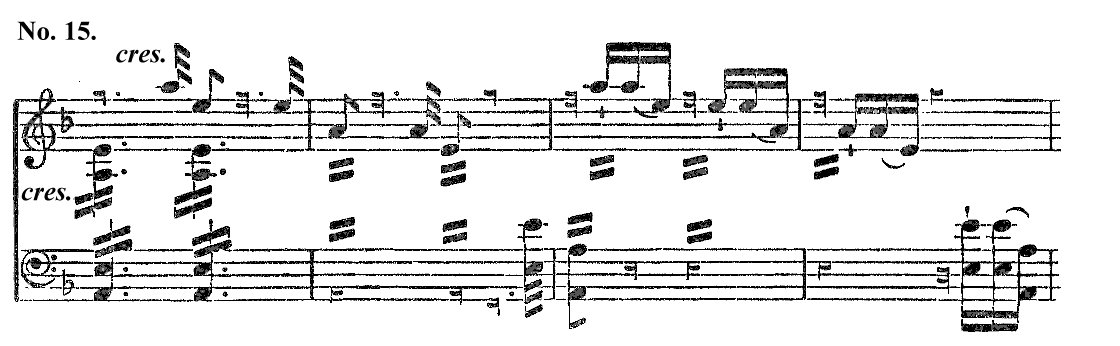
And so, at last, the wind instruments coming in one by one, and the
whole increasing in force bar by bar, we are launched into that
tremendous unison of the whole orchestra in the successive intervals of
the chord of D minor [62],
which really forms the principal
subject or animating spirit of the movement: -

It is now easy to see, what at first sight may not be apparent, that the first broken phrases of the first violins, tenors, and basses are, in fact, the same with the great subject itself, except for the mysterious vagueness which they acquire from the suppression of the third, and the secret manner of their entrance. Each consists of the intervals of a common chord descending through a couple of octaves. This is even more apparent when the prologue is repeated in the key and on the chord of D, in the strings, with long holding notes in the clarinets and horns, as it is shortly after the conclusion of the last extract: -

This
time, however (to proceed with our
analysis), the great subject-passage is given in B flat: -

perhaps as a remote preparation for the entrance of the 'second
subject' in that key. And then we have an indication (ut ex ungue
leonem) -

of what Beethoven intends to do with the rhythm and
intervals of the semiquavers which are contained in that great phrase
(see a,
No. 16), notes for which a very remarkable and important rôle
is destined. But though for a moment in B flat, he has no present
intention of remaining there, and he immediately returns into D minor,
and gives us this vigorous new phrase, ben marcato and forte in the
whole orchestra; a phrase which he has put down at an early period in
the sketch-book [63],
as one of
the principal stones to be employed in his
edifice: -

This he immediately repeats, according to a favourite habit, in
a more florid form, showing, at the same time, how it may be made to
imitate at a bar's interval -

and at length arriving at the 'second subject' in the key of B flat.
According to the usual rule, the
'second subject' should be in F, the relative major of D minor, but
Beethoven has chosen otherwise, and having reached the key of B flat,
he plainly signifies his intention of not going back for some
considerable time to D minor by the unusual course of drawing a double
bar through the score, and altering the signature to two
flats.
The
second subject is as strong a
contrast to the first as can be desired or devised: -
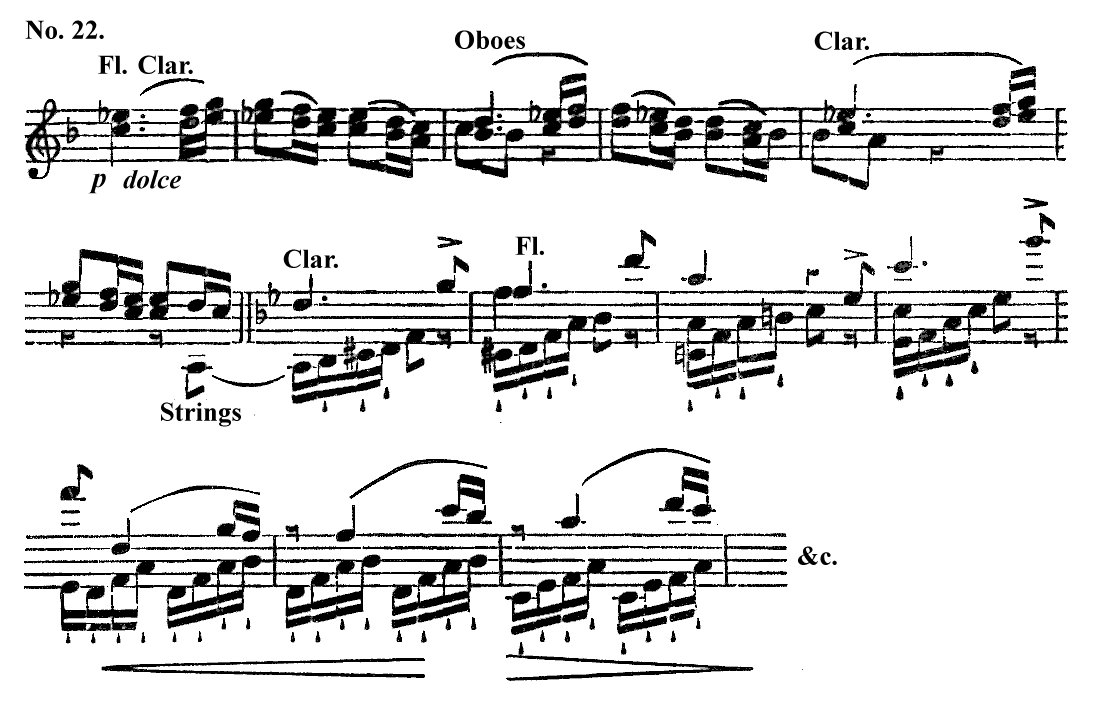
It begins
with a legato
phrase, in three members of two bars each, divided
between the flutes, oboes, and clarinets; and continues with bolder
phrases, also distributed between the various members of the wind band
(somewhat after the fashion of the second subject in the Allegro of the
Eroica), while to the latter portion the strings maintain an
interesting accompaniment in semiquaver arpeggios. An
indication of
the restlessness implied in the hurrying already noticed is visible
here again in the change of the phrase in the last three bars of the
quotation, and the more rapid repetition of the arpeggios in the
accompaniment.
It may be mentioned en passant that this subject (No. 22) is maintained by Séroff, a Russian critic, to be 'identical' with the theme of the Finale (No. 62), and that this curious identification is adopted by Lenz as a 'thematic reference of the most striking importance, vindicating the unity of the entire work, and placing the whole in a perfectly new light. (Lenz, Beethoven, eine Kunst-Studie, 4ter Theil, p. 178.) This is too strong a statement, as is also that of a writer in the Orchestra of May 1st, 1874, who calls attention to the 'form and figure' of the opening phrase of the second part of the Scherzo (Trio, No. 41) as an 'announcement' of the 'vocal portion of the work.' But the subject of the Finale is in D major, and starts on the third of the scale. The one may be a modification of the other, but they are certainly not 'identical.' It is, however, very remarkable that so many of the melodies in the Symphony should consist of consecutive notes, and that in no less than four of them the notes should run up a portion of the scale and down again - apparently pointing to a consistent condition of Beethoven's mind throughout this work. But surely the 'unity of the work' does not require to be 'vindicated' or denoted by such mechanical means as this! However, to return.
The
second subject has a Codetta
in the wind instruments, which
finishes it - not in B flat, but in G minor: and after this the
following stormy phrase is started by the violins, in E flat: -

repeated by the clarinet and bassoons in the same key; by the clarinet,
bassoon, and flute in C minor; and lastly by the strings again in D
minor. In each case the phrase is accompanied in contrary motion,
though never in the same way. By this bridge we are landed fortissimo
on an episode: -

the march-like rhythm of which (bars 1, 2, 5,
6) plays a large part in subsequent portions of the movement.
Out
of it grows a broad melody in the key of B major: -

which, however, after a short existence of four bars is dissolved into
an astounding passage of semiquavers for all the strings (except the
basses) in unison and sempre
pianissimo, leading into an episode
entirely different and distinct from anything that has come before it,
and of the most beautiful effect: -

The G flat and G natural with which the members of the passage alternately commence, seem to be entirely accidental to the chords which follow them; and perhaps it is this fact that is the secret of the peculiar tender poignant effect that they produce. The passages repose on the figure quoted in No. 25, here given in the drum, and it will be observed that the phrases are again hurried as the conclusion is approached: -

From
here to the end of the first division of the movement
Beethoven remains almost entirely in B flat. He closes this portion of
his work with a loud passage of eight bars, in which the whole
orchestra ranges in unison up and down through the intervals of the
common chord of the key, in the rhythm of No. 25: -
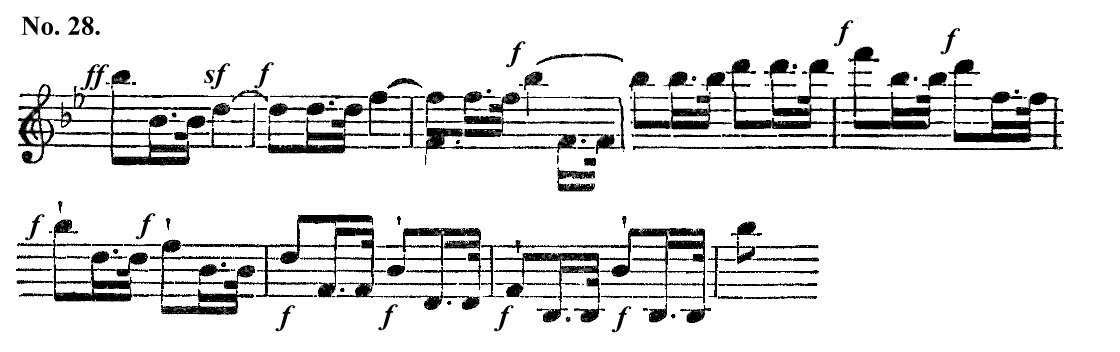
and here
once more we encounter the restless hurrying already spoken of. The
first division is not repeated as usual, Beethoven doubtless having an
eye to the unusual length to which his Finale was to
stretch; so he
makes a transition in his own wonderfully direct way from B flat to A,
draws a double-bar through the score, restores the signature to one
flat, and proceeds at once with the working-out. For this he makes use
of the prologue in somewhat more concise form than at the opening, but
very soon introduces the striking rhythm quoted in Nos. 25 and 28,
always with violent sforzandos.
For key, he is evidently leaning towards
G minor. He has already (see No.
19)
given an indication that he knows
what development his main subject is
capable of, and he now commences the process of treating the four
semiquavers (a
of No. 16)
as
a regular
melody, in a phrase of four bars
given alternately to the oboes and clarinets, and ending with a short
ritardando,
which becomes very characteristic before the movement is
over. However, he abandons this phrase for a time, and goes back to the
main subject itself, the grand phrase quoted in No.
16. And now we see
how nobly this great composer and poet could treat a subject after his
own heart. Surely there is nothing in the whole range of music more
noble than the effect of this great theme, sweeping down through its
simple natural intervals from top to bottom of the scale, and met by
the equally simple pizzicato
bass, which is in fact little but the
theme itself in reversed order. The A flat which Beethoven has added to
the phrase on its second occurrence (*): -

has an
astonishingly
passionate effect. It is no exaggeration to say, as Geminiani
said of a certain semitone in the fugal answer in Handel's Overture to
Muzio Scevola:
'Quel semitono vale un mondo' - that A flat is truly
worth the world! [64]
But
Beethoven is still too restless to remain in this
noble and dignified frame of mind, and he brings it to an end as he did
the prologue, with impatient sfarzandos
- this time in C
minor, and
again introduces his four semiquavers, which he seems to love, as a
mother sometimes loves a puny child, almost in inverse proportion to
their significance. Something appears at last to decide him, and he
goes off into a lengthened passage founded entirely on these two bars
of his original subject: -

It
begins as follows: -
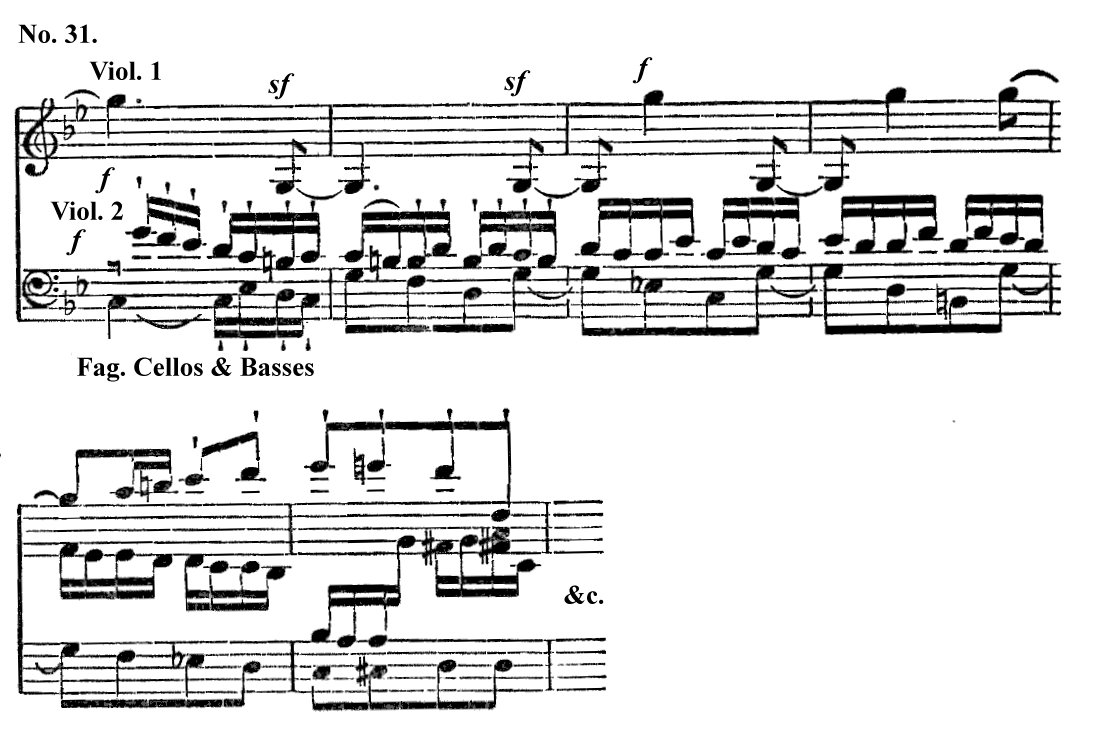
The
second
violins and basses have the working of the subject, while the first
violins indulge in wild leaps from their lowest G to the same note two
octaves higher. This passage - six bars in length - is
repeated three
times in 'double counterpoint' - that is to say, the instruments change
their parts among themselves, that which was above being played below,
that which was below, above; and with other variations suggested by
the skill of the composer. In the present case, as will be seen from
the quotation, there are three
subjects - that in semiquavers, that in quavers, and
the octave passage of the violins: and each of the three is made to do
duty in different positions and parts of the scale with an effect of
which the hearer may judge for himself. At length the semiquavers are
consigned to the basses, who retain them for twenty bars, while the
violins execute their leaps in the latter portion of the figure. It
takes Beethoven in all forty bars to work off this mood, and at the end
of it he seems more than ever alive to the capabilities of his little
subject for expressing the feelings which are in his mind. But the mood
has softened, and now the phrase appears as a 'Cantabile'
- a word which Beethoven never uses without special meaning,
and never
with more intense meaning than here. The passage is a duet between the
first and second violins, the cellos accompanying with the quaver
portion of the theme: -

At length he seems to recollect that there are other materials at command, and turning to the second half of the second subject (No. 22), he gives it in F, treating it partly as before and partly in double counterpoint, the melody in the basses and the arpeggios in the treble. But the charm of the little semiquaver phrase is still too much for him; he returns to it once more, trying it this time mixed with inversions; and at length, as if resolved to dismiss it for ever from his thoughts, gives it with one grand burst of the whole orchestra.
Here I would call attention, though with reluctance, to a singular feature in this great work - namely, to the occurrence more than once during the working-out of the first movement of a vacillation or hesitancy in expression of which I know no trace in any of the other Symphonies, but which cannot but be recognised here by a loyal hearer; where the notes of flutes and oboes seem to tremble and falter as if they were the utterance of human lips, the organs of an oppressed human heart. These places need not be specified, they cannot but strike the sympathetic listener, and will almost suggest, if it be not disrespectful to entertain such a thought, that the great Beethoven was, with all his experience, too much overpowered by his feelings to find adequate expression for them. These tokens of human weakness may be safely left to the affectionate sympathy of the friends and admirers of this great poet.
At
length the composer completes the due circle of the form,
and
arrives at the resumption of the original subject (No.
16) in its
entirety, after having made so thorough a treatment of the several
parts. For this he prepares by a recapitulation of the original theme
from the prologue (No.
14);
but
in how different a style from that in
which it first crept on our notice! Instead of that vagueness and
mystery which made it so captivating, it is now given with the fullest
force of the orchestra and the loudest clamour of the drum, and ending
unmistakably in D major.
Its purpose is accomplished, its mission
fulfilled, its triumph assured; no need now for concealment or
hesitation! And so it merges into the great
descent of the main subject, not a mere unison
as before - but in full harmony, with a bass ascending in contrary
motion, and with all possible ostentation. Nor is this all. To give
greater weight to the main features of the subject, it is lengthened
out by the insertion of two bars in the middle and two bars at the
end. See (a)
(a) and (b) (b): -

This is a difference far more pronounced than that in which Beethoven
has indulged himself at the return of the subject either in No. 5, 6,
7, or even No. 8, where the theme comes back in the bass; and it shows
- if such a thing wanted showing - how entirely the prescriptive forms
of music had become subordinated in Beethoven's mind to the expression
of the thoughts and emotions which were animating him.
The ben marcato phrase (No. 20) is next given, but with a difference, and on a pedal D - six times over. The second subject (No. 22) follows on this, in D major, and then the various passages and episodes already enumerated, with corresponding changes of keys, and important modifications in the distribution of the instruments. At length the repetition of the first portion of the movement is concluded, not as before in B flat, but in D minor, and now begins a peroration, or Coda, which is so immense in its proportions, so dignified, noble, and passionate in its sentiment, and so crowded with touching beauties, as almost to put out of mind even the noble music we have been already hearing. This Coda begins with the descending phrase of the first subject (No. 16), harmonised as before by pizzicato basses in contrary motion, but treated at much greater length than before, and with constant variety. Next a great deal is made of the stormy phrase quoted as No. 23. The two favourite bars which formed so prominent a feature in the working-out (No. 30) are once more brought forward and worked between the horns and oboe, over a holding A in the strings; then by the strings themselves in unison, with the holding A in the horns; then the stormy phrase recurs with an astonishing passage in contrary motion in the violins; and then the ritardando, twice given. So far Beethoven is dealing with previous materials. But, before finishing, he has something to tell us entirely different from anything that he has already said. The earlier portions of this movement, notwithstanding the occasional hesitation to which we have referred, paint in unmistakable colours the independence and impatience which characterise him throughout life, and which in 1823 had increased to an almost morbid degree. They show all the nobility and vigour, and much of the tenderness and yearning, which go to make up that individual being who was called Beethoven. But this the former Symphonies do also in their degree. He will now show us a side of himself which he has hitherto kept veiled. He will reveal to us the secret of his inmost grief, and we shall see that, great and noble and stupendous as he is, his heart can be a prey to pangs as bitter and as unassuageable as those which rack the fondest woman. And this he does as no one but himself ever could do. The strings begin a passage consisting of repetitions of the following phrase of two bars:

This passage, like the somewhat analogous one in the first movement of the Seventh Symphony, may be regarded as a 'pedal point' on D. It commences pianissimo, and gradually increases in tone through sixteen bars till it reaches double forte; while over it, in the touching accents of oboes, clarinets, and flutes, is heard the following affecting wail: -

Was ever grief at once more simply, more fully, and more touchingly told? The sorrows which wounded the great composer during so many of the last years of his life, through his deafness, his poverty, his sensitiveness, his bodily sufferings, the annoyances of business, the ingratitude and rascality of his nephew, the slights of friends, the neglect of the world [65] - sorrows on which he kept silence, except by a few words in his letters, are here beheld in all their depth and bitterness. Surely if anywhere he has here produced his proprio e proposto effetto. We almost seem to see the tears on his cheek. But if Beethoven thus succumbs to emotion, it is only for a moment. His independence quickly returns, and the movement ends with the great subject in its most emphatic and self-reliant tones; and, like the first Allegro of the Eighth Symphony, in the very notes of the chief subject. Mendelssohn has left his opinion of this portion of the Symphony on record in the following interesting words [66]: 'The conclusion of the first movement (of Beethoven's Violin Sonata in C minor, Op. 30, No. 2) has a 'go' (Schwung) which I hardly know in any other piece of his; except, perhaps, the end of the first movement of the Ninth Symphony, which certainly surpasses in 'go' everything in the world.'
The opening movement is almost always the most important portion of a Symphony. It gives the key to the work, in every sense of the word, and is usually the representative member of the entire composition. To this rule the opening Allegro of the Ninth Symphony is no exception. Great as are the beauties of the second and third movements - and it is impossible to exaggerate them - and original, vigorous, and impressive as are many portions of the Finale, it is still the opening Allegro that one thinks of when the Ninth Symphony is mentioned. In many respects it differs from other first movements of Beethoven; everything seems to combine to make it the greatest of them all. The mysterious opening, which takes one captive at once; the extraordinary severity, simplicity, and force of the main subject; the number of the subsidiary themes; the manner in which they grow out of the principal one, as the branches, twigs, and leaves grow out of a tree; the persistence with which they are forced on the notice; the remarkable dignity of some portions and the constant and obvious restlessness of others; the incessant alternation (as in no other work) of impatience and tenderness, with the strange tone of melancholy and yearning; the inevitable conviction, here and there, that with all his experience Beethoven has not succeeded in expressing himself as he wants, and the consequent difficulty of grasping his ideas, notwithstanding the increasing conviction that they must be grasped - all these things make the opening Allegro of the Ninth Symphony a thing quite apart from all the others. It is startling to think how much the world would have missed if Beethoven had not written this work, and especially the first movement of it. Several of the eight others would still have been the greatest Symphonies in the world, but we should not have known how far they could be surpassed. It is in the hope of elucidating some of the difficulties of the movement, and thus leaving the hearer more free to realise the total effect, that the foregoing imperfect analysis has been attempted.
It must be here said that no connection need be looked for between the first three movements of the Choral Symphony and the 'Ode to Joy' which inspired its Finale. The very title of the work - Beethoven's own - is conclusive on this point. It is not a Symphony on Schiller's Ode to Joy, but it is a Symphony with Final Chorus on Schiller's Ode to Joy - 'Sinfonie mit Schluss-Chor über Schillers Ode an die Freude.' Beethoven, says an intelligent critic, 'has not given us any programme to the first movement, not even a descriptive title, as he does in the Pastoral Symphony' [67]. The first three movements might have had another Finale - indeed, they nearly had one (see No. 13); and it is not necessary to attempt to reconcile either the opening Allegro, the Scherzo (so called), or the Adagio with the train of thought and feeling suggested by the Ode which is embodied in the latter portion of the work. In fact, as we shall see farther on, Beethoven tries the three first movements one after the other, to see if any of them will suit for a Finale, and rejects them all!
So far, then, the first movement of this great Symphony.
II. The second movement is the Molto vivace; in fact, though not so entitled, the Scherzo - here, for the first time in the nine Symphonies, put second [68]. It has a double interest from the fact, already noticed, that, as far as at present known, its chief subject is the first actual morsel of the Symphony ever put on paper. The movement is in the same key with the Allegro, and, like all Beethoven's other Orchestral Scherzos, in triple time [69]. It has been called a 'miracle of repetition without monotony,' and truly it is so; for it is not only founded upon - it may almost be said to consist of - one single phrase of three notes, which is said to have come suddenly into Beethoven's mind as he stepped from darkness into brilliant light. - The autograph sketch in the collection at the Royal Library at Berlin bears Beethoven's favourite proverb, 'Morgenstund hat Gold im Mund' [70].
That
there may be no mistake as to his intention, he opens
this - at
once the longest and greatest of his Scherzos - with a
prelude of eight
bars, in which the phrase in question is given four times successively
in the four intervals of the chord of D minor, though with a strange
irregularity of rhythm in the sixth bar: -

The movement then starts pianissimo
(and observe, almost wholly in
consecutive notes), in the second violin, the oboe accenting the first
note of each bar. The subject on its original appearance, in 1815 (see
earlier),
is labelled
'Fuge,' and
it is here treated in a fugal style. After four bars
the viola answers 'in the 5th below' in strict imitation, accompanied
by the clarinet; then - at intervals of four bars - the cello, first
violin, and double bass follow, each with its strict response: -

The second motif
- a perfect contrast to the foregoing - is a
delicious crescendo
in the wind instruments (note the harmonies
at * and *) accompanied in the strings by
the incessant octave figure: -

This is given twice, and is followed by another very melodious
phrase [71],
also given out by
the wind, and accompanied as before by the
strings in the initial figure -

and this again is soon
succeeded by a long and tuneful passage, of which we can only quote a
few of the commencing bars: -

After this, the tone diminishes to pianissimo, and with a pause of three bars we arrive at the end of the first portion of the Scherzo. This portion is then repeated. After the repetition a connecting-link or 'inter-chapter' of eight bars (ending with three bars' pause) brings us into E flat, and the second portion of the movement. And here, under the same form as before, and in the narrow limit of eighteen bars, we encounter a great deal of modulation, and pass from E flat, through D flat, C flat, E, into E minor. In this last key the original theme (No. 36) starts off with great drollery in the bassoons, and, as Beethoven has marked the score, in the rhythm of three beats, 'Ritmo di tre battute' - the phrases being three bars long. In the course of this it will not escape notice how the drum, with characteristic audacity, puts the composer's direction at defiance by coming in four times at intervals of three bars, and the fifth time making the interval four. This, with the co-operation of the bassoon, seems to have been one of the points which specially enraptured the audience at the first performance [72]. The rhythm of three bars is succeeded by a 'rhythm of four bars,' containing some charming effects of the horns and trumpets. - We cannot help noticing at this place the extraordinary persistence with which Beethoven has given his directions throughout these movements. In the original folio score, and probably still more if we could examine the autograph manuscript, the various indications are sown thick through the staves. It was his constant practice. He had certain very definite intentions and it should be no fault of his if they were not carried out. This reiteration is one of the most characteristic things about a Beethoven manuscript, and it has here found its way to a certain extent into the engraved score.
The
pianissimo
is maintained almost throughout, and this part of the
work contains some truly splendid music. It is wonderful with what
persistence the original figure is maintained, and how it is made to
serve for melody, accompaniment, filling up, and every other purpose.
The second portion of the Scherzo
is repeated; we then have another 'inter-chapter' of twenty-four bars,
the last eight of them marked
Stringendo il tempo
- in other words, slightly accelerating the time
and fortifying the impulse. By these we suddenly reach the Trio, in
this case called simply a 'Presto.' This Presto is in the
key of D
major, and in common time of four crotchets. In the original MS. of the
Symphony, in the Imperial Library, Berlin, it is in two crotchets; but
Beethoven afterwards changed this by erasing each alternate bar, and in
the fair copy corrected by his own hand, and dedicated to the King of
Prussia, it appears as in the printed scores. At the same time the pace
changes to Presto,
an indication which, in the original folio score, is
accompanied, both over and under the score, by the metronome
mark

in accordance with Beethoven's own letters to Moscheles and
Schott already quoted (see earlier).
In Schott's octavo score and in the
later 'critical edition' of Breitkopf and Härtel this minim is
changed to a semibreve, thus doubling the pace and making it almost
impossible for the horns to play the passages given to them. No warrant
whatever exists for the change, and it ought to be at once rectified.
The
Trio
brings in the wind with a subject of eight bars, made
sixteen
by repetition. The bass trombone wakes up from its long sleep and
utters its first note, a high D [73],
fortissimo,
to welcome it: -

This theme [74]
- a slight
modification of the familiar ancient melody on
which 'Non nobis' is founded, employed by Handel in 'The horse and
his rider,' and elsewhere, and simple almost to rusticity - is
succeeded by a charming motif,
in which the violas and cellos run up
the scale crescendo
with a delicious eagerness, as if rejoicing in
the freedom of the major scale after so much minor: -

The
first motif
then re-appears in the horns, with the melody which
before accompanied it as a bass divided between the strings in turns -
now above and now below the theme. The theme then shifts to the
bassoons, and the accompaniment (see No. 41) - in its turn a theme, and
a most charming one - to the oboes, the horns gradually joining with a
sub-stratum of harmony: -

The whole of this passage is
well known, and the delicate temporary
modulation into F at bar 7 -
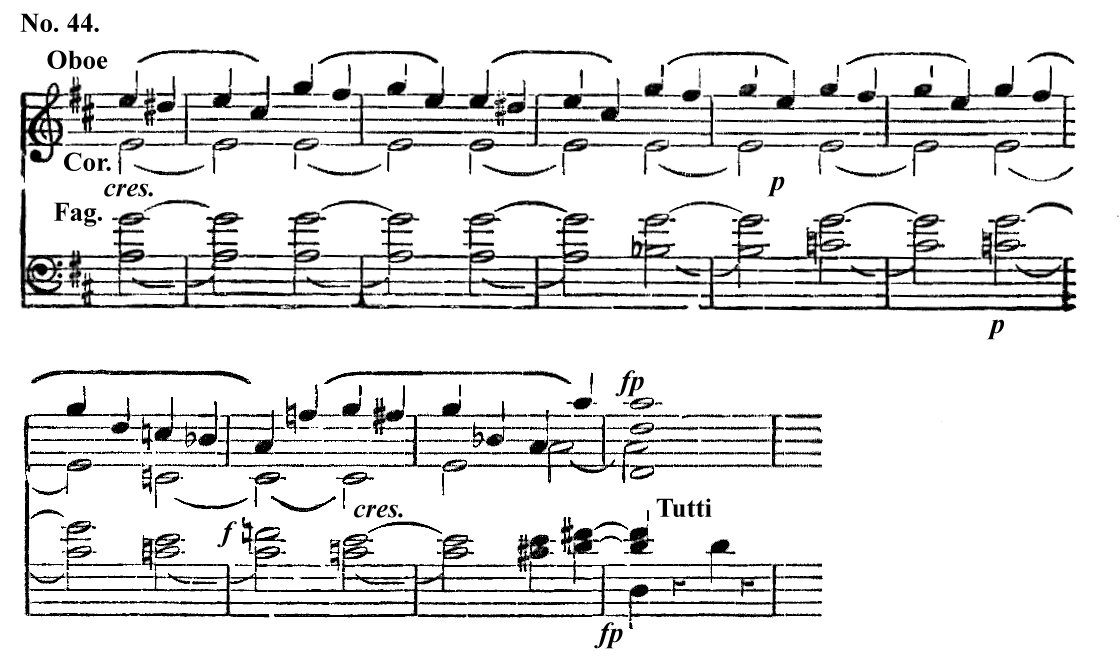
is as anxiously watched for and as keenly enjoyed as any passage in
Beethoven's works. The delicious effect of the peculiar tones of the
oboe in this place must be heard to be understood. Berlioz is not far
wrong when he classes it with the effect produced by the fresh morning
air and the first rays of the rising sun in May [75].
Whatever privations
his deafness had inflicted on Beethoven, it had not deprived him of the
memory of nature, or of the sense of the combination of sounds! Here
he is possibly reproducing the feeling of some sunrise which he had
'seen through the mist' on the hills above his beloved 'Brühl' at
Mödling, or at Baden - occasions which seem to have awakened all his
religion and all his poetry.
In the Coda - after the repetition of the first portion of the Trio - the whole orchestra comes into play; and the effect of the great crescendo and diminuendo, with the grand clang of horns and trombones, and trumpets in low register (somewhat unusual with Beethoven), is truly splendid. After this the Scherzo is repeated throughout; and then, with a short allusion to the Trio, this long but most interesting, elaborate, and exhilarating movement comes to a close.
A characteristic anecdote connected with this movement, at the first performance of the Symphony at the Conservatoire at Paris, has been preserved by Elwart in his history of those famous concerts (p. 204). As Rossini was coming out of the building after the performance, he was heard to say to Ferdinand Hiller, 'I know nothing finer (plus beau) than that Scherzo. I myself could not make anything to touch it. The rest of the work wants charm, and what is music without that?' Hardly less interesting is the anecdote told by Lenz of the behaviour of his friend Glinka, at the first performance of the Symphony at St. Petersburg [76]. He was completely overcome by the Scherzo; weeping violently and hiding his face in his hands he said, 'Mais on ne touche pas là! Oh! c'est impossible.' Interesting; but it is difficult to say which of the two composers, Glinka or Rossini, was the more self-conscious in his remarks.
III. The Adagio is absolutely original in form; and in effect more calmly, purely, nobly beautiful than anything that even this great master - who knows so well how to search the heart, and try the spirit, and elevate the soul - has accomplished elsewhere in his Symphonies.
It
consists of two distinct pieces - distinct in tune, in
character, in
key, and in speed - which are heard alternately until the one yields,
as it were, to the superior charms of the other, and retires. The first
of the two is in B flat, and in common time, Adagio molto e cantabile.
A prelude of two bars - the second containing a crescendo
full of such unutterable yearning as seems almost to burst the heart of
the author - introduces this broad, sweet, and tender
melody, in four separate strains [77]: -

harmonised
in the same style. The two choirs of the orchestra, string and wind,
are kept distinct. The melody is given out on the strings alone, and
the effect of the echo of the last few notes of each strain by the
clarinets, bassoons, and horns is exceedingly beautiful, quite
original, and always fresh.
After the strings have completed the melody, the last two strains are taken up by the wind, with an arpeggio accompaniment in the strings, and the first portion of the movement, twenty-two bars in length, ends. The time then changes to 3-4, and the key to D, the speed quickens to Andante moderato, and the second violins and tenors give out the following melody (a polacca, as it has been sometimes termed!) in unison, accompanied by the basses and bassoons in an exquisite rhythm, and by the upper portion of the wind: -

In the autograph sketches in the Royal Library at Berlin [78], shortly before the arrival of the second theme, we find the words, 'The chorus may perhaps appropriately enter here'; and immediately before the theme itself, as if an indication of tempo, 'Grandioso, alla Menuetto.'
On
the repetition of this tune (over a pedal A in the cellos)
the first
violin accompanies it with an independent melody of great charm (see
(a) in the
last quotation). The Andante
is eighteen bars long, and it
gives place at once to the Adagio
in its old key. The tune is now
varied, after Beethoven's own noble and incomparable manner, by the
first violins, in semiquaver figures [79]
-

and the treatment of the
wind and the other strings in the first portion is entirely different
from what it was before. After each section of the tune has been
completed, the clarinets and their companions echo the concluding notes
as before, and with the same accompaniment. The delicious lazy grace of
the figures just quoted - due to the syncopation introduced -
is almost a repetition of that which gives such a charm to a portion of
the Larghetto
in Beethoven's Second Symphony, namely: -

This
over, the Andante
returns, but now in the key of G:
-

The tune remains unaltered, but it is taken by the
flutes and reed instruments. On the repetition, the accompaniment
melody in the first violins (a,
No. 46) is strengthened and made more
prominent.
We
now return to the Adagio,
and arrive at a most beautiful section of
the movement. The melody (in E flat) is given by the clarinets and
bassoons, with a deep horn as bass, and occasional pizzicato notes
distributed over the strings. The effect of the opening is so strange
and so beautiful that we give a skeleton of the first few bars. Note
the G flat (*) and the mysterious effect produced by the distance
between the melody and the bass: -

Note too the imitation by the horn, in
bars 3 and 4, of the tune as given by the clarinet in bars 1 and 2.
Here, too, is a melody, the speaking beauty of which is, if possible,
increased by the peculiar tones of the horn - the fourth horn be it
observed - which delivers it: -

This
section of the movement is only sixteen bars long. It is
not a
repetition of the former Adagio,
and if a variation it is a remote one;
but whatever it be, it is most beautiful. Farther on is
a passage in
which the fourth horn runs in semiquavers up and down the scale of C
flat [80]:
-

a feat of no ordinary difficulty for that much-tried instrument, and,
like other trials of life, not always successfully accomplished.
These
sixteen bars lead into the second variation proper of
the
original melody; the key B flat as before, the time 12-8, and the
figure a semiquaver one, of wonderful beauty, dignity and elegance: -
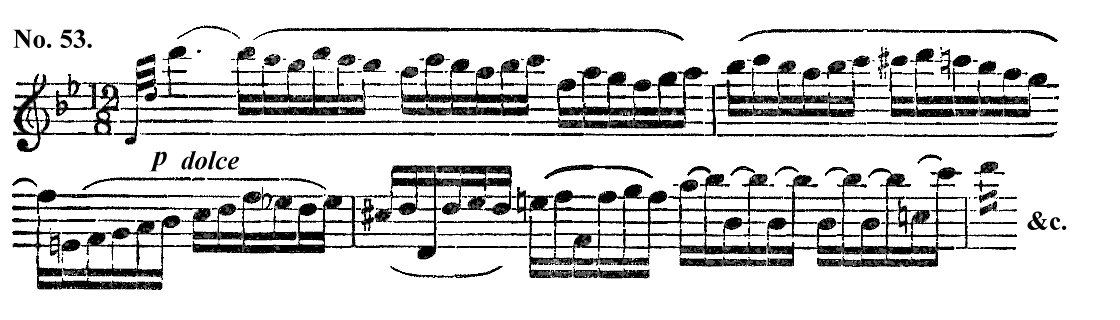
with a pizzicato
accompaniment, and at the same time
extraordinarily full of vigour. No passages of Beethoven's or anyone
else's can surpass the following for irrepressible brilliancy and
majestic sweep
of life - full of dignified sentiment, without a grain
of sentimentality or any other morbid thing: -

and there are
several of such!
In
the course of this variation, the horn has
again some difficult feats to accomplish (we quote a couple of
specimens): -
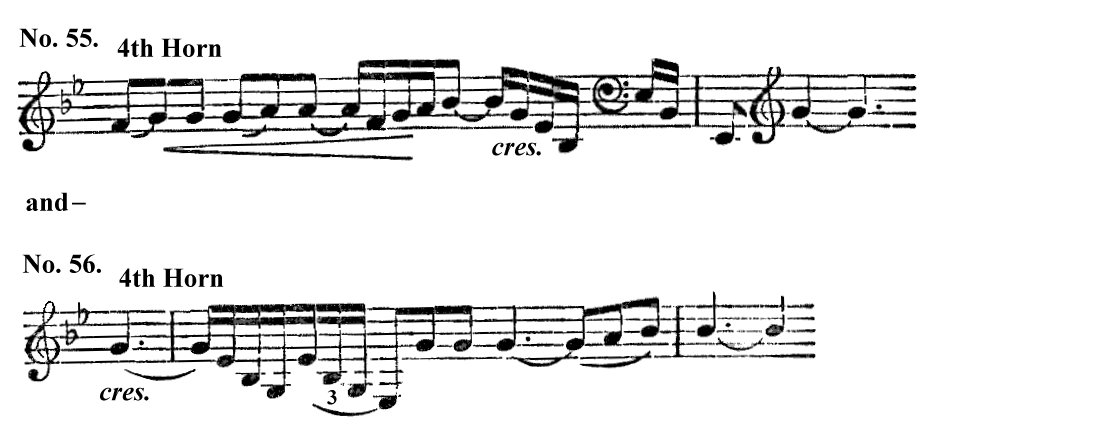
but Beethoven has amply repaid this most human instrument for
any such trials by the lovely part which he has given it
in this Adagio.
The fourth horn was in his good graces
all through the movement [81],
and a horn-player might well choose to have
engraven on his tomb the beautiful notes which are given to his
instrument - either those already quoted (No.
50) or the delightful
accompaniment of triplets which we give farther on (No.
58).
As he approaches the end of the variation, Beethoven gives a specimen of his skill in counterpoint by adding a new melody in the flute (doubled in the octave below by the oboe) above the long violin figure, while taking as bass to the passage a portion of the primal melody of the movement. The latter melody is sustained by the bassoons and two horns, and given in detached notes in the basses: -
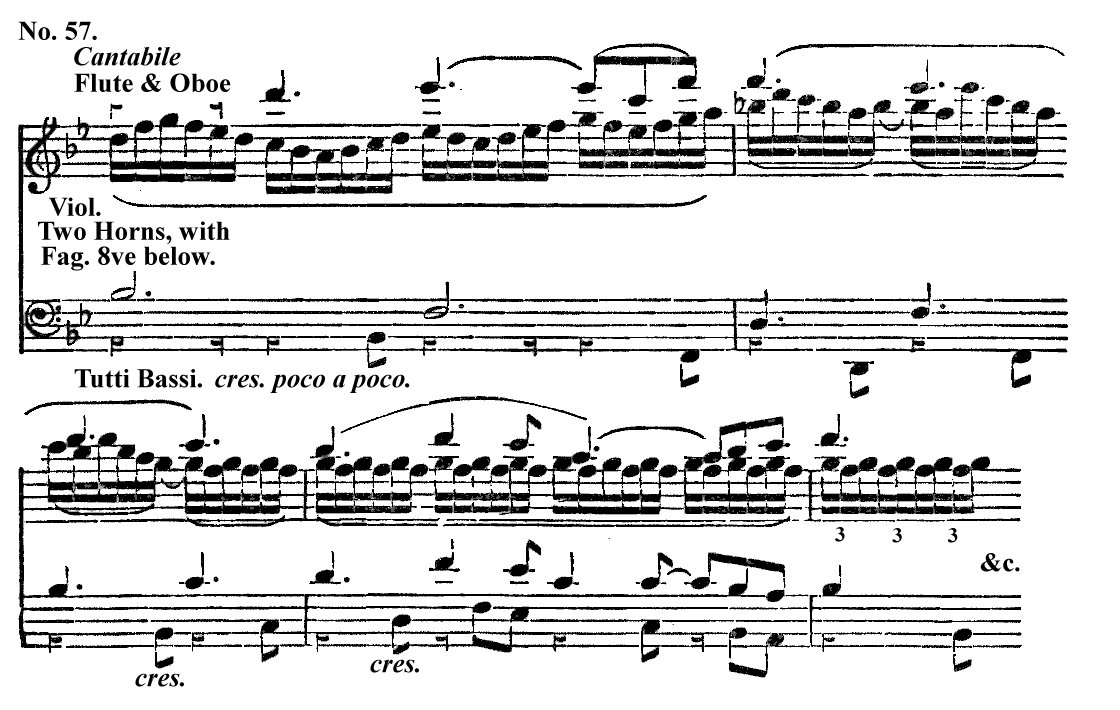
It will not be overlooked that the melody for the flute is marked with Beethoven's special term Cantabile.
The
Coda
of the Adagio,
like the Coda
of the opening Allegro,
is almost
more striking and more beautiful than the body of the movement itself.
We cannot resist quoting the beginning: -
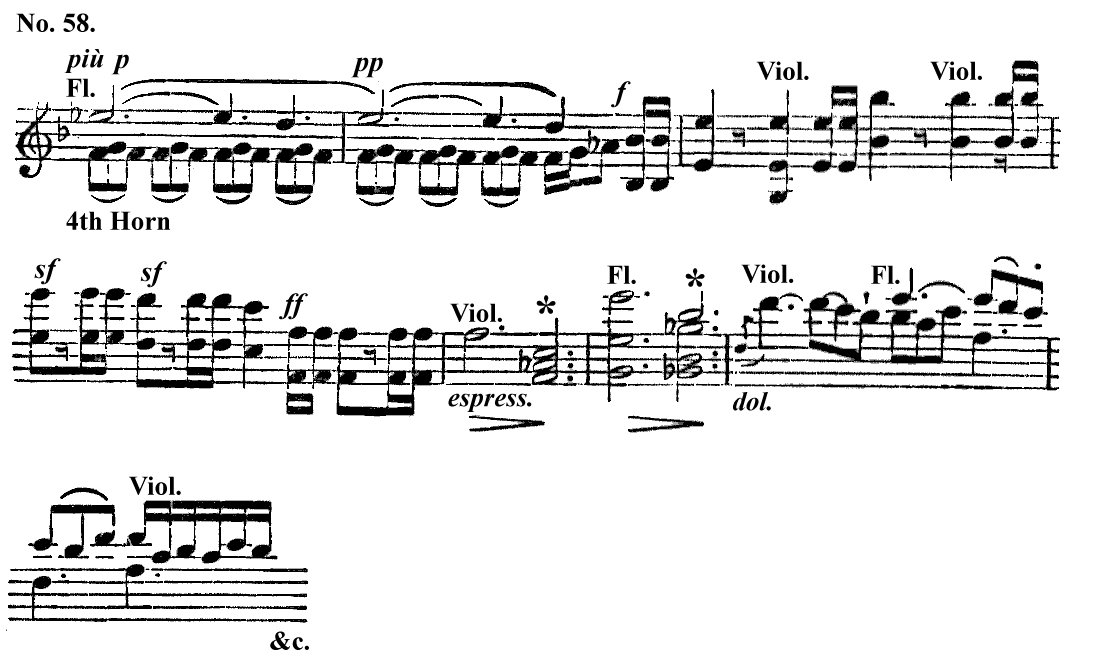
where the A flat (*) and G flat (*) have an effect truly magical; and
the resumption of the florid figures by the violin - first in quavers (Cantabile) and then
in semiquavers - with the response of the flute,
is too beautiful for words.
Another passage of four bars with a transition into D flat, shortly after the last quotation, might be headed Vanitas Vanitatum, for no more solemn or impressive dirge was ever uttered. But indeed the whole of the Coda is a gem of the purest lustre. The movement ends without any mark of pause - a thing carefully observed in all the other sections of the work. And this is so not only in Beethoven's own first edition, the proofs of which were repeatedly through his hands, but in the manuscripts. No indication of a pause at this place is to be found in any of them. Recollecting his extreme care to note everything necessary for the exact performance of his music - a care which increased upon him towards the end of his life - it seems impossible not to believe that he intended the interruption which follows to be as sudden as a thunder-clap [82]. It is to be hoped that no future Editor will supply the pause symbol without a word of warning! Alas! it is not improbable.
At the same time, is it possible to make the necessary changes in the horns and drums to suit the change of key in the next movement, without a pause? In our own days it may be done, as Sir Arthur Sullivan showed at the Leeds Festival of 1889, but in 1823 there were no valve-horns or other mechanical helps to the player, except his 'crooks.'
IV.
The disturbance of the beautiful
dream which
has so long held us
spell-bound is indeed of the roughest description - a
horrible clamour or fanfare, Presto,
given with all the force of the
drums and wind instruments, including the contra-fagotto, or double
bassoon, an octave lower than the ordinary instrument, which was
employed in the Finale
to the C minor Symphony, and is here introduced
into the score for the remainder of the work: -

A dignified recitative by the whole of the cellos and double basses, to
which the composer has affixed this direction, 'Selon le caractère
d'un Recitatif mais in tempo,' seems to rebuke this demoniacal uproar.
We say 'the whole,' because in the early performances by the
Philharmonic Society it was the custom for Dragonetti to play it as a
solo [83].
True, expression is
imperative, as is proved by Schindler's
question to Beethoven on the point in the conversation books: 'also
ganz so als ständen Worte darunter?' 'exactly, then, as if it had
words to it?' but this is a different thing from giving the passage
to a solo player, however eminent [84].
The rebuke, however, is administered
to no purpose; the blow is repeated with even aggravated roughness:
-

Again the basses interpose, and then a
remarkable passage occurs in which Beethoven passes in review each of
the preceding three movements, as if to see whether either of them will
suit for his Finale. All
this singular passage
- as truly dramatic 'as if it had words to it' - is
Beethoven's device, of which Schindler tells us (and indeed gives, in
the fac-simile
of Beethoven's writing at the end of his
Biography), to connect Schiller's words with his previous music [85].
Hitherto, in the three orchestral movements, Beethoven has
been depicting 'Joy' in his own proper character: first, as part of
the complex life of the individual man; secondly, for the
world at large; thirdly, in all the ideal hues that art can throw over
it. He has now to illustrate what
Schiller intended in his Ode, and the method he adopts of connecting
what he has done with what he has to do is truly a simple one, but it
is effectual. He makes a horrible clamour
and then says: 'O friends, not these noises! as we are to sing about
this great thing in words, let us sing the words of the immortal
Schiller.' 'But will the themes of any of the
preceding movements be suitable for the new undertaking? Let
us try.' The first few
bars of each movement are then brought on in order, and each is
instantly dismissed by its author, speaking through the voices of his
cellos and double basses; the Allegro
and Scherzo
are even sent back
with some show of impatience. The
heavenly opening of the melody of the Adagio, though but
two bars,
alone has power to shake his resolution, and the recitative which
succeeds it is softer in tone, and almost caressing in manner,
though still sternly antagonistic in its
conclusions. It is too plain that no portion of
his preceding movements will suit him to express the new idea. At
length we hear a new, fresh motif
stealing-in in the wind instruments
-

and then at last not only the basses, but other members of the
orchestra welcome the deus
ex machinâ with every mark of applause. It
is only a sketch of the great tune which is to come, but it contains
infinite promise.
If not too technical for these imperfect notices, it is right to mention here the slight point by which Beethoven has differenced his sketch of the new subject from the perfect theme as it appears later, and which gives it a distinct flavour. There it is frankly in the tonic of D major (see the next quotation); here it is in the dominant of the key, over a pedal A; and he has even enforced the fact by marking the G natural in the score in the fourth and twelfth notes of the second bassoon, which had had G sharp in the preceding bar.
And now the Finale begins in earnest. First we have the theme, the prediction of which has just been welcomed - the result, as we have seen, of years and years of search, and worthy of all the pains that have been lavished on it, for a nobler or more enduring time surely does not exist. 'Beethoven,' says Wagner finely, 'has emancipated this melody from all influences of fashion and variations of taste, and has raised it into a type of pure and lasting humanity.' And here, just before we enter upon this grand melody, think of the astonishing boldness and originality, and yet the perfect propriety in so great a master of the orchestra - in giving out with the Band a theme which was to be varied by the Chorus! Beethoven still lingers among his beloved instruments, as if unwilling to forsake them for a field less peculiarly his own. 'When an idea occurs to me,' said he, 'I always hear it in some instrument or other - never in the voice.'
And now, here at last is the theme of the Finale, frankly, as we have said, in the key of D major: -

And note - while we are still listening to the simple tune itself, before the variations begin - how very simple it is; the plain diatonic scale, not a single chromatic interval, and out of fifty-six notes only three not consecutive. Much the same is the case with the melody of the vocal Finale to the Choral Fantasia; the melody in the Adagio of the Grand Trio in B flat; the Adagio of the Fourth Symphony, and others of Beethoven's noblest and most enduring themes. It is indeed a grand and pregnant tune. Schubert could not escape the spell of it in his Great Symphony in C - see the working-out of the Finale of that noble work immediately after the double-bar: -

But
to return to Beethoven. The tune is first
given soft, stealing upon the ear piano
in the double basses and cellos
alone; then it is taken up by cellos and violas with an independent
bass, and a separate counterpoint for the bassoon: -

Next the
first violins take it up, accompanied by the whole of the strings, and
with occasional help from the bassoon; and lastly it is given forte by
the whole power of the orchestra. Then comes a Coda containing new
features: first a ritornel
melody [86]:
-

obviously formed out of a
phrase of the principal tune; then an accompaniment figure -

in
a rhythm which we shall meet again in the accompaniment to
one of the vocal pieces: and closely following this, a
vague and wistful phrase of one bar, poco ritenente -

almost
conveying the impression that he was uncertain or unwilling to proceed
farther in his task - an impression which is strengthened by the
repetition of the phrase four times, in the four strangely unrelated
keys of A major, B minor, E flat minor, and A major again.
And
yet noble and endearing as this great tune appears to us -
fully
meriting Wagner's warm eulogium just quoted - so far in advance of its
time was it that we find ripe and able musicians like Spohr and
Oulibicheff speaking of it in the most depreciatory terms.
Oulibicheff finds in the theme of the Finale 'no reflex
of the fiery words of
Schiller, and the immense and sublime feeling which animates them [87]; but
a languishing Cantilene
repeating itself over and over again, and
furnishing no images but those of age and exhaustion!' He even suggests
that it has been borrowed from the old Grossvatertanz of the German
nurseries, as another sapient critic, Ortlepp, derives it from the old
hymn, 'Freu dich sehr, O meine Seele' [88]
-

It is more to the point to notice, as Herr Wasielewsky has
done [89],
that Beethoven
himself has closely anticipated his great subject
in a song (Op. 83, No. 3) of 1810 to Goethe's words -

Spohr,
while judging the first three movements to be, 'in spite of
occasional flashes of genius, inferior to either of the previous eight
Symphonies,' finds the Finale
'so monstrous and tasteless, and as an
expression of Schiller's Ode so trivial, that he cannot understand how
a genius like Beethoven can have put it on paper' [90].
And now, that he may carry out consistently the plan which he had conceived for introducing Schiller's poem, Beethoven again suddenly dismisses his irresolution, and allows his music to be interrupted by the horrible cry which we have heard twice already, and which might well be an impersonation of the opposite to all that is embodied in the 'Ode to Joy.' But this time the rebuke of the prophet finds an articulate voice, and Beethoven addresses us in his own words and through the bass singer, in a noble strain of florid recitative: -
'O Freunde, nicht diese Töne! Sondern lasst uns angenehmere anstimmen und freudenvollere!'
'O friends, no more these sounds! But let us sing something more cheerful, and more full of gladness!'
This recitative
stands in the score as follows: -
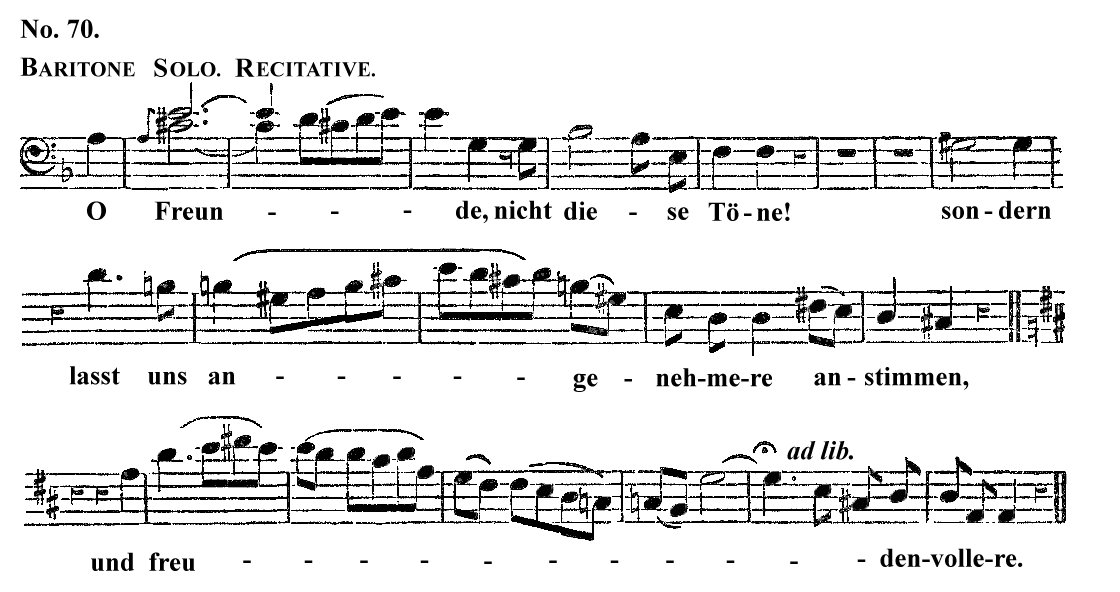
But the latter part was too much for Preisinger, a basso profondo who
was engaged to sing the part; and, notwithstanding Beethoven's dislike
to changes for the sake of executants, and his rebuffs to Mademoiselles
Sontag and Ungher, we are told by Schindler [91]
that Beethoven
altered it as follows, both in range and length [92]: -

With
which
exhortation and a third repetition of the four noisy bars we enter the
vocal portion of the Symphony. The whole of the following six numbers
are formed on the great melody so recently played (No.
62), or on
motifs
formed out of it or upon it.

[a] see Note 93.
[b] see Note 94.
[c] see Note 95.
This begins with a bass
solo on the tune
itself, introduced by the four bars which predict the tune (see No.
61), and
afterwards beautifully accompanied in independent
counterpoint by the oboes and clarinets. The wealth of melody in such
accompaniments throughout this number is extraordinary. Here is a
fragment of one of the tunes -

(in
which observe (at a)
the Beethovenish touch of repeating a
phrase in notes of half the value). There is another accompaniment -
quite as independent - in the flute and bassoon, and the melody quoted
in No.
65
also appears
furtively, in the flutes, as a ritornel.
After
the bass solo the chorus and quartet join in, at first with the melody
in crotchets, but towards the end in a more florid shape: -

with a jubilant
accompaniment in the strings: -

The
foregoing sparkling figures and the loud fiery accompaniment of the
following nature, in double octaves, given to the long high holding
notes which carry the words 'vor Gott' -

seem to show that Beethoven's conception of the Cherubim who
surrounded the throne of the Almighty was of a fiery being [96].
They do
not inspire him with the awe which he feels when he contemplates the
'loving Father dwelling above the tent-roof of the stars, with His
children bowing down before Him,' in the impressive passage which
terminates the next movement but one. (See later).

For these stanzas we seem to come down from heaven to earth; but a splendid earth, full of the pomp and circumstance and also the griefs of war. This is a showy military march-movement with big drum, piccolo, flute, triangle, cymbals, and all other apparatus of warlike parade. It begins with a long orchestral introduction, for the wind only (contra-fagotto very prominent), on the following variation of the theme in 6-8: -

Then
follows the tenor
solo: -

supported, after thirty-six bars, by a chorus of men's
voices; then a long orchestral interlude with the signatures of B flat
and B minor, containing some beautiful points, especially a diminuendo
episode, eighteen bars in length, for horns, oboes, and bassoons,
beginning with a very arresting passage for horns in octaves. The whole
episode might well convey the poet's dread at the thought of battle
[97] -

and lastly a short
chorus in D major [98]. The
following phrase, beginning in the basses and gradually pervading the
whole orchestra, is largely used in the accompaniment of this movement:
-


This
movement is throughout
choral, and as distinctly religious in character as the last was
military. The three trombones appear here in the score for the first
time, and the chorus opens with the following subject for the tenors
and basses in unison, finely sustained by the solemn tones of the bass
trombone: -

- answered by the full chorus, with grand
accompaniment in the following imposing figure: -

The second portion (Adagio ma non troppo, ma divoto) opens with a passage of interlude, in which the wood instruments, cellos and violas produce a beautiful effect. This is a most impressive piece, full of mystery and devotion, especially at the words, 'Ueber Sternen muss er wohnen.' The accompaniments are wonderfully original and beautiful throughout, and by keeping the voices and instruments in the upper registers, Beethoven has produced an effect which is not easily forgotten. The flutes, oboes, and clarinets seem to wing their way up among the stars themselves. The germ of this most mystical and beautiful effect is found in the Finale to 'Fidelio;' and then more developed in the Choral Fantasia. It has been alluded to by Schumann in the Finale to the third part of his 'Faust.'

Beethoven does not intend his hearers to remain in this mood of mystic devotion. The next movement is a chorus of extraordinary energy and spirit. It is formed on two motifs - the original tune (in triple time), supported by trumpet and trombones, and the theme of the last chorus, which we now discover to have a most intimate relation with the main theme - and it starts thus: -

The brilliant accompaniment for the violins is afterwards transferred to the basses.
This is one of the most trying movements in the work for the chorus, and though not so exacting as the well-known passage of the Credo of the Mass in D [100] - where the sopranos lead off the subject of the 'Et vitam venturi' with four high B flats - it has a passage [101] in which the high A natural has to be sustained for twelve bars, as well as other all but impossible feats. Many representations and remonstrances were addressed at the time to Beethoven, not only by Sontag and Ungher, but by the chorus-master [102], but without effect, he would change nothing; and it is affecting (though not unnatural) to find that at last the singers were compelled by the necessities of the case either to be silent in these impossible passages or to take advantage of Beethoven's deafness and sing what they could for what he had written [103]. The only exception he made was for Preisinger, the bass singer; and that we have already noticed. Moscheles took his own remedy, which will be seen in his version of Schindler [104]. He was certainly carrying Beethoven's hint into practice (see earlier), and 'helping himself.'

This is for solos and chorus alternately. It opens with four bars of introduction, in which the original theme is at once given in shorter notes ('in diminution' is the technical term), and treated with close imitation: -

After four bars of this the solo voices enter with a motif to the words, 'Joy, whose magic,' &c., which, though related to the original one, is new, and not unlike one of Mozart's gay spontaneous little themes: -

Farther on the soli soprano and tenor (and afterwards the alto and bass) move in strict 'canon' with one another: -

The movement contains a cadence for the solo voices of the most elaborate kind, Poco adagio, at once very difficult, very singular, and very beautiful; it has a strong resemblance in effect, though not in passages, to the cadenza in the Mass in D, near the end of the 'Et vitam.' For this the signature is changed to that of B natural, and a double-bar drawn through the score [105]. At the close of the cadence ten bars of increasingly rapid Allegro connect the number with the final movement.

This is the Coda to the Finale, and is on a theme closely related to the second theme of No. 81, but in shorter notes, and entirely altered in character. The noisy military instruments here re-appear in the score: -

Near the close the sudden introduction of four bars, maestoso, makes a remarkable effect, after which the Prestissimo returns, and the chorus ends with a mighty shout: -

Such is Beethoven's music in his last Symphony. The first three movements contain his most human and some of his most beautiful orchestral strains; and if in the Finale a restless, boisterous spirit occasionally manifests itself, not in keeping with the English feeling of the solemnity, even the sanctity, of the subject, this is only a reflection, and by no means an exaggerated reflection, of the bad taste which is manifested in parts of the lines adopted from Schiller's Ode, and which Beethoven, no doubt, thought it was his duty to carry out in his music. That he did not entirely approve of such extravagance may be inferred from the fact that, in his selection of the words, he has omitted some of the more flagrant escapades, as will be seen by comparing the Ode itself, which is given entire at the end of these remarks.
Such
lines as those which close the thirteenth and fourteenth
stanzas
of the Ode are only intelligible in connection with the solemn scenes
described when we remember the frantic delight so widely felt
throughout the Continent at the magnificent prospects held out by the
philosophers of France, and which more or less upset even the best
spirits of the times; which in four years after the date of Schiller's
poem were to culminate in the Revolution and the Reign of Terror, and
the recollection of which several years later probably influenced even
our own Wordsworth, in his splendid Ode, to use the words 'jollity' and
'shouts,' and to impersonate the universal gladness under the image of
a hot, noisy young rustic [106]
-
Shout round
me, let me hear
thy shouts, thou happy shepherd-boy.
We must also remember that Beethoven - and it throws a strong light on
the sobriety and dignity of his genius - had already uttered his
raptures at the new era in the 'Eroica' Symphony, the first
conception of which dates from 1791, many years before the date of the
Ninth, and which does not contain a trace of extravagance.
We have witnessed the reception of the Symphony in Vienna. In Germany the welcome was naturally not so warm. The first performance outside Austria appears to have taken place at the concert of Herr Guhr - a Kapellmeister to whom Mendelssohn was indebted for an autograph of Bach's and much else [107] - at Frankfort, on Good Friday, April 1, 1825. The second was at the Lower Rhine Festival of May 23 of the same year, at Aix-la-Chapelle. The performance was conducted by Beethoven's pupil, F. Ries, but it cannot be called satisfactory, inasmuch as the whole of the second movement and part of the Adagio were omitted. It is not necessary to quote the report of the Allg. musik. Zeitung [108], but its tendency may be inferred from its concluding words: 'In spite of all, we may say of Beethoven, as has been said of Handel, great even in his mistakes.' At the Gewandhaus Concerts at Leipzig the work was brought forward under Schulz, the then conductor, on March 6, 1826. After this the following appeal appeared in the newspaper of three days later (March 9): 'A request. The honourable board of directors of the Concerts is most earnestly requested to give, if possible, a second performance of Beethoven's last Symphony at the Concert for the poor on Palm Sunday, that a repetition of this noble poem may enable its inmost depths to be revealed. In the names of several friends of music [109]'. Doubtless in obedience to this request, a second performance took place on March 29th, and a third was given on October 19th of the same year (the second of these without the Finale). A long and adverse criticism of the last of the three (doubtless by Fink) will be found in the A. m. Z. of that year, p. 853, 'Beethoven is still a magician; and it has pleased him on this occasion to raise something supernatural; to which this critic does not consent.' These judgments cannot be wondered at. The standpoint of the work is in advance of that of even the latest of its predecessors. Splendid and beautiful as several of the orchestral movements are, they contained none which at once fastened on the world as the Allegrettos of No. 7 and No. 8 had done; while in addition to its length and its native strangeness and frequent obscurity, there was the executive difficulty of the music, which was really above the heads of the orchestras of the day [110], and the serious obstacle of the novelty of the vocal Finale. Some such consideration may have induced Möser, then a concert-director in Berlin, to take the singular course of engaging young Felix Mendelssohn, then a lad of seventeen, to play the work through on the piano as an introduction to an orchestral performance a fortnight later. Mendelssohn's feat took place on the 13th of November, 1826, at the Jägerhall, at Berlin, before the most eminent musicians and amateurs of the city, and a report of it was made at the time by L. Rellstab - who turned over for him on the occasion - which is given in his Gesammelte Schriften, xx., p. 5. Möser's orchestral performance took place on the 27th of the same month.
The first performance at the Gewandhaus Concerts, under Mendelssohn's direction, took place on February 11, 1836. Schumann thought the tempi too rapid, but in other respects does him justice [111]. For instance, in the concert of February 11, 1841, he notices the note of the bass trombone at the beginning of the Trio, which Mendelssohn had brought out for the first time 'with an astonishing effect, giving quite a new life to the passage [112]'.
With all her unusual opportunities for music Mendelssohn's sister Fanny, strange to say, had not heard the Symphony till 1836, when she heard it under her brother's bâton at Düsseldorf. Her remarks upon it are worth reading, though they were probably modified as she became acquainted with the music. 'This gigantic Ninth Symphony,' says she, 'which is so grand and in parts so abominable, as only the work of the greatest composer could be, was played as if by one man [113]; the finest nuances, the most hidden meanings were expressed to perfection; the masses fell into shape, the music became comprehensible, and for the most part exquisitely beautiful. A gigantic tragedy with a conclusion meant to be dithyrambic [114], but falling from its height into the opposite extreme - into burlesque.'
In Paris, Habeneck, with his usual caution, deferred the production till he had had sufficient rehearsals; and it was first performed at the Conservatoire Concert of March 27, 1831 [115]. After that time, and after a little coquetting with the instrumental movements only, it took a regular place in the programmes.
In England the Symphony was first heard at the Philharmonic Society, at a concert of the early date of March 21, 1825, conducted by Sir George Smart. The score was not yet published, and a MS. copy had been obtained from Beethoven, still in the possession of the Society, which, though not wholly an autograph, had been corrected throughout by him and bore these words, in his own hand, on the title-page: 'Grosse Symphonie geschrieben für die Philharmonische Gesellschaft in London, von Ludwig van Beethoven. Erster Satz.' ('Grand Symphony written for the Philharmonic Society of London by Ludwig van Beethoven. First Movement.') The words of the Finale were translated into Italian [116], and the solos were sung by Madame Caradori, Miss Goodall, Mr. Vaughan, and Mr. Phillips. The performance lasted for one hour and four minutes.
Sir George Smart had taken great pains on the occasion. We do not know how many rehearsals there were, but the work met with no favour from the audience, as is evident from the remarks in the Harmonicon, at that time the leading musical paper in London, edited by Wm. Ayrton, a musician of much intelligence, and, for the time, of liberal views. But, as we have already said, no proper judgment could be expected, either here or in Germany, in the teeth of a poor performance and extreme novelty, from gentlemen who were not only far behind the great composer whom they were criticising, but believed themselves to be so far his superiors as even to advise him how to modify his work that it might obtain their approbation [117].
À propos of the rehearsal or trial - probably there was only one - Wm. Ayrton says that the composition 'embodies enough of original matter, of beautiful effects and skilful contrivances, to form an admirable Symphony of ordinary duration, but that unfortunately the author has spun it out to so unusual a length that he has drawn out the thread of his verbosity finer than the staple of his argument [118]'. Of the performance itself, a month later [119], he remarks: -
'The new Symphony of Beethoven, composed for, and purchased at a liberal price by, this society, was now first publicly produced. We see no reason for altering the opinion offered in our last number. . . . In the present Symphony we discover no diminution of Beethoven's creative talent; it exhibits many perfectly new traits, and in its technical formation shews amazing ingenuity and unabated vigour of mind. But with all the merits which it unquestionably possesses, it is at least twice as long as it should be; it repeats itself, and the subjects in consequence become weak by reiteration. The last movement, a chorus, is heterogeneous, and though there is much vocal beauty in parts of it, yet it does not, and no habit will ever make it, mix up with the first three movements. This chorus is a hymn to joy, commencing with a recitative, and relieved by many soli passages. What relation it bears to the Symphony we could not make out; and here, as well as in other parts, the want of intelligible design is too apparent. . . . The most original feature in this Symphony is the Minuet, and the most singular part, the succeeding Trio - striking, because in duple time, for which we are not acquainted with anything in the shape of a precedent. We were also much pleased by a very noble march which is introduced. In quitting the present subject, we must express our hope that this new work of the great Beethoven may be put into a produceable form: that the repetitions may be omitted, and the chorus removed altogether. The Symphony will then be heard with unmixed pleasure, and the reputation of its author will, if possible, be further augmented.'
The next performance in London was on April 26, 1830, at the concert of Mr. Charles Neate, a well-known musician of the time, who had spent a year in very intimate contact with Beethoven. Sir George Smart was the conductor. The Philharmonic Society resumed their performances on April 17, 1837; April 23, 1838; and May 8, 1841, &c.; each time under the conduct of Moscheles. On March 26, 1855, the Symphony was given under the conduct of Wagner.
The following performances are also recorded: the Royal Academy of Music, June 20, 1835, and again April 15, 1836. Mr. Charles Lucas conducted both times, and Oxenford's translation was first used; the Società Armonica, March 24, 1836, conductor, Mr. H. Forbes; at Drury Lane Theatre for the Beethoven Monument at Bonn, July 19, 1887, conductor, Mr. Moscheles; Moscheles's Morning Concert, May 23, 1838 (already mentioned). London can hardly be said to have been wanting in anxiety to hear the masterpiece!
An epoch in the history of the Ninth Symphony in this country is formed by the performances of the so-called New Philharmonic Society, under Berlioz and Spohr, in 1852 (twice) and 1853 respectively. They were held in Exeter Hall, and many persons then heard this mighty work for the first time. A fresh translation was made by G. Linley. - At the Crystal Palace it was first performed on April 22, 1865, and has been played twenty-five times since. It is now one of the most attractive pieces that can be given in London, and even if the proposal of Dr. von Bülow to perform it twice at one concert, with an interval of half-an-hour between the two performances, were attempted, we should probably be astounded at the number who would remain to the second! [120].
In the United States the first performance was given on May 20, 1846, by the Philharmonic Society of New York [121].
There would seem to be a certain difference between the position of the Ninth Symphony in England and in other countries. It is received with a special sentiment by Englishmen, a sentiment which attaches to no other of the nine. When classical orchestral music began to be brought before the public of non-professional hearers, through the performances of the 'New Philharmonic' and the Crystal Palace, the Choral Symphony, to those who heard it, as many did, for the first time, assumed a special position outside its individual musical qualities. This was more or less based on the following facts. It was Beethoven's last and greatest orchestral work. It was said to be extraordinarily difficult, if not impossible of execution. It stood alone among Symphonies as having a chorus. This flavoured the whole performance, and one felt through the Finale a desponding sympathy with the singers, who, do their best, could never execute their parts properly. It was strangely different from Handel's choruses, at that time to English hearers the accepted model for choral music. It was for the most part pervaded by a lofty, mystical, almost religious tone, which none of the others possessed. There never was a doubt in one's mind that in this work one was entering a higher, more remote heaven than even the 'Eroica,' the C minor, or the No. 7. Hence the hearing of this work was an event in one's life; and to some, certainly to the writer, this feeling remains. To me, I am happy to say, the Ninth Symphony still possesses the strange cast and mysterious fascination with which I first heard it under Berlioz and Spohr in 1852 and 1853. Comparisons are always undesirable, but sometimes they are inevitable. The impression left by Mont Blanc or the Great Pyramid is unique, and so is that of the Ninth Symphony. There can be no doubt that Beethoven's last Symphony is also his greatest. This was Schumann's opinion. He says: 'It seems as if we were at last beginning to understand that in this work the great man has given us of his greatest' [122]. In his letter to Prince von Hatzfeld, the Prussian Ambassador at Vienna, Beethoven too says: 'I am just publishing the greatest Symphony I have yet written' [123] - 'die grösste Symphonie die ich bisher geschrieben' - (not 'one of my best,' as in the case of No. 7, see earlier).
These judgments, by the master himself and one of the greatest of his disciples and followers, have been amply ratified by the world in the interval, and there is perhaps now no one able to judge who does not fully join in the opinion that the Ninth Symphony was the climax of Beethoven's work.
In the last few years of his life, the thoughts of the composer of 'Fidelio' and the 'Mount of Olives' often strayed in the direction of opera and oratorio, but without any definite result. A large number of MS. opera libretti had accumulated in his possession, but none of them was to his mind. What he wanted he told Gerhard von Breuning on his death-bed. He craved something to interest and absorb him, but of a moral and elevating tendency, of the nature of 'Les deux journées' or 'Die Vestalin,' both which he thoroughly approved. Immoral stories like those of Mozart's operas had no attraction for him, and he could never be brought to set them [124].
At the request of the 'Gesellschaft der Musikfreunde' of Vienna, Beethoven had undertaken, somewhere about 1818, to write an oratorio to a libretto to be supplied by a certain Herr von Bernard; and though he would have preferred a heroic subject to a sacred one, so far did he look upon the engagement as bonâ fide that on August 18, 1819, he received from the Committee a sum of four hundred florins in respect of the work. It dragged on, however, in spite of repeated enquiries and remonstrances, and died a natural death in 1826 [125].
Meantime, in 1823, he received a communication from an unexpected quarter, the 'Handel and Haydn Society,' of Boston, U.S.A., inviting him to write a Biblical oratorio for them, on a text translated into German from an original in English by the U.S. Consul at Vienna. This also came to nothing; but the attempt will always redound to the lasting honour of the Boston Society [126].
Another very important proposition was made to him by the eminent publishing firm of Breitkopf and Härtel, of Leipzig, through Rochlitz, at his visit to Vienna in 1823 [127] - namely, the composition of 'Faust' in a similar style to the 'Egmont' music. It seems to have inspired the old admirer of Goethe with unusual interest: 'That,' said he, 'would be a fine piece of work.' . . . 'Something might be done with that.' But no progress seems to have been made with it. He was now probably too far advanced in life to look with the favour necessary for composition on any subject not entirely spontaneous.
There
was, however, one department of music which Beethoven
still
pursued with the greatest success. To the last two years and a half of
his life are due those wonderful String Quartets which, under the name
of 'posthumous,' have been the admiration and astonishment of the
world up to the present time, and which bear a somewhat similar
relation to the earlier Quartets that the Ninth Symphony bears to the
earlier Symphonies. The last Quartet that he produced before the period
of which we are speaking was that in F minor, Op. 95, which bears his
own title, Quartett
serioso, and date of October, 1810. Those of this
period are as follows: -
E flat, Op. 127. 1824.
B flat, Op. 130. 1825.
C sharp minor, Op. 131.
1826.
A minor, Op. 132. 1825.
F major, Op. 135. 1826.
The very last piece of work completed by the master was a fresh Finale - the existing one - to the Op. 130, to replace the extremely long and elaborate fugue which had originally terminated it, but which is virtually unplayable. (It is now known in two forms, as Op. 133 and 134.) The new Finale was written at Gneixendorf, and though dated November, 1826, within four months of his death, on March 26, 1827, is extraordinarily gay.
These
great works he did as no one ever did, and probably no
one ever
will. But of orchestral music he wrote no more after the Ninth
Symphony. Music will advance in richness, scope, and difficulty; but
such music as Beethoven's great instrumental works, in which thought,
emotion, melody, and romance combine with extraordinary judgment and
common sense, and a truly wonderful industry, to make a perfect whole,
can hardly any more be written. The time for such an event, such a
concurrence of the man and the circumstances, will not again arrive.
There can never be a second Beethoven or a second Shakespeare. However
much orchestras may improve and execution increase, Beethoven's
Symphonies will always remain at the head of music as Shakespeare's
plays are at the head of the literature of the modern world -
Age cannot wither them, nor
custom stale
Their infinite
variety.
