BRITAIN’S
WONDERFUL
AIR FORCE
Part 2

CONTENTS
Click on the blue dots  for direct access
CHAPTER
5. WORK OF THE BOMBER
CREWS
CHAPTER
6. FIGHTER AIRCRAFT OF
THE R.A.F.
CHAPTER
7. FIGHTER PILOTS AND
FIGHTER TACTICS
LIST OF ILLUSTRATIONS
Where
the bombs are carried
Bomb
cells of a Wellington
Ammunition
for the rear gunner
Flying
crews arrive at the dispersal points
Nerve
centre of Bomber Command
Halifax
crew go aboard
Selecting
the bombs
Dropping
a parachute flare
The
navigator plots his course
The
bomb aimer takes aim
Wireless
operator and flight engineer
Aerodrome
control post
Aerodrome
control room
On
the control tower
Intelligence
Officer interrogates the crew
Escort
and high-guard squadrons
Start
of a day bombing raid
Raids
by medium bombers
A
direct hit is scored
The
weapons of Fighter Command
Spitfire,
king of single-seater fighters
Tricycle
undercarriage of a Havoc
Twelve-gun
Hurricane
Ranges
of cannon and machine guns
British,
German and Italian machine guns
Re-loading
a Hurricane fighter
Loading
and testing 20-mm. cannon
Testing
Spitfire cannon
Variable-pitch
airscrew
Contra-rotating
airscrews
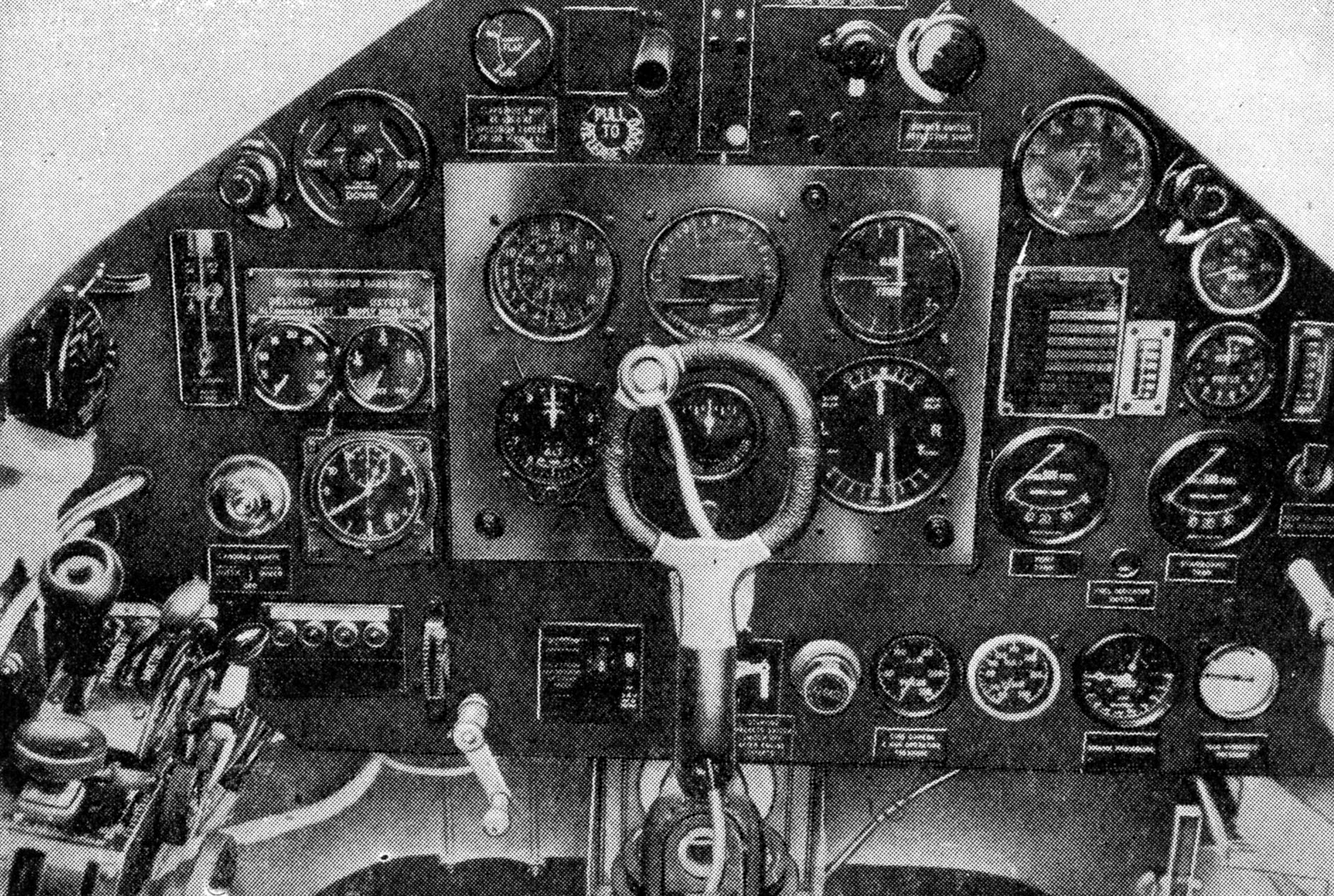
Cockpit
of a Spitfire
Gloster
Gladiator fighter
Hawker
Hurricane Mk I
Hawker
Hurricane Mk IIc
Vickers-Armstrong
Supermarine Spitfire Mk V
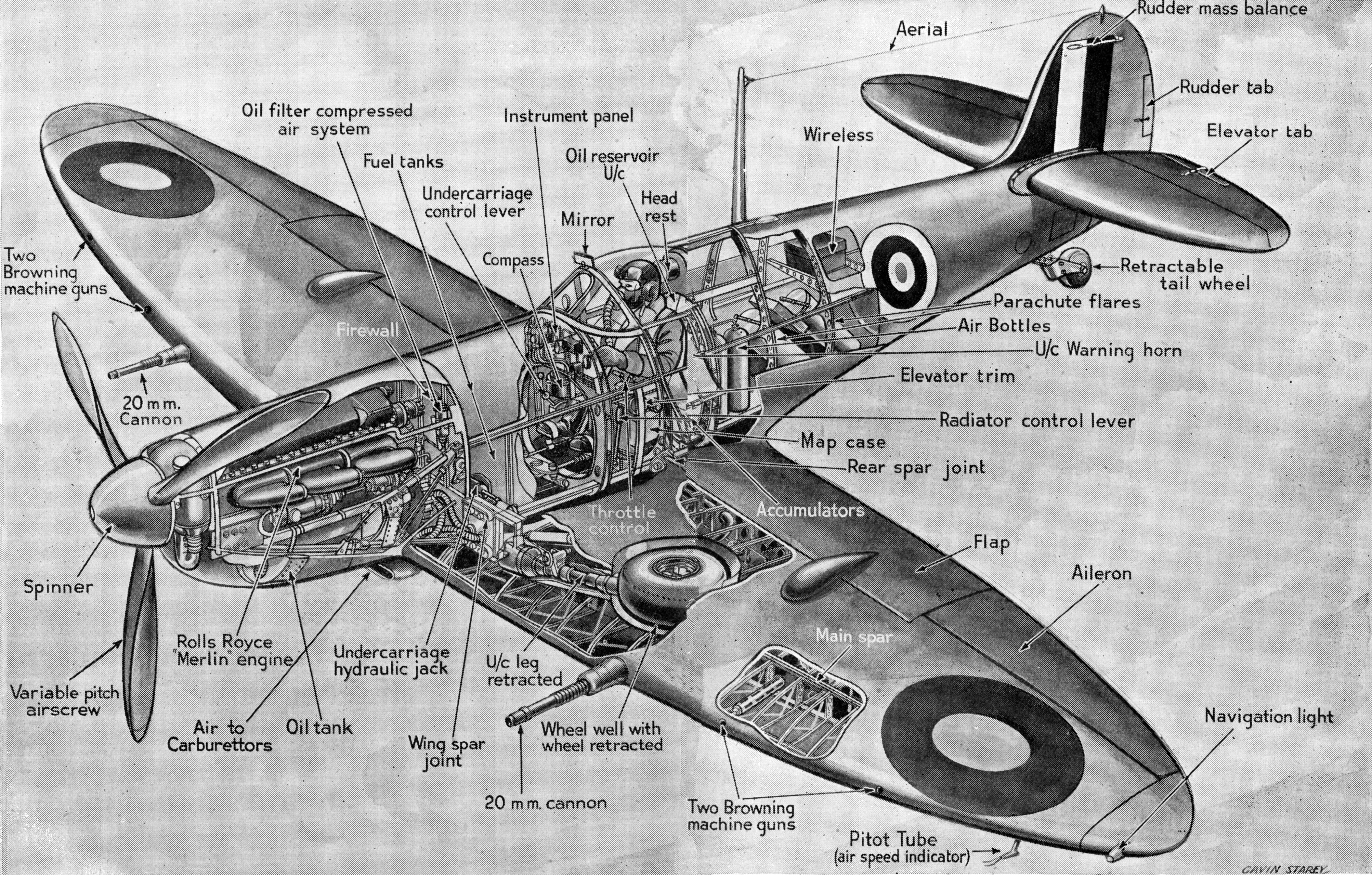
Constructional
details of the Spitfire
German
fighter aircraft
Germany’s
famous Me. single-seat fighter
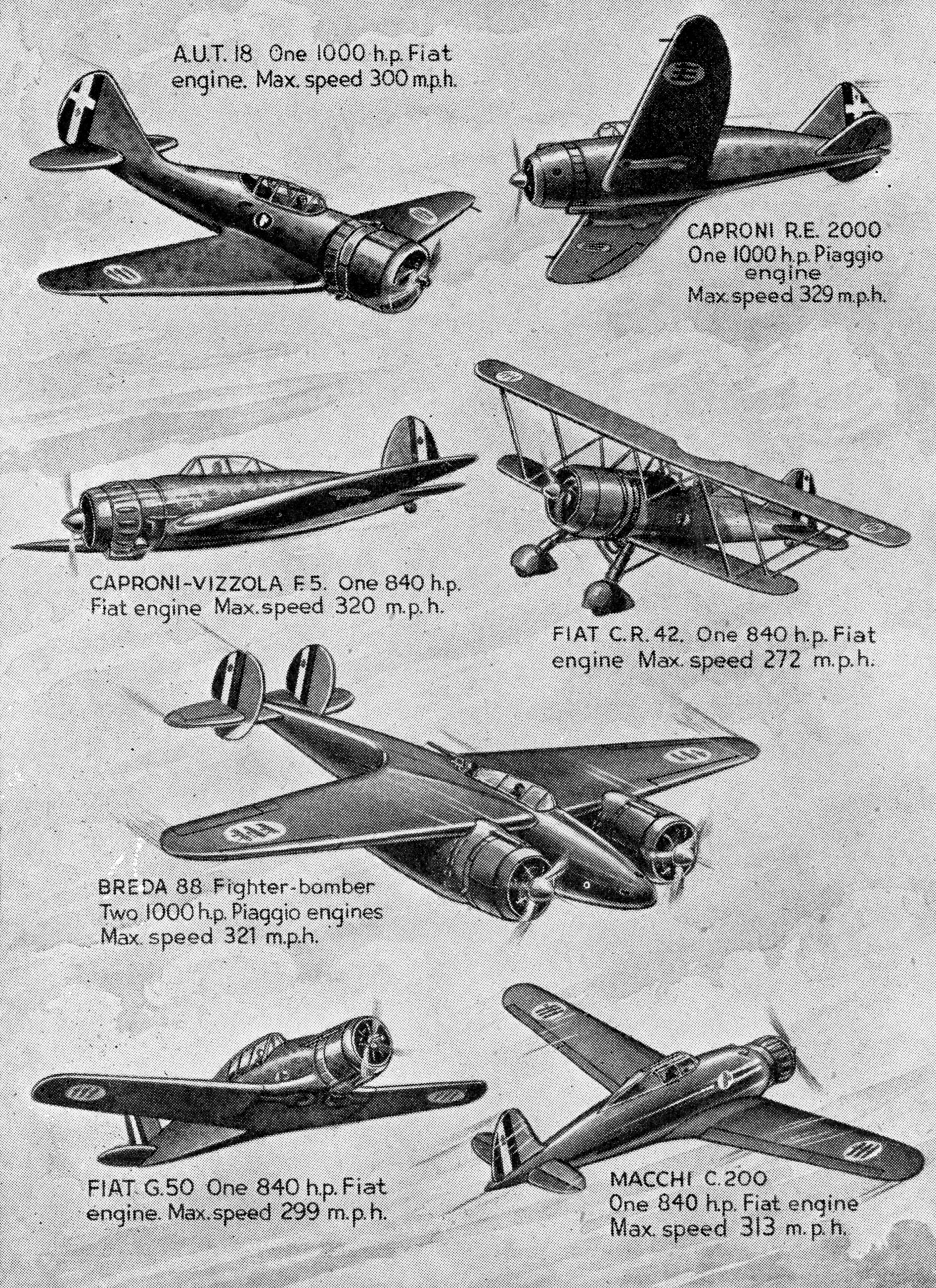
Italian
fighter aircraft
Short-nose
Blenheim
Bristol
Beaufighter
Beaufighter
details
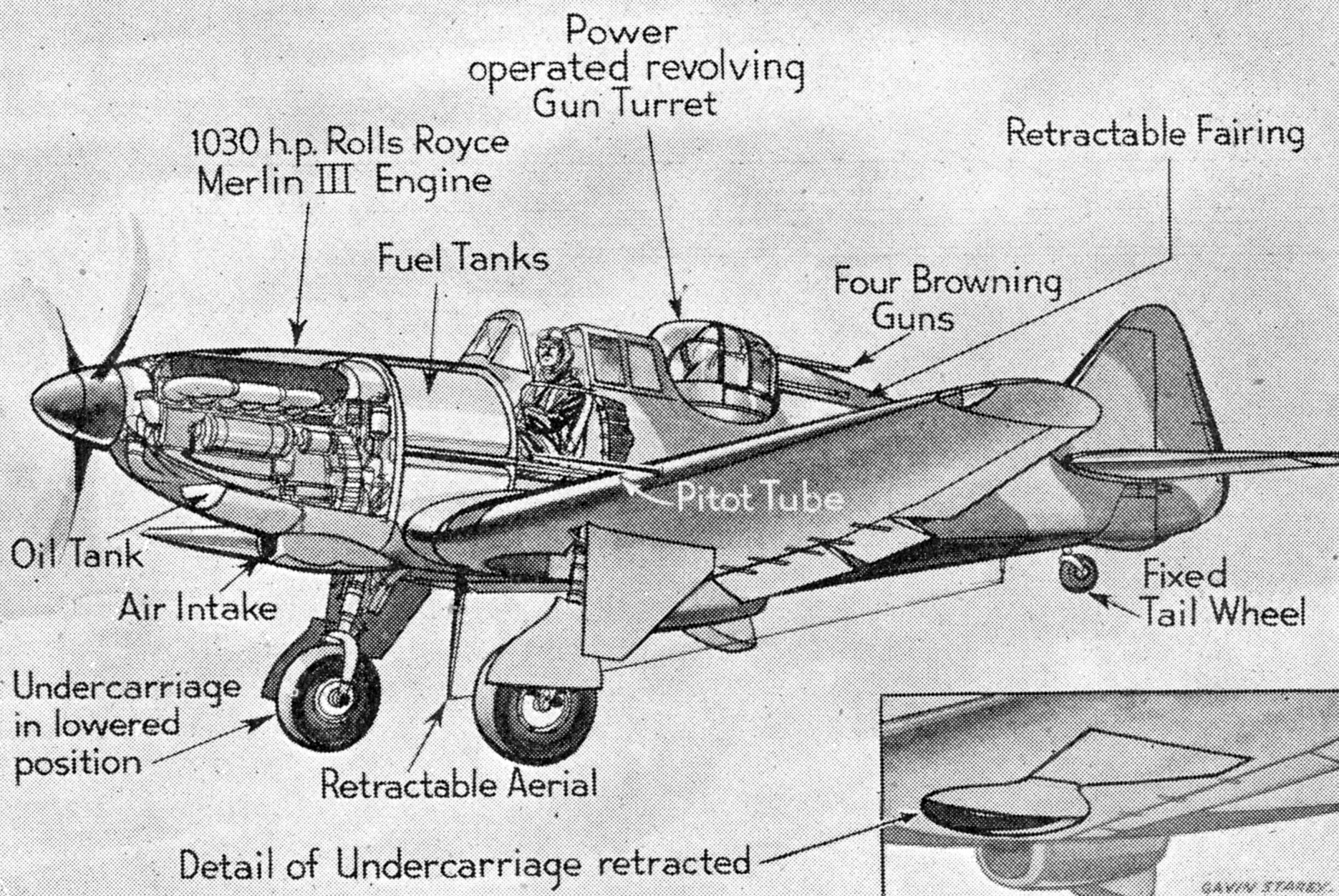
Bolton
Paul Defiant
Defiant
details
De
Havilland Mosquito
Hawker
Typhoon
Performance
data of British fighter aircraft
Night
fighter pilots stand by
Miles
Master advanced trainers
Instrument
panel of Miles Master
North
American Havard trainers
Rear
seat of the Master
“Blackout”
and “redout”
Flying
in close formation
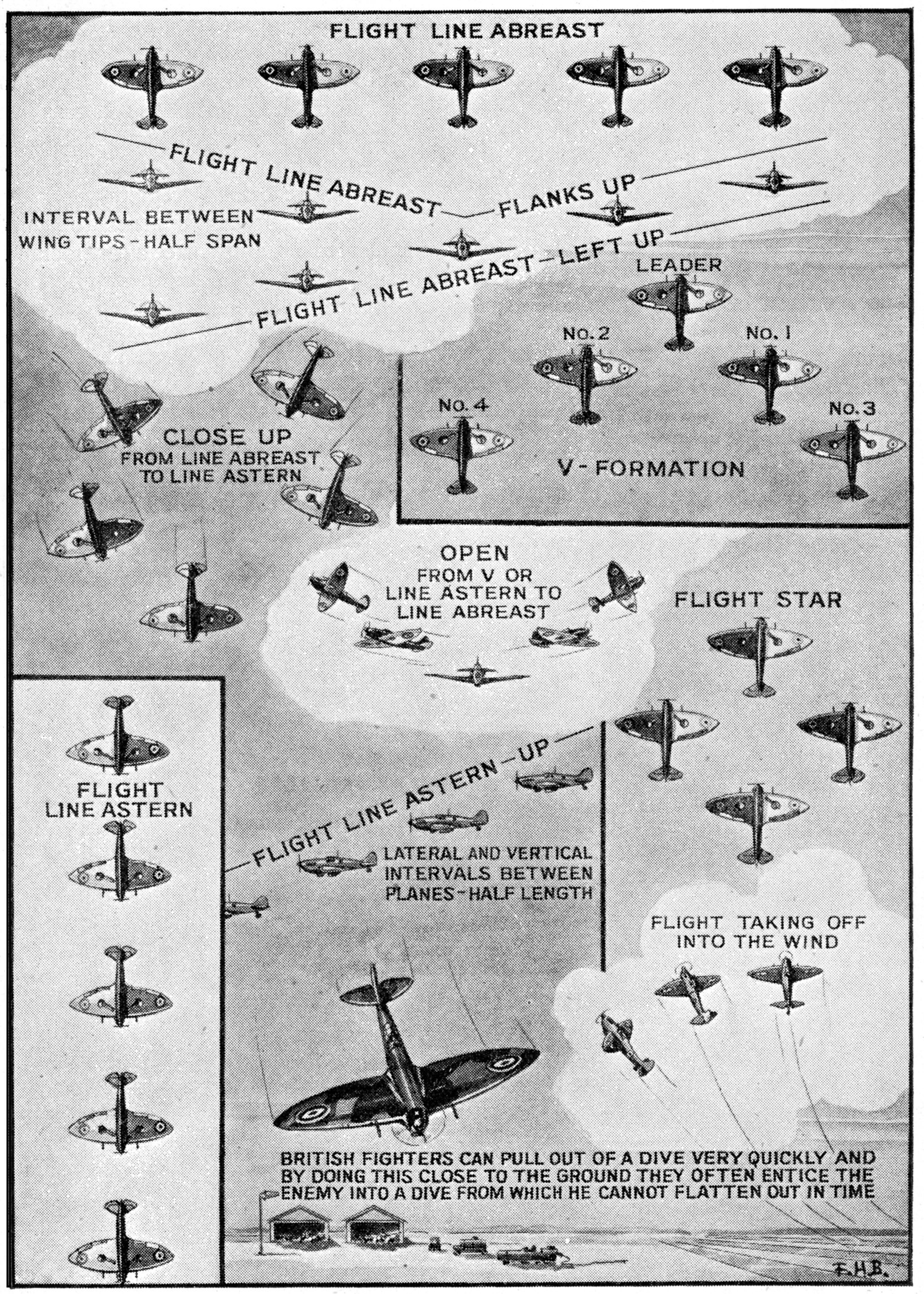
Formations
adopted by fighter aircraft
Hurricanes
in V-formation
On
the lookout for the enemy
Sections
in line astern
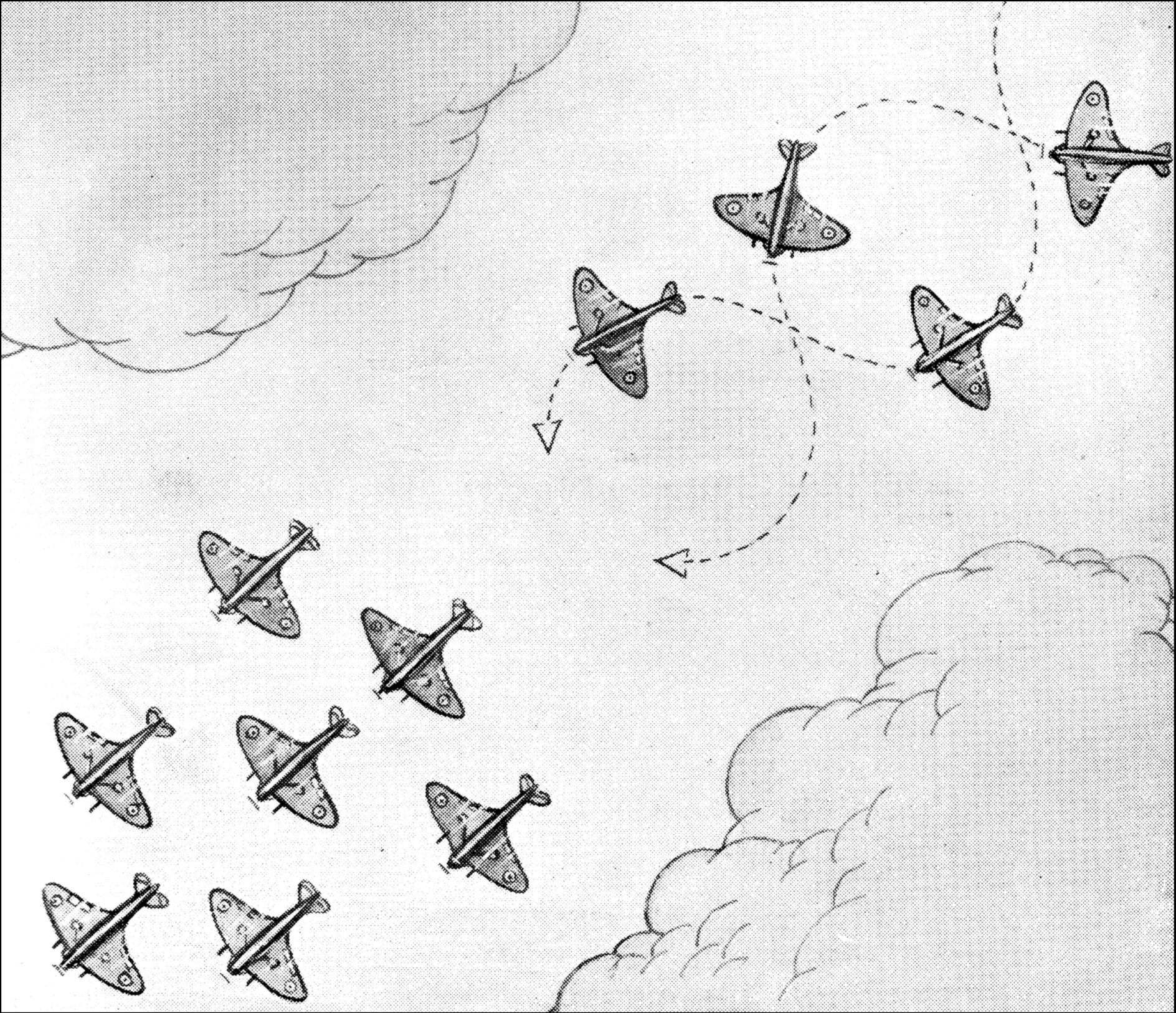
Weaving
tactics of fighter aircraft
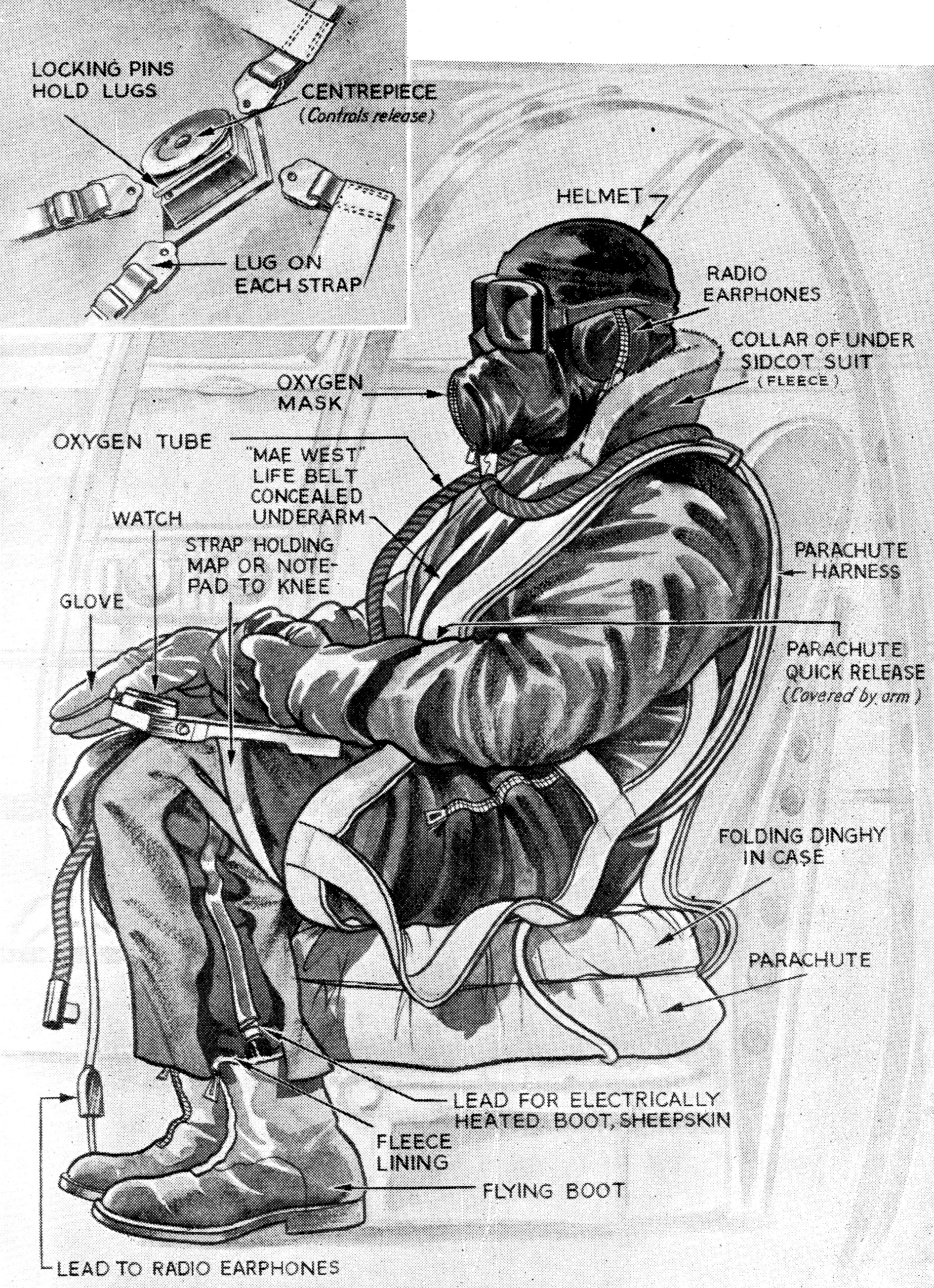
Equipment
worn by a fighter pilot
Rubber
dinghy for fighter pilots
Target
for practice shooting
How
a pilot bales out
Oxygen
equipment in a modern fighter
Attacks
on enemy bombers
Aiming
at the enemy
How
the fighter pilot sees his foe
Cannon
Hurricane in action
Tactics
of the Hurri-Bomber
Close-up
of the Hurricane bomber
Preparing
for an offensive sweep
A
Beaufighter goes on patrol
End
of a Heinkel III
A
fighter pilot makes his report
Attacks on enemy transport
CHAPTER
5
Work
of the Bomber Crews
Operational
Training Units. A typical night raid. Bombing up. The briefing. The
take-off. The journey to the objective. Pin-pointing the position.
Approaching and identifying the target. Releasing the bombs. The
journey home. A night fighter attack. A safe landing. The interrogation
of crews. Day bombing operations. The “Circus” operation
IN
the previous chapter we have seen something of the complicated
lay-out of a modern bomber and the tasks which have to be performed by
the air crew. The object of this chapter is to sketch a brief outline
of the various stages in the development of their training as a crew
and to give a description of one or two typical bombing operations.
OPERATIONAL TRAINING UNIT
When
the individual members of a crew meet each other for the first time at
an Operational Training Unit, each of them has learnt his own trade at
the appropriate school, but has had no training in the team work and
crew drill which are fundamental to the efficient operation of a bomber
aircraft, nor have they any experience of a service type of bomber.
Their training up to now has been carried out on smaller types of
training aircraft, and the pilots must therefore undergo what is called
a conversion course to learn to fly the type of bomber which they are
destined to use in active operations. The remainder of the crew will
also be learning to apply their knowledge to the special problems of
the service type of aircraft. When the crew are proficient by day they
must then start work by night. Everything is much more difficult at
night, for not only have they to learn to fly under blackout conditions,
but they must learn how to work their complicated instruments in the
dark, or with very little light to help them. The most that can be
permitted will be a few screened lights, for the night bomber, if it is
to escape interception by the enemy night fighter, must be blacked out.
At
the completion of the course at the Operational Training Units the crew
will be fit to begin their operational career, and they are posted as a
crew to a service squadron using the type of aircraft on which they
have trained. When they reach the squadron they are known as freshmen
and a further short period of advanced training is in front of them
before they can be regarded as fully fit for active bombing operations
against the enemy.
THE “NURSERY SLOPES”
After
a day or two in which to settle at their new station the crew will be
put through their paces by the flight commander, first of all in daylight
and then at night. They will be sent to the local bombing range and the
results of their bombing checked up. If they perform satisfactorily
they will be detailed to attack a short-range objective in enemy
country. This is known as “going on the nursery slopes.” If they carry
out this task satisfactorily they will be sent to objectives
progressively further away until they are able to fly to the full radius
of action of their aircraft, find and bomb the target and return to
their base. They can now regard themselves as fully fledged.
Let
us now go to a night bomber station and see how a night bombing raid is
organized. We will imagine a pleasant day in the late spring. The sky
is clear except for a small amount of very high cloud and a mild
southerly wind is blowing. If we are to see everything we must arrive
at the station not later than mid-day, for by that time the targets for
the night will have been ordered and the preparation begins.
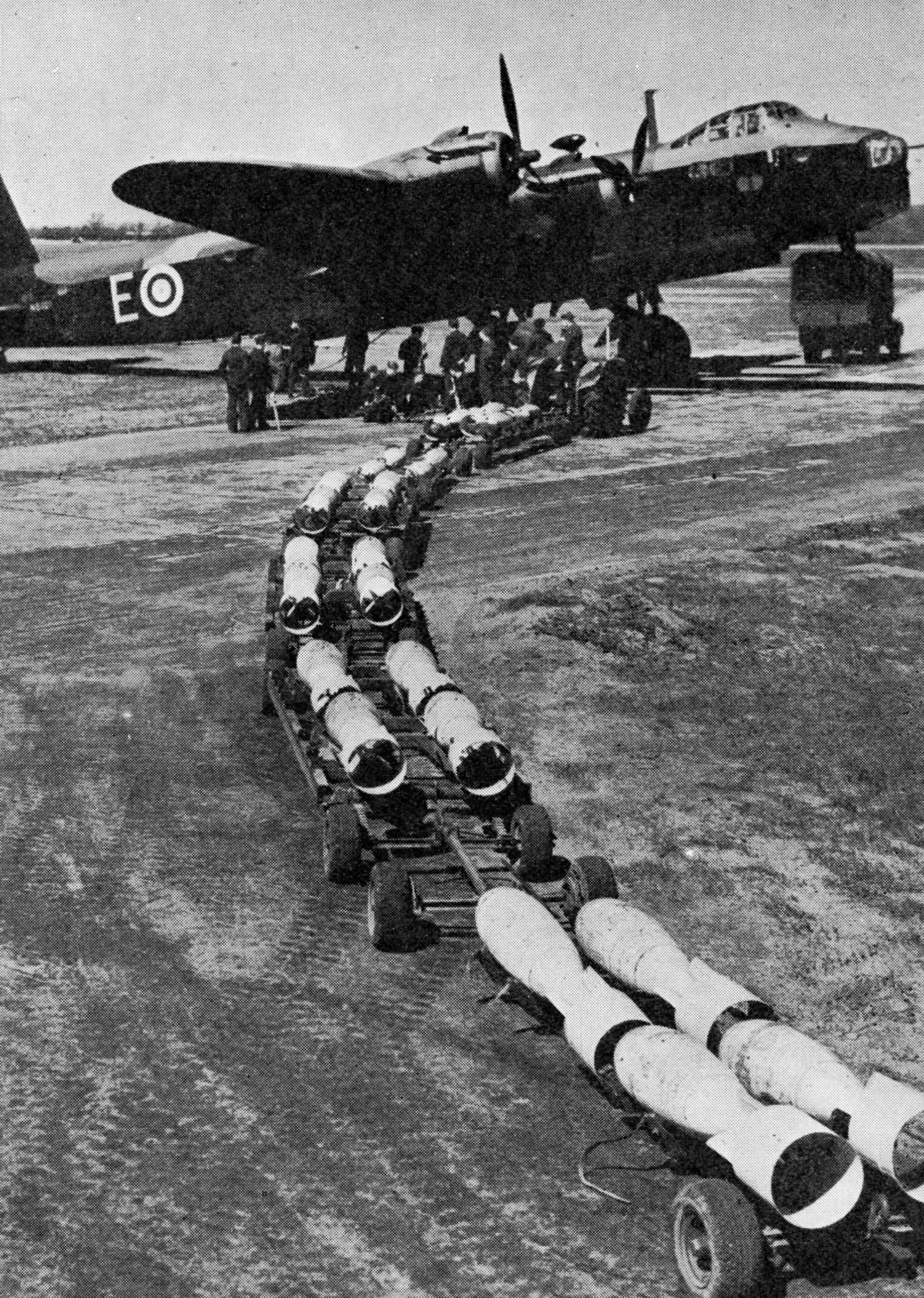
THE
STIRLING’S LOAD ARRIVES
Fig. 1.
Preparations for a night’s raid begins about mid-day, when tractors
pull trains of bomb-loading vehicles to the dispersal points on the
airfield. These low-wheeled vehicles carry the ready fused bombs. The
full load of a Stirling aircraft is 8 tons
DISPERSAL POINTS
The
aircraft are standing at their dispersal points all round the
aerodrome. Those that are detailed for duty tonight have already had
their air tests and have been handed over to the maintenance crews for
a final inspection. As we walk over to a dispersal point we can see a
tractor pulling a long train of curious low vehicles, making its way
towards one of the aeroplanes (Fig. 1). The long low vehicles are
trailers carrying the fused bombs from the bomb store to be loaded on
to the aircraft. If we hurry we shall be in time to watch this being
done.
The bomber is standing on a piece of tarmac close to the
edge of a wood about a quarter of a mile from the aerodrome. The
aircraft carries the bombs internally in cells (Figs. 2 and 2a), the
doors of which are opened and closed by a hydraulic ram. As we approach
we see the bomb cell doors slowly opening. One of the bomb trailers is
manoeuvred underneath the cell and the bomb is lifted by a hand
operated winch until the lug on the bomb engages with the hook of the
bomb carrier, which is then snapped shut (Fig. 3). The crutches are
then adjusted so as to steady the bomb and prevent it wobbling or
vibrating when in the air, and the fusing link connected up. This is a
device which enables the bomb aimer to make the fuse of the bomb “live”
before it is dropped. If this is not done, the bomb is dropped “safe”
with very little chance of its exploding.
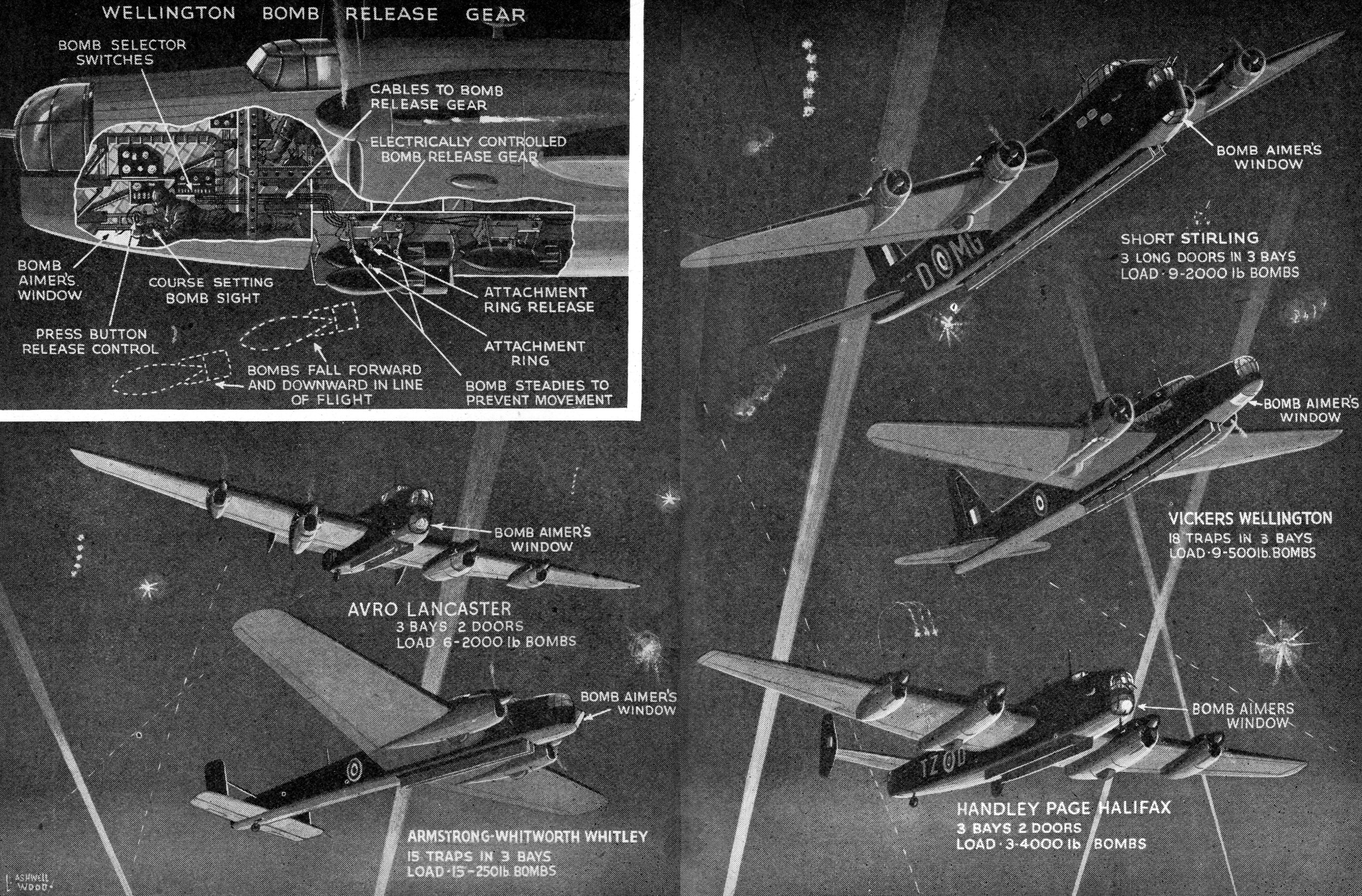
BOMB-CARRYING
CAPACITY OF FIVE WELL-KNOWN BRITISH BOMBERS
Fig. 2.
British bomber aircraft carry their bombs internally in cells, the
doors of which are opened by a hydraulic ram. The diagram gives
particulars of bomb load and storage of five types of modern British
bombers. The load of the Stirling, although not officially announced,
is said to be equal to that of three Wellingtons. Inset, particulars of
bomb release gear of a Wellington. The bomb load of an aircraft
naturally varies according to circumstances. On a very long flight with
a heavy load of fuel, for instance, fewer bombs would be carried than
on a comparatively short flight. If the tanks were filled to capacity and
bombs were on all the racks the aircraft would be so overloaded that it
would be unable to take off
WHERE
THE BOMBS ARE CARRIED
Fig. 2a.
On the Short Stirling, seen above, the bombs are carried in three long
bays running almost the whole length of the fuselage. They are hoisted
into position by a winch
Some modern British bombs
weigh as much as 4,000 lb. and 8,000 lb. For most general purposes,
however, the 500 lb. and 1,000 lb. are the ones usually carried and one
after another they are lifted carefully up and hooked into the bays and
the necessary adjustments made. Then come two large rectangular metal
boxes, which are a tight fit in the bomb cell and which are drawn up and
slung on to the bomb carrier in exactly the same way as the bomb. These
are containers, each holding a large number of small incendiary bombs.
The bombs are prevented from falling out of the box by a number of
cross-bars. When the lock is released the cross-bars fall away and the
incendiary bombs descend and disperse in a shower.
A
motor-driven fuel tanker now approaches to fill up the tanks and a large
hose is connected to the filler cap of the fuel tank in the bomber.
Electrical connections are carefully made at each end of the hose so as
to avoid the risk of any sparking due to static electricity generated
in the hose by friction when the fuel passes through it under pressure.
FILLING THE TANKS
The
motor-driven pump is now set in motion and in a surprisingly short time
the aircraft’s tanks are quite full. In the meantime, other airmen are
busy testing the electrical accumulators and the oxygen bottles to see
that they are fully charged, while the armourers are looking over the
hydraulic mechanism of the turrets and filling the ammunition tanks with
long snake-like belts of machine gun ammunition (Fig. 4). Another man
is busy polishing the pilot’s windscreen, the astrodome and perspex
canopies over the turrets, for these should be clean.
The
aircraft’s maintenance crew are still busy inspecting everything,
testing the tyre pressures, checking the working of instruments and
greasing and oiling, for nothing must be left to chance. The correct
working of the engines and the wireless will have been ascertained
during an air test earlier in the day.
It is now two o’clock and
it is time to go to the Operations Centre to listen to the “briefing” of
the crews. Between sixty and seventy men, officers and sergeants, are
seated in a large room while from a raised desk the squadron commander
is explaining the plan of tonight’s operations. First of all he tells
them the target which they are going to attack; he explains the reasons
for its importance and gives them his general ideas of the way in which
the attack should be made, taking into consideration the weather
conditions expected over the target and the disposition of the enemy’s
defences, information concerning which has been gleaned from crews who
have been there before. He then gives them such other advice as is
prompted by his experience. When he has finished he asks the air crews
if everything is quite clear in their minds and if not, invites them to
ask him any questions they wish. When the questions come, they are
always answered in a straightforward and businesslike way.
WEATHER REPORT
The
meteorological officer then goes on to explain the weather forecast in
detail. The met. officer, as he is always called, gives a forecast of
the weather en route
and in
the target area, and says that there is some risk of the aerodrome
going out of action owing to fog after midnight. He explains that, if
that should occur, aircraft will be diverted to another aerodrome forty
miles away, which is expected to remain clear. Once again questions are
invited and answered. Next the intelligence ofiicer gives the latest
information about enemy defences. He warns the crews against
approaching the target from the north, where searchlights and guns are
known to be concentrated.
When the last question has been
answered, the squadron commander gives the crews his final admonitions.
“Some of you,” he says, “occasionally forget, in the stress of the
moment, to use your night cameras. I must impress on you again
how
important it is that we should have photographs recording the fall of
your bombs. Don’t be afraid of letting it be known that your bombs have
not hit the target—we all make mistakes and the fact that you know
where your bombs have gone will help you to do better next
time.
Now go and get your tea. You know your time of take off. Good luck to
you all!”
The captains and crews dismiss, and the officers and
sergeants go off to their messes to get their tea, and make their final
preparations for the night’s work. The navigators will have already
laid off their courses on their maps and studied the route for
prominent landmarks.

BOMB
CELLS OF A WELLINGTON
Fig. 3.
The trailers are manoeuvred beneath the bomb cells and the bombs are
lifted by a hand operated winch until the lug on the bomb engages with
the hook on the bomb carrier, which is snapped shut. Crutches are then
adjusted so as to hold the bombs rigid, and the fusing link is
connected. If this were not done the bombs would be dropped “safe,” and
fail to explode
AMMUNITION
FOR THE REAR GUNNER
Fig. 4.
While the bombs are being loaded, members of the aircraft’s maintenance
crew are busy filling the tanks, fitting and testing oxygen bottles and
making other last-minute adjustments. Meanwhile the armourers are
looking over the hydraulic mechanism of the turrets and filling the
ammunition tanks with long, snake-like belts of machine gun bullets
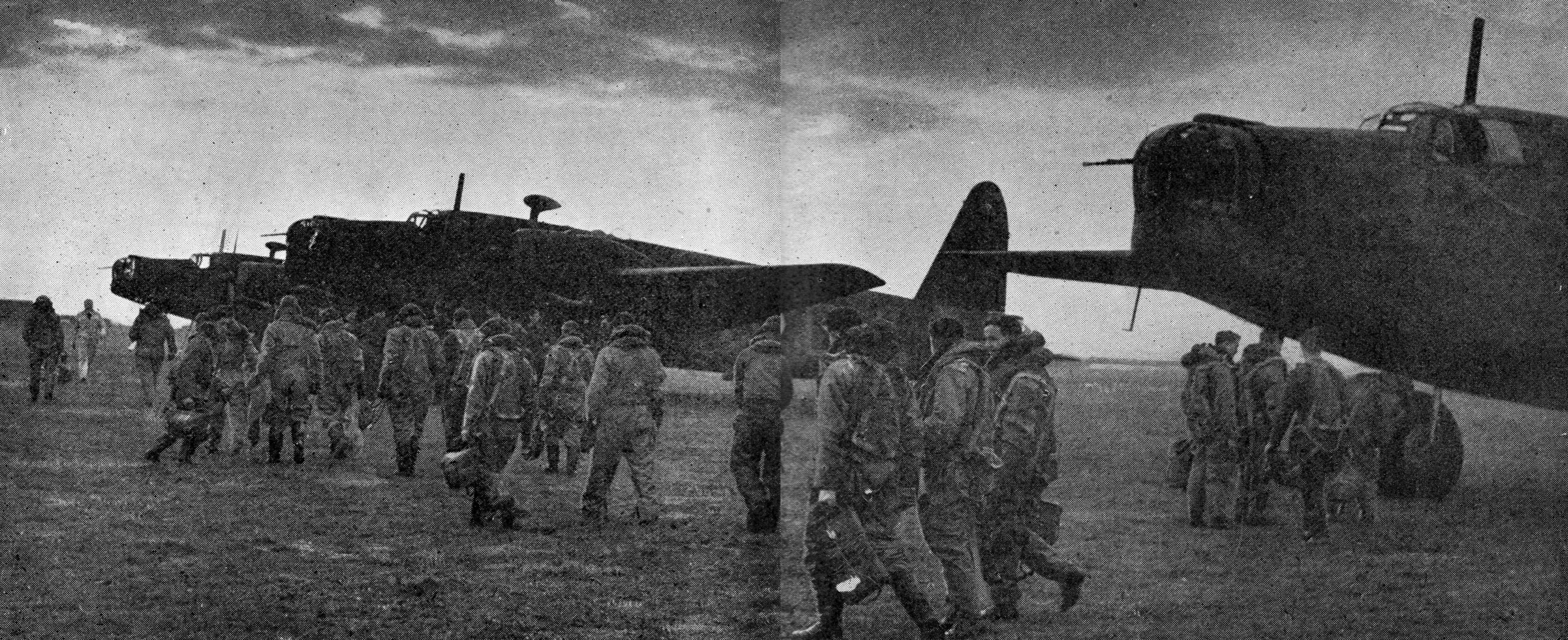
DAYLIGHT
IS FADING AS THE FLYING CREWS BEGIN TO ARRIVE AT THE DISPERSAL POINTS
Just
before the appointed time for the take-off the air crews begin to
arrive at the dispersal points. The aircraft stand silent, silhouetted
against the darkening sky. The silence of the aerodrome is suddenly
shattered as the engines spring one by one into life, and the roar
increases as they are given a final test to make certain that they are
giving their full power
Daylight is fading as the
flying crews put on the remainder of their flying clothing and begin to
arrive at the dispersal points. The aircraft are now completely ready
and preparations are being made to start the engines. The evening
silence is broken as all round the aerodrome engines burst into life
and soon the air is filled with their subdued rumbling as they are
warmed up. Twelve aircraft are due to go off tonight, taking off at
two-minute intervals, commencing at 6 o’clock. In these days of
concentrated raids on given targets, with aircraft unloading their
bombs to a definite time schedule and the whole of an attack by
as many as 500 machines being carried out
in the
space of less than an hour, punctuality in leaving is absolutely
insisted upon and the departure of each aircraft is usually carried out
almost to the second. The air crews scramble aboard with their baskets
containing thermos flasks with hot drinks, chocolate and other condensed
and nutritious foods. The roar increases as the engines are tested on
the ground.
Let us now leave the dispersal point and go to the
control tower in order to watch the take-off. At the appropriate time
permission is given from the control tower for the first aircraft to
leave. In the gathering dusk we can see it creeping slowly round the
edge of the aerodrome to the down wind end. The flares which mark out
the take-off run have been lit, and can be seen faintly, two parallel
rows of seven or eight lights covering several hundreds of yards in
length. These lights are screened from above to prevent enemy aircraft
from spotting the landing ground. The first aircraft is now waiting to
take off with its engines slowly ticking over, while the captain calls
up his crew in turn on the intercommunication telephone and assures
himself that each is at his post and has carried out his share of the
duties which must be performed before the aircraft is ready to take off.
It
now wants a few seconds to 6 o’clock and exactly at the right
moment the full deep roar of the engines is heard and the aircraft
begins to run with gathering speed across the aerodrome. In its fully
loaded condition it has run several hundred yards and is travelling at
more than 100 miles per hour by the time the wheels leave the ground.
As soon as it has lifted a few feet the retractable undercarriage
begins slowly to disappear into the fuselage, and the aeroplane climbs
rsteadily into the night sky.
AIRCRAFT
AWAY
While
we were watching it, the second aeroplane has already taken its place
and is waiting its turn to take off. At precisely two minutes
past
six the process is repeated and so it goes on until all twelve
aircraft are off the ground exactly to time.
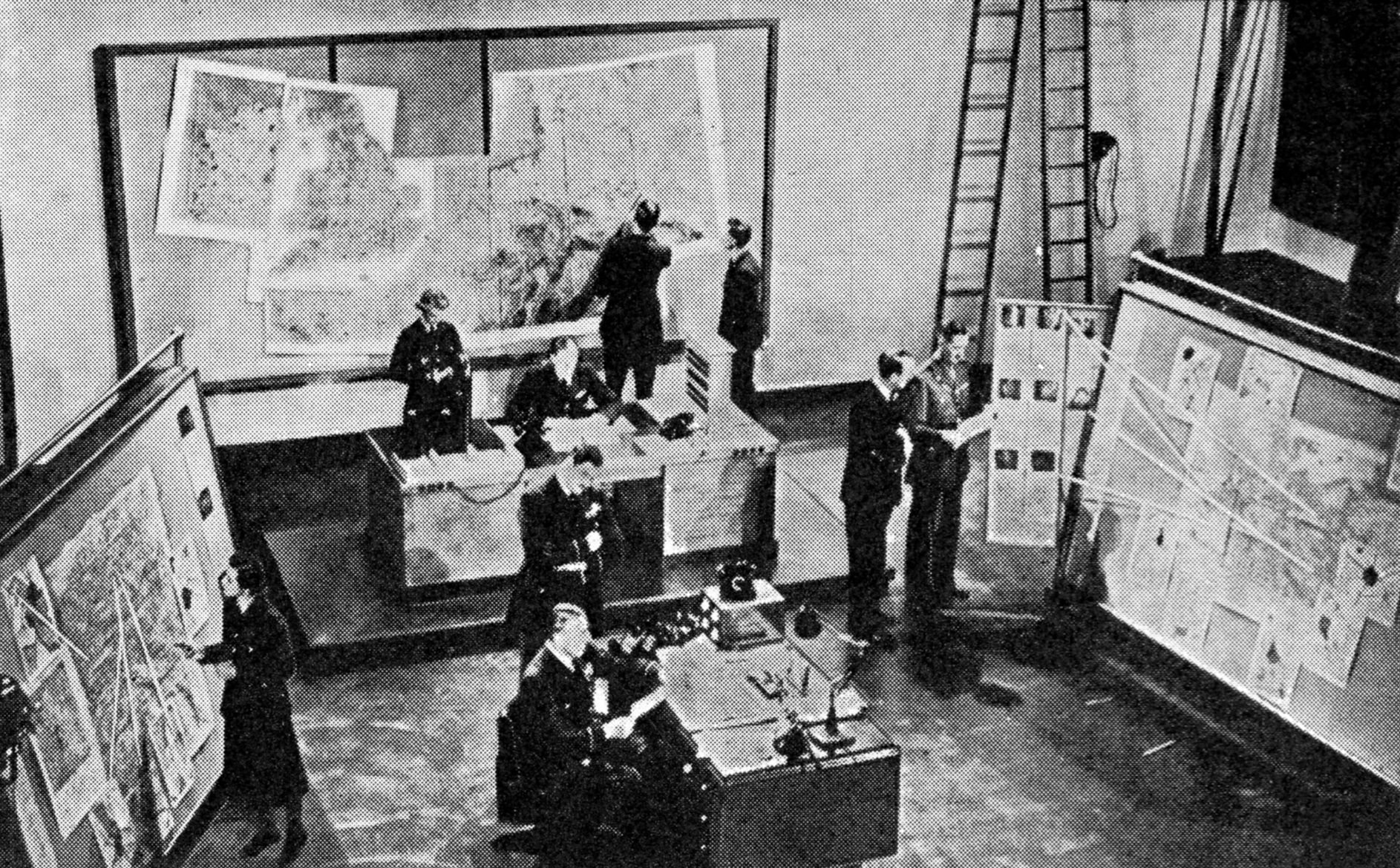
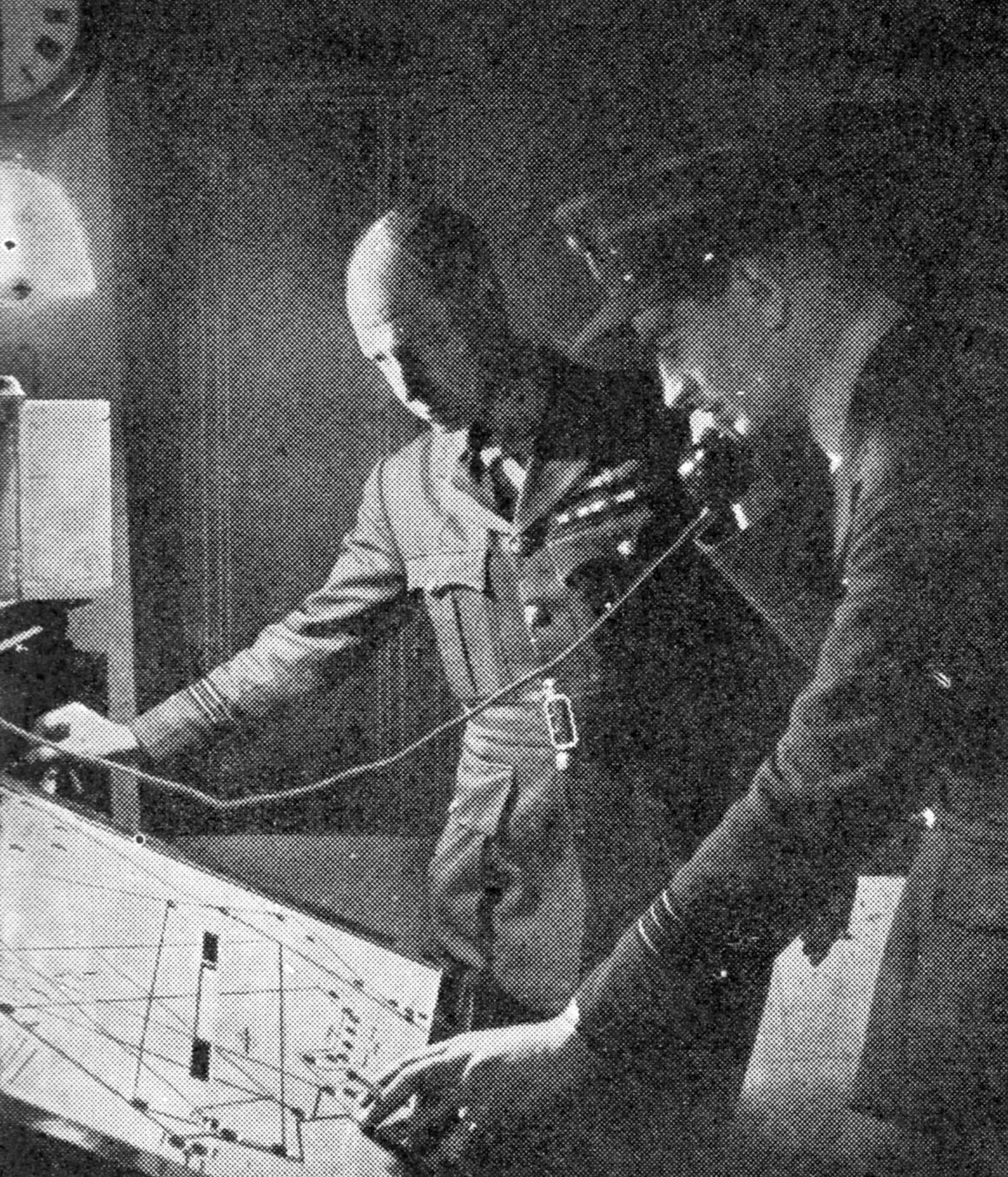
NERVE
CENTRE OF BOMBER COMMAND
The
underground Operations Room at Bomber Command headquarters is shown
above. Here the Commander-in-Chief (at desk in foreground) and his
staff plan the operations for the night. Huge maps, charts and
photographs giving particulars of enemy objectives are hung on the
walls. This photograph is reproduced from the film “Target for Tonight”
We
will now go into the operations room to see how the progress of the
raid is controlled and recorded. Here all is quiet, and shaded lights
illuminate large boards on the walls on which airmen are busy chalking
the numbers of the aircraft that have just taken off and the time of
their departure. Opposite each number is written the time at which it
is expected to return home. If orders should come through to recall the
aircraft or to change the objective, or if it should be
necessary
to divert the returning bombers to some other aerodrome, either on
account of weather or enemy action, the appropriate message can be
passed to the aircraft by wireless. The operations officer on duty sits
at a desk with his telephones and shaded light making entries in the
log.
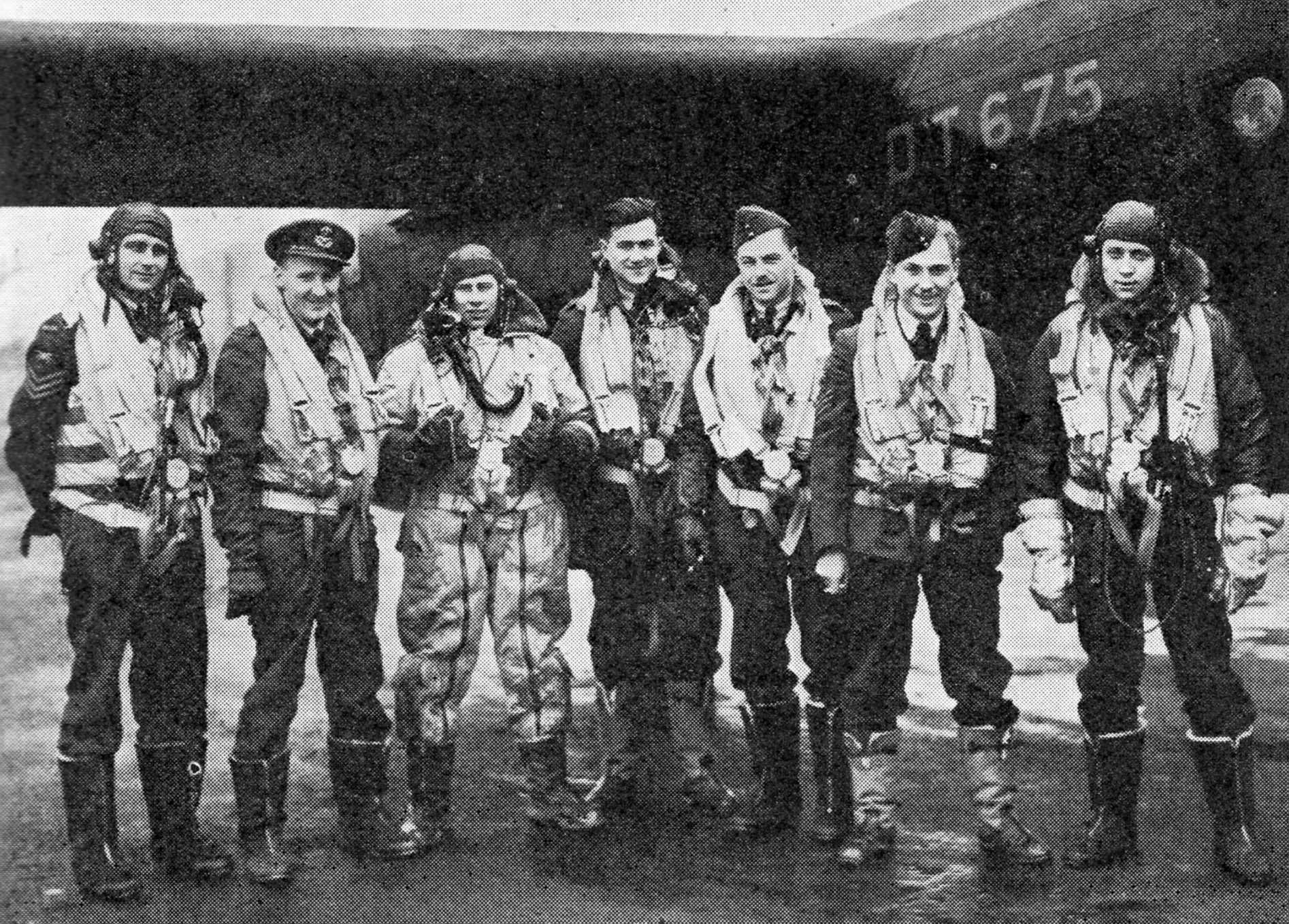
HALIFAX
CREW GO ABOARD
This
Halifax crew are ready and eager to enter their aircraft and take up
their allotted positions inside it. It may be as long as nine hours
before they will set foot on terra firma again
Meanwhile,
the captain of the leading aircraft has checked
up on everything and has satisfied himself that all is well. He is
climbing steadily on the course given to him by the navigator and very
soon the English coastline is reached. Behind him is the
sepia-coloured landscape, while in front is the dark-grey North Sea
which stretches away towards the distant horizon. From a height of
5,000 feet it looks just about as flat as a billiard table. Soon after
crossing the coast the captain decides to alter his course in order to
avoid flying over one of our shipping convoys.
OVER THE NORTH SEA
Nothing
is now visible but a wide monotonous expanse of sea. The moon is not
yet up and it will be a dark night. After a few more minutes the
aircraft flies through a short stretch of cloud, during which it is
necessary for the captain to fly by instruments alone. A small amount of
ice forms on the leading edges as the aircraft climbs into the clear
air above. By the time the aircraft has reached 10,000 feet, the cloud
has been left behind and a few dim points of light indicating the Dutch
coast can be seen ahead. The aircraft is still climbing steadily and
has reached 14,000 feet by the time the coast is crossed. Some miles to
the south a great cone of searchlights has appeared; twenty or more
beams of light converging at a height of some 15,000 feet. No aircraft
can be seen illuminated by the lights, but near the point of
intersection are the vivid orange flashes of bursting shells.
The
captain now adopts the policy of altering course a few degrees every
half minute or so. Several beams of light are now searching the sky in
his direction. They come closer, hesitate and move away again and then,
as though in despair of finding anything, suddenly dowse, giving the
appearance of added darkness to the surrounding sky. The captain flies
on occasionally exchanging a word through the intercommunication
telephone with other members of the crew. He asks the air observer to
tell him again the estimated time of arrival over the target. He
glances at the clock on the dashboard and sees that he has 50 minutes
more to go. He calls up the gunner in the tail turret and asks him if
all is well. The gunner has seen no other aircraft come near. A few
miles ahead is an extensive patch of cloud and the captain sees that if
he maintains his present course and height he will pass over it with a
couple of thousand feet to spare. Once again the waving fingers
of
searchlights come close and the captain alters course sharply to port
to avoid a beam in his direction.
The target for tonight is a
large factory in an industrial town in the Ruhr and the navigator
wishes to check his position on crossing the Rhine. He had laid off his
course to cross the river where there is a very distinctive bend, at
which he hopes to pin-point his position and set a new course for the
objective, which will be only twenty-five miles away. As the time
approaches when they should be getting near the river, the captain
peers through the windscreen in an endeavour to pick it up, while
the bomb aimer gazes through his window with the same object.
ON THE COURSE
At
the same moment they both see the gleam of starlight on water and the
captain turns the aircraft slightly so as to bring the river more
clearly into view, while at the same time the navigator searches for
some other distinctive feature which will make him doubly sure of his
position. Soon he sees what he wants and reports to the captain.
“O.K.,” he says. “Course ninety-five degrees for 15 minutes.” The
captain acknowledges, and turns the aircraft gently until it has taken
up the new course. Many other aircraft will also be attacking the same
target tonight, but he took off early and not many will be ahead of
him. Nevertheless, there are signs that some aircraft have already
arrived. Several cones of searchlights can be seen and many shell
bursts are studding the sky, while on the ground a few dull glows,
which are probably the early stages of fires caused by incendiary bombs,
can be seen.
SELECTING
THE BOMBS
Fig. 5.
When close to the target the bomb aimer selects his bombs by means of
switches on the bomb-selector panel, seen above. He then opens the bomb
doors and settles down to the task of picking out the target
The
bomb aimer now operates switches that select and fuse the bombs (Fig.
5), checks the settings on his bomb sight, and finally opens the
bomb-cell doors. He then gives the whole of his attention to the task
of picking up the actual target. Two miles to the north of it is a
small lake of distinctive shape, while along its southern edge runs the
River Ruhr itself. He is giving the captain frequent changes
of
course which he indicates by an apparatus resembling a small version of
a ship’s engine-room telegraph.
The
man behind the bomb sight strains his eyes into the darkness and
momentarily sees the gleam of water. He signals to his captain to alter
course to bring it dead ahead but now he can see nothing. Then again he
spots the glint of the water reflecting the light from the beam of a
searchlight. He sees that it is indeed the lake for which he has been
looking. He alters course still further to starboard to bring the
estimated position of the target dead ahead and then strains his eyes
once more to find the River Ruhr and the acres of workshops which are
his objective.
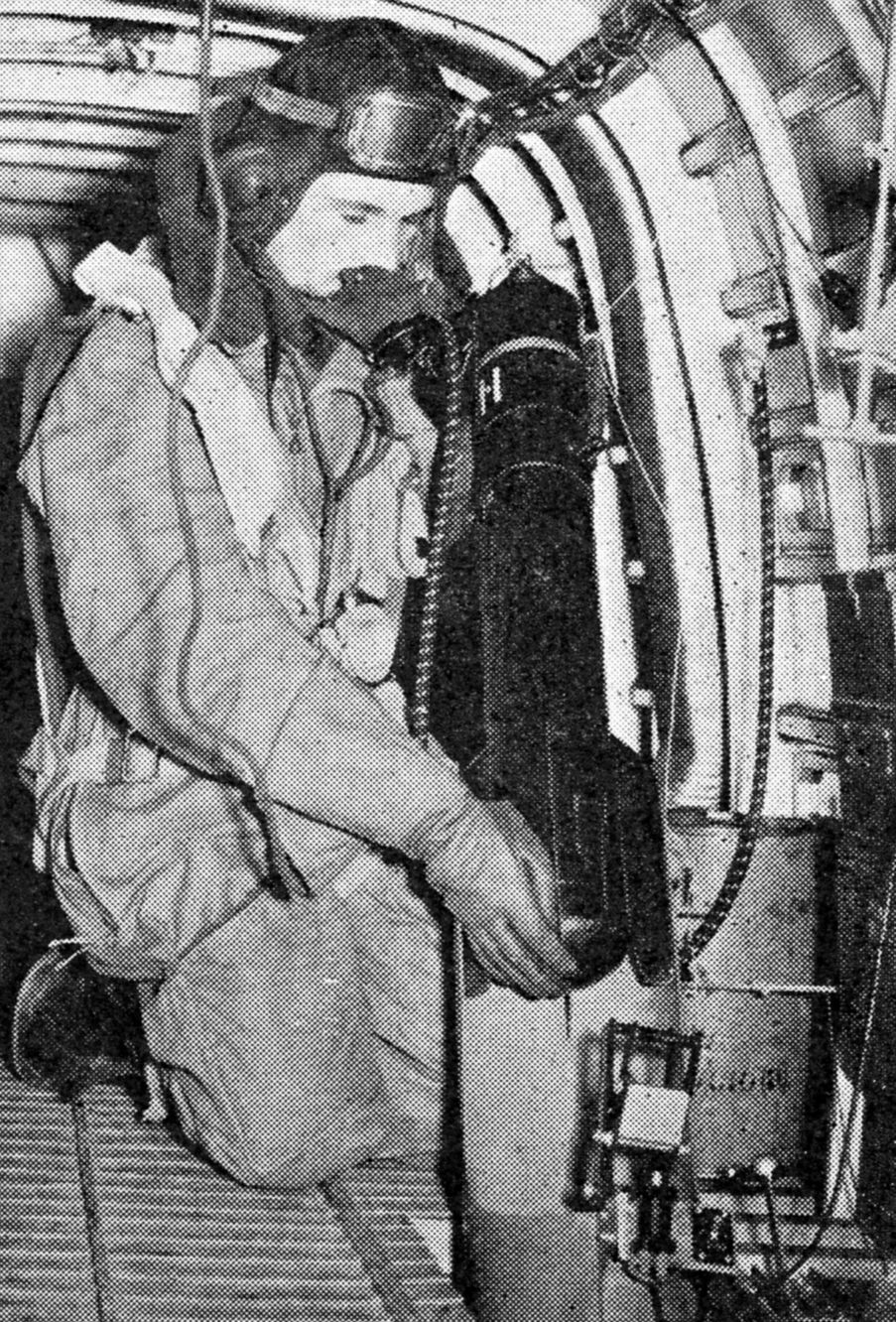
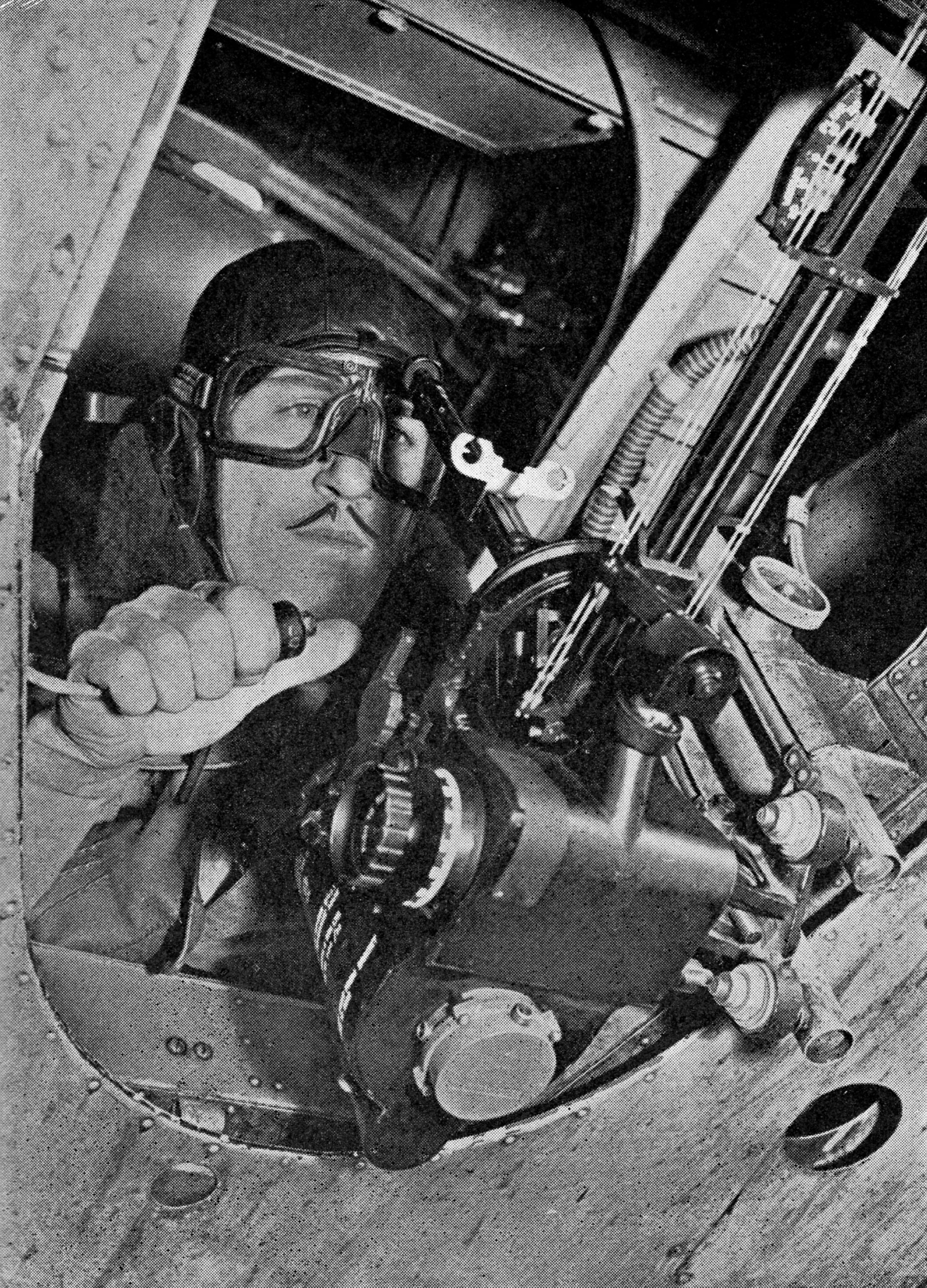
DROPPING
A PARACHUTE FLARE
Fig. 6.
In order to light up the target area the bomb aimer, seen above, drops
a powerful parachute flare. This burns for several minutes and gives a
brilliant light equal to several hundred thousand candle power
In
order to help in this, each bomber carries a number of powerful
parachute flares which can be released by the bomb aimer (Fig. 6). When
one is dropped, it falls for a pre-arranged time, after which the
parachute opens and checks its descent. At the same moment the flare
begins to burn with a light equal to several hundred thousand candle
power. When a number of bombers are attacking the same target, there
will probably be several flares, dropped by different aircraft, burning
at the same time and in clear weather conditions the ground will be
sufficiently well illuminated to enable the bomb aimers to pick up the
target.
DROPPING THE FLARES
The
observer releases his flare and peers into the darkness. After about a
quarter of a minute it starts to burn and almost at the same time
another flare dropped by another bomber lights up in the sky ahead of
him. By the combined light of the two flares he searches the ground for
the target. He is almost certain that it is straight ahead and just as
he is beginning to make out the cluster of buildings and the tall
chimneys, the whole cockpit is lit up by a brilliant flood or light,
completely dazzling him and forcing the pilot to fly entirely by
instruments. A large group of searchlights, controlled by a complicated
electrical system, has suddenly, without warning, switched on and,
aided by fortune, illuminated the bomber at the first attempt.
The
captain shuts off the engines, banks violently and turns sharply to
port, dropping the nose and letting the speed rise in an effort to
escape. He watches the needle of the air-speed indicator creep round
the dial until it registers more than 300 miles an hour. The bomb-cell
doors are closed. The glare of the light is dimmer now, and as the
captain pulls up the nose of the aircraft he realizes that he has
escaped.
It is not always so easy to escape the persistent cones
of the searchlights. Not long ago when over the same district, the
captain had to take violent evasive action and lose height down to
6,000 feet before he could elude their dazzling glare. As he turns to
starboard to return to the target, anti-aircraft shells begin to burst
all round the aircraft. They give a vivid orange flash. The captain half
throttles the engines, and loses height slightly, as he thinks that in
this way he will have a better chance of approaching the target without
being picked up again by the searchlights.
Meanwhile, the
observer has managed to fix the position of the aircraft by recognizing
a landmark and once more gives the pilot the correct course to steer.
He resets the bomb sight and settles down with straining eyes to pick
up his objective. Once more, he releases a parachute flare, and by its
light, he sees the target right ahead of him.
This time there is
no mistake. He identifies it quite clearly, and, waiting for the right
moment, alters the course of the aircraft slightly to bring the target
in line with the end of the drift bar of the bomb sight. As the
aircraft flies towards it, the target apparently moves along the drift
bar and when it gets to a point where a cross wire intersects it, the
observer will press the button which functions the electric
bomb-releasing gear.
OVER THE TARGET
On
the last run up the target the ground defences redouble their efforts
and shells burst very close. The captain sets his teeth and keeps on a
steady course, while the observer coolly waits for the few seconds that
must elapse before the moment comes for him to release the bombs. At
last the target reaches the cross wire. He presses the button. The
bombs fall off in quick succession, and a moment later he sets the
automatic night camera in action. “Bombs away,” he shouts through the
telephone to the captain, “but hold on to the course for a bit if you
can, as I have switched on the camera.”
A few seconds later the
bombs explode far below and the flash bomb of the night camera goes off,
looking for all the world like lightning. As soon as he sees the flash
the captain knows that the photograph has been taken, and, opening up
the engines to full throttle, he turns the aircraft for home, still
pursued by bursting shells. Two other cones of searchlights have sprung
into existence within the last few seconds, illuminating other bombers
arriving in the target area. The captain puts the nose down slightly
and watches the air-speed indicator rise steadily. There is no object
in loitering in the vicinity of the target once the bombs have gone.
COURSE FOR HOME
The
air observer has closed the bomb-cell doors and, as the bomb-aiming
part of his job is now over, he returns to the navigator’s table and
gives the pilot the course to steer for home. This will not necessarily
follow the shortest way, as bombers frequently route themselves so as
to avoid known concentrations of searchlights, A.A. batteries and areas
popular with enemy night fighters. The tail gunner reports that he can
see large fires burning in the target area and the sky over the target
is fairly plastered with bursting A.A. shells. In a few minutes the
aircraft is flying over the layer of cloud, this time just skimming over
the top of it.
THE
NAVIGATOR PLOTS HIS COURSE
At
his station in a Stirling bomber the navigator is busy calculating his
course. Upon this very important member of the air crew the success of
the bombing raid may depend. An error in course may waste the work of
the rest of the crew together with fuel and bombs
THE
BOMB AIMER TAKES AIM
In
addition to his other duties the navigator also aims and releases the
bombs and sets the automatic night camera in action. In his right hand
he holds the bomb-release switch which operates the delicate mechanism
that sends the bombs speeding on their deadly mission
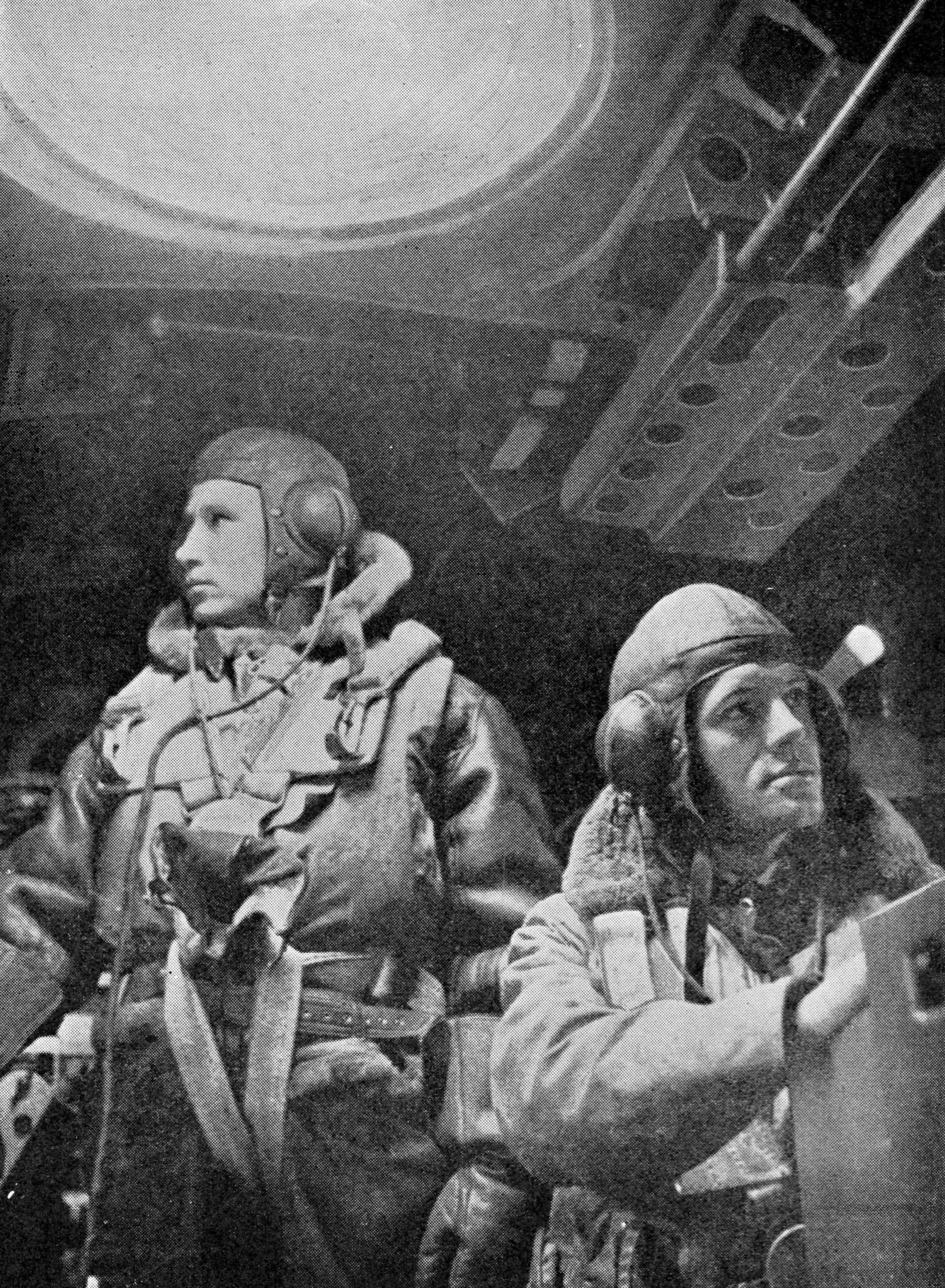
WIRELESS
OPERATOR AND FLIGHT ENGINEER
Two
important members of a bomber’s crew are seen above at their stations
inside the fuselage of a Short Stirling four-engined bomber. On the
left the flight engineer is watching the telltale gauges that tell him
how the engines are behaving; on his right is the wireless
operator—Sparks, as he is known—who is the only link between the
aircraft and the outside world
The
crew have been in the air now for some four
hours and they are all beginning to feel the effects of cold. Thermos
flasks are opened, and every one has a hot drink; the captain leaves the
pilot’s seat, handing over the controls to the second pilot, and takes
up his station near the air observer and surveys his surroundings
through the astrodome. He asks the air observer to let him
know
the expected time of arrival over the English coast, but before he can
get a reply the tail gunner reports that an aircraft, which he thinks
is an enemy fighter, is approaching from the starboard quarter.
ATTACK BY NIGHT FIGHTERS
The
captain immediately warns all the crew to stand by for an attack and
tells the second pilot to turn to port to bring the fighter well within
the field of fire of the tail gunner. He strains his eyes, peering
through the astrodome and after a few moments can plainly see a
twin-engine fighter, behind and below him, faintly silhouetted against
the cloud. The captain considers whether he will remain in clear air
and trust to shooting back if the fighter attacks him, or risk going
into the cloud, in which he will probably meet bad icing conditions,
but before he has made up his mind the fighter has turned sharply away
and disappeared.
The captain knows by experience that German
fighters often behave in this way. They come and look at you and go
away, but, like sharks, they generally return. He therefore warns the
tail gunner to keep an especially careful watch and returns to his
conversation with the air observer. The expected time of arrival at his
base is a few minutes before midnight. The captain is anxious not to be
late owing to the risk of fog forming after midnight. When he looks
again out of the astrodome he sees that they have left the cloud bank
behind and are near the Dutch coast. The tail gunner reports that the
enemy fighter has reappeared and is approaching rapidly from astern and
slightly below. The captain orders him to hold his fire until the fighter
is within effective range. The tail gunner operates his turret and,
allowing for deflection, gets his sights fair and square on the enemy
fighter, while his finger squeezes the trigger as he waits for the moment
to fire off his ammunition.
All of a sudden there is a vivid stab
of flame from the nose of the fighter and the crew hears the rattle of
bullets striking the tail plane and lower part of the fuselage. This is
at once followed by a roar of machine gun fire from the powerful battery
in the bomber’s tail. The captain watches the fight from his post of
vantage at the astrodome. The fighter turns slightly and goes past at
high speed on the port side. The captain warns the front gunner that he
will have a chance of a shot and a moment later hears the rattle of
machine gun fire from the front turret. In face of the bomber’s powerful
guns the fighter climbs and turns away, disappearing against the dark
starry sky.
The captain calls up all the members of the crew on
the telephone to see if any one is wounded and to ask for reports of
damage. No one is hurt, though the wireless operator reports several
hits on the armoured bulkhead which protects him from astern attack.
The remaining damage appears to be superficial; in a few moments all
traces of excitement have passed and the crew return to the normal
routine of their duties. The Dutch coast is now well behind them and it
is time for the wireless operator to tune in to his home station. He
will now obtain a fix from the long-range D/F (direction-finding)
stations and pass it to the navigator in order to assist him in
checking the aircraft’s position.
UNFAMILIAR VIBRATION
The
practised ear of the captain detects a slight change of note in the
port engine, and he carries out in the pilot’s cockpit a check up on
the instruments. Oil pressure and oil temperature seem all
right,
fuel pressure gauge, boost, everything seems to be normal, but the
engine is running irregularly and a certain amount of vibration can now
be felt. There can be little doubt that one of the enemy fighter’s
bullets has damaged something. It is impossible to see
what, as the engine is away out on the wing and cannot be inspected
during flight. He can only hope that it will continue to run till they
get home. The captain remains in the cockpit watching the instruments
and listening to the note of the engine. As the vibration does not
appear to get any worse and the engine is still giving nearly full
power he concludes that with luck it will see them home. He glances at
the clock and sees that they have another twenty-five minutes to go, and
gazes through the pilot’s windscreen, watching for the first sign of the
English coastline. The aircraft is now steadily losing height and the
coast is crossed at 5,000 feet. As he looks down on the ground the
captain can see, faintly, patches of fog and mist.
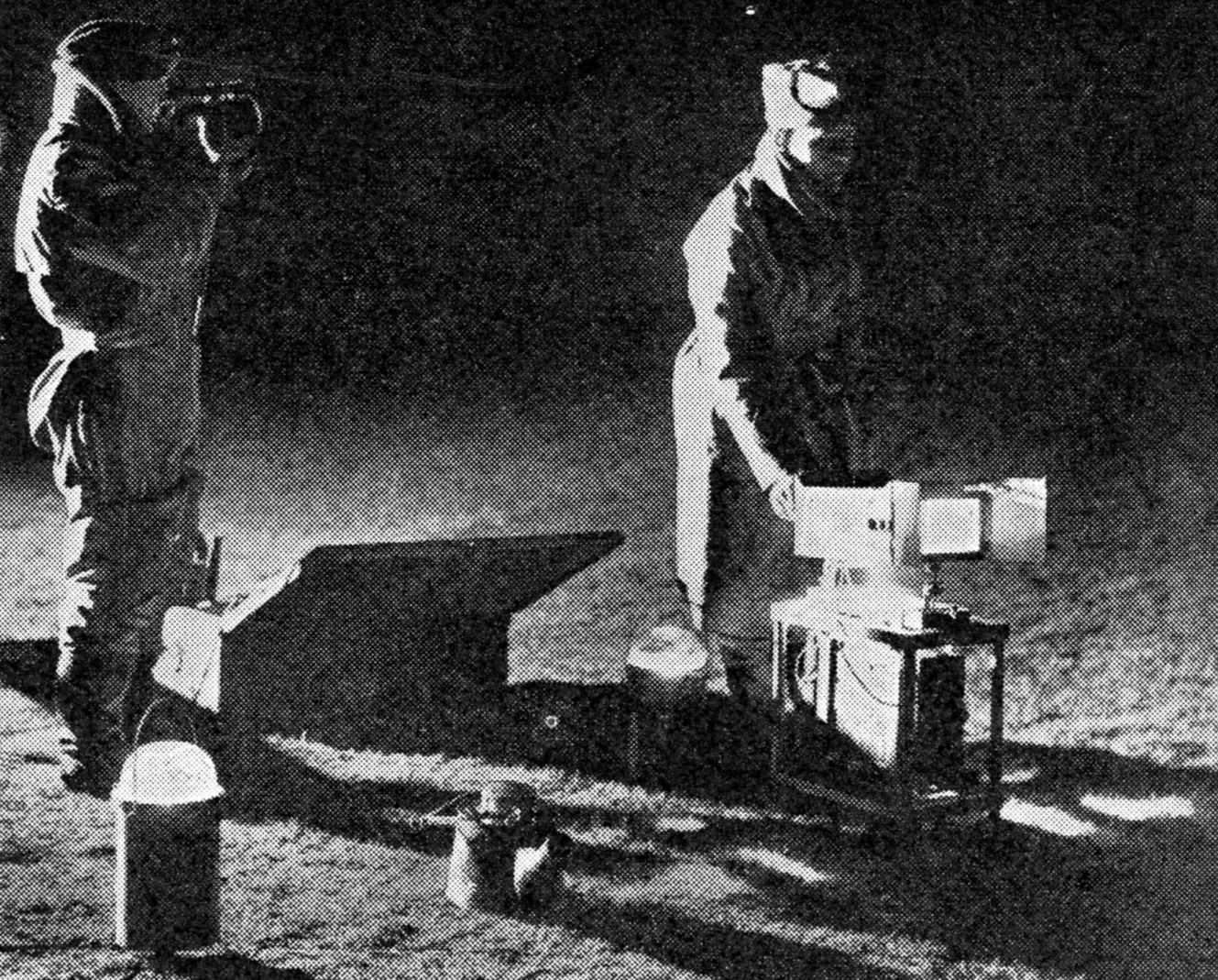
AERODROME
CONTROL POST
Fig. 7. A returning bomber receiving a
signal by an Aldis lamp from the aerodrome control post giving it
permission to land.
Inside
the control room where officers, with a plan of the aerodrome lighting
and runways before them, direct landing
operations
ON
THE CONTROL TOWER
Many
hours have elapsed since the aircraft set out. They will soon be due
back. The aerodrome, silent since their departure, begins to stir into
life as preparations are made to bring the bombers safely to earth. On
the control tower a group of officers strain their ears to catch the
drone of the first returning bomber. The question in all their minds is
how many will return
The
automatic pilot holds the aircraft on its steady course while the
captain changes places with the second pilot and takes over the
controls. In a few minutes the aircraft is circling round the dimly lit
flare path of the aerodrome. The height has now been reduced to 1,000
feet and the captain sees that although the visibility is not very
good, the fog has not yet reached the landing ground. As he circles
round he makes a signal asking for permission to land and an answering
signal giving permission is received from the aerodrome control post
(Fig. 7), though sometimes other bombers which arrived first are still
in the air and he has to await his turn, continuing to circle at a
height which is given to him so that he and the other aircraft remain
at different levels, much as though they are on different
storeys
of a house, and do not run the risk of collision.
On
receipt of the signal the captain pulls the lever that lowers
the
undercarriage. He watches the tell-tale lights turn from red to green,
which indicates that the undercarriage is fully extended and locked in
position. The captain half closes th throttles and pushes the nose of
the aeroplane down, lowers the flaps and circles round, losing height.
He judges it so that he reaches the down-wind side of the aerodrome at
about 500 feet. He watches the flare path and turns in towards it at the
right moment, at such a height that he will slightly undershoot. He
comes in steadily into wind at half throttle and at 50 feet up opens up
the engines for few seconds to nearly full throttle to help him in. As
he comes over the boundary light of the aerodrome he shuts off the
engines and puts the nose down to the normal gliding angle. The
aircraft approaches the ground at a steep angle and at the right moment
the captain pulls back the elevator control and holds the aircraft just
off the ground. It floats parallel with the surface of the aerodrome for
a few seconds and then sinks lightly on to the ground. The captain now
gently puts on the brakes and the speed gradually slows up until the
aircraft comes to rest near the end of the flare path.
The
captain now taxies the aircraft off the flare path and proceeds slowly
to the dispersal point. On arrival, the air crew hand over the aircraft
to the maintenance crew, giving them a brief report on its condition
and performance.

INTELLIGENCE
OFFICER INTERROGATES THE CREWS
Fig. 9.
Immediately after landing, the captain taxies his bomber to the
dispersal point where he hands it over to the maintenance crew. The air
crew then proceed to the operations block where they are interrogated
by an intelligence oflicer. He listens to the story they have to tell
regarding the part they have taken in the raid, and questions them
whenever necessary regarding the effect of their bombs, the amount of
enemy interference and so on. The crew then go to their messes for a
good meal before turning in for a well earned sleep
THE INTERROGATION
The
crew now get into a light lorry, in which there are several other air
crews whose aircraft have just landed, and drive about a mile to the
operations block. On arrival they go to a large room in which are a
number of tables, each with half a dozen chairs disposed round them.
Several of these tables are already occupied by crews who are giving
their stories to one of the intelligence officers, who sits at the head
of the table. The crew help themselves to large enamel mugs, and fill
them with steaming hot cocoa from a large urn that fizzles on another
table in the middle of the room. They make their way to a vacant table
and seat themselves. The atmosphere is warm and they take off much of
their flying clothing. Presently an intelligence officer comes along to
give them their “interrogation” (Fig. 9). He questions them whenever
necessary but for the most part encourages them to tell their story in
their own words. Gradually the sheet of paper in front of the
intelligence officer becomes covered with his notes and after a final
question or two he releases the crew, who make way for the next one and
go to their respective messes.
Here they have a meal which is
usually taken at any time from 1 a.m. onwards and is a sort of combined
supper and breakfast. Sausages and mash, or bacon and eggs (when they
are obtainable) are very popular and as they eat they exchange
reminiscences of the night’s work. One crew has done particularly well,
for not only did they obtain direct hits on the target, but they claim
to have shot down in flames an enemy fighter which was rash enough to
attack them on their way home.
As it is still only half-past two
in the morning, there are several hours of darkness in front of them.
They can sleep for seven or eight hours, getting up in time for a late
breakfast at ten or eleven o’clock. In high summer it is not so easy,
as they may land after dawn and then have to try to sleep during
daylight hours. Soon the mess is empty, and the lights are turned out.
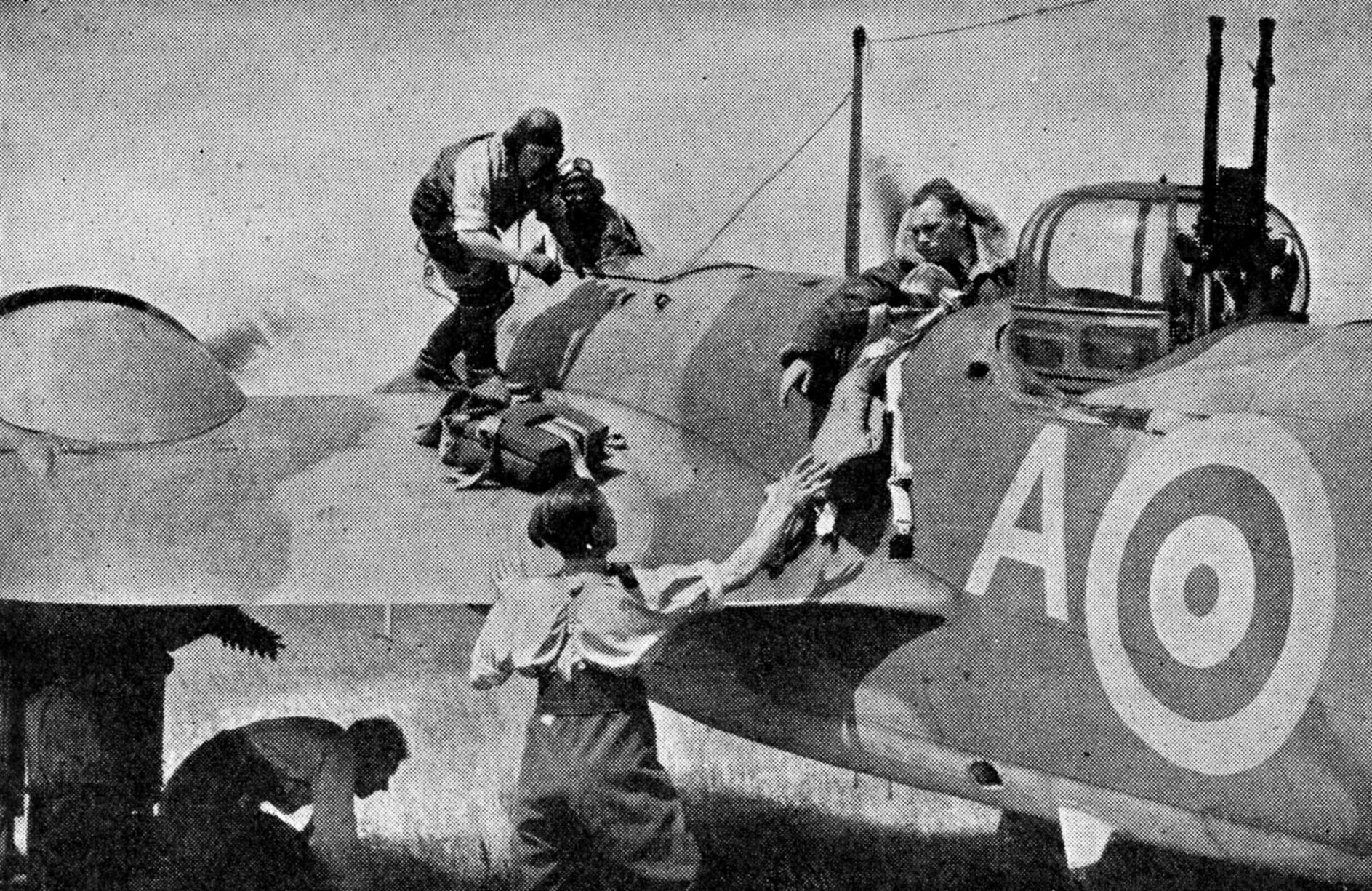
START
OF A DAY BOMBING RAID
By
the time that the bomber crews reach their aircraft the engines have
already been started up by the maintenance crews at the aerodrome and
are ticking over quite smoothly. The crews scramble aboard, making all
the necessary last-minute adjustments to their flying clothing and kit.
The engines are given a final test at full throttle, after which the
planes taxi out on to the airfield and take up their stations on either
side of the leader before taking off
Most
bombing operations against enemy ships moving up and down the English
Channel are carried out nowadays by fighter-bombers, Hurricanes and
Whirlwinds, while Coastal Command has the responsibility of looking
after the German convoys farther afield off the Dutch and Norwegian
coasts. Specialised bombing by day on targets as distant as Oslo and
Berlin is undertaken by the exceedingly fast Mosquitoes. They go out in
small force and rely on their speed and manoeuvrability to make their
attack and return home safely, as they did on their now historic raid
on Berlin when Goering was due to speak in celebration of Hitler’s
tenth anniversary of coming to power.
MEDIUM BOMBER RAIDS
But
also there are the day bombing raids on specified targets like power
stations, steel works and harbour installations, so we will go to an
aerodrome where medium bombers are preparing to go out with an escort
of fighters. The “circus” operation, as it is called, is timed to take
off at 2 o’clock. It is a deliberately planned operation, very
carefully timed and there is no need to stand by or rush into
the air to catch a fleeting target. The bombers and fighters will either
take off from the same aerodrome or will meet at a pre-arranged time
and place. The bomber and fighter leaders will get together beforehand
and discuss with the greatest care every detail of the arrangements.
Fighters have a limited petrol capacity and therefore cannot afford to
waste any time in the air waiting for the bombers at the rendezvous.
Everything
must go like clockwork if it is to be successful. The bombers will
circle over the rendezvous at a pre-arranged height for a few minutes
to allow the fighter squadrons to take up their station in the best
manner to protect the bombers from enemy fighter attack. Then at a
signal from the bomber leader, the combined formation will set off for
the target. The bomber leader must be careful not to make any sudden
alterations in the course or height which may cause the fighter
formation to lose station or straggle in any way, for if this should
happen it will give the enemy fighters the chance they are looking for.
In a matter of seconds, perhaps, a straggling aircraft will be singled
out for attack and will be lucky if he can get home to tell the tale.

ESCORT
AND HIGH-GUARD SQUADRONS
Fig. 10.
In circus operations the bombers are escorted by fighters. One squadron
flies close behind and above the bombers and is known as the escort
squadron. Above and behind the escort are two other squadrons which are
called the high-guard squadrons. The arrangement of the bombers and
their attendant fighters is here illustrated diagrammatically
THE FIGHTER ESCORT
When
we arrive at the aerodrome we see that the three Spitfire squadrons
which are going to escort the formation of six Bostons have already
arrived and are dispersed around the leeward side of the aerodrome. The
bomber crews and fighter pilots are having the details of the operations
explained to them at the operations centre by the various formation
leaders. None of them are new to the game, however, and a very few
minutes suffice to put every one in the picture. The conference over,
the pilots and crews go to their aircraft and one after another the
engines are started up. The bombers go off first and climb gently in a
wide sweep. The leader carefully notes the time and follows the course
he has mapped out to bring him over the rendezvous at 10,000 feet three
minutes before the appointed time.
As soon as the bombers are in
the air, the three Spitfire squadrons take off in formation, one after
the other and disappear in the same direction. Arrived over the
rendezvous, the bomber leader makes a wide circle and looks behind to
see if the Spitfire squadrons are taking up their positions. One Spitfire
squadron is close behind and above the bombers. This is the “escort”
squadron. Behind and above the escort are the other two Spitfire
squadrons, which are called the “high-guard” squadrons. Behind each
fighter squadron one Spitfire weaves from side to side, keeping a look
out astern for enemy fighters (Fig. 10).
The leader turns gently
on to the correct course, and, still climbing, the formation crosses
the coast. The leader looks far below to the smooth blue water of the
Channel. He intends to cross the French coast at 13,000 feet and then,
increasing speed, reduce his height to 12,000 feet over the target,
which is a large electric power station in occupied territory. When
crossing the French coast they are saluted by the enemy’s heavy A.A.
guns, which put up a stiff barrage of bursting shells in and around the
formations. It is astonishing that none of the aircraft is hit, as many
of the bursts appear to be very close. Once the leader flies through the
smoke of a shell which bursts a couple of hundred yards ahead of him.
When clear of the coast the A.A. fire dies away, but is renewed on a
smaller scale as they approach the target. The leader’s air observer
has no difficulty in this clear weather in picking up the target when
more than ten miles away and he watches it coming slowly along the
drift bar of his bomb sight until the moment comes to release the
bombs. As he presses the button which causes the bombs to fall off the
racks, he gives the signal by R /T and all the other observers in the
formation simultaneously release their bombs. He watches the great
cluster of bombs go falling down towards the target, growing smaller
and smaller as they creep on towards it. Many seconds pass and the
bombs have grown so small that they have disappeared altogether when
suddenly all over the target area large puffs of greyish-black smoke
appear, and spout upwards to the sky. In a few moments the target is
completely obscured by a heavy pall of smoke and the bomb aimer knows
that his shooting has been good.
Immediately after releasing the
bombs the air observer switches on the automatic camera, which will
take a photograph every few seconds. As soon as the bombs have burst he
stops the camera and tells the leader that all is well. The bomber
formation now turns gently to port and sets course for home, the
Spitfires keeping their proper station during the turn. Formations of
enemy fighters are now arriving to take a hand in the game. Four of them
dive steeply past one of the Spitfire squadrons, and pulling out of the
dive, attack the bombers by zooming up underneath them. A flight of six
Spitfires detaches itself from the escort squadron and attacks the enemy
fighters from behind, whereupon three of them roll on their backs and
dive steeply away towards the ground. The fourth loses speed, stalls
and spins down to earth with fire and smoke pouring from the engine.
No
more fighters attempt to attack the bombers, but they repeatedly dive
upon the escort Spitfires and fire their guns from a long range. At last
one more venturesome comes too close. Immediately a section of
three Spitfires breaks away from one of the “high-guard” squadrons and
manoeuvres on to his tail. The enemy fighter dives vertically at a
tremendous speed, but, as he is not seen to be set on fire or crash, he
is not claimed as destroyed. The three Spitfires then quickly take up
their former positions in the squadron. By now the formation has
reached the coast and again it has to pass through the barrage of
bursting A.A. shells. Once more all the aircraft come safely through
and now only the narrow strip of the Channel lies between them and
England. The leader eases back the throttle and, losing height, crosses
the coast at about 5,000 feet. Here he bids farewell to the Spitfires,
which break off to go to their own aerodrome.

RAIDS
BY MEDIUM BOMBERS
While
the heavy bombers make the devastating night raids on industrial
centres and ports in Germany, the medium bombers, with powerful fighter
escort, carry out valuable daylight attacks on power stations, steel
works and harbour installations all over enemy-occupied territory.
These daylight raids, which involve the combined use of fighters and
bombers, have to be planned with the utmost care and precision.
Everything has to be timed to the minute if the attack is to be a
success. Such daylight attacks are carried out by medium type bombers
like the Bostons which are shown on the left. The Douglas Boston III is
powered by two Wright double-row Cyclone radial engines and has a top
speed of more than 350 miles per hour at about 12,000 feet. Its
armament comprises six machine guns and it can carry a bomb load up to
2,000 pounds. This aircraft is also used as a night intruder bomber and
in such a capacity has done a great deal of useful work over France and
the Low Countries
After completing a period in a
bomber squadron, the air crews pass on to the Operational Training
Units, where they are employed in teaching their business to the crews
under training. It is particularly important that the instructional
staff at the Operational Training Units should be composed of men with
recent experience in a service squadron so that they can
ensure
that the fresh crews reach their units imbued with
up-to-date tactical ideas. It would, however, be a mistake to suppose
that the instructors at Operational Training Units are enjoying a rest
after their spell of operations. Although the change is no doubt
beneficial, the work is hard and, moreover, lacks the thrill of
operational flying. The air crews look forward with pleasure to the day
when, having finished their time as instructors, they will return to a
squadron. There is something very satisfying about the esprit de corps of
a service squadron; air crews are such true comrades in arms that
almost from the first day of their second tour of duty, the re-joined
crews feel at home again. They now become the old hands of the
squadron, veterans in the eyes of the crews now doing their first tour
of duty, who look to them tor advice and help.
The men of the bombers, by day and night, in fair weather and foul,
carry on a continuous offensive against the enemy. No task can worry
them; nothing can put them out of humour but a spell of
inactivity caused by hopeless weather conditions. But it must not be
supposed that they are supermen. They are ordinary fit young men, who
have been through an intensive course of training and have absorbed the
spirit of the Royal Air Force. Their conversation may often be flippant,
and their demeanour at times apparently off-hand, but this is merely a
mask which conceals a remarkable standard of courage and devotion to
duty. To quote a line of Rudyard Kipling, they are not children or
gods, but “men
in a world of men.”
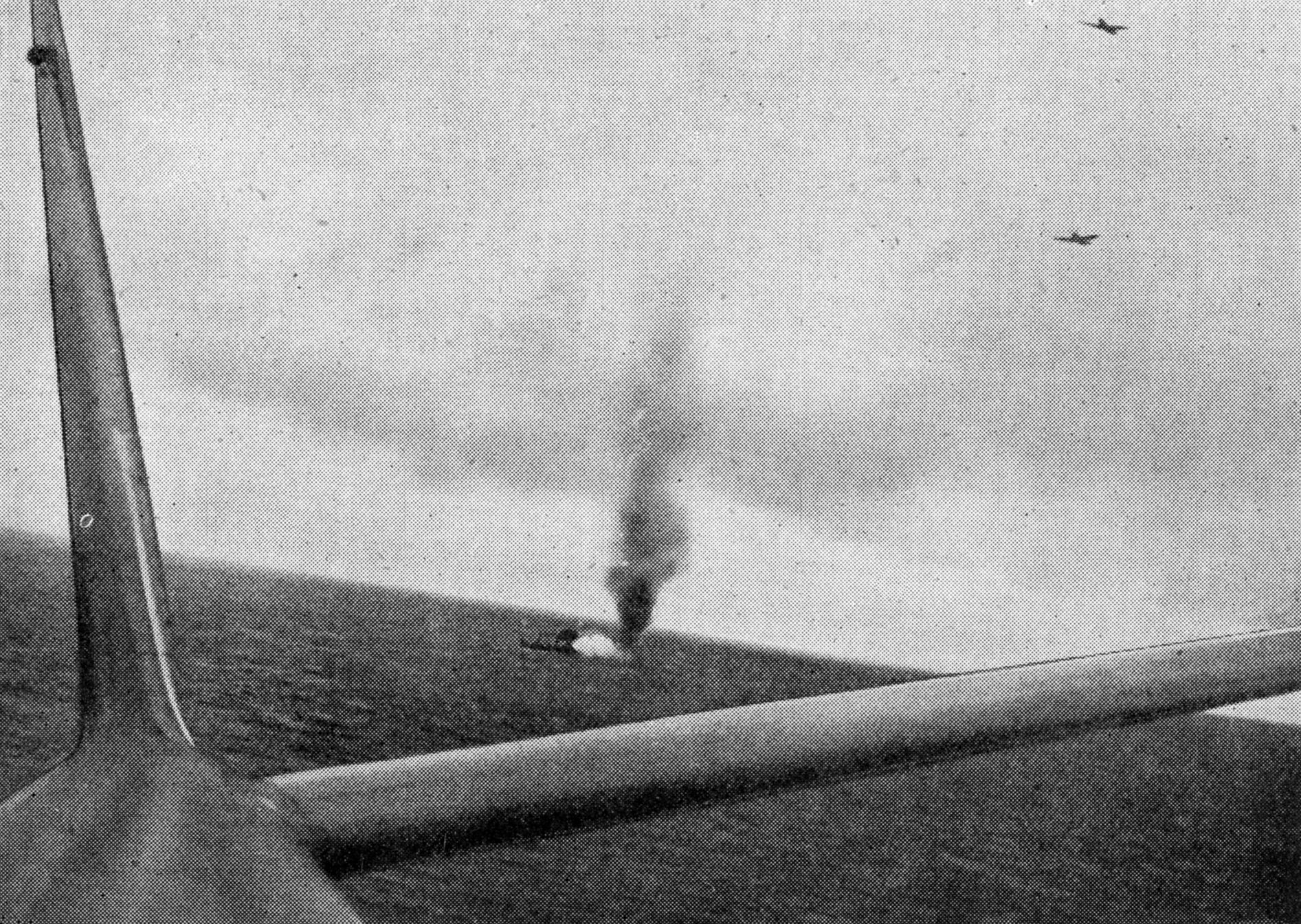
A
DIRECT HIT IS SCORED
Attacks on ships are carried out
from a very low level, partly because this is the best way to secure
surprise and partly because it is harder for the flak ships to hit
low-flying aircraft. In addition it is extremely difficult for any
defending aircraft to dive from above upon planes which are just
skimming the waves. A fractional error in judging the moment in which
to pull out of the dive would be fatal. Here a direct hit has been
scored upon an enemy ship
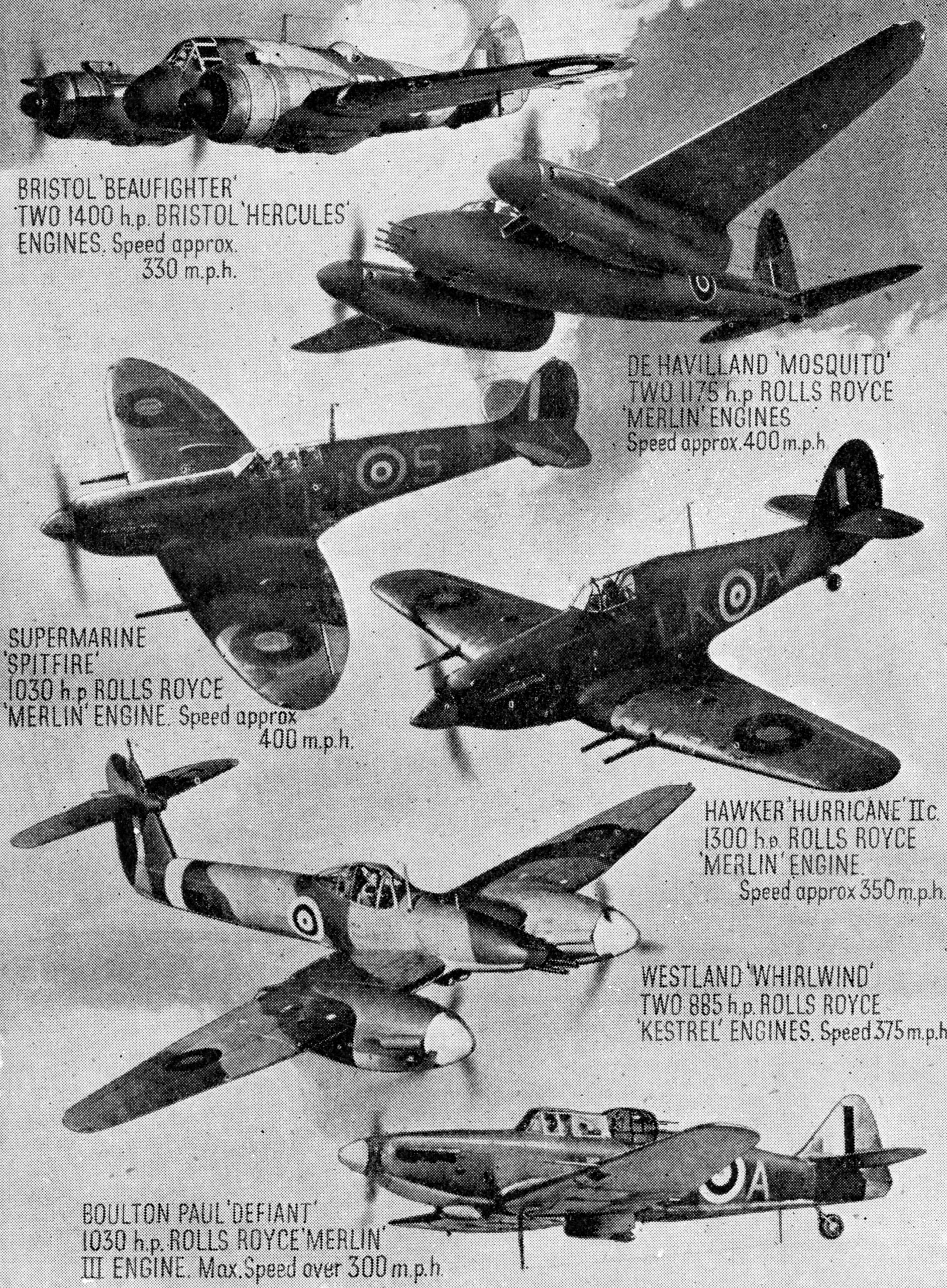
THE
WEAPONS OF FIGHTER COMMAND
Engine particulars and maximum
speeds of six types of fighter aircraft in service with the R.A.F. They
are all very heavily armed and, with the exception of the Defiant and
Hurricane IIc, have cannon as well as machine guns. The Hurricane IIc
has four 20 mm. cannon only. The Mosquito is a powerful long-range and
bomb-carrying fighter made entirely of wood
CHAPTER
6
Fighter
Aircraft of the R.A.F.
The Interceptor fighter. Fire
power, speed, climb and manoeuvrability. Wing loading. Streamlining.
Retractable undercarriages. Tricycle type. Cannon and machine guns.
Rate of fire. The reflector sight. Tracer ammunition. Construction of
wings and fuselage. Superchargers. Oxygen equipment. Flaps. Trimming
tabs. Adjustable-pitch airscrew. Contra-rotating airscrews. Gloster
Gladiator. Hawker Hurricane. Supermarine Spitfire. Messerschmitt 109E
and F. Focke-Wulf 190. Fiat C.R.42. Fiat G.50. Macci C.200. Long range
day fighters. Bristol Blenheim. Junkers Ju88. Breda 88. Beaufighter.
Mosquito. Messerschmitt 110. Night fighters. Plastics. Performance
details
IN
Chapter 4 we discussed the qualities necessary to produce the
ideal bomber aircraft and found that the designers were faced with a
number of conflicting requirements which had to be blended in a balanced
form. So it is with the fighter. The rival claims of speed and
manoeuvrability, for example, both of which are highly desirable, to
some extent conflict with each other. A gain in speed is usually at the
expense of manoeuvrability and vice versa, but the designer who is able
to mix these and any other desirable qualities, such as climb, armament
and so on in the best proportions will always produce an aircraft that
is infinitely better than that of his opponent.
CHANGES IN TECHNIQUE
The design of fighters since the art of flying was turned to the purposes
of war has undergone many changes. From frail, slow, poorly-armed
contraptions they have evolved into sturdy, compact and deadly weapons
of war with a terrific top speed and a huge fire power. They can ascend
to heights of seven or eight miles, they can dive at speeds of more
than six hundred miles an hour. The pilot can keep in constant
communication with his base and with other members of his squadron, he
is placed within visual distance of enemy aircraft by ground control,
and he can land blind in fog or darkness by means of the radio beam, an
important aeronautical development.
Fighter aircraft may be broadly classified under two headings. Those
that operate by day and those designed specifically for night
interception. When the war began, it was thought that the role of the
fighter was purely defensive and that the fast
single-seater aircraft which operated by day could also carry
out such night defensive work as the limitations of weather conditions
would permit. Very soon, however, both ideas had to be radically
changed. Once the Battle of Britain was over and the Germans began to
concentrate on night bombing, it was found that the attacking bomber
had many advantages in the dark over a small fighter. A special night
fighter had to be produced, while, with the R.A.F. reaching out towards
France, the need for an offensive fighter arose and from that need came
the development of the fighter-bomber and the low-level attacking
machines which are used for the shooting up of troops and
transport.
Even
so, however, the day fighter is still chiefly an interceptor fighter with
a comparatively short range in the neighbourhood of seven or eight
hundred miles. This means that it can only stay in the air for short
periods, about one and a half to two and a half hours. It has a very
high top speed, a great rate of climb, a high service ceiling and, in
comparison with its size, a devastating battery of guns. It is used
first and foremost to intercept and destroy enemy bombers, although it
is often employed for low-level attacks on enemy troop concentrations.
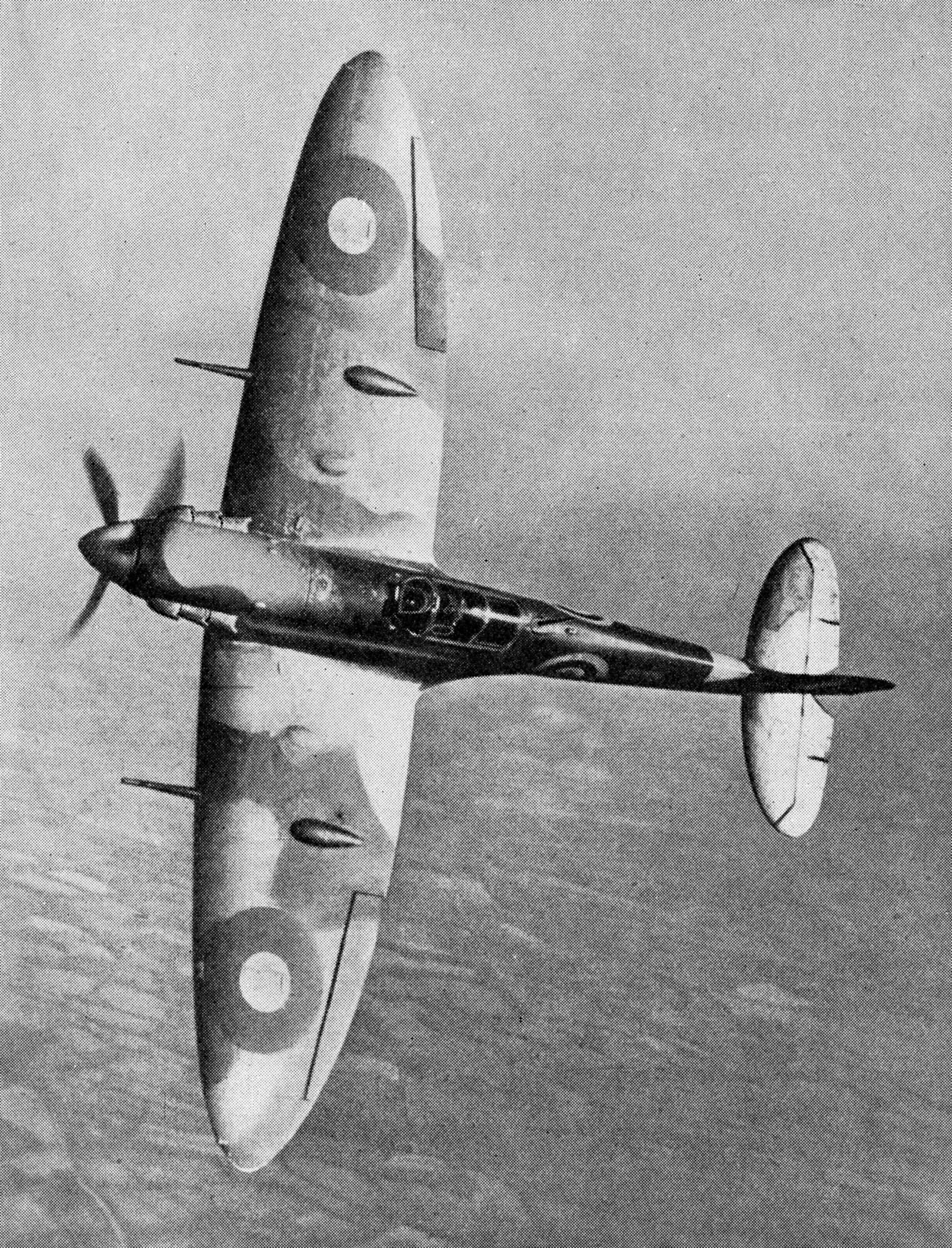
A
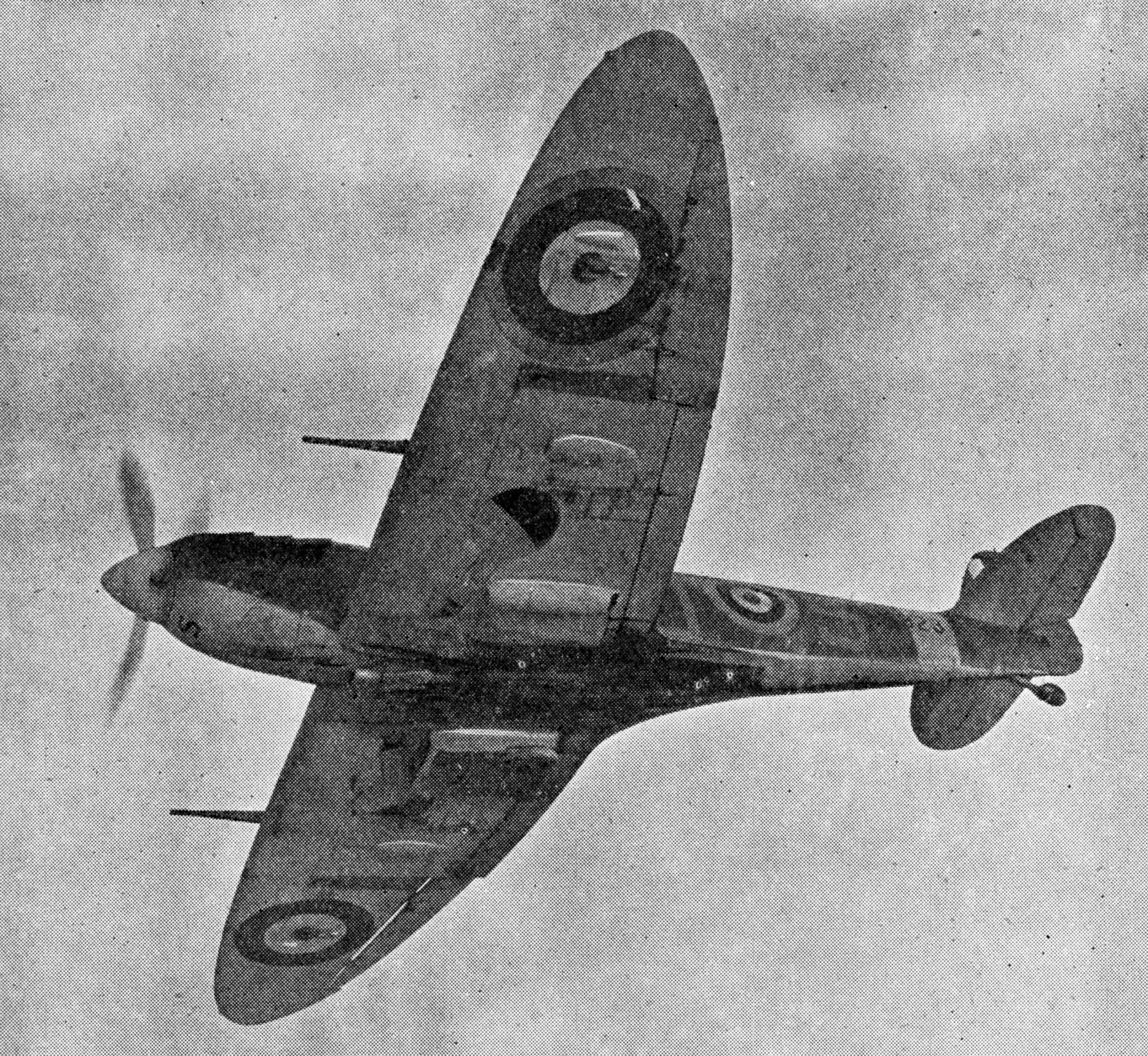
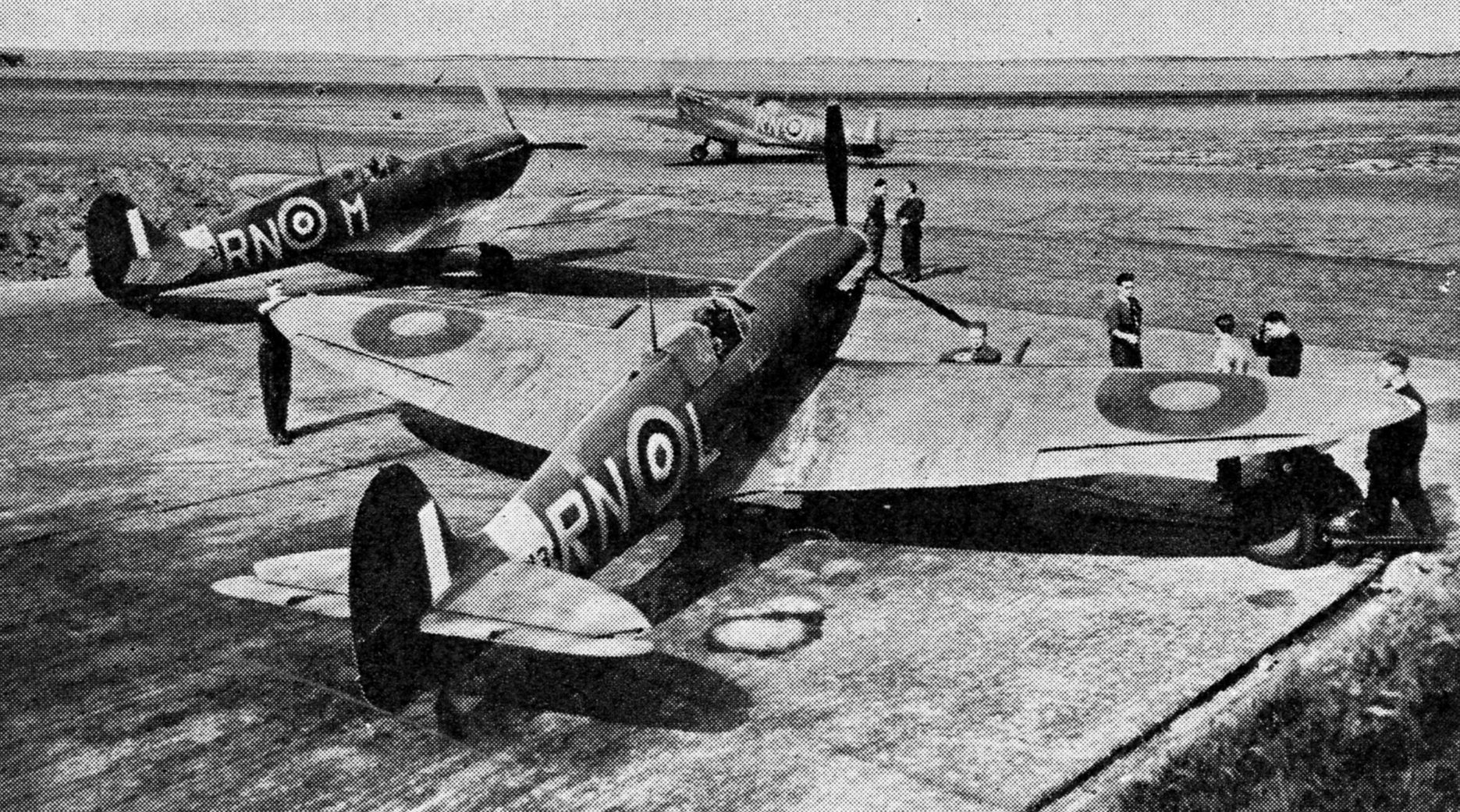
SPITFIRE, KING OF SINGLE-SEATER FIGHTERS
It
is generally acknowledged that the Vickers-Armstrongs Supermarine
Spitfire, with its magnificent lines and handling qualities, is the finest
single-seater fighter at present in service with any air force in the
world. The Mk I version had an armament of eight machine guns, four in
each wing, but later the Mk II and Mk V came into service armed with
two 20-mm. cannon and four machine guns. The Mk V illustrated above has
been fitted with a more powerful engine than the earlier models. A later
model, the Mark IX, is now in service
IDEAL REQUIREMENTS
The
interceptor has perforce to be a compromise between a number of ideal
requirements, and in different nations different weight has been placed
on these attributes. In Great Britain, for example, a very high degree
of importance is placed on armament, speed, climb and manoeuvrability,
in that order. Germany has put speed at the top of the list, with
climb, armament and manoeuvrability following. Italy, on the other
hand, put manoeuvrability first, followed by climb, speed and armament.
These remarks are, of course, generalisations only and do not coincide
exactly with the attributes of all the different types of fighter
aircraft belonging to these nations.
All these qualities,
however, cannot be included in maximum degree in a single aircraft.
Speed, for example, depends on high wing loading. Wing loading is the
gross weight of an aircraft divided by the area of the main planes and
ailerons. As an example, the Gloster Gladiator, a biplane which was
still in operational use when the war began, but which has long since
been superseded by newer and faster types, has a wing area of 323
square feet and a loaded weight of 4,750 pounds, giving a wing loading
of 14.7 pounds.
The higher the wing loading, however, the less
the manoeuvrability, so the designer must decide at the outset whether
his aircraft is to be extremely fast at the expense of manoeuvrability
or less fast and more manoeuvrable. It is interesting to note in this
connexion that the German Messerschmitt 109E with a wing loading of
31.4 pounds and a top speed of 354 miles per hour, usually came off
second best when opposed to the more manoeuvrable Hurricane with its
top speed of 335 miles per hour and wing loading of 23.3 pounds.
Now,
as regards climb. Like manoeuvrability this can be improved with a low
wing loading. Thus we get two factors, climb and manoeuvrability, both
dependent upon low wing loading and a third, speed, dependent on a high
wing loading, power being equal. We cannot here enter into a discussion
as to the sort of balance that should be struck between these
conflicting requirements, so we will content ourselves by pointing out
some of the advantages.
The need for speed is obvious. A fighter
is primarily designed to bring the enemy to combat, but if it cannot
catch him it is clearly of little use except, possibly, to scare him
away. Climb is important because the pilot who is above his foe always
has an advantage for he can dive down on his enemy and take full
advantage of the extra speed which such a dive will give him either to
continue or to break away from the combat.
MANOEUVRABILITY AND ARMAMENT
Manoeuvrability
in aerial combat is of considerable importance because the aircraft
that can turn quicker, or dive or bank or zoom quicker, can bring its
guns to bear on the target faster than its opponent, and that fact is
all important in fighter combat. Lastly, armament in a fighter aircraft
must be powerful because, however fast or manoeuvrable the aircraft may
be these attributes will avail little if, having manoeuvred his
aircraft into the best position to administer the knockout blow, the
pilot is prevented from doing so by inadequate gun power.
In
their quest for speed aircraft designers have been helped considerably
by the powerful engines that have been put into their hands. The latest
aero engines develop enormous power for their weight, and this is
responsible for the very high speeds that are common today.
TRICYCLE
UNDERCARRIAGE OF A HAVOC
Fig. 1.
Some of the fighter aircraft supplied to the R.A.F. by the U .S.A. are
fitted with tricycle undercarriages. With this type a nose wheel
replaces the more conventional tail wheel. Such undercarriages are
fitted to the Havoc, seen above, the Bell Airacobra, and to some bombers
RETRACTABLE UNDERCARRIAGES
Designers
have for years been experimenting with devices to increase speed
without affecting manoeuvrability, and one of the most successful means
by which they have achieved this is streamlining. Modern fighters are so
designed as to fly through the air with the minimum of resistance. All
projections likely to increase air drag have, wherever possible, been
eliminated; undercarriages have been made to retract into the wings;
all rivets are countersunk, and the whole exterior of the aircraft is
treated with special non-friction paint.
The retractable
undercarriage is an ingenious mechanism. It is operated by hydraulic
rams, and each leg with its wheel is made to retract either inwards,
outwards or backwards into wells built into the wings to receive it. On
one side of each leg is a fairing so that when the undercarriage is
retracted the whole assembly fits flush with the wing and offers little
or no resistance to the air. The pilot always retracts his
undercarriage as soon as the aircraft is airborne so as not to retard
acceleration. This is done by means of a lever in the cockpit, and a
dial on the instrument panel tells him whether the wheels are up or
down. In addition he has a warning buzzer which sounds should he
attempt to land with the undercarriage not properly lowered. The Air
Ministry insists that all such undercarriages have locks to fix them
securely in the up and down positions.
A recent innovation in
undercarriage design is the tricycle type. This is incorporated in
several types of aircraft built by the U.S.A., notably the Bell
Airacobra, the Lockheed Lightning and the Havoc. With this
type
there is no tail wheel. Instead a wheel is fixed in the nose. Aircraft
fitted with such undercarriages, therefore, are in the flying position
when standing on the ground, and amongst the advantages claimed for it
are quicker take off, shorter landing run, and a considerable lessening
of the danger of nosing over when landing (Fig. 1).
The armament
of interceptor fighters consists of machine guns, shell-firing cannon, or
a combination of both. In British types these guns are usually mounted
in the wings outside the area swept by the airscrew, and so arranged
that their fire converges some distance in front of and in line with the
aircraft’s nose. In some enemy aircraft interrupter gear is fitted which
enables the guns to fire through the airscrew, and in some cases the
cannon is so arranged as to fire through the airscrew boss.
The
number of- fixed guns that can be carried in the wings is limited by the
length of wing available outside the airscrew disc, by the structure of
the wings, and by the space occupied by the undercarriage when in the
retracted position.
The greatest number of machine guns to be
carried by any interceptor aircraft today is twelve, and six of these
guns are contained in each wing (Fig. 2).
As we have said,
Britain lays great stress on heavy armament. The earliest Spitfires and
Hurricanes, for example, carried four machine guns in each wing. These
had an effective range up to about three hundred yards, but their
combined weight of fire was devastating. Later, however, cannon were
fitted which had a longer range (Fig. 3), but machine guns, although
reduced in number, were still used. Later Spitfires carried two cannon
and four machine guns, whilst the latest Typhoons carry either four
cannon or twelve .303 machine guns.

TWELVE-GUN
HURRICANE
Fig. 2.
The greatest number of machine guns carried by any single-seater fighter
is twelve. These are to be found on the Mk IIb version of the
Hurricane, seen above. They have a maximum combined rate of fire of
14,400 rounds a minute, a devastating power of attack
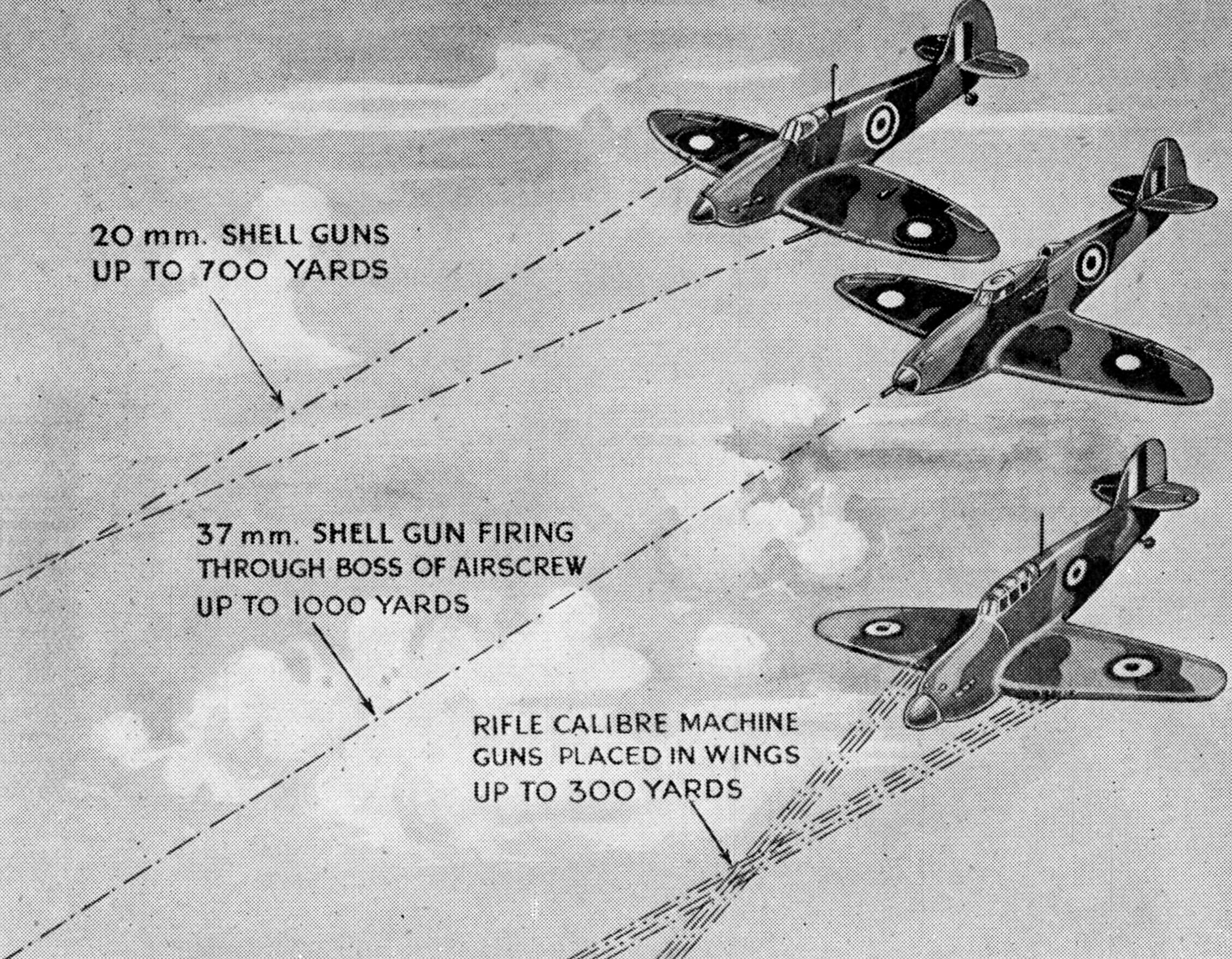
COMPARATIVE
RANGES OF CANNON AND MACHINE GUNS
Fig. 3.
Diagram illustrating effective ranges of 37-mm. cannon, 20-mm. cannon
and rifle calibre machine guns. The cannon fire explosive shells which
have a great power of penetration. The maximum rate of fire of a single
machine gun is about 1,200 rounds per minute
RATE OF FIRE
The
normal rate of fire of a single machine gun is about 1,200 rounds a
minute, and some idea of what this means may be gathered from the fact
that the twelve-gun Hurricane has a maximum rate of fire of 14,400
rounds a minute, giving a total weight of 360 pounds. The four cannon
version has a maximum weight of fire of 600 pounds per minute.
Normally,
the amount of ammunition carried by each gun in a single-seat fighter is
about 300 rounds. It will be realized therefore, that with their
tremendous rate of fire, the supply would run out in something like
fifteen seconds’ continuous firing. This, to the
layman, must sound inadequate, but it must be remembered that modern
fighter combat consists of considerable periods of manoeuvre with only
comparatively short bursts of firing. A two-second burst at the correct
range is usually sufficient to send the enemy down in flames. It is for
this very short period of firing that the whole design of the
interceptor is directed: the speed, the climb, the manoeuvrability are
only important in so far as they enable the aircraft to get into the
position from which it can fire its guns at the enemy.
With
modern machine guns placed as they are comparatively far away from the
pilot, it is impossible for him to attempt to clear any stoppage in his
guns. This was perhaps his biggest trouble during the war of 1914-1918
when the guns were placed well within his reach and frequently
developed stoppages through overheating or other reasons. The pilot of
today fires his guns by pressing a button on the control column and
trusts to the skill of the armourers that they will not let him down.
Fortunately, in spite of their tremendous rate of fire, they are
extremely reliable. Types of aircraft machine guns are illustrated in
Fig. 4.
The ammunition for the machine guns is carried on long
belts inside the wings (Fig. 5). That for the cannon is contained
either in large drums or on belts.
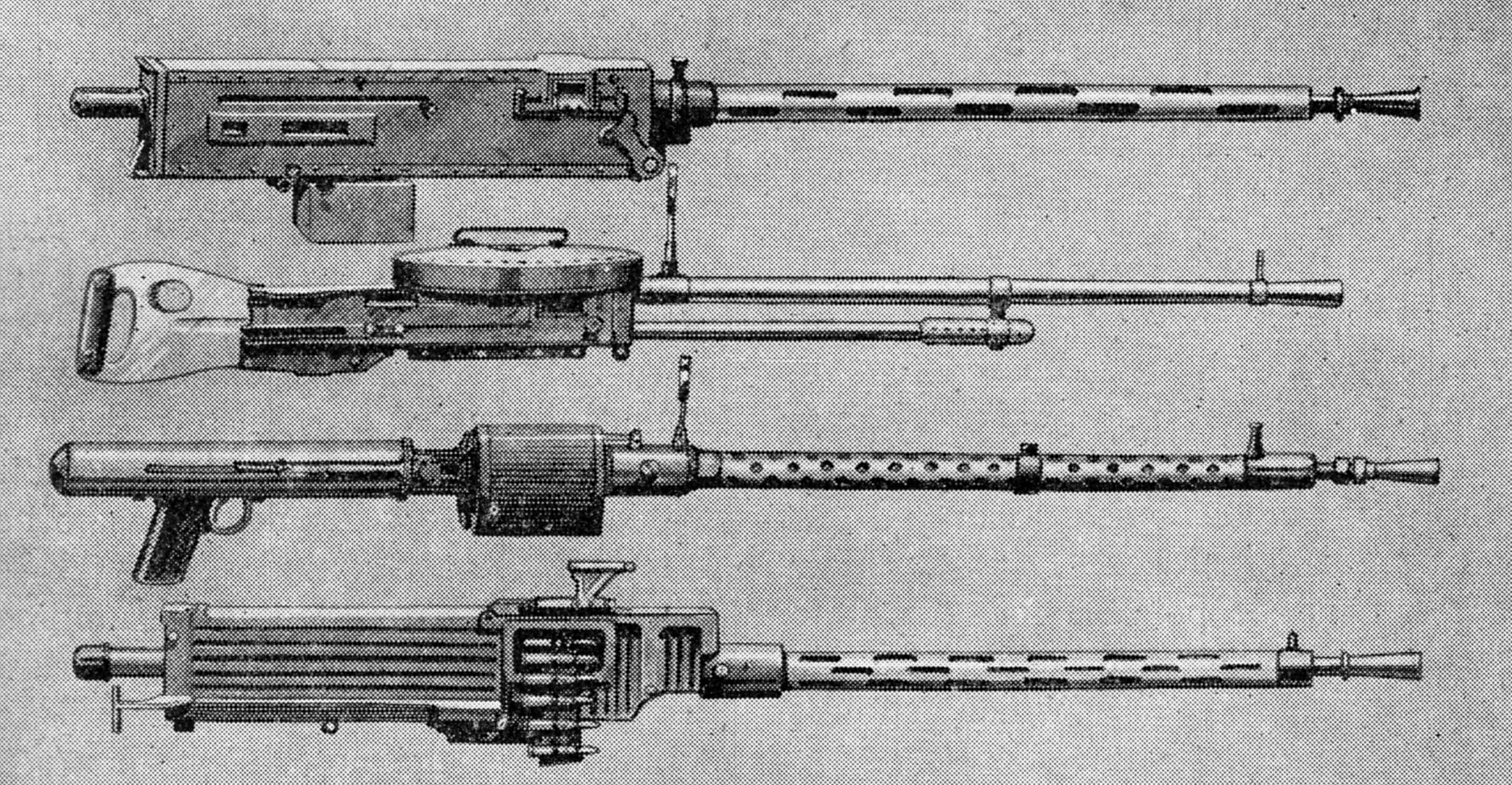
BRITISH,
GERMAN AND ITALIAN MACHINE GUNS
Fig. 4.
Top to bottom: Rifle-calibre Browning belt-fed gun, it has a rate of
fire of approximately 1,200 rounds per minute; Vickers’ drum-fed
observer’s gun; Rheinmettal-Borsig, Germany’s standard aircraft machine
gun which has a rate of fire of approximately 1,000 rounds per minute;
Breda belt-fed gun as used by the Italian air force before Italy
surrendered
RE-LOADING
A HURRICANE FIGHTER
Fig. 5.
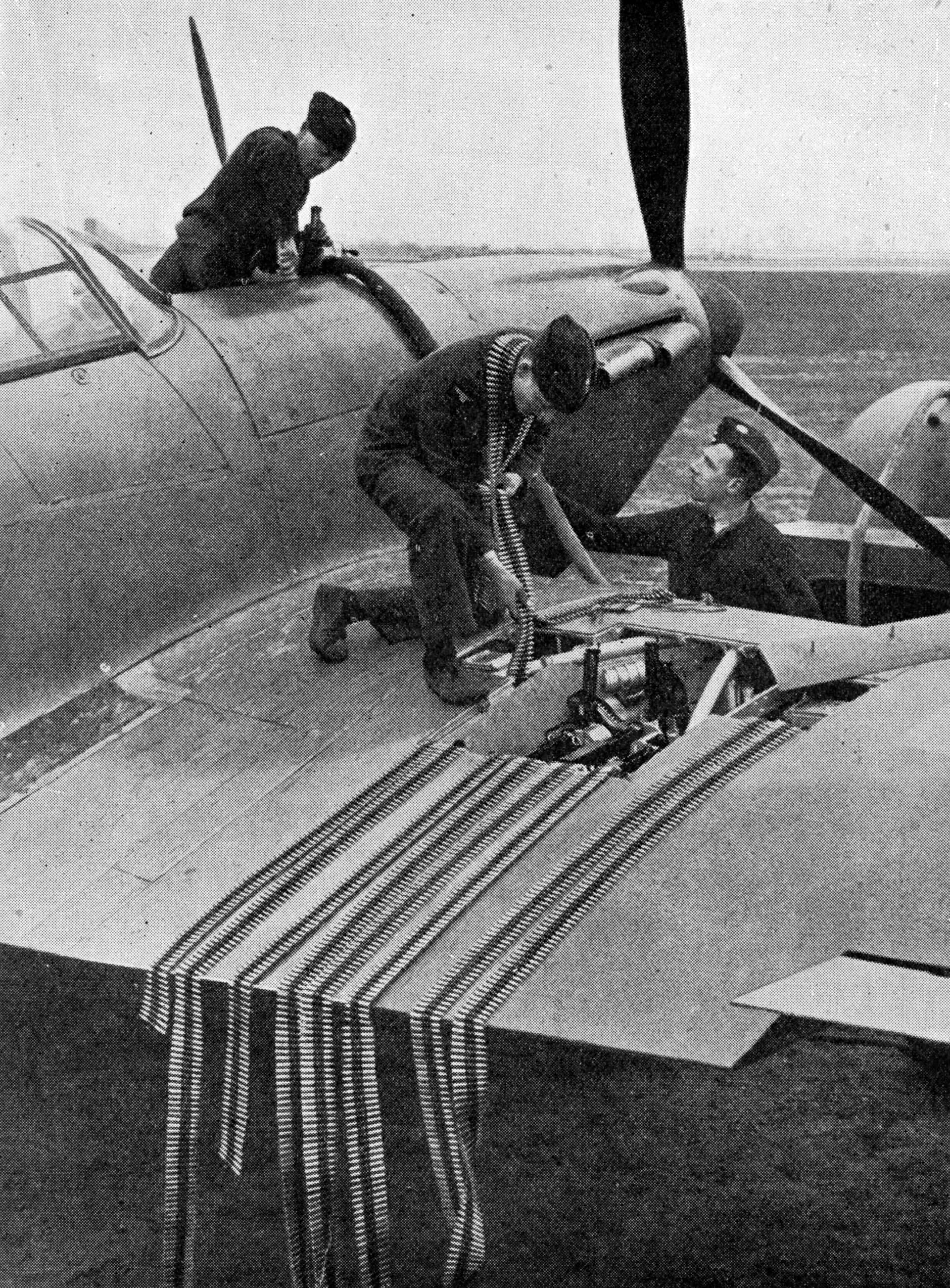
Ammunition for the machine guns of fighter aircraft is carried on long,
snakelike belts inside the wings. Above, a member of a Hurricane’s
maintenance crew is seen loading up, whilst two more are replenishing
the fuel tanks from a motor-driven tanker
When the
modern fighter pilot attacks an enemy aircraft he actually aims his
machine at his opponent and special sights have been evolved which are
a great improvement on those used in the last war. In those
days
the pilot had to look through a wire graticule to get his foresight on
the enemy. Later he looked through a long tube through which he would
see his opponent against an etched graticule in a glass lens. Nowadays
he has a reflector sight which throws up a reflected ring on to his
windscreen and considerably simplifies his task of watching his enemy
and, at the same time, avoiding collision with his friends in the heat
of the action.
Another aid to firing is the use of tracer
bullets and tracer shells. Normally, in machine guns at any rate, every
fifth bullet is a tracer. These bullets are visible to the pilot during
their flight and are of considerable assistance to him in determining
whether his fire is hitting or missing the enemy.
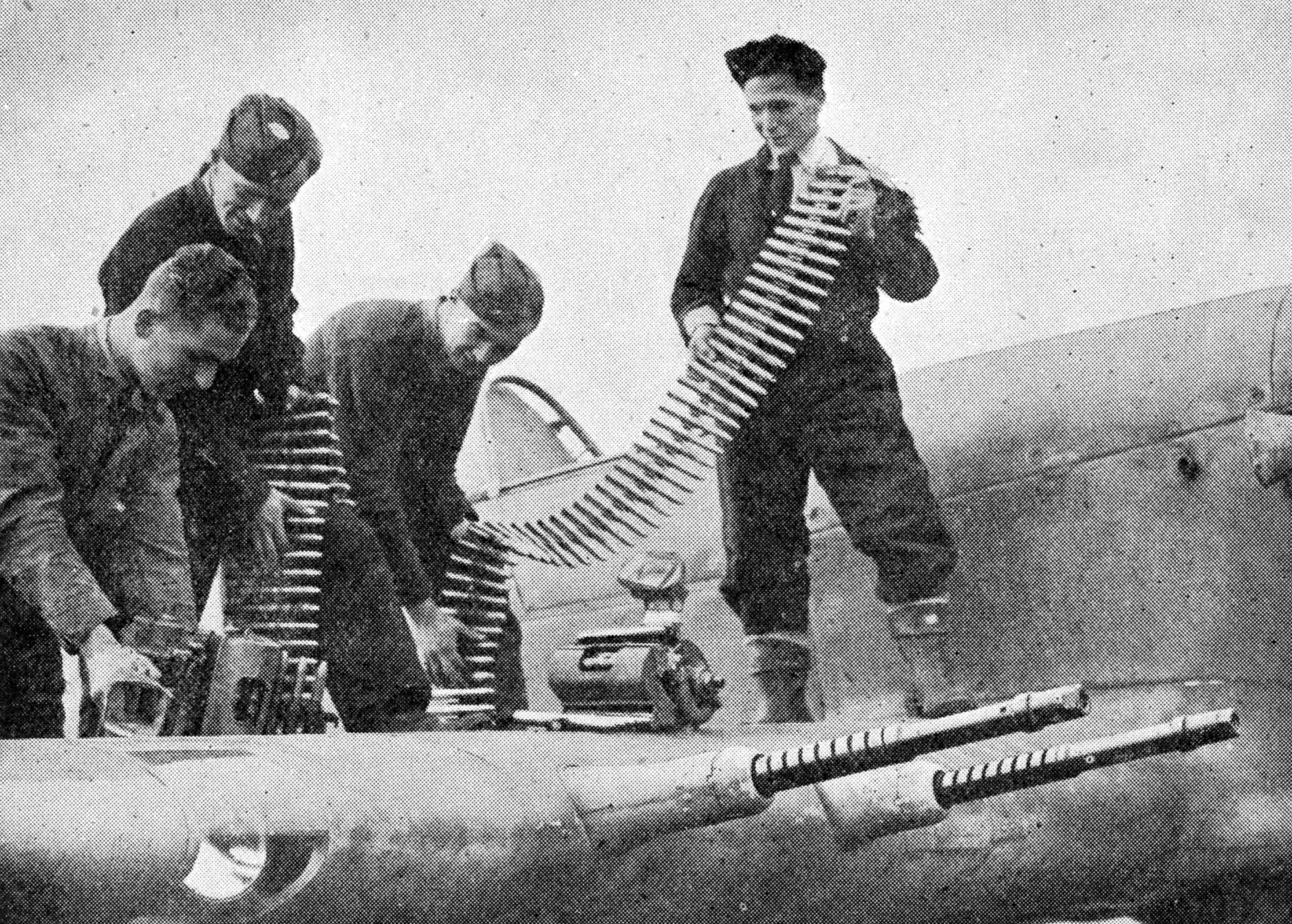
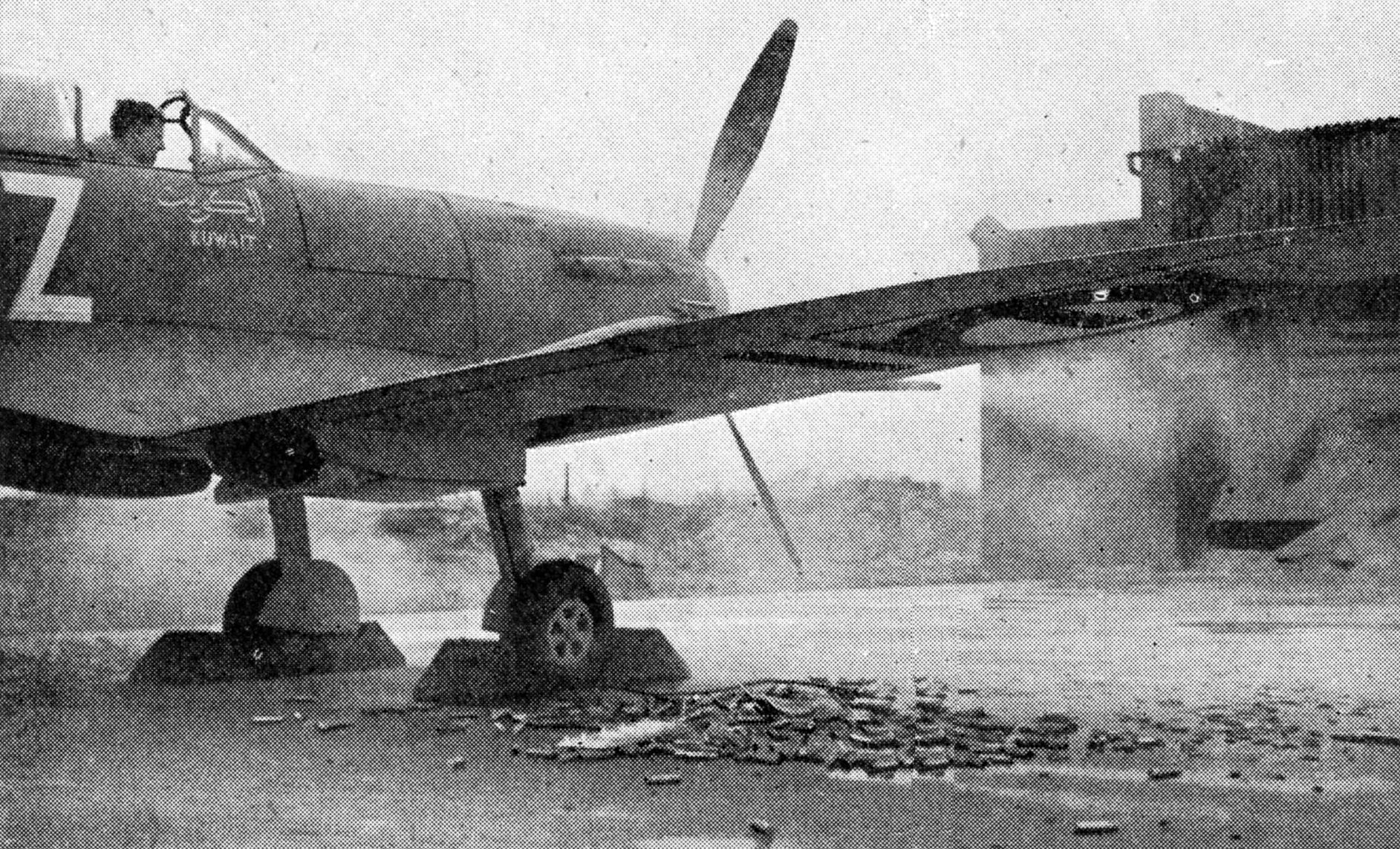
LOADING
AND TESTING 20-MM. CANNON
Cannon
shells are placed in belts which are rolled in drums. The machine shown
above is being equipped and is a four cannon Hurricane.
Most
modern fighters are of all-metal construction. The fuselage generally
consists of a framework of aluminium alloy and steel with a stressed
skin covering. The wings normally have high tensile steel spars with
aluminium alloy ribs. Everything possible is done to keep the weight
down to a minimum, and in recent years designers have been considerably
helped by the metallurgist in attaining this end. By taking an ounce
off here and a pennyweight off there, the designer has produced a
machine which uses every single horse power of its engine to the best
advantage. No unnecessary weight is carried, but strength is never
sacrificed at the expense of safety. It is interesting to note that a
comparatively heavy machine like the Hurricane, with all its equipment,
has a power loading of seven and a half pounds per horse power, a
remarkable tribute to the skill of its designers.
Fighters, like
other aircraft, are subject to certain limitations when flying at great
heights, and various devices are incorporated in their design to
overcome these difficulties. These limitations are brought about by the
drop in the density of the air as height increases, and besides
affecting the pilot, as explained in the next chapter, it affects the
engine also, so that most modern fighters must be fitted with at least
two-stage superchargers in order that they can maintain the highest
possible speed at the different heights at which action may be
necessary.
AIDS TO CLIMBING
These
superchargers come into operation at the selected height and tend to
compress the air to the same pressure as is experienced at ground
level, and maintain it at a greater density than the supporting air at
all altitudes. Without them it would not be possible for aircraft to
ascend to the very great heights, often in excess of seven miles, at
which action is necessary in modern war.
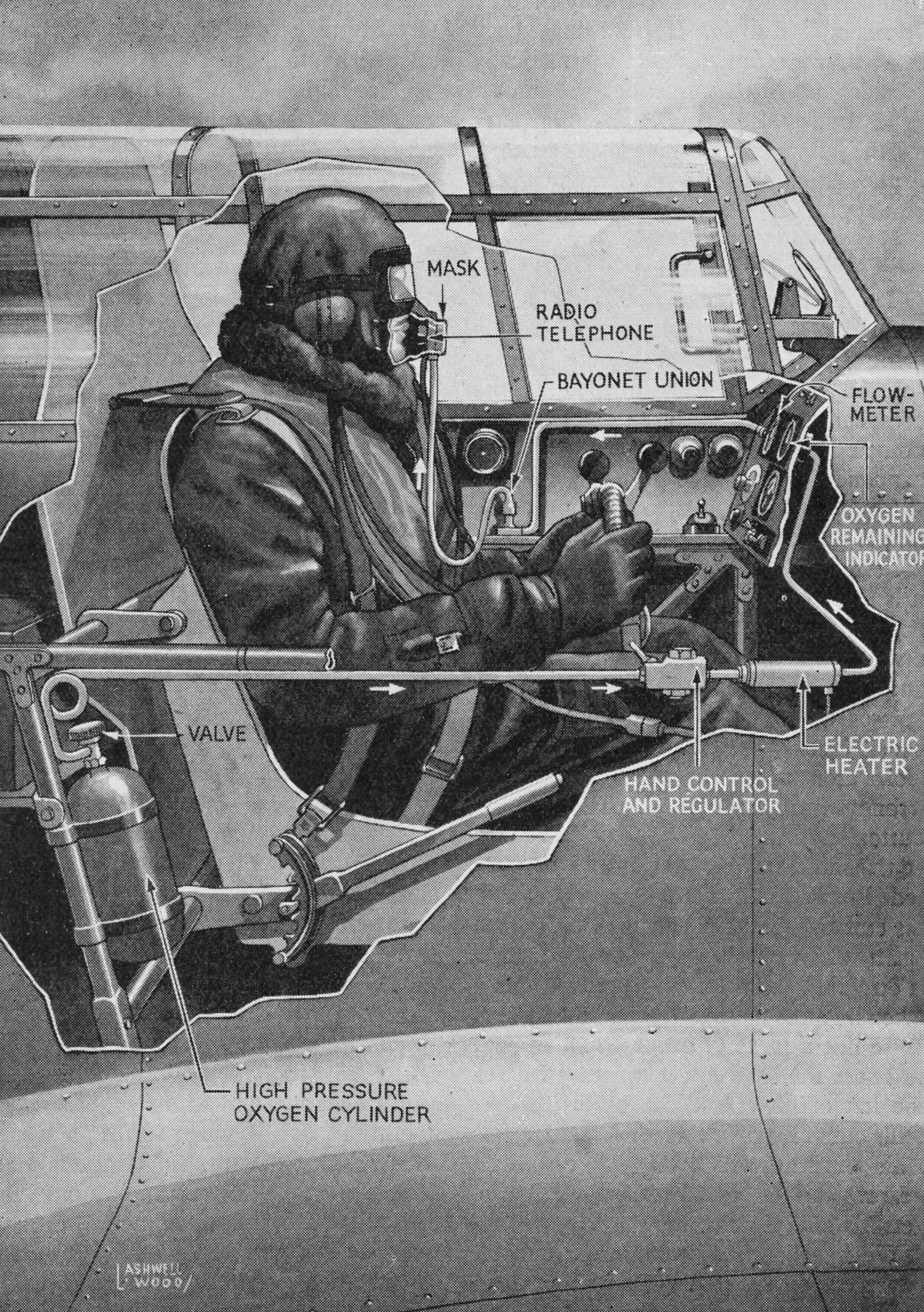
Height also makes it
necessary for fighters to carry oxygen equipment, for the rarefied air is
not sufficient to support life and the pilot must be supplied with
oxygen by artificial means. High pressure oxygen bottles are carried
behind the pilot and the gas is inhaled through a mask. In some types
of equipment the gas is inhaled through the mouth.
On account of
the high wing loading of modern fighters and their consequent higher
landing speed, they must be fitted with flaps. These are attached beneath
the trailing edges of the wings, and are brought into operation by a
lever in the pilot’s cockpit. Besides making slower landings possible,
they also make the angle of glide steeper, a considerable
advantage if a forced landing has to be made in a confined space.
Most
fighters are fitted with trimming tabs which are adjusted at varying
speeds. An increase or decrease in speed tends to raise or lower the
nose of the aircraft. Unevenly disposed loads can also produce the same
effect. To counteract this a pilot would have to exert pressure
backwards, forwards or sideways on the control column if he had no
trimming tabs. Therefore trimming tabs are mechanical aids to save the
pilot undue exertion. These are fitted to the ailerons, rudder and
elevator, and they take the weight of the aircraft off the controls so
that the pilot can fly hands off.
Then there is the
adjustable-pitch airscrew which is fitted to most types of interceptors.
In this type of airscrew the blades are constructed so as to swivel,
and their grip on the air can thereby be adjusted. This is desirable so
that the most efficient engine and airscrew revolutions can be obtained
at the same time under varying conditions of flight. The variable-pitch
airscrew (Fig. 6) solves this problem. It has been suggested that by
reversing the pitch of the airscrew it would act as a brake, but this
idea has not yet been adopted.
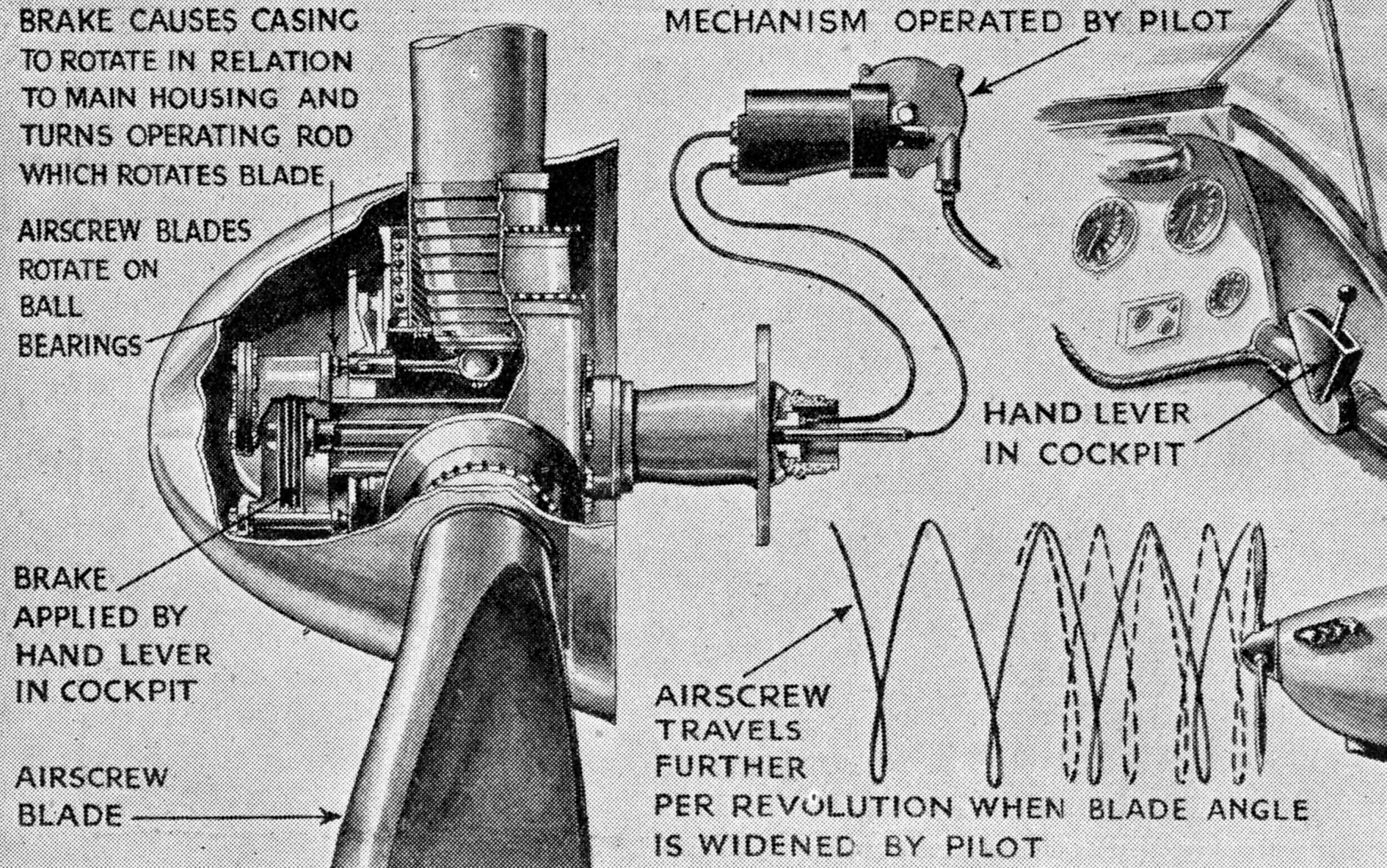
PRINCIPLE
OF THE VARIABLE-PITCH AIRSCREW
Fig. 6.
Diagram showing how the blades of a variable-pitch airscrew
can be
adjusted by the pilot so that the most efficient engine and airscrew
revolutions can be obtained
The
question of having two airscrews on the same engine, each rotating in
different directions, is being experimented with for use on fighter
aircraft. It is claimed that such an airscrew will dispense with the
inconvenient effect of torque, that is, the tendency of the aircraft to
twist in the opposite direction to that in which the airscrew is
rotating, that it will assist take-off and will allow of a reduction in
the diameter of airscrews. It is claimed that the contra-rotating
airscrew would also considerably increase the performance of fast
aircraft at high altitudes (Fig. 7).
CONTRA-ROTATING
AIRSCREWS
Fig. 7.
Aircraft fitted with three-bladed contra-rotating airscrews. It is
claimed that such airscrews, amongst other things, increase the
performance of aircraft at high altitudes
The
interceptor fighter nowadays has to carry a special type of short-range
wireless transmitting and receiving set. This is a vital piece of
apparatus through which the pilot can communicate with
his squadron and with his base. In
addition some
nations fit their fighters with blind landing equipment that enables them
to land in foggy weather on a radio beam. Some nations also fit their
fighters with radio compasses which enable them to “home” on any radio
station. Britain, however, does not adopt this device but relies upon
the pilots obtaining their course as the result of a “fix” on a signal
sent out by them and located by two or more ground stations. This will
be explained in some detail in the chapter on navigation. All fighters,
of course, have magnetic and gyro compasses.
PILOT’S
COCKPIT OF A SPITFIRE
Fig. 8. 1, Gun sight; 2, gun-sight
mounting; 3,
artificial horizon; 4,
rate of climb indicator; 5,
revolution counter; 6,
brake lever; 6a,
turn indicator; 7,
gun button; 8,
control column; 9,
air-speed indicator; 10,
oil and fuel pressure gauges; 11,
engine-boost gauge; 12,
oil and radiator pressure gauges; 13,
fuel gauges; 14,
rudder bar; 15,
light switch; 16,
emergency pump for operating undercarriage if automatic mechanism fails
to function; 17,
undercarriage selector lever; 18,
pilot’s seat; 19,
recognition lamp switch; 20,
radiator-flap control
INSIDE THE COCKPIT
To
look into the cockpit of a fighter and see the multiplicity of
instruments which these devices entail, together with the various
controls and instruments which enable the engine’s performance to be
watched, gives one seriously to wonder how the pilot can find time to fly
his aircraft, much less to fight the enemy. Fig 8 shows the inside of a
Spitfire’s cockpit.
Enough
has been said to show what a complicated masterpiece of engineering and
design the modern interceptor fighter is. It represents the result of
years of experiment, and the fact that so much gear and equipment can
be compressed into so small a space makes the achievement all the more
wonderful.
Let us now take a look at some of the different types
of interceptor fighters which have been, and are being, used by the
warring powers and see how they compare.
GLOSTER
GLADIATOR FIGHTER
Fig. 9.
The Gladiator, last of Britain’s biplane fighters, saw much service in
Norway and Africa. It has a top speed of 250 miles per hour and a
service ceiling of 32,800 feet
We will start this
survey with the Gloster Gladiator (Fig. 9) as it shows more than
anything the change that has come about in fighter aircraft since the
war began. It is a biplane and is now obsolete, but it was an extremely
manoeuvrable little machine with a top speed of 250 miles per hour, a
service ceiling of 32,800 feet and an armament of four machine guns. It
operated in Norway in 1940 and although working under very difficult
conditions, achieved success against Heinkels and Dorniers encountered.
It also saw considerable service against the Italians and Germans in
the North African campaign.
HAWKER HURRICANE
The
Hawker Hurricane (Fig. 10) is probably the most versatile fighter in use
by any country. Together with the Spitfire it was primarily responsible
for the crushing defeat of the Luftwaffe in the autumn of 1940. The Mk
I version has a top speed of 335 miles per hour, a ceiling of 31,000
feet, and an armament of eight machine guns firing through the leading
edges of the wings clear of the airscrew. It is slightly
slower
than the German Messerschmitt 109, but considerably more manoeuvrable,
especially in combat.
HAWKER
HURRICANE
Fig. 10. Details
of layout of the Hurricane Mk I fighter. It is bigger than the Spitfire
and not so fast, but is extremely manoeuvrable. The later versions have
a heavier armament and are sometimes equipped to carry bombs. The
drawing is reproduced here by the courtesy of the “Illustrated London
News”
When small, light single-seat fighters open fire,
unless the burst is a very short one, the effect of the guns
firing
makes it very difficult for the pilot to keep the target in his sights.
The Hurricane, however, which is large for its class, is a very steady
gun platform, a fact which contributes greatly to the destructive
effect of its guns.
The Hurricane pilot has armour plate behind
his head and back which gives him good protection from attack. The
petrol tanks are self-sealing.
The Hurricane Mk IIb is a
faster plane than the Mk I and has a better ceiling. It is armed with
twelve machine guns. The IIc (Fig. 11) has four 20-mm. cannon only,
which slightly reduce its top speed.
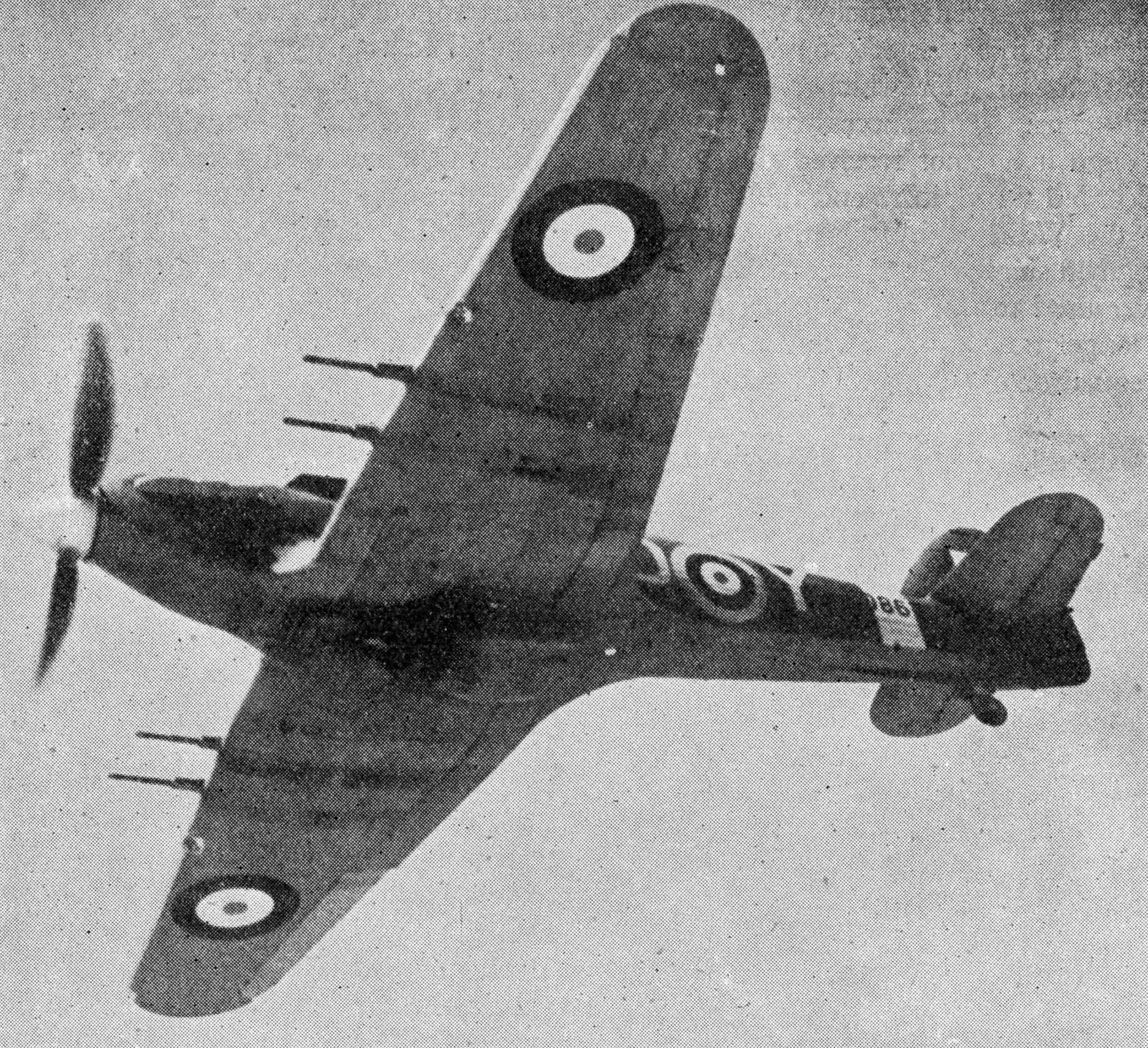
HAWKER
HURRICANE Mk IIC
Fig. 11.
This aircraft is armed with four 20-mm. shell-firing cannon mounted, as
shown, in the wings. It has an inwards-retracting undercarriage, a
central radiator, and straight tapered wings. Like the Spitfire, it is
powered by a Rolls Royce Merlin liquid-cooled engine
The
IIc has made a speciality of attacking enemy coastal shipping and flak
ships and its devastating weight of fire has been sufficient to sink or
set fire to quite large ships. The Hurricane Mk IIb has also been used
with marked success as a fighter-bomber. This version carries two
250-lb. bombs, one under each wing outboard of the undercarriage. These
are fitted with delayed action fuzes and are dropped from a very low
altitude.
SPITFIRE
Mk V
Fig. 12.
This aircraft may be distinguished from the Hawker Hurricane by its
elliptical wings. Other points of difference are its
outwards-retracting undercarriage and radiator under the starboard
wing. It is armed with two 20-mm. cannon and four machine guns, two in
each wing
CONSTRUCTIONAL
DETAILS OF THE SPITFIRE
Fig. 13.
Diagram showing main features of the Spitfire. This aircraft was
developed from the seaplane that won the Schneider trophy for Britain,
and was first flown early in 1936. It is a low-wing cantilever monoplane
with a span of 36 feet 10 inches, a length of 29 feet 11 inches and a
height of 11 feet 5 inches. The undercarriage retracts outwards and is
equipped with an emergency device for lowering the wheels
should
the automatic system fail. A warning buzzer in the pilot’s cockpit
tells the pilot if the undercarriage has not been properly lowered and
locked in position. Split flaps are fitted beneath the trailing edge of
the wings between the ailerons and the fuselage. These are indicated,
but not shown in the drawing
VICKERS-ARMSTRONG SUPERMARINE
SPITFIRE
The
Spitfire (Figs. 12 and 13) with its magnificent lines and handling
qualities is almost certainly the world’s finest single-seat fighter. The
original version, the Mk I, was armed with eight machine guns, but
later the Mk II and Mk V came into service armed with two 20-mm. cannon
and four machine guns. There is now a Mark IX which is a still greater
improvement on the original model. The armour is just the same as that
of the Hurricane.
The Mk I Spitfire had a speed of 370 miles per
hour and a ceiling of about 36,000 feet. The later versions with their
more powerful engines and other refinements have a better ceiling and a
maximum speed which is probably a good deal in excess of 400 m.p.h.
Another
fighter which has been used with considerable success by the R.A.F.,
though it has not received the publicity accorded the Spitfire and the
Hurricane, is the Whirlwind. It is the only twin-engined single-seat
fighter the R.A.F. has ever used to equip its squadrons. It has a longer
range than the Spitfire and once a squadron of Whirlwinds acted as
fighter escort to bombers as far as the Dutch coast. The two 850
horse-power Rolls Royce engines make the aircraft exceedingly fast.
Four 20-mm. cannons are fitted in the nose and latterly two bombs have
been carried outboard of the engines. The use of the Whirlwind has,
however, been restricted to special purposes.
The Typhoon, about
which for security reasons very little can yet be said, has also just
come into operational use by the R.A.F. It is a larger, grown-up
brother of the Hurricane and was designed by the same man, Mr. Sidney
Camm. It is powered by the Napier 2,400 horse “Sabre” engine and is
credited with a speed of more than four hundred miles an hour. It is
said to be very sturdy in construction and a steady gun platform. It
was first known that it had become operational after a daylight raid on
south-east London by F.W. 190 fighter-bombers, when a squadron of
Typhoons chased the raiders back to the coast and shot down five. It was
then announced that Typhoons had also had a share in providing the air
“umbrella” cover at the time of the Dieppe Commando raid.
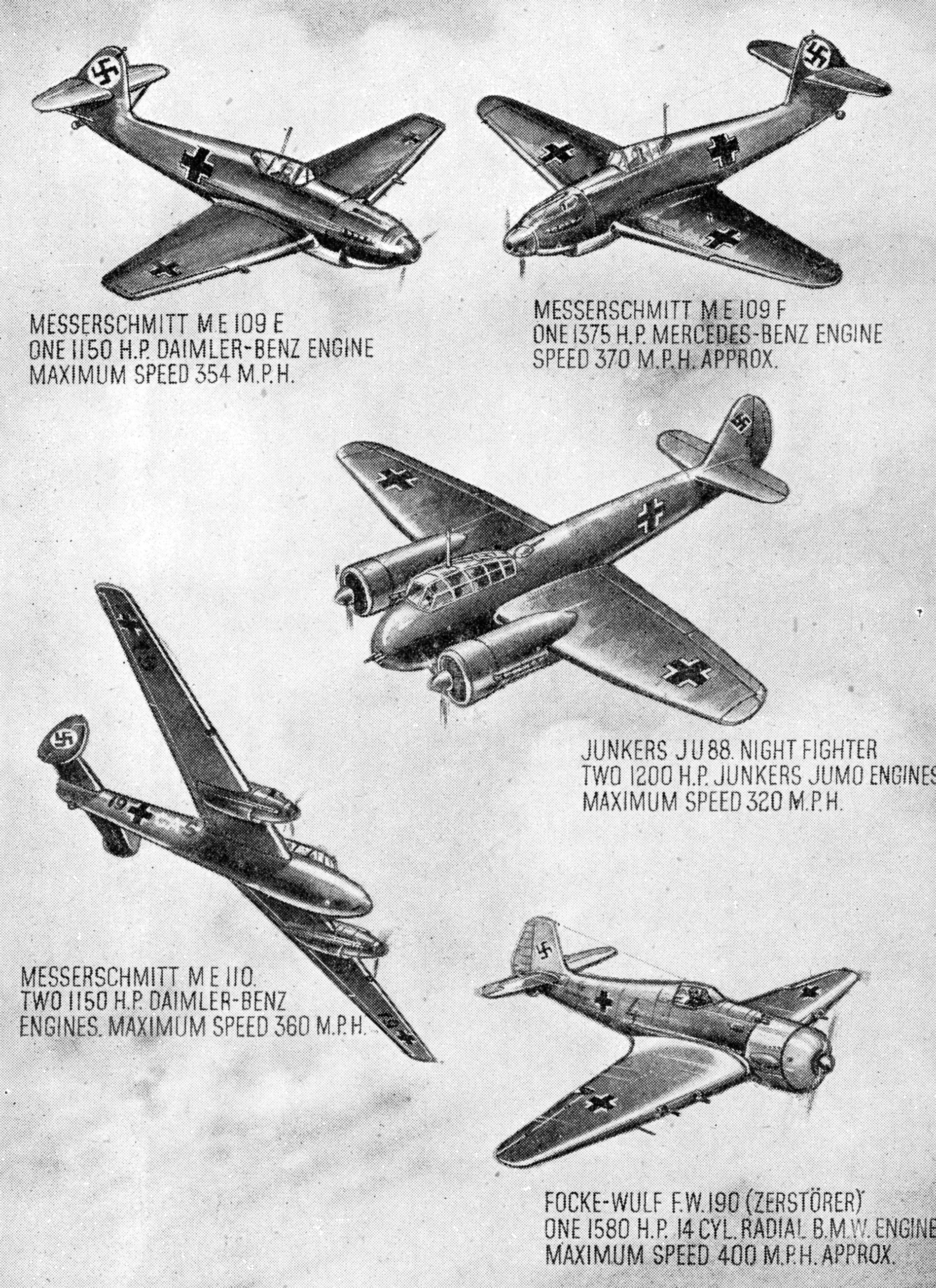
GERMAN
FIGHTER AIRCRAFT
Fig. 14.
Engine particulars and top speeds of five types of single- and
twin-engine fighter aircraft in service with the Luftwaffe. The Junkers
88 is a modified version of the dive bomber, and is used mainly as a
night fighter. All these types are fully described in the text
The
Germans have two interceptor fighters in the Hurricane-Spitfire class.
These are the Messerschmitt 109 and the Focke-Wulf 190. The
Messerschmitt, like the Hurricane, has been used for a variety of
purposes and there have been two models, 109E and 109F (Fig. 14).
Designed in the first place as an interceptor fighter, it was used for
escort work and also for low level bombing operations.
The 109E
has a top speed of 354 miles per hour and a ceiling of 36,000 feet. The
armament consists of two .300 machine guns mounted on the engine
crankcase and synchronized to fire through the airscrew, and either two
20-mm. cannon or two .300 machine guns, one in each wing.
In
combat with British aircraft several characteristics are noticeable.
The 109E seems to have difficulty in executing a climbing turn to the
right. So a climbing turn to the right is often used by British bombers
when attacked by these aircraft.
When attacked by fighters the
109E pilots invariably go into a steep dive because when the stick is
pushed violently forward, the engines on aircraft fitted with
carburettors will cut out for a second or two and then pick up
again. Owing to their petrol injection device the engines of the 109E
do not do so, and the extra second they gain by what might be termed
their “crash dive” helps them considerably in their efforts to get away.
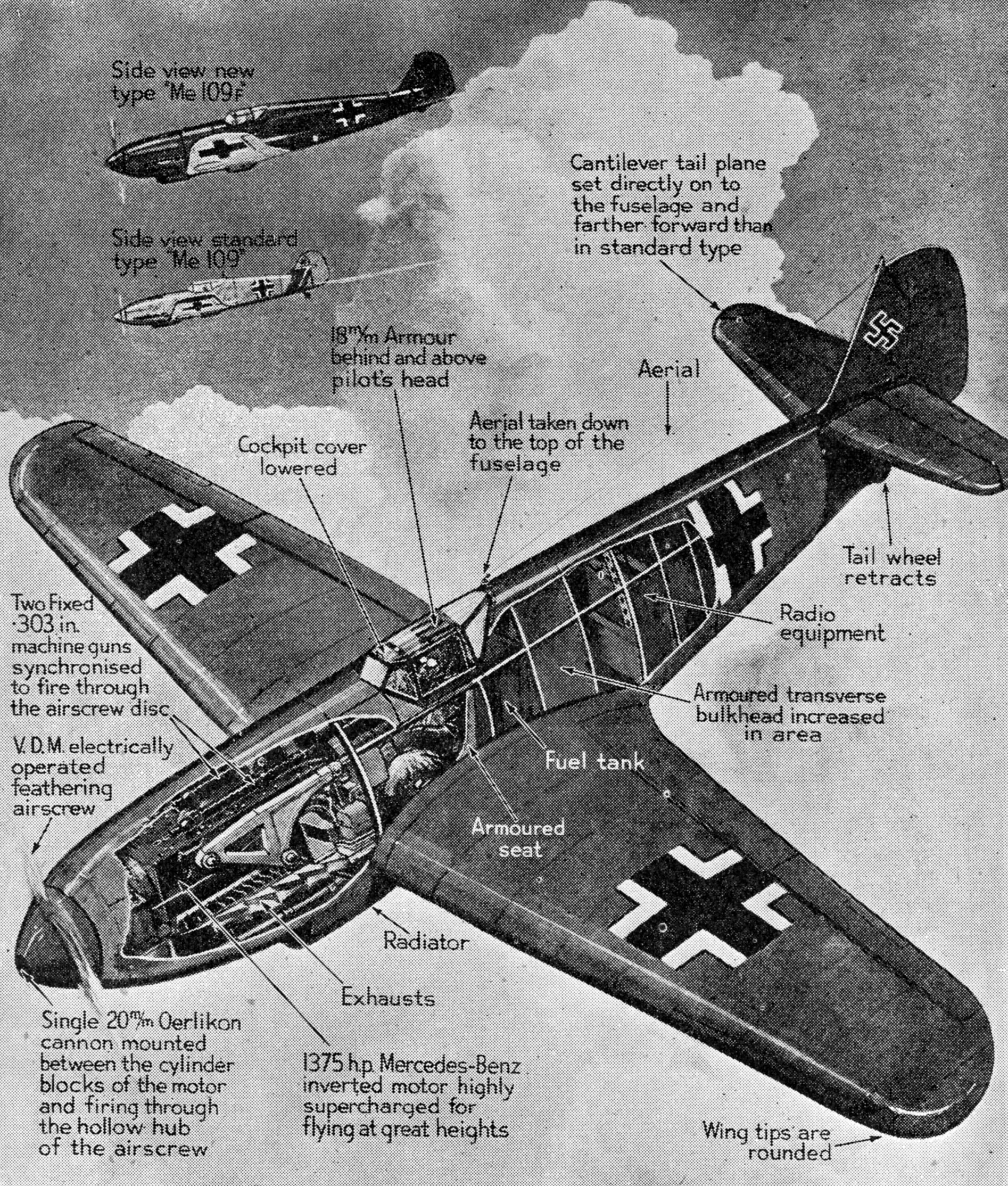
GERMANY’S
FAMOUS ME. SINGLE-SEATER FIGHTER
Fig. 15.
Diagram showing main features of the Messerschmitt 109F. It is an
improved version of the 109E, the main changes being the removal of
bracing struts from the tail plane and the extension to the wings,
which now have rounded tips. The performance is better than that of the
109E. Drawing reproduced by courtesy of the “Illustrated London News”
The
109F (Fig. 15) is a modified form of the 109E. The main differences in
appearance are the lack of bracing struts on the tailplane and the
extension to the wings which instead of having square tips are now
elliptical in shape. The general appearance of the aircraft is
now
much more like the Hurricane. The power of the engine has been
increased and the whole performance of the aircraft improved. Its top
speed is about 370 miles per hour and the service ceiling 38,000 feet.
The armament of this German fighter has been reduced to one 20 mm.
cannon firing through the airscrew boss, and two machine guns which are
synchronized to fire through the airscrew.
This aircraft is a
good high altitude flyer and has replaced the 109E. Its performance now
more nearly equals the latest version of the Spitfire, but these
improvements have only been achieved by a reduction in fire power and
the Spitfire Mk V with its two cannon and four machine guns has a big
advantage.
The
Focke-Wulf 190 was a surprise to the R.A.F. when
it was first used by the Germans from their bases in Northern France. It
has a radial air-cooled engine and it was thought to be a Curtis Hawk,
supplied by America to the French Air Force and captured by
the
Germans when they occupied France. Its appearance in increasing numbers
and closer acquaintance with it, however, soon disabused the British
pilots and they found that it had a fine turn of speed and a good rate
of climb. It was outmanoeuvred by the Spitfire in straight dog-fights all
the same and the Germans began to use it more for diving on straggling
fighters with reliance on
its climbing abilities to get it out of trouble. A model was soon
captured intact by the R.A.F., overhauled and flown by British test
pilots. They found that it had a wing loading of 42.3 lbs., a climb
rate of 3,200 feet at 17,500 feet and a speed of 375 miles an hour at
18,000 ft. The engine was a 14 cylinder B M W radial of 2,000 horse
power. It was armed with four 20-mm. cannon and two machine guns of
7.92 calibre. The machine guns were arranged to fire through the nose.
There was a bomb rack beneath the fuselage for a 250 lb. bomb, and
latterly the aircraft has been used as a sneak night bomber.
In
addition, Germany experimented at one time with the Heinkel 113,
developed from the aircraft which set up the landplane record in 1939.
It was reported to have a top speed of about 400 miles an hour, but it
was not encountered much by the R.A.F. and apparently never got over
its initial teething troubles sufficiently to go into mass production
for operational use.
ITALIAN
FIGHTER AIRCRAFT
Fig. 16.
Engine particulars and maximum speeds of seven Italian types used
against the United Nations before Italy surrendered unconditionally.
None of these could compare in speed or armament with their British and
German counterparts, but they were very manoeuvrable
Very
little need be said about Italian fighters used against us before Italy
surrendered. Even in the Middle East, before we had Spitfires and
Hurricanes out there, our bombers were able to give a good account of
themselves when they met Italians and it was stated at the end of 1942
that production of Italian designed aircraft in Italian factories was
to cease, the works being turned over to the erection of German troop
carriers and transport under the guidance of German technicians.
FIAT C.R.42
Some
Italian types of fighters are, however, illustrated in Fig 16. Unlike
the British and the Germans, the Italians had not concentrated upon one
or two types, but had built altogether something like ten different
fighters, none of which was in the same class as their British or German
counterparts. The Fiat C.R.42, for example, was a biplane with
a
top speed of 272 miles per hour and a service ceiling of 32,800 feet.
It was an improved version of the C.R.32 and was almost exactly the
same size as the Gladiator. It was not so manoeuvrable, however, and
had a poor armament of two machine guns firing through the airscrew as
against the Gladiator’s four guns. It was used a great deal in the
Middle East and in Greece where it was found to be of little hindrance
to British bombers and an easy opponent for the Gladiator.
Another
product of the Fiat company was the G.50 monoplane fighter which had a
top speed of 299 miles per hour and a ceiling of 30,000 feet. The pilot
sat in an enclosed cockpit aft of the trailing edge of the wings. The
armament was two fixed machine guns firing through the airscrew, and the
pilot had no armour protection. It was generally thought to be
unsuccessful and it had probably gone out of production by the time
that Italy surrendered.
MACCHI C.200
Probably
the best of the Italian single seater fighters was the Macchi C.200 and
its later development the 202, seen in small numbers over Malta at the
height of the attacks on the George Cross island in the summer of 1942.
It had distinctly better lines than the G.50, but even so, its
performance was poor in comparison with British fighters. It was smaller
than the Spitfire and easily recognizable by its radial engine and the
humped appearance of the fuselage. The pilot’s cockpit was on top of
the hump and he had an excellent view. Its maximum speed was 313 miles
per hour and its service ceiling 30,000 feet. Like other Italian
fighters its armament was poor consisting of one .5 and one .3 calibre
gun, both mounted in troughs in the top of the fuselage and firing
through the airscrew. In accordance with general Italian practice it
was equipped to carry small bombs of about 2 lb. in weight. The Macchi
202 conformed to modern British and German practice in as much as it
was fitted with a liquid-cooled in-line engine.
To sum up briefly,
the special qualities of the day interceptor are very high speed and
rate of climb, high service ceiling and heavy armour. The day fighter vis-à-vis enemy
fighters and not against bombers, requires a high standard of
manoeuvrability as well. In such fighters the power to turn in a smaller
circle than one’s enemy while maintaining height is of enormous
importance. It enforces on the opponent the need to break off the
combat because if the circling match is continued for long theaircraft
with the smaller turning circle will inevitably get on the tail of its
opponent.
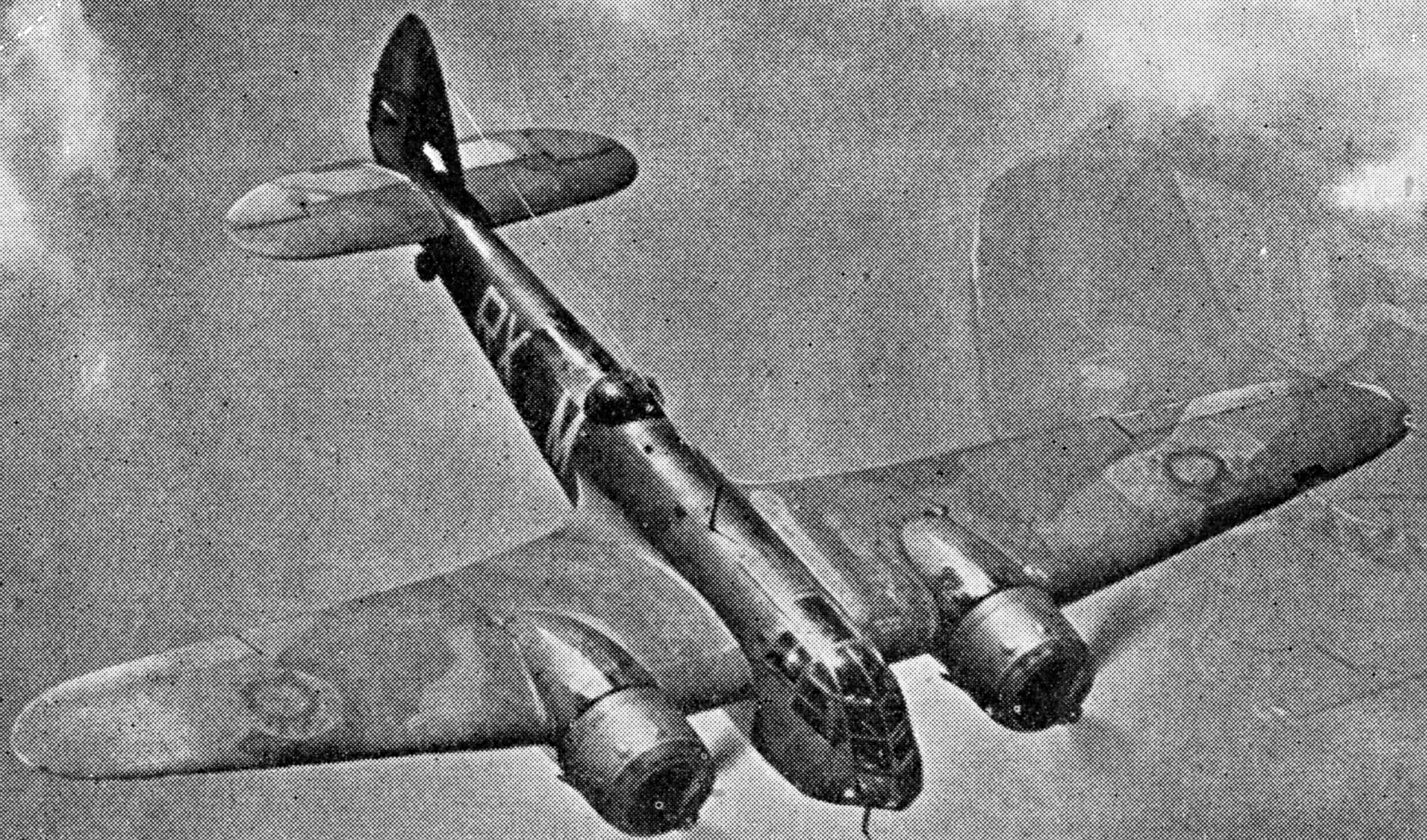
SHORT-NOSE
BLENHEIM
Fig. 17.
Bristol Blenheim Mk I fighter-bomber. It is powered by two 840 h.p.
Mercury engines, has a top speed of 285 miles per hour and a range of
1,125 miles. When used as a fighter it is armed with four additional
machine guns under the fuselage and one machine gun in a Bristol power
operated retractable turret on top of the fuselage. It carries a crew
of three
The long range
aircraft whose duty it is to escort bombers and, on occasion, make
surprise attacks on its own well behind the enemy lines on
concentrations of transport and troops, to shoot up and bomb small
bridges over rivers and viaducts carrying important railway lines is
also a day fighter. This type of fighter tends to resemble the night
fighter in its design and lay-out much more than does the simple
interceptor. It is almost invariably a twin-engine machine so that it
has power to counteract the extra weight that has to be carried to give
it long range fuel supply. The pilot usually has a navigator or gunner
flying with him, not so much for the purpose of firing the guns but to
reload them and attend to all the many details of wireless and course
finding, map reading and to give him an extra pair of eyes to pick out
targets by day and search the blackness of the sky by night. In modern
practice, the guns or cannon of a long range fighter are fixed so as to
fire straight ahead of the machine as in an interceptor.
Long
range fighters are also equipped with most of the devices of the
interceptor, flaps, oxygen equipment, and so on, but in addition
frequently carry direction finding apparatus as well. The retractable
undercarriages, instead of folding into the wings, generally retract
backwards into the engine nacelles, and the airscrews, in some cases,
rotate in opposite directions in order to counteract the effect of
torque. The speeds of these fighters, because of their design, were
lower in the aircraft that did duty for the first year or so of the war
than those of the interceptors, but modern machines such as the
Beaufighter and, particularly, the Mosquito are incredibly fast.
The
three long-range fighters of Britain, Germany and Italy which most
closely corresponded when the war began were the Blenheim, the Junkers
88 and the Breda 88. These three aircraft each had their special
characteristics in which they excelled each other. The Blenheim was the
slowest, but had the longest range and was very manoeuvrable (Fig. 17).
It was used either as a day bomber or long range fighter and is still
operational on some of the lesser fronts and for special purposes.
There are two versions, the Mk I, which is known as the short-nosed
Blenheim and the Mk IV, or long-nose version. The Mk I is ten miles per
hour slower than the Mk IV, having a maximum speed of 285 miles an hour
at 15,000 feet as compared with a so far undisclosed speed for the
Mosquito, but one probably a hundred miles an hour faster. The ceiling
for both versions of the Blenheim is about 27,280 feet. The Mk I
version has a range of 1,125 miles. and the Mk IV, fitted with extra
fuel tanks in the wings, a range of 1,900 miles.
The Blenheim
was the first modern high speed bomber to be produced for Britain, and
has certainly been one of the most useful aircraft. It has been used
for almost every type of operation, coastal reconnaissance, long
distance reconnaissance, attacks on shipping, day and night bombing,
day escort fighting and night fighting, and it has fulfilled all these
duties magnificently. These duties remain. Later types merely carry them
out more efficiently, having been specially designed because of
the
lessons learned.
Here we will only deal with the Blenheim when
it is employed as a fighter. Both long-and short-nose versions have been
used for this purpose.
The Mk I carries a crew of three; pilot,
navigator and air gunner, the last being in a semi-retractable power
operated turret on the top of the fuselage. The Mark IV has extra
petrol tanks fitted in the wings to give it extra range and carries a
crew of three, the navigator’s position being in the extended portion
of the nose. Besides the pilot there is also a wireless operator-rear
gunner in the turret.
The armour and armament on both the
versions are the same. The armour consists of an armoured bulkhead
across the whole width of the fuselage behind the pilot and observer’s
seats, and armour in the nose of the front of the pilot’s instrument
panel. The armament consists of five fixed .303 machine guns, four in a
mounting under the fuselage and one in the port wing outboard of the
engine, and one or two free machine guns in the power operated turret.
Remotely controlled guns fire rearward from a blister immediately under
the nose.
The Blenheim is a very pleasant aircraft to fly and for
its size one of the most manoeuvrable twin engined aircraft in the
world. It can be flown quite comfortably on one engine and can take an
almost unlimited amount of punishment.
The Junkers 88 is a low
wing monoplane and is similar in all respects to the Junkers 88 A1
bomber with the exception of the nose which is all metal, cone shaped
and similar in appearance to the Beaufighter’s. The power plant consists
of two 1,200 h.p. Junkers Juno engines which give it a
probable
top speed in excess of 320 miles per hour, and a probable range of
1,500 miles. Although its ceiling is not definitely known it is likely
to be in excess of the Junkers 88 bomber, which has a ceiling of 30,000
feet. Following general German practice the accommodation is cramped,
provision being made for a crew of three in that part of the fuselage
forward of the front spar.
This aircraft is used mainly as a
night fighter to intercept enemy aircraft over their own aerodromes. It
is painted completely black and is comparable for size with the Havoc
which has been used by the R.A.F. for the same purpose.
The
usual armament is one 15-mm. high velocity shell cannon and three rifle
calibre machine guns, all fixed in the nose to the right of the pilot on
a level with his feet. These guns occupy the space used in the bomber
version by the bomb aimer. In addition there are twin upper rear guns
on a spherical mounting, and the single lower rear gun is in a blister
beneath the fuselage. The number of guns carried seems to vary with
individual aircraft, some having only one above and one below the
fuselage.
BREDA 88
The
Italian counterpart to the Blenheim and the Junkers 88 was the Breda
88. It was powered by two 1,000 h.p. Piaggio air-cooled radial engines
that gave it a top speed of 321 miles per hour. It had a 1,100 miles
range and a ceiling of 27,000 feet.
When used as an escort
fighter it normally carried a crew of two. It was somewhat similar in
side and plan view to the Lockheed Hudson, the distinctive features
being the large engine nacelles beneath the wings and kidney-shaped fins
and rudders. The normal armament consisted of three fixed .5 in. bore
machine guns in the nose, the rear gunner having a .300 bore free
machine gun. Provision was also allowed for the storage of bombs.
Compared
with the fighter Blenheim, the Breda 88 was faster but much less
manoeuvrable and had a smaller range. The armament about equalled that
of the Blenheim, three heavy bore fixed machine guns as compared with
five .303 machine guns. The Breda 88 was certainly the best all-round
aircraft the Italians had.

BRISTOL
BEAUFIGHTER
Fig. 18.
The Beaufighter is a larger aircraft than the Blenheim, having a wing
span of 58 feet and a length of 40 feet 11 inches. It is powered by two
1,400 h.p. Bristol Hercules engines and has a top speed in excess of
320 miles per hour. It is heavily armed with cannon and machine guns
and carries a crew of two. It has achieved great success as a night
fighter
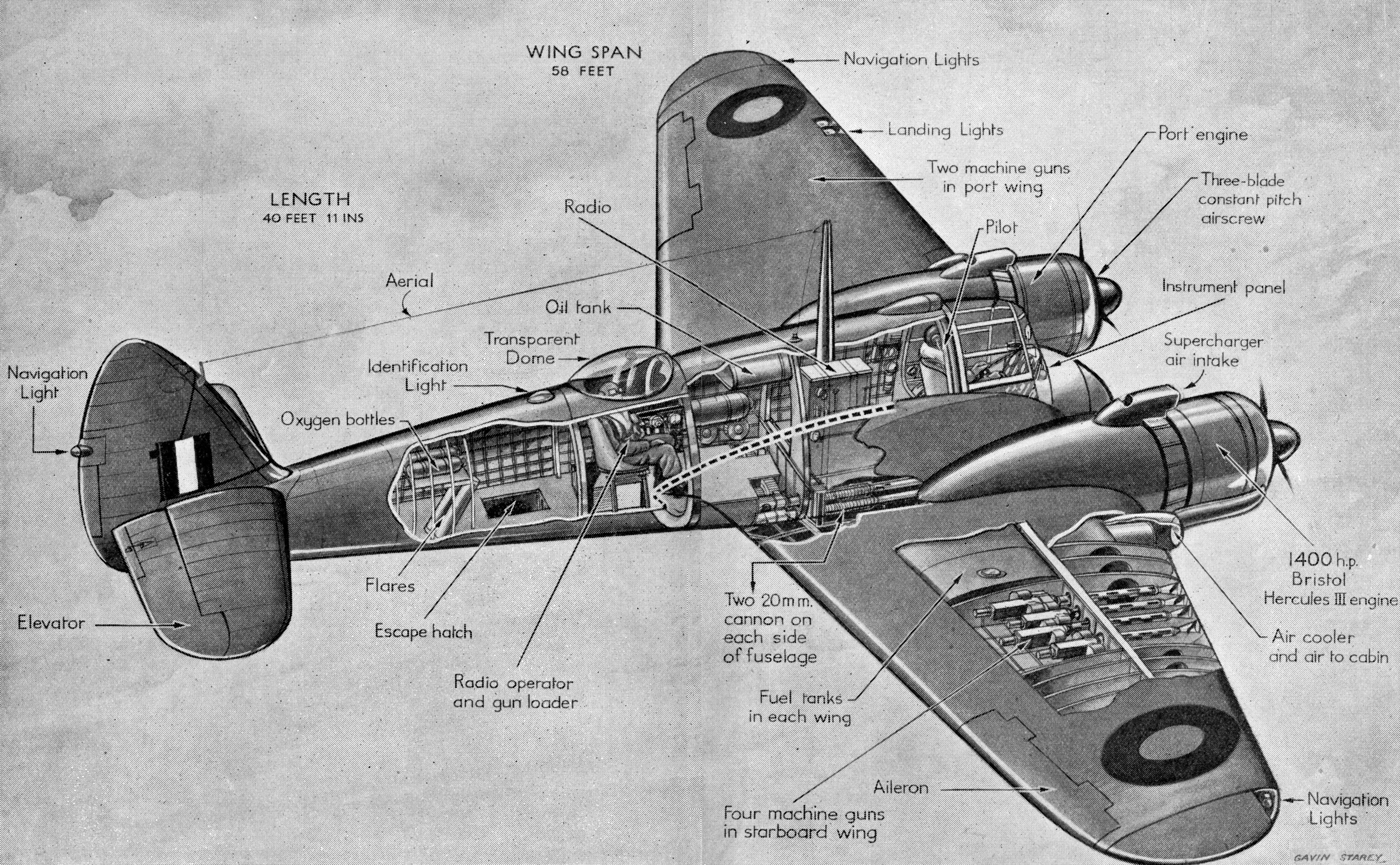
THE
BRISTOL BEAUFIGHTER, BRITAIN’S DEADLY TWIN-ENGINE FIGHTER
Fig. 19.
Drawing of the principal parts of the Bristol Beaufighter twin-engine
two-seat fighter. This aircraft is a mid-wing monoplane powered by two
1,400 h.p. Bristol Hercules III engines which give it a maximum speed
of about 330 miles per hour. It is the most heavily armed fighter at
present on active service in the world, having four 20-mm. cannon
mounted in the nose below the pilot and six machine
guns in
the wings outboard of the engines. Plentiful supplies of ammunition are
carried, and the loading is done by the second member of the crew who
sits behind the pilot. The “Beau,” as it is known in the R.A.F., is
larger than the Blenheim and is easily recognizable by its short nose
and large protruding engines
BRISTOL BEAUFIGHTER
The
Beaufighter (Figs. 18 and 19) is a product of the Bristol Aeroplane Co.,
and is in a class by itself because of its very heavy armament and high
speed. It is a mid-wing monoplane powered by two Bristol Hercules
radial engines which give it a top speed well in excess of 300 miles
per hour. Particulars of range and ceiling are still secret. It is the
most powerfully armed fighter at present on active service in the world,
having four 20-mm. cannon mounted in the nose below the pilot and six
machine guns in the wings outboard of the engines. The pilot has a
selector switch and can fire either the machine guns or the cannon
separately, or both at once. Plentiful supplies of ammunition are
carried, and the loading is done by the second member of the crew who
sits beneath an astrodome behind the pilot. The effect upon another
aircraft of this terrific fire power has to be seen to be believed. No
aircraft, however heavily armoured, can stand up to it, and with
accurate shooting a target generally blows up or falls to pieces within
a few seconds, often before the crew have had time to use their
parachutes. More than one Beaufighter has come back to its base damaged
after an engagement because it has been hit by flying debris from the
machine it had attacked and “blown to pieces.”
The “Beau,” as it
is called, is larger than the Blenheim and is easily recognizable by
its short nose and unusually large, protruding engines. It is
difficult to compare the “Beau” with any enemy aircraft. The nearest
comparison would be a cross between the Junkers 88 and the Me 110, but
it is faster than the 88 and heavier than the 110.
Beaufighters
have been used mainly for night fighting where they have done more
damage than any other aircraft, but they have also been used with great
success by Coastal Command and for long range fighting in the Middle
East.
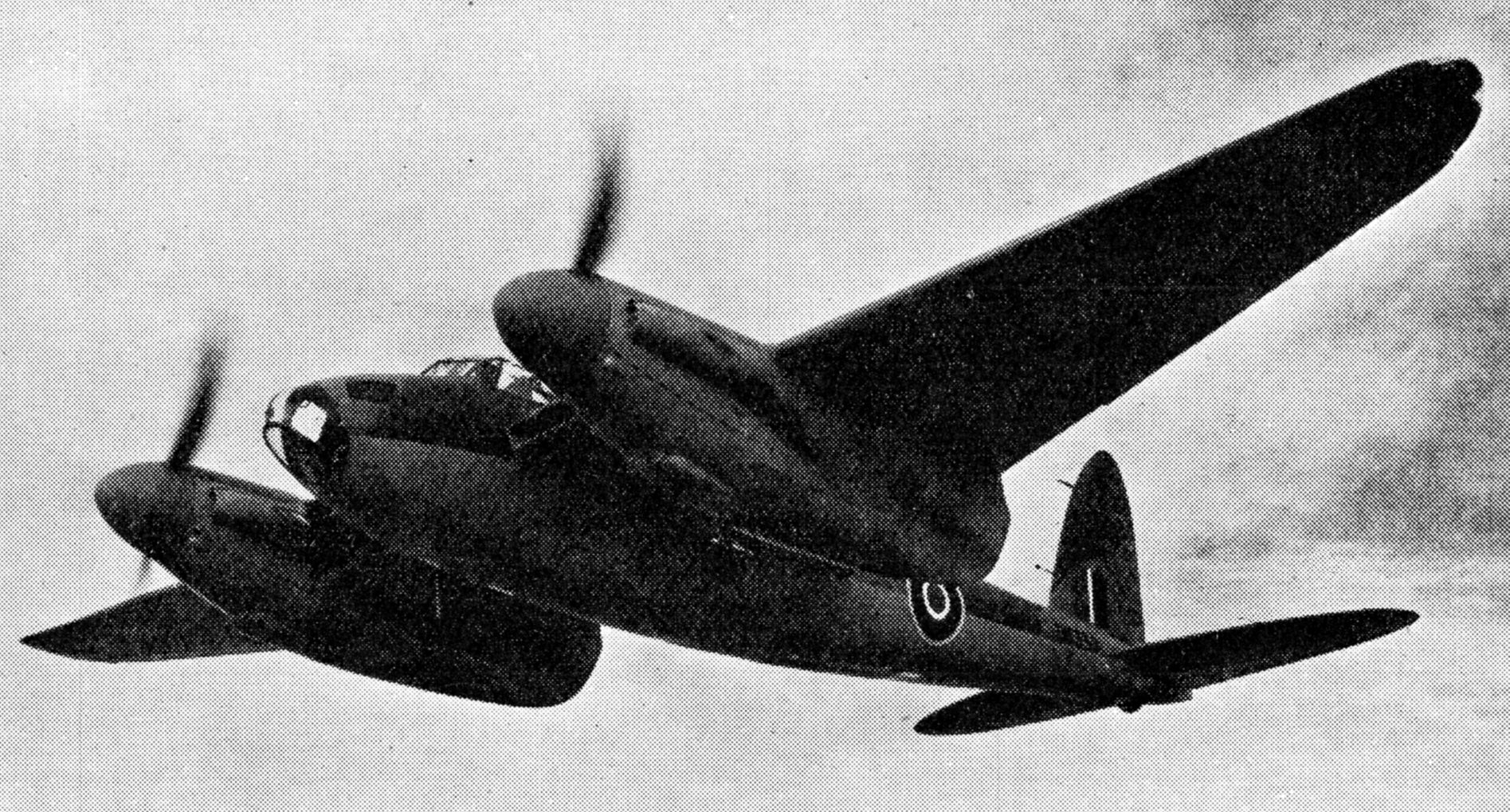
DE
HAVILLAND MOSQUITO
Fig. 22.
The famous Mosquito twin-engined long range fighter or bomber.
Constructed of wood, it has a maximum speed of well over 400 miles per
hour. Its wing span is 54 feet 2 inches and its length is 40 feet 9½
inches. It is powered by two Rolls Royce Merlin engines and its
offensive armament usually consists of four 20 mm. cannon and four .303
machine guns
MOSQUITO
Little
can be said about the Mosquito at present except that it has been
disclosed as being operational both as a day bomber and fighter (Fig.
22). It has bombed Berlin and Oslo as well as places in Holland, which
gives some idea of its range. It is in operation as a long range fighter
from Malta. It has a wing span of 54 feet 2 inches, a length of 40 feet
9½ inches and is armed with four 20 mm. cannon and four .303 machine
guns. Its power and speed come from two of the latest type Rolls Royce
engines. It is made entirely of wood, a reversion to earlier practice
which came as a surprise when it was first announced. The use of wood
had meant a great saving in weight and, curiously, wood does not burn
so freely as the metal in some of the stretched skin constructions. Or,
perhaps it would be more accurate to say that it does not break up so
quickly under the stress of furious heat. The Mosquito, designed and
built by the de Havilland Company, is a development of the twin engined
“Comet” which won the England to Australia race when piloted
by C.
W. A. Scott and T. Campbell Black. The pilot and observer sit side by
side in the nose, where the cannon are carried.
The Germans have
attempted to produce an aircraft equivalent to the Mosquito by
developing the Me110 and bringing out the Me210. Its performance,
however, falls short of that of the Mosquito. The Me210 is said to have
a speed of 380 miles an hour at 18,000 feet, ten miles an hour faster
than the Me109F. Its all up weight is 21,350 lbs. and it carries a bomb
load of 2,200 lbs. The increased weight over the Me110 is accounted for
by 900 lbs. of armour plating. It carries six guns, two fixed 7.9 mm.
two Mauser 20 mm. and two 13 mm. guns controlled by the rear gunner,
who is also wireless operator. The bomb compartment is in the nose of
the fuselage underneath the pilot’s cockpit. Very considerable
quantities of ammunition are carried. For dive bombing, the Me210 uses
hydraulically operated dive-brakes which ingeniously fold flush into the
top and bottom surfaces of each wing during normal flight. Wing span is
53 ft. 9 ins., length 40 ft. 3 ins. It has two Daimler-Benz 601-F1
engines which are an improvement on those in the Me110.
ME. 110
The
Me110 was perhaps the most successful twin-engined fighter possessed by
the Germans. This is a low wing cantilever monoplane powered by two
1,150 h.p. Daimler-Benz engines. The pilot is accommodated in a cockpit
forward of the leading edge, and the rear gunner over the trailing
edge, provision for the navigator being made immediately behind the
pilot. All crew space is covered by a continuous transparent
hood.
The Me 110 has a top speed of 360 miles per hour at 16,000 feet, a
ceiling of 35,000 feet and a range of 1,500 miles. In common with the
Spitfire it is an excellent aircraft both in performance and in handling
qualities. A good single-seater should always beat a good
multi-seater in a dog fight, but though it is outmatched both in
performance and manoeuvrability by the Spitfire, and in manoeuvrability
by the Hurricane, the fact that it is a better aircraft than many of
the world’s single-seaters, and almost equal to the best,
makes it outstanding.
The
armament of the no consists of two 20-mm. cannon in the nose and below
the pilot, and four rifle calibre machine guns mounted to fire aft. It is
known that a much larger type gun was fitted in some 110’s but was
discontinued probably because of trouble from stoppages. The cannon,
like those of the Beaufighter, can be loaded from inside the fuselage by
the navigator. Bomb racks can be fitted under the centre section on each
side of the fuselage.
The Germans possess another twin-engine
fighter in the Focke-Wulf 187, also known as the Zerstoerer. It is
powered by two 1,150 h.p. Daimler-Benz engines, and the radiators are
placed well forward beneath the engines. Unlike most aircraft, its
maximum speed is believed to be attained at sea level and to
be
about 360 miles per hour. It has a high service ceiling of 37,000 feet.
It has not, however, proved particularly successful and operationally
has been little seen. The most noticeable features for identification
are its single fin, large narrow fuselage, narrow pencil-shaped nose
stopping at a point just short of the engines, and large
spinners
which do not come to a point but have a flattened tip.
The
armament is six fixed rifle calibre machine guns and two 20-mm. cannon in
the nose. One free machine gun is operated by the rear gunner. This
aircraft should be more in evidence in the future.

BOULTON
PAUL DEFIANT
Fig. 20.
The Defiant is a single-engined two-seater fighter with an armament of
four machine guns in a power operated turret. It was used with very
marked success as a night fighter
DETAILS
OF THE DEFIANT
Fig. 21.
General layout and constructional details of the Defiant. This aircraft
is thought to have a top speed of about 300 m.p.h. and employs tactics
that are quite diflerent from those of fixed-gun fighters. It has no fixed
guns, all the shooting being done by the-air gunner
Until
recently Britain used extensively one type of fighter which was unique.
This was the Boulton and Paul Defiant single engine, two-seater fighter
(Figs. 20 and 21). It is a low wing, cantilever monoplane,
powered, like the Spitfire and the Hurricane, by a Rolls Royce Merlin
engine. It was one of the few single engine, two-seater fighters in use
with the R.A.F. It first became prominent over Dunkirk, then did good
work in the Battle of Britain and subsequently, throughout the long
months of the night “blitzes” it was used with great success as a night
fighter. Squadrons equipped with Defiants not only took part in the
defence of London at that time, but of many of the great industrial
centres of the Midlands and the North, and shared with Beaufighters the
honour of forcing the Germans to give up concentrated, heavy night
attacks. They are now, however, becoming obsolete.
The pilot of
the Defiant sits in an enclosed cockpit on the forward part of the wing
with his gunner in a Boulton Paul power operated turret immediately
behind him. The turret contains four .300 calibre Browning machine guns
and has a 360 degrees’ traverse. An interrupter gear is fitted which
prevents the gunner from hitting any part of his own aircraft. The
fuselage decking behind the turret retracts to allow the turret to
rotate.
Comparison with other fighters is difficult as the
tactics employed by the Defiant are entirely different from those of
normal fixed-gun fighters. Full details of its performance are not
available, but it is thought the maximum speed is in the neighbourhood
of 300 miles per hour.
No mention is made in this chapter of the
many types of interceptor and twin-engine fighters which have been
supplied to Britain by the United States of America. These include the
Bell Airacobra, the Curtiss Tomahawk and Kittyhawk, the Mustang,
Lockheed Lightning and the Havoc. They are fully described and
illustrated later on, in Chapter 13.
Before the war there was
quite a discussion as to whether stressed-skin metal wings would stand
up to the fire of the modern machine gun or the modern shell gun, and
there was also some reason to doubt whether they would stand up to the
effect of anti-aircraft fire. Many experts said the fabric would stand
the racket better. However, the stressed-skin has fully proved itself
and has shown that aircraft built in this way can stand very heavy
punishment. Even so, as previously explained, one of the most
successful aircraft yet designed and produced by Britain, the Mosquito,
is of wooden construction.
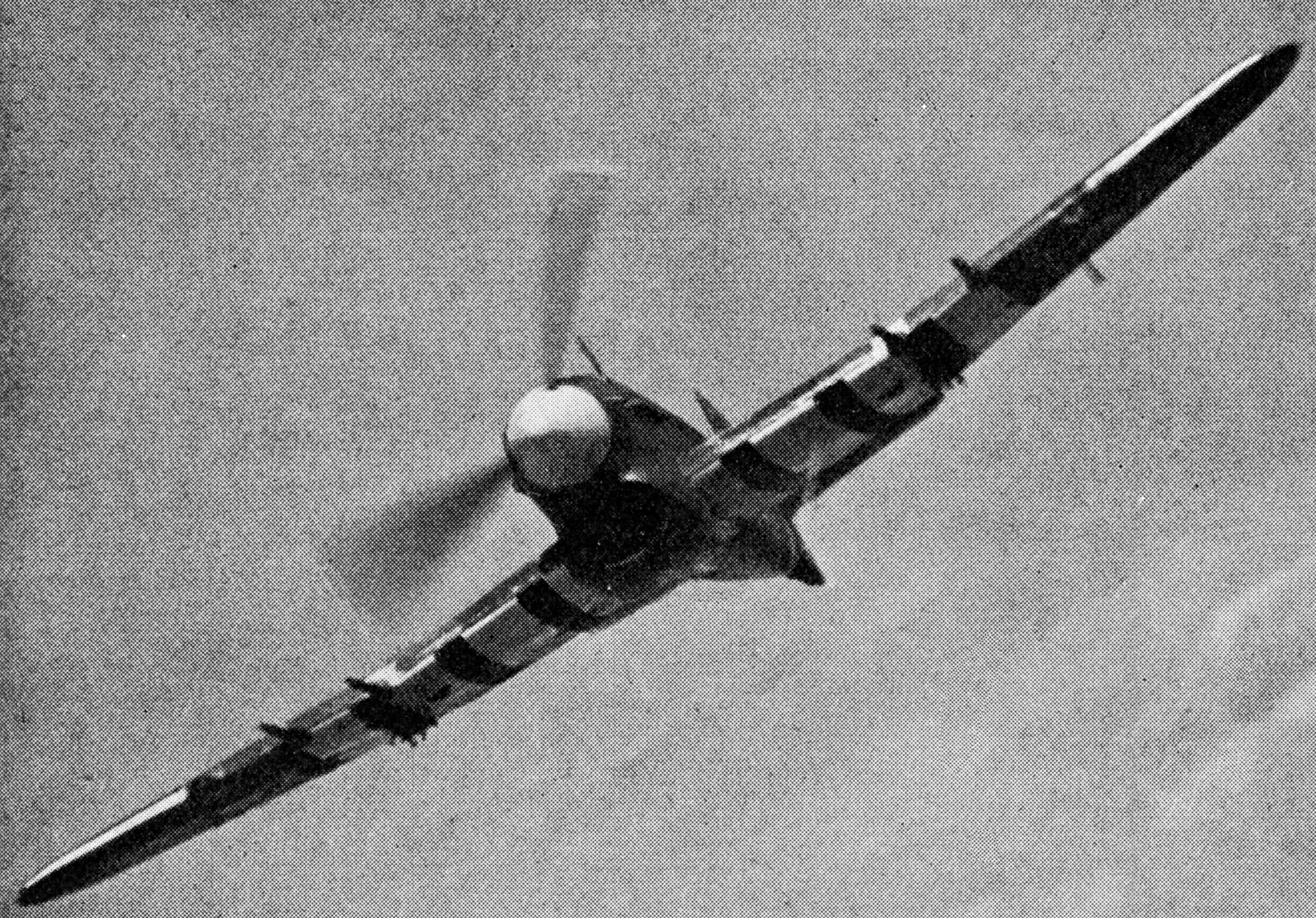
HAWKER
TYPHOON
The
Hawker Typhoon is a recent recruit to the armoury of Fighter Command.
It is powered by a 2,400 h.p. Napier Sabre engine and has a top speed
of more than 400 miles an hour. Its powerful armament consists of four
20 mm. cannon or twelve machine guns. Under each wing is carried a 500
lb. bomb with thin casing, having twice the blasting power of ordinary
bombs
A new development which may favourably affect
the speed of production of aircraft in the near future is the use of
plastic material, experiments on which are now intensively taking
place. There is apparently a promise that this type of structure will
not only prove easier and quicker in manufacture, but will also stand
up against weather and enemy fire, equally well with, or perhaps better
than, the stressed-skin metal structures. It is also claimed that these
new plastic materials, especially when based on a wood foundation, will
actually prove considerably stronger, weight for weight, than
equivalent metal structures.
The development of fighter aircraft
under the stimulus of war proceeds at a terrifying pace. The race for
aerial supremacy is a grim one. Speeds are continually increasing, and
each new aircraft flies higher than its predecessor. Guns become yet
more deadly and more accurate. How far can such progress, if progress
it can be called, go? When will the human factor call it to a halt?
These are questions that only the future can answer.

PARTICULARS
AND PERFORMANCE DATA OF SIX TYPES OF BRITISH FIGHTER AIRCRAFT
NIGHT
FIGHTER PILOTS STAND BY
The
night fighter pilots above are in the dispersal hut of a fighter station
where they are awaiting the call to action. They are wearing most of
their flying clothing so as to be ready to take the air at a moment’s
notice. The dark goggles are worn to adapt their eyes to the darkness.
Once in the air they are guided into contact with the enemy by radio
telephone
[Courtesy of Life Magazine]
CHAPTER
7
Fighter
Pilots and Fighter Tactics
Advanced
training unit. Types of advanced trainers. Gravitational forces.
Blacking out and red vision. Aerobatics and formation flying.
Operational training unit. Rubber dinghies. Baling out. Flying
operational aircraft. Use of oxygen. Camera gun practice. Air-to-ground
gunnery. Methods of attack. The first kill. Oflensive sweeps. Attacks on
shipping. Fighter-bombers. Night fighters. Pilots’ reports
In
Chapter 3 we followed the fortunes of John Smith and went with him
through the various stages of his training, until, as a fully qualified
pilot, he went to an operational training unit to complete his training
on heavy bombers.
Not all pilots, however, want to fly bombers.
Indeed, it is probably true to say that the lure of the high-speed
fighter is stronger than that of the bomber, and that more pilots start
their flying career with the ambition of becoming fighter pilots than
pilots of any other type.
CHOICE
OF PILOTS
However,
as their flying training proceeds, their instructors, who are no mean
psychologists, can usually pick out the men best suited for the various
types of flying. They weigh up the temperaments and special
qualifications and abilities of each man who comes under their care, and
make a detailed report to the powers that be. Although consideration is
given to the pilot’s own wishes in the matter, very often it is
considered that a man who wants to be a fighter pilot would be far more
useful at the controls of, say, a bomber or a reconnaissance plane, and
in such cases the decision of the commanding officer, which is based, of
course, on the full reports of the man’s flying career to date, must be
accepted as final.
All pilots start their career in the same
way—they begin at the receiving wing, then they go to an initial
training squadron, then to an elementary flying training school. It is
after they have completed their course at the E.F.T.S. that they reach
the parting of the ways, the bomber pilot, as we have seen, continuing
his training on twin-engine machines such as the Airspeed Oxford, and
the embryo fighter pilot on fast single-engine trainers such as Miles
Masters or North American Harvards.
The fighter pilot on arriving
at an advanced training unit is introduced to these new types of
machines. He finds them altogether different from the tiny Moths or
Magisters which he flew at the E.F.T.S. They are much bigger and faster,
and are equipped with all the complicated peraphernalia with which the
fighter pilot must become fully conversant before he is qualified to go
into action in a Spitfire or a Hurricane.
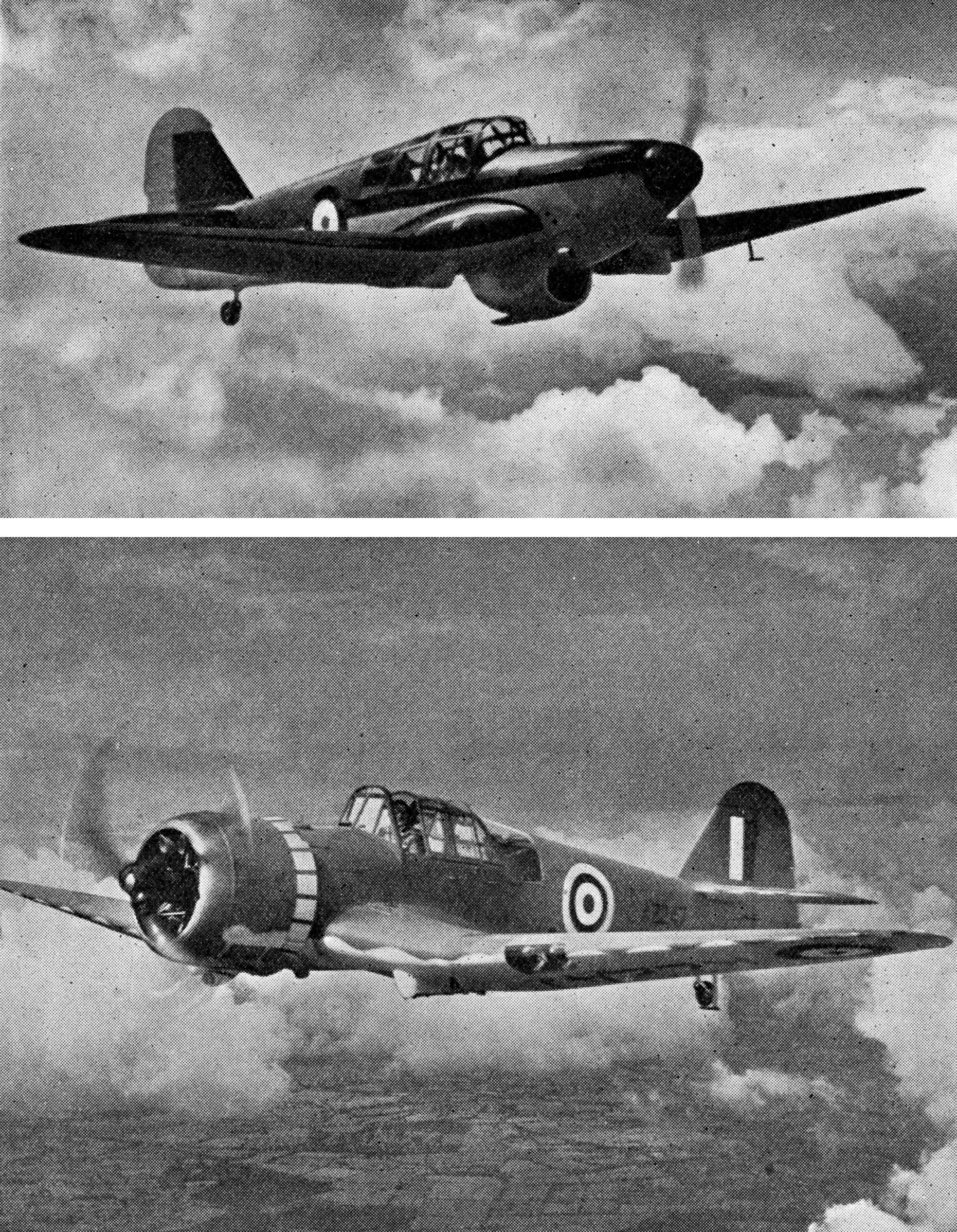
MILES
MASTER ADVANCED TRAINERS
Fig. 1
(above). Miles Master I advanced trainer. This aircraft contains
practically all the equipment found on operational types of fighters and
is an ideal machine for introducing pilots to the new technique of
high-speed flying. It is powered by a 585 h.p. Rolls-Royce Kestrel
engine which gives it a top speed of 250 miles per hour. It is a
low-wing cantilever monoplane of wood construction, and has a
retractable undercarriage and a three blade constant-speed wooden
airscrew. The Master II, Fig. 2 (below), is similar to the Mk.
I version except that it has a Bristol Mercury radial engine which
gives it a higher top speed
MILES
MASTER
The
Miles Master is the fastest training machine in use by any air force in
the world. It is a cantilever low-wing monoplane of wood construction
with enclosed cockpits in tandem, and is fitted with a specially acting
undercarriage that turns and retracts backwards into the wings. The
power unit of the Master I (Fig. 1) is a single 585 h.p. Rolls-Royce
Kestrel XXX engine which gives it a maximum speed of 250 miles per
hour. The Master II (Fig. 2), with its Bristol Mercury engine, is even
faster. The Master, like all other trainer machines, is fitted with dual
controls and is painted bright yellow on its under surfaces.
INSTRUMENT
PANEL OF MILES MASTER
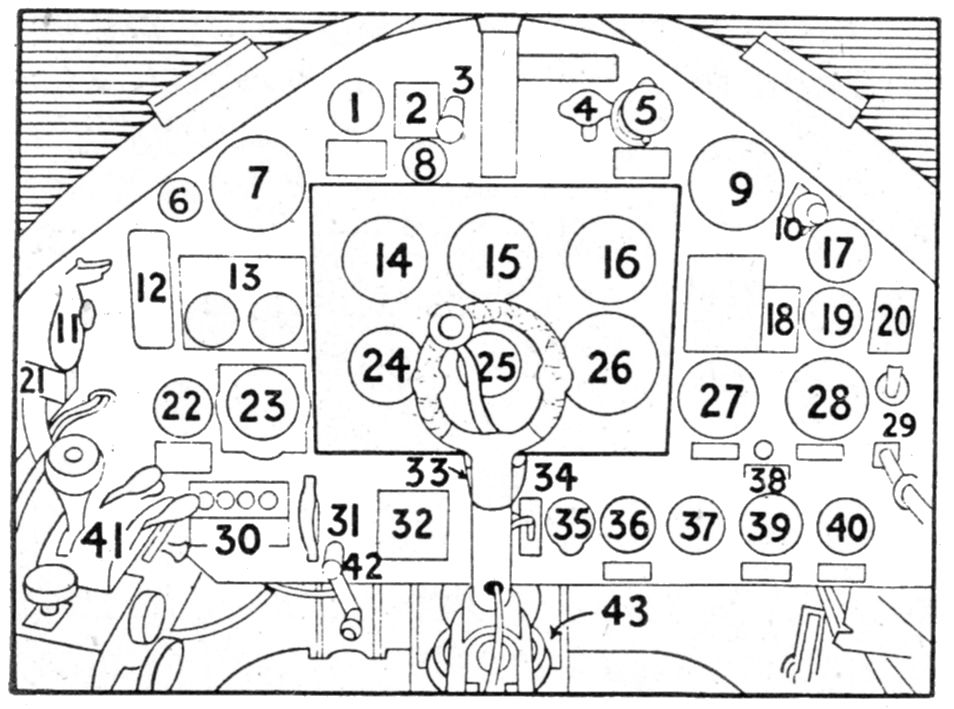
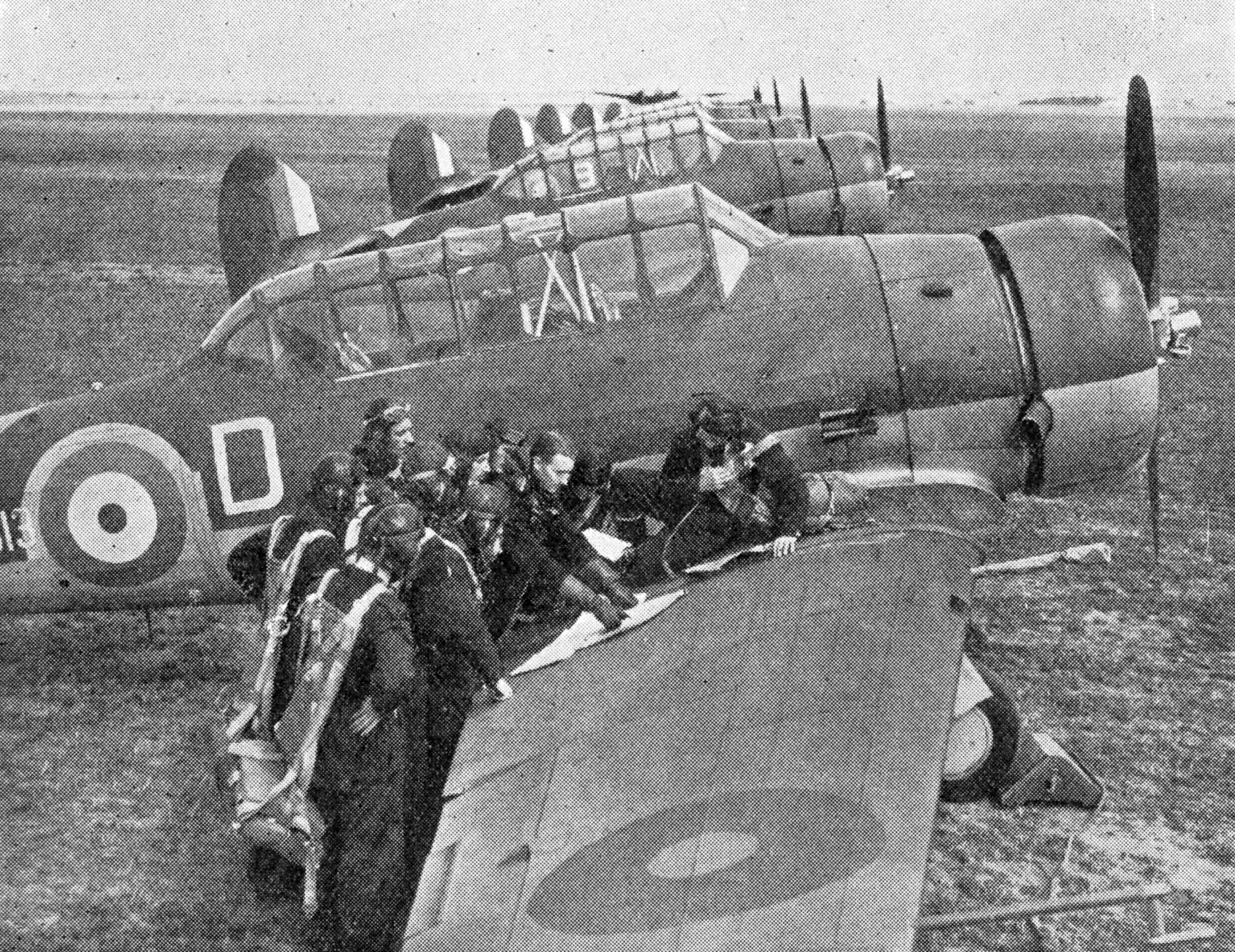
NORTH
AMERICAN HARVARD TRAINERS
Fig. 4.
The Harvard, although slower than the Master, is an excellent training
aircraft. It is of metal construction and is powered by a 600 h.p.
Pratt and Whitney Wasp engine which gives it a top speed of 209 miles
per hour. It has a service ceiling of 24,000 feet. The pilots above are
receiving final hints on map reading before going up on a cross-country
flight
The North American Harvard trainer (Fig. 4) is
also widely used for training our fighter pilots. Although it is
considerably slower than the Master, it is an excellent machine for the
purpose. Like the Master, it is a low-wing cantilever monoplane; it is
of all-metal stressed-skin construction, and its 600 h.p. Pratt
and Whitney engine gives it a maximum
speed of 209
miles per hour. The undercarriage retracts inwards. It can be easily
recognized in flight by the swept back leading edges of the wings and
the straight trailing edges. These, then, are the machines in which the
fighter pilot gets his first real taste of high-speed flying. They are the
last rung on the ladder leading to the latest types of fighting planes
which he will fly in operations against the enemy. After the
little
initial trainers to which he has been accustomed, the budding fighter
pilot finds the advanced trainer rather a formidable proposition—at first
at any rate. The imposing array of gauges, dials and levers
that
ornament the instrument panel impress him considerably—the Master, for
example, has forty-three (Fig. 3)—and he wonders whether he will ever
be able to check up on them all and still find time to fly the machine.
His fears, however, are soon put at rest, for he finds that, with the
aid of the excellent system of memorizing the flying procedure used in
the Service, he is, before long, scarcely conscious of them at all.
The
pilot is astonished when his instructor takes him up for his first trial
“flip” in an advanced trainer, at the tremendous rate of acceleration.
He notes with interest the increased angle of climb and the higher
take-off and landing speeds. This first flight is, of course, only an
“experience” flight, its object being merely to give the pilot an
introduction to this rather different form of flying. The instructor
chats away to him through the intercommunication telephone and from
time to time draws his attention to various general points of interest
regarding the aircraft and its behaviour, taking care not to say too
much at first for fear of confusing his new pupil.
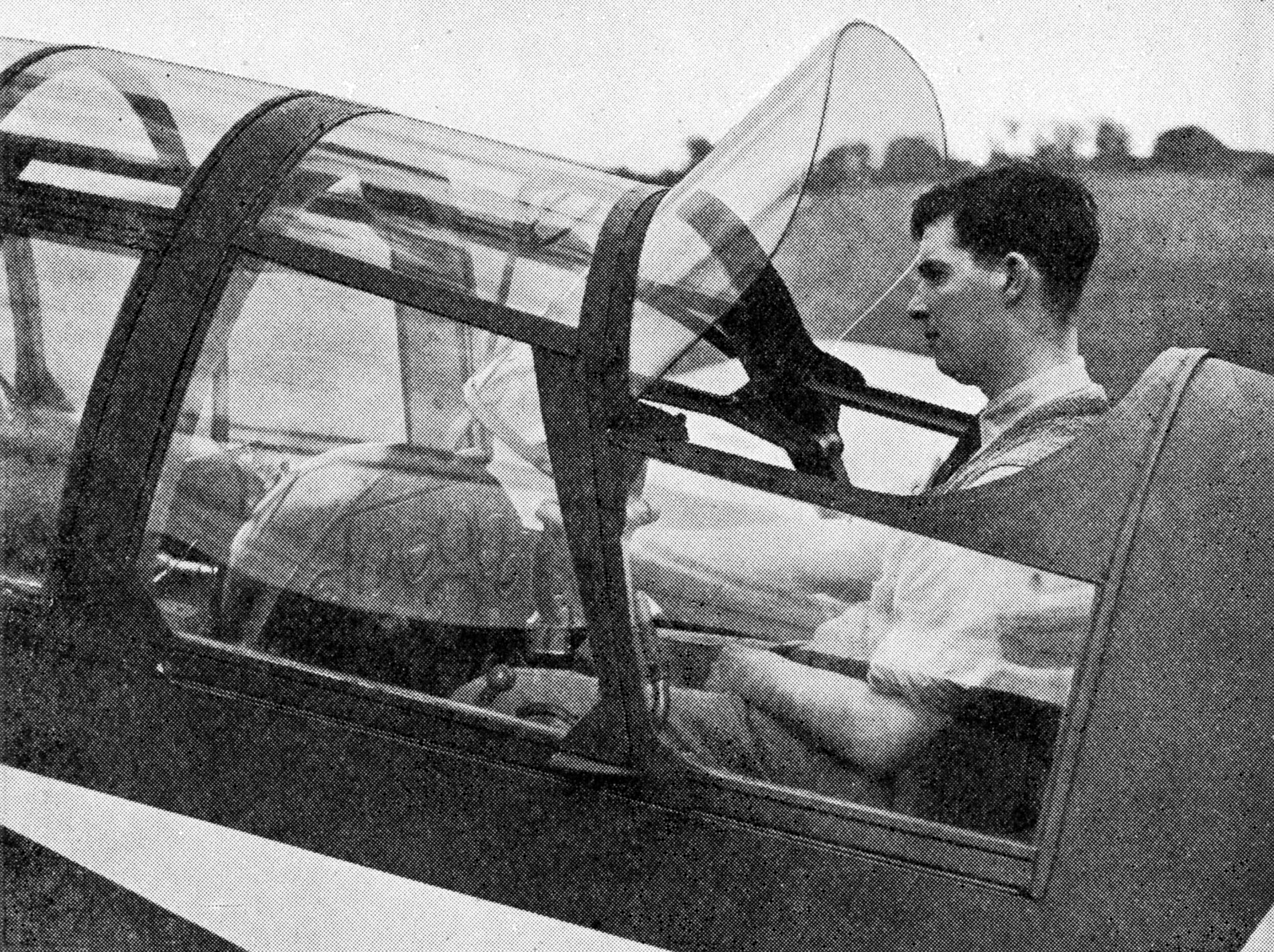
REAR
SEAT OF THE MASTER
The
rear seat of the Master is specially designed so that it can be raised
by the occupant, thus bringing his head above the normal line of the
fuselage and providing an excellent view when landing and taking off.
The folding windscreen, shown above, which forms part of the cabin top,
protects the pilot’s face when the seat is raised. The rudder bar is
also adjustable
Before the pilot is actually allowed
to handle the controls of the new machine he attends lectures and
learns much he did not know about high-speed flying. He is initiated
into the mysteries of the retractable undercarriage, and told that the
first thing he must do on taking off is to retract it so as not to
retard the rate of acceleration. He is also told that it is very much
better, should he have to make a forced landing on difficult ground, to
do so with the undercarriage pulled up, for if he were to hit an
obstacle with it down it is almost certain that the plane would
overturn with serious consequences both to himself and his aircraft.
With the undercarriage in the retracted position, however, he could
“pancake” his aircraft to earth and in all probability get away with
nothing worse than a bit of a shaking and perhaps a bent or twisted
airscrew.
With
the passing of time the pilot is allowed to fly the aircraft, and he
goes through very much the same procedure as he did on the Moth at the
E.F.T.S. The instructor corrects his faults, makes him do numerous
circuits of the aerodrome, landing and taking off until he has
completely mastered the feel of the new aircraft and is thoroughly
proficient.
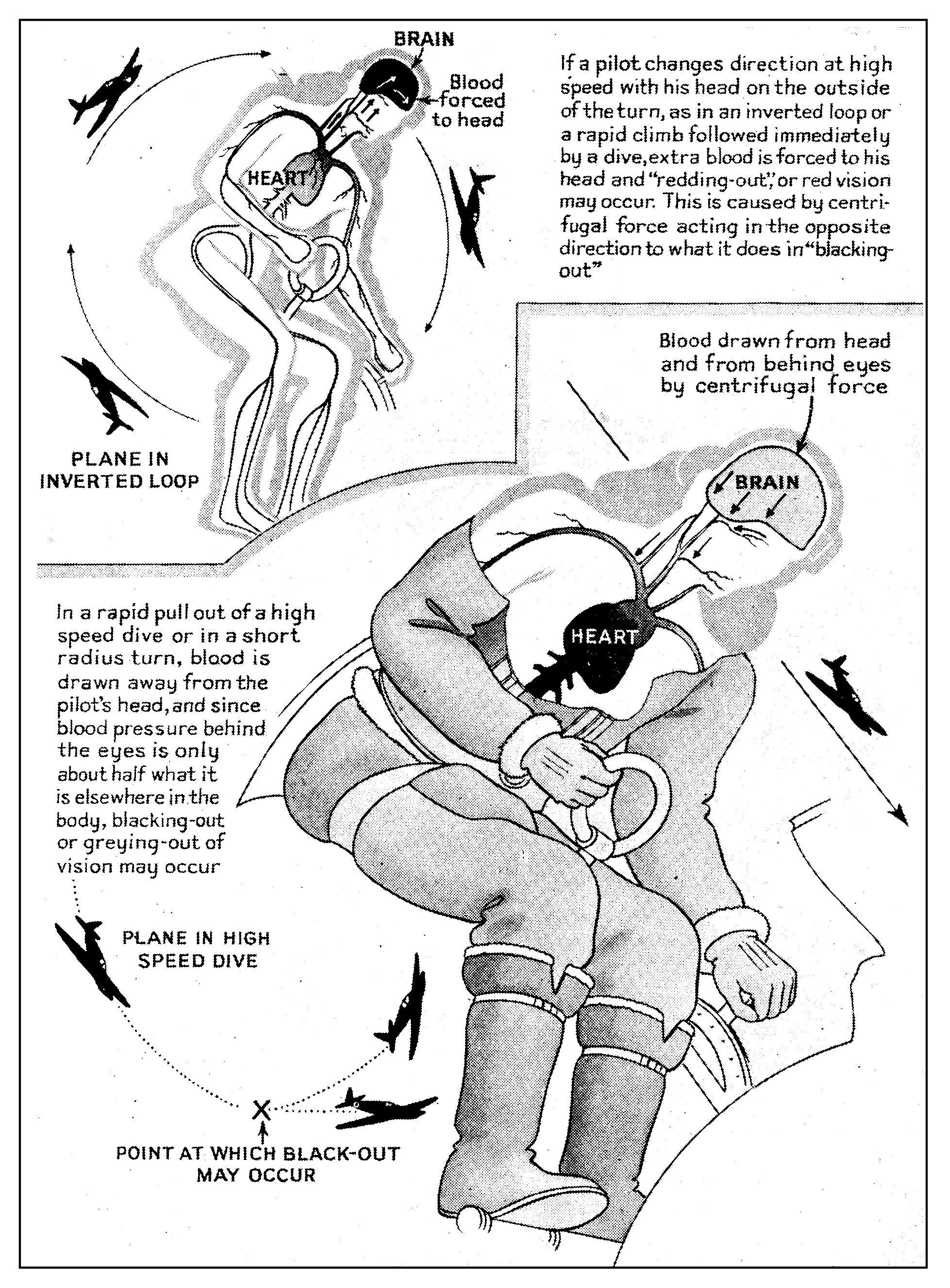
“BLACKOUT”
AND “REDOUT” EXPLAINED
Fig. 5. When
changing direction at high speeds, pilots are subjected to considerable
gravitational forces which may cause them momentarily either to lose
their vision or to see red. These phenomena are known in the R.A.F. as
“blackout” and “redout”, and the reasons for their occurrence are
explained diagrammatically in the above illustration
As
soon as a pilot goes over to high-speed aircraft he makes the
acquaintance of the mysterious symbol “g,” which stands for the
acceleration due to gravity. When flattening out after a dive, or making
a short radius turn he is conscious of the feeling of being pressed
hard into his seat. The faster he goes, the greater the force, and when
it is explained to him that a fighter pilot may have to withstand
retardations of as much as five or six “g,” he realizes why he had to
undergo such a thorough medical examination before being accepted.
These
great forces to which the pilot is subjected naturally place a
considerable physical strain upon him, and he may experience the
phenomena of “blackout” and “redout.” Both of these are brought about
by centrifugal forces induced by rapid changes of direction at high
speed. In the case of the former, if the pilot makes a very tight turn,
or flattens out rapidly after a dive, the blood tends to be forced from
his head, particularly from behind the eyes, for a split second, during
which time he cannot see.
Redding out is caused in exactly the
same way, but it occurs only when the pilot changes direction with his
head on the outside of the turn, as in the case of an inverted loop or
the start of a dive. This, instead of drawing the blood away from the
head as in the case of blackout, causes it to rush to the head, and it
may cause slight haemorrhage of the blood vessels behind the eyes which
accounts for the red vision. Both these phenomena are illustrated
diagrammatically in Fig. 5.
To the new pilot blacking out and
redding out may sound somewhat alarming, but they are not as bad as
they sound. Pilots vary considerably in their resistance to these
forces.
It is not long before the pilot is thoroughly at home
with the advanced trainer and is throwing it about in the air, making
it do just what he wants it to, supremely confident in his new-found
prowess. He practises turning and aerobatics, paying particular
attention to spins and how to get out of them. He is now starting to
learn advanced aerobatics, which form an essential part of the training
of a fighter pilot. Not only may many of the aerobatics he learns be of
use to him in actual combat, but also they are excellent training in
handling the aircraft and they give the pilot a feeling of confidence.
Amongst other manoeuvres he learns how to loop,
roll, half
roll off the top of a loop and do stall turns. He is also told how to
do the tail glide and falling leaf, but these are merely fancy
manoeuvres used for display purposes. Pilots are told what these
manoeuvres are and are told not
to do them.

FLYING IN
CLOSE FORMATION
Formation
flying is one of the most difficult things the pilot has to learn. It
requires great concentration, and for that reason the early periods of
instruction are short. The Hurricanes seen above are in close
formation, which is normally used for drill purposes. Other formations
are often adopted when aircraft are flying together on active operations
against the enemy
FORMATIONS
ADOPTED BY FIGHTER AIRCRAFT
Fig. 6.
Some of the best-known formations used by fighter aircraft are
illustrated above. They are all designed so that each machine can give
fire support to the one in front
HURRICANES
IN V-FORMATION
Fig. 7.
In V-formation the leader takes station at the apex. Each
machine
has a number, even ones being on leader’s right and odd ones on his
left. The following aircraft keep station by dressing with the opposite
number. Formations may take off as such or be formed in the air
ON
THE LOOKOUT FOR THE ENEMY FIVE MILES ABOVE THE EARTH
High
above the clouds, in a world of astonishing beauty, a Hurricane
squadron is on the lookout for enemy aircraft. Should a bandit be seen
the squadron leader will detail a section of two aircraft to attack
and, if possible, destroy the enemy. During the flight the leader of
the formation keeps in constant communication with his base by means of
the radio telephone
TYPES
OF FORMATIONS
When
he is complete master of his machine the pilot learns to fly in
formation. This, at first, is extremely difficult and requires
considerable concentration, so his early periods of instruction are of
short duration.
Various types of formations (Fig. 6) are used in
the R.A.F. They have the object of enabling groups of aircraft to fly
together in an orderly manner and most of them are designed so that
each aircraft can give fire support to the one in front. The V (Fig. 7)
is perhaps the commonest, and in this the aircraft each have a number.
The leader flies at the apex, and the other aircraft are numbered
alternately backwards on each side of the leader, even numbers being on
his right and odd numbers on his left.
Formation flying in the
R.A.F. has been brought to an exceedingly fine art, and an elaborate
drill has been evolved. Formations may be either open or close, but it
is usual, for drill purposes at any rate, to fly in close formation.
This is valuable training in distance gauging and undoubtedly accounts
for the wonderfully precise way in which formations of the R.A.F. keep
together and move or change direction as one. In wartime, of course,
more open formations may be necessary in order to reduce the danger
from concentrations of A.A. fire.
In
formation flying the leader sets the pace. Those that follow take up
their place behind him on each arm of the V and keep station by
dressing with the opposite number. The pilots fly on their throttles,
slightly adjusting them the whole time—opening up a bit if they see
they are falling back, and easing back a little if they get too far
ahead. At first it is rather difficult, but after
constant
practice it becomes second nature.
Formations sometimes take off
and land together, or they may be formed when in the air. The smallest
formation is the section of two machines, a leader and one aircraft;
the next smallest formation is a flight of three machines, a leader and
two aircraft. The section is the tactical unit in battle, and the
squadron, which consists of six sections, may fly in sections in line
astern in three lines (Fig. 8) or in flights in V. Aircraft may also fly
in line abreast or line astern, or they may adopt the rather more
complicated diamond or box formations, according to whatever the
circumstances may be.
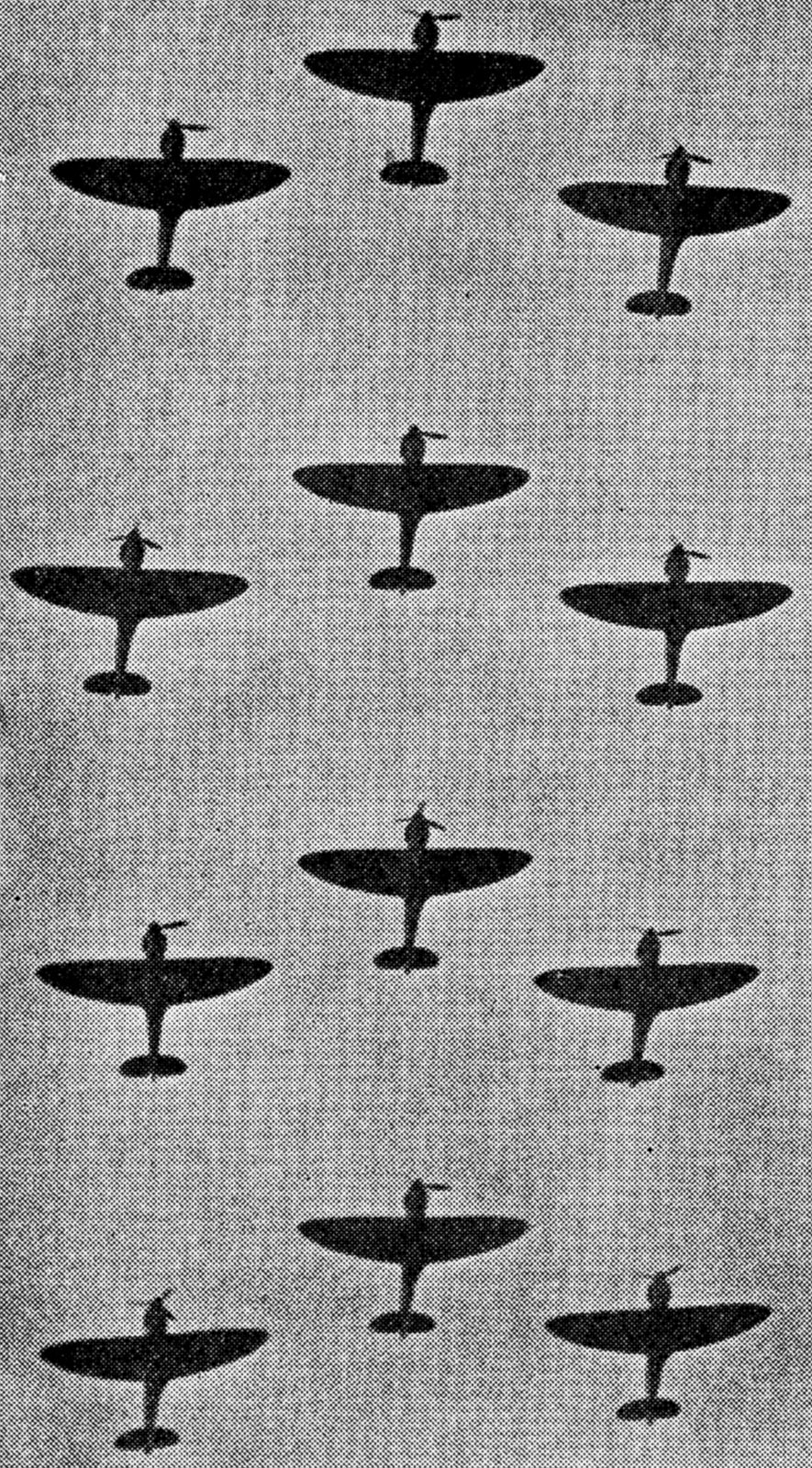
SECTIONS
IN LINE ASTERN
Fig. 8.
The section of two aircraft is the tactical unit of the R.A.F. in
battle. Above, a squadron, which consists of six sections, is
seen
flying in line astern in three lines
FLYING IN SECTIONS
When
flying in sections, if the leader saw an odd enemy aircraft, he would
call up a section and detail it to attack. Two aircraft would leave the
formation, returning to it again only after having completed or failed
in their task. During the whole period of the flight the formation would
have scouting planes weaving behind it, that is, crossing from side to
side, to prevent surprise attack (Fig. 9).
WEAVING
TACTICS OF FIGHTER AIRCRAFT
Fig. 9.
During the whole period of flight a formation, however large, turns or
“weaves” from side to side. This makes it difficult for enemy aircraft
to approach the formation without being seen. Scouting planes are seen
here weaving in the rear of a formation of fighters. They keep a lookout
for enemy aircraft which they might miss if they flew along a straight
course
Having completed his
advanced training, our fighter pilot to be is now a fully qualified
pilot, but he is not yet operational, and to complete his training, he
is next posted to an operational training unit or O.T.U. The term “a
fully qualified pilot,” only means that he has completed his general
training as a pilot, not that he knows all there is to know about
flying—if he flew for a hundred years he would still have plenty to
learn. Like the sailor, he soon learns that just when he thinks he
knows all there is to know, the elements will show him something he had
never seen before just to keep him from becoming over-confident, and
like the sailor, he learns in the hard school of experience. A pilot
cannot be considered really experienced until he has flown for at least
500 hours. Over-confidence is watched for by instructors even more than
inability, because it is more difficult to discern and equally
dangerous, if not more so, to the person concerned. If you ever meet a
pilot who tells you that “flying is a piece of cake” you can be sure
that sooner or later (unless he is lucky enough to have time to change
his opinion) that pilot will kill himself. But we must return to our
pilot waiting so patiently to go to his O.T.U.
If
our young man is lucky he will probably have had seven days’ leave on
finishing his advanced training, and will arrive at his O.T.U. fresh for
still more instruction. On his first day most of the time will be spent
finding a room for himself, depositing his baggage, being interviewed by
the station commander, station adjutant, and finally the chief ground
instructor (C.G.I. to you). He will allocate them to a flight or flights
and tell them the general layout of the station.
RUBBER DINGHIES
Leaving
the C.G.I.’s office the members of the course go over to the stores to
collect any articles of flying kit they may not possess. Now that they
are becoming operational they will have to add several articles to
their already ample wardrobe. They will be issued with “Mae West”
lifebelts to keep them afloat should they come down in the sea, and a
dainty little package, only 15 inches square by 3 inches thick will be
added to their parachute packs. This is the self-inflating rubber dinghy
that is now part of the standard equipment of British fighter
pilots. It is a masterpiece of compression and besides the action boat
itself there are paddles, sea anchors, iron rations and other necessary
gear. It will support a weight of 400 lb. and many a pilot has had good
reason to be glad of this piece of equipment. Fig. 10 shows the fighter
pilot’s equipment together with the dinghy (illustrated in Fig.
11),
which also acts as a cushion for the pilot.
EQUIPMENT
WORN BY A FIGHTER PILOT
Fig. 10.
The full equipment of a fighter pilot is heavier than that of an
infantryman, and weighs about 60 lb. The drawing above shows the
various items of clothing and equipment worn by fighter pilots, with
(inset) details of the parachute harness quick release box
RUBBER
DINGHY FOR FIGHTER PILOTS
Fig. 11.
Particulars of the self-inflating rubber dinghy which forms part of the
equipment of fighter pilots. When folded it is attached to the
parachute pack as shown in Fig. 10, and acts as a cushion for
the
pilot; it measures only 15 inches square by 3 inches
thick, and
can support a weight of 400 lb. It is equipped with paddles, rations,
and other gear
Although our fighter pilot has now
received his full equipment and has had thorough instruction in its
use, his knowledge as regards his parachute will be theoretical only.
Pilots are told how to bale out during their training, but they are not
required to do an actual drop. This pleasure is reserved for a later
date when, perhaps as a result of enemy action, they will have to “jump
for it.”
Baling out of a high-speed aircraft is no mean feat,
for the tremendous pressure of air tends to hold the pilot firmly in his
seat. Before he can leave his aircraft, therefore, he must either slow
it up or, as is often the case, turn it upside down and fall out. Once
clear the pilot must wait a few seconds before pulling the ripcord,
otherwise his ’chute might become entangled in the aircraft with fatal
results. The art of making a parachute descent is illustrated
diagrammatically in Fig. 12.
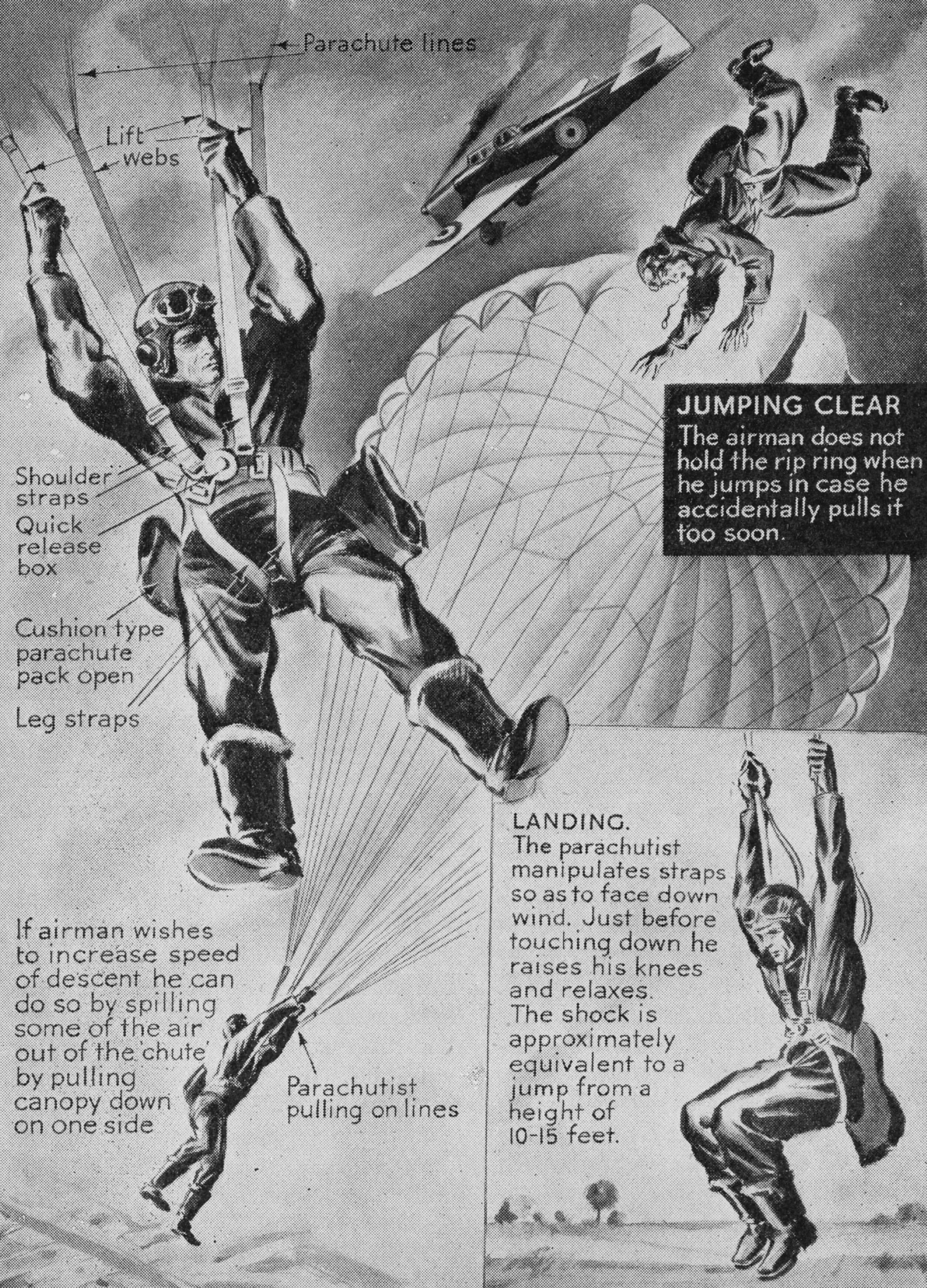
HOW
A PILOT BALES OUT
Fig. 12.
Diagram showing how an airman makes a parachute descent. Fighter pilots
when they want to leave their machines usually turn them on their backs
and fall out. Before doing so they must disconnect the oxygen
tubes and telephone cables from their helmets
To go back to our young man; let us
call him Sergeant Jones. He now knows that he is a member of
Course 22, and that he is to report to Flight Lieutenant
Brown, O.C. “A” Flight, at 8.30 next morning. Until then, as
it is
the first day, his time is his own.
Duly at 08.30 hours Sergeant
Jones presents himself for interview with his new flight commander.
After a short talk he is told to get into his flying kit and to
climb into a Master waiting on the tarmac. Flight Lieutenant Brown soon
follows and, settling himself the second cockpit, tells Jones that he
wants to fly with him for half an hour or so. Jones starts up his engine
and, having warmed it up and tested his switches, waves his chocks
away, taxies into wind and takes off. For the next thirty minutes Jones
shows his flight commander how good or bad a pilot he is. We
will
assume that the O.C. is satisfied with Jones’s progress, for when he
lands he is told to go up on his own for an hour or so to get used to
the air again after his leave.
In the afternoon his big moment
arrives and he is detailed to do an hour’s circuits and landings and
local flying in a Spitfire. As Jones has been trained progressively on
several types of aircraft, each one slightly faster and more
complicated than the last, his switch from trainers to an operational
aircraft is not such a violent change as it might have been;
nevertheless his first take off in a Spitfire is something of a
revelation.
His first few take-offs and landings will be watched
from the ground by his flight commander, but never again will he have
any one in the back to tell him when he makes a mistake. From now on
his operational training follows in a natural sequence; local flying,
formation flying, cross countries, aerobatics, and target practice at
ground targets and at “drogues,” which are sleeve targets towed behind
another aircraft.
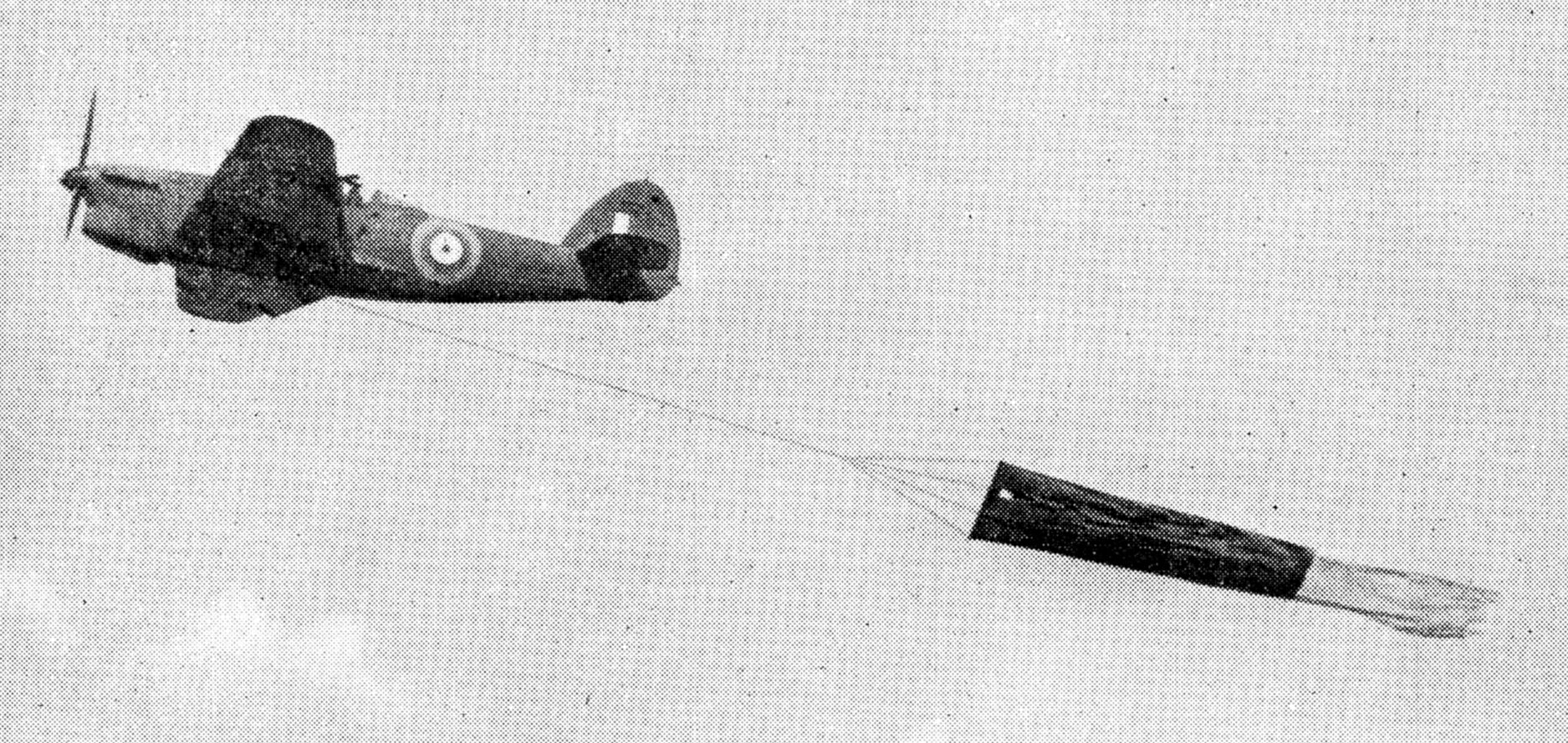
TARGET
FOR PRACTICE SHOOTING
A
great deal of the fighter pilot’s time at his O.T.U., and later in his
squadron, is spent in carrying out practice machine gun attacks on
sleeve targets, or “drogues” as they are called, similar to that seen
above, which is being towed behind a Hawker Henley target-towing
aircraft
He
soon finds out
what a magnificent aircraft the Spitfire is and how beautifully it
handles; and that except for the fact that everything happens rather
more rapidly than it did in a Master, things are not so very difficult,
which, after all, is the aim of progressive training. He learns to
accustom himself to map reading while covering the ground at a high
speed, and also from altitudes of 20,000 feet or more. He is shown why
oxygen is necessary at high altitudes, taught how to use his oxygen
equipment (Fig. 13), and is sent up to practise flying at 30,000 feet.
OXYGEN
EQUIPMENT IN A MODERN FIGHTER
Fig. 13.
Diagram showing arrangement of oxygen breathing apparatus for
high-altitude flying. The gas is carried in high-pressure bottles and
inhaled by the pilot through a mask
He turns on his
oxygen as soon as he has taken off, and begins to climb. Every 5,000
feet he turns the tap of his oxygen regulator to increase his supply as
the oxygen in the air decreases; as he climbs up he notices that the
air becomes clear and that the sky is a vivid Mediterranean blue;
higher still he finds it difficult to do a “tight” turn until he gets
used to the “loose” and sloppy feeling of his controls, due to the
rarefied air. Jones gets used to flying at this height for twenty minutes
or so and starts his descent, not too rapidly, and swallowing every now
and then to even out the pressure on his ear drums. When he gets down
to about 1,000 feet, he flies around the aerodrome for a few minutes to
accustom himself to the nearness of the ground, for if he came down
from, say 30,000 feet and landed quickly, he would probably misjudge
his height, and land badly.
CAMERA GUN PRACTICE
As
the days pass Sergeant Jones finds more of his time taken up with
formation flying and camera gun practice. The camera gun is a
cine-camera mounted in the wing, which is sighted like a normal gun and
takes pictures when the firing button is pressed. He has been shown the
best methods of attacking aircraft under varying conditions. The astern
attack, the beam and quarter attacks, the head-on attack and variations
of all four (Fig. 14); and the safest method of “breaking away” when
the attack is finished. His armament lectures teach him just what
deflection shooting means, and how much deflection should be allowed
under varying conditions; then he is sent up on camera gun practice.
ATTACKS
ON ENEMY BOMBERS
Fig. 14.
The method of attack is dictated by such factors as the defensive
armour and position of armament of the target. The pilot therefore must
have a knowledge of the characteristics of enemy aircraft. The diagram
shows how front (A), rear (B), and beam (C) attacks are made
For
camera gun practice, aircraft take off in pairs; first one aircraft will
act as target and the other will practise attacks on him. When the
attacking pilot has finished his film, he tells his companion that he is
ready to act as target and the procedure is reversed.
Sergeant
Jones takes off on his first camera gun flight, and quickly finds, that he
needs all his new-found skill to complete anything faintly resembling
the attacks he had been shown; however, by the time he has finished his
film he begins to think he has done quite well, and by the time he
lands, he feels quite confident that his results will be all they should
be.
SEEING THE RESULTS
When
he has landed and has “switched off,” the camera gun is unloaded and
the spool of film taken to the photography section to be developed. The
next day Sergeant Jones is shown his film by the armament instructor.
Several exposures show masses of white cloud, or a large expanse of
blue sky, but no trace of the target aircraft. Jones begins to think
that all is not as it should be, when, on or about the fifteenth
exposure he sees a small speck: “I got him there all right,” he says
brightening visibly. “You might, if you’d been using a 4.7 and your
target had been standing still,” replies his instructor, and shows
Jones that he has been opening fire at about 800 yards range instead of
200 to 300, and also that he has been using no deflection, though the
target was travelling across his sights at 200 miles per hour. So on
through the film the instructor showing his pupil his faults and telling
him how to correct them.
When Sergeant Jones finally joins a
squadron and goes on an operation he will find another use for his
camera gun. It will take pictures when he has an engagement and the
roll of film will help the Intelligence Officer to assess whether
he completely destroyed his enemy or only “probably” did so.
If he
brings back film showing an aircraft dramatically breaking up in the air
under the impact of his bullets, he may see that film later in the
newsreel at his local cinema. A photograph taken by an aircraft camera
gun appears later.
USING LIVE AMMUNITION
The
first time Jones fires his guns he will be on air-to-ground practice—that
is firing from the air at square fabric-covered targets. He is thrilled
at the prospect of shooting off some ammunition and is not quite
certain what will happen.
He makes his way to the air firing
ranges and sees the target looking about the size of a postage
stamp; he sees that it is all clear for him to fire, he gets into
position, puts the aircraft into a slight dive towards the target and
gets his sights on; when he thinks he is within range, he presses his
firing button: nothing happens. Jones pulls out of the dive and looks
around the cockpit to see what’s wrong; eventually he finds that his
firing button is on “safe.” If you could see him at this moment, his
face would be very red. But luckily no one is there to share his
embarrassment. He gets into position again, this time making sure his
button is on “fire” and starts another dive. Now when he presses the
button he hears a dull noise like a piece of calico being ripped, and
sees the sand spurt up ten yards to the left of his target. He ceases
to fire, pulls out of his dive and goes round again. This time he will
probably be a little nearer, and so on, until eventually he gets his
bullets all round the target.
We have assumed that Jones’s
aircraft is armed with machine guns. If he had cannon, the effect on
firing would be different. He would feel the aircraft shaking
considerably and hear a succession of sharp heavy bangs while large
holes would appear around the target, throwing up clods of earth or
lumps of sand high into the air.
Once he has got used to a new
type of aircraft, a great deal of a pilot’s time at his O.T.U. and
later in his squadron, is spent on carrying out practice attacks on
aircraft and air firing on “drogues.” For the reader’s benefit we will
now explain why more than one method of attack is necessary, and the
factors which decide the use of any particular attack.
The main
aim of any attack is to destroy the target aircraft. The secondary aim
is to attack from a position, or in such a manner that the target has
least chance of retaliating. Obviously therefore the method of attack
will depend on many factors: the type and numbers of aircraft to be
attacked, the number of fighter aircraft carrying out the attack, the
defensive armour and armament of the target, and, not least, whether
the attackers have time to chose a favourable position.

AIMING
AT THE ENEMY
Fig. 15.
Diagram showing when the pilot presses the gun button for (top) a full
deflection shot; (centre) threequarter to half-deflection shot; and
(bottom) no deflection shot
RECOGNIZING THE TARGET
To
begin with, a fighter pilot must have a detailed knowledge of all the
characteristics of any enemy aircraft he is likely to encounter. The
easiest method of attacking and hitting an aircraft is to
approach
from directly behind and on the same level. This gives the fighter pilot
a no deflection shot (Fig. 15) and has been responsible for the
introduction of the tail gunner in big bombers. From behind the pilot
has a steady sight on his target, can regulate his speed of approach,
has plenty of time to decide when to fire, and can keep on firing until
the target is shot down or he runs out of ammunition. This method of
attack in its simple form can be used against aircraft which have
little or no defence against an astern attack, such as single-seat
fighters or single aircraft with poor armament and armour.
However,
single-seat fighters have a mirror mounted on their windscreen
to enable them to see behind them to a certain extent; and
multi-seater aircraft have someone to tell the pilot of the attacker’s
approach and are also very heavily armoured against this form of
attack. Therefore in order to attack unseen and in a vulnerable place,
the approach under ideal conditions would be from astern and slightly
underneath, where the target’s tail plane would obviously hide the
attacker from view.
The only other no deflection shot, that is
the position from which a pilot can shoot with his target in the middle
of his sights, is from “head on.” From all other positions the pilot
must aim ahead of his target, the amount varying with the angle of
approach and the range. This is illustrated in Fig. 15.
Large
numbers of bombers in close formation present a difficult target to
attack from astern owing to the amount of cross fire they can bring to
bear on the fighters, who can probably only approach one or two at a
time. Under these circumstances the head-on attack is used tobreak up
the bomber formation. The head-on attack is extremely difficult to
execute, and as the target is only at the correct range for a very
short time, only a short burst can be fired at it.
When two
aircraft are approaching each other at a relative speed in the
neighbourhood of 600 miles per hour, the time taken to cover 400 yards,
which is the range at which the fighter will open fire, is about one and
a half seconds, so almost as soon as the fighter pilot has pressed his
fire button he has to pull up or turn to avoid colliding head on with
the bomber. From this the perfection of timing necessary for a
successful head-on attack will be appreciated. A well-executed head-on
attack is more effective than any other, bullets striking the
bombers in their most vulnerable areas, generally hitting the pilots,
and the moral effect by itself is enough to make the most hardened
bomber pilot endeavour to get out of the way. And so the formation is
broken up and the bombers may then be attacked individually.
Attacks
are also carried out from the beam and above and from the beam and
below, and from the various quarters from above and below, according to
the positioning of the attacker and the defensive armour or armament of
the target. If beam and quarter attacks are to be successful, good
shooting is necessary. As far as shooting is concerned, the attack from
astern may be compared with a shot at a sitting rabbit, the beam and
quarter attacks with difficult cross-shots at flying birds.
From
this very brief explanation the reader will be able to realize why,
from the newest arrival in a squadron to its most seasoned campaigner,
camera gun and air firing practice are important features of their daily
round.
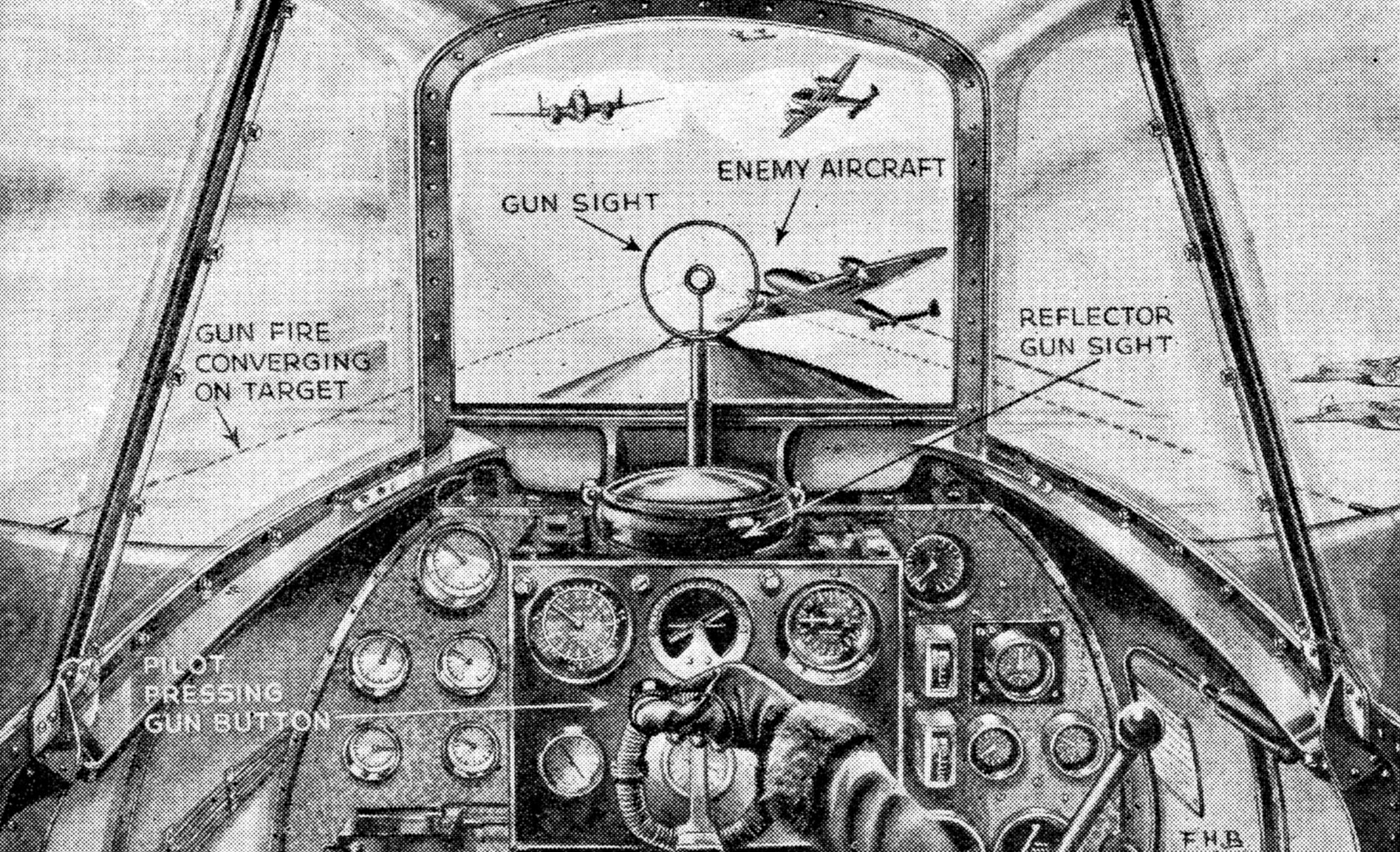
HOW
THE FIGHTER PILOT SEES HIS FOE
Diagram
showing a fighter pilot attacking an enemy bomber. He is taking an
almost full deflection shot and is firing well in front of the enemy in
order to allow for the speed of the bomber across his sights. A shot of
this kind requires great skill on the part of the pilot
The
reader will probably have almost forgotten Sergeant Jones at his O.T.U.
He is still there. The weather has been as reasonably good as English
weather ever can be, and he has been putting in a lot of
hours. He
can now do all the various attacks, singly and in squadron formation,
and he has been getting ever-improving scores on the “drogue.” He has
more or less mastered the R/T procedure (radio telephony, R/T for
short, is the means by which pilots talk to one another and to the
control room. The procedure is the drill for saying what one has to say
by the shortest and most intelligible means) and the day has arrived
when he has completed his training and is a fully operational pilot. He
is called to the chief flying instructor’s office, where the progress he
has made is discussed. He learns that he has been posted to No. 900
Fighter Squadron at Upchester. He is given his log book and sees that
he has been assessed as an average fighter pilot, with no special flying
faults. Then, with a few final words of advice from the C.F.I., he says
goodbye, collects his railway warrant and luggage and sets off for his
new station. His training school period finished, his operational
career, with all its attendant excitements, has begun.
CALL SIGNS
A
week has gone by, Sergeant Jones is beginning to settle down to
squadron life. His first week has been a probationary period, during
which he has been allotted to “A” flight, given a Spitfire of his own, a
Mark V, armed with two cannons and four machine guns, and has spent his
flying time in getting to know the sector and in becoming accustomed to
sector control. The sector is the part of the country which his
squadron normally defends, and therefore it is most important that
every pilot knows his sector’s landmarks and peculiarities intimately.
He
has an R/T call sign which he will get to know as well as his own name,
indeed, from now on when he is in the air he will no longer be Sergeant
Jones, but Jackdaw 21, or Blue one or two, Red one or two according to
the section in which he is flying. Jackdaw will be his squadron call
sign and 21 his individual number. We shall see later how the section
colour code works.
Seven or eight days after his arrival Jones
does his first day at readiness. A squadron always has a certain number
of aircraft standing by to take off at a moment’s notice should there
be any hostile aircraft for them to intercept, and pilots
usually
take it in turns to be among those standing by, or “in readiness.”
It
is early, and the first light of dawn has not yet appeared, when Jones
makes his way to his dispersal hut. The air is full of the noise of
aero engines warming up. Reaching the hut he has a few words with his
crew to make sure that all is well with his Spitfire, then he puts on
his flying clothing and, lighting a cigarette, sits down to wait. Soon
another pilot enters the hut. This is Sergeant Smith, Jones’s section
leader (fighters are not detailed to intercept singly but in pairs;
these pairs are called sections).
The day progresses, the sun is
high and the sky partly covered by huge towering cumulus clouds.
Sergeant Smith and Jones are lying on the grass near their Spitfires,
reading. Suddenly an order from control comes through: “Blue
section, scramble base.” This means that blue section must take off as
quickly as possible and circle the aerodrome. Sergeant Smith and Jones
leap up and have climbed into their Spitfires in a flash. Helmets on,
engines started up, parachutes and safety harnesses properly
fastened, chocks away, and they are off.
THE FIRST PATROL
Over
the aerodrome Sergeant Smith calls up control by a code name. We will
assume that it is “Money”. He says: “Hallo Money, Jackdaw Blue one
calling Money. I am now airborne.” Back comes the reply: “Money calling
Jackdaw Blue One. Course 130. Climb to 10,000 feet. Are you receiving
me?” Smith answers: “Receiving you loud and clear. Message understood.”
Sergeant Smith and Jones set their compasses to 130 degrees, turn on to
the course and begin to climb. The altimeter needle moves rapidly round
the clock, and in a few minutes they are skimming the tops of the
clouds. Control comes through again and Jones gets the thrill of his
life: “Money calling Blue one. Money calling Blue one. Bandit
approaching you from the west at 10,000 feet, continue on present
course. Over to you.” Flight Sergeant Smith replies that he understands
the message, and Jones opens out formation slightly so that he can
search more easily.
Another minute and control comes through
again: “Hallo blue one. Bandit now very near you. Over.” Jones, who has
been searching hard, so far in vain, is by this time so excited that he
can hardly sit still. Suddenly he sees his leader turn slightly and
hears his “Tallyho,” and, “Hallo Blue 2. Bandit is half a mile away to
port.” Jones turns sharply and there, half a mile away, streaking along
the tops of the clouds, he sees his first Hun, a lean, snub-nosed
Junkers 88. Sergeant Smith calls again: “Hallo blue 2, prepare to
attack.” At this moment the “88” decides that the Spitfires are too near
for comfort, and dives into the cloud. Sergeant Smith follows, and
Jones, who in his excitement has not been formating as well as he might
have done, finds himself alone. Jones puts the nose of his Spitfire down
and screams through the cloud. In ten seconds he comes to a clear
patch, and as he emerges a dark shape flashes across his bows 50 yds.
ahead. Wonder of wonders, it’s the “88”! Jones’s excitement leaves him;
now he has a real live Hun at close quarters, he is calm and collected.
A violent turn to port, which, at the speed he is travelling at, nearly
makes him black out, and he’s on the “88’s” tail. A string of
orange-coloured balls leave the “88” and move quite slowly, it seems,
in his direction, as they reach his aircraft they flick past his cockpit
with the terrific speed of the bullets they are, and a small compartment
somewhere in Jones’s brain starts working and registers mild
astonishment at the startling phenomenon.
SHOOTING IN EARNEST
His
sights are dead on now, he squeezes his firing button, and several
things happen at once. Flashes of light dance about on the “88’s”
fuselage and wings, part of the port engine cowling flies off, the
orange fairy lights cease, and Jones’s windscreen becomes covered in
oil. The “88” is now the size of a house and Jones breaks away to avoid
ramming it. As he does so he sees another Spitfire coming down for a
quarter attack. The “88’s” port engine is on fire and pouring black
smoke as Sergeant Smith disintegrates the pilot’s
cockpit with a well-aimed burst. The “88” slowly turns over on to its
back and plunges towards the ground leaving a fiery trail behind it, a
brilliant flash as it strikes, and another German crew have finished
their flying careers.
Sergeant Smith and Jones circle the spot for a few moments, Jones
feeling just a little overawed by the episode.
Sergeant
Smith calls up control to say that the bandit has been destroyed, and
is given a course to steer for base. On landing Jones leaves his
Spitfire to be refuelled and re-armed, and makes his report to
the
intelligence officer.
Smith, an old-stager with twelve confirmed
victories “in the bag” gives Jones full credit for the “88,” and, the
report finished, they make their way towards the mess for a well-earned
lunch. Someday someone will probably write a book about Jones and his
exploits; meanwhile, having followed his career from his training
school to his first Hun, let us leave him to have his lunch in peace.
OVER THE CHANNEL
The
role of the fighter pilots is not purely defensive. With the growing
strength of the R.A.F. since the Battle of Britain they have more and
more gone on the offensive. First they made small sorties from the
South Coast out over the English Channel. Then larger sweeps, with as
many as a hundred Spitfires taking part, followed. They were designed to
tempt the Luftwaffe into the sky, make the German fighters give battle
and disclose their strength. They had the added value of being
wonderful training for Sergeant Jones and his fellow new pilots from
the Operational Training Units. During these sweeps, anything is lawful
prey for the pilots. They may be shooting up E-boats or other enemy
ships in the Channel one moment and the next swooping low over his
aerodromes and raking his aircraft on the ground with cannon and
machine gun fire. The technique of destroying railway engines and barges
in canals in enemy country has been brought to a fine pitch.
These
sweeps are not just stunts, however. They are carefully planned and
skilfully executed operations designed for purposes of swift
reconnaissance and for testing out the state of the enemy’s defences.
They are timed with great care, for fighters have a comparatively short
range, and should they linger too long over hostile territory they
might run out of petrol and fail to return to their base.
ATTACKS ON SHIPPING
The
larger sweeps and the attacks on ground targets in Northern France are
carried out by Spitfires. The new Typhoons are now taking a hand.
Hurricanes
armed with four cannon and two 250 lb. bombs, make a speciality of the
shipping attacks. They have been known to sink quite large ships (Fig.
16), and even if they fail to sink them, their explosive shells may set
the cargo alight. Such attacks require considerable determination on
the part of the pilots who have to dive close to their target in face
of heavy machine gun fire from the ships themselves in addition to the
barrage put up by the flak ships which are usually in attendance.
CANNON
HURRICANE IN ACTION
Fig. 16.
With its four 20 mm. cannon blazing the Hurricane IIc, seen above, is
diving to attack an enemy tanker through an intense barrage put up by
the tanker and its escorting flak ship. The drawing, by L. Ashwell Wood,
is reproduced here by courtesy of the “Sphere”
The
use of fighters to carry out low level bombing attacks is a
comparatively recent development. Hurricanes and Whirlwinds are used.
For such duties the pilots have to undergo a special course of
training, but they are all agreed that for real thrills there is
nothing to compete with low-altitude bombing with a bit of ground
strafing thrown in. The pilots fly very low on the way to their
objective, using every fold in the ground to hide themselves until the
final moment of assault. They hop over hedges, dodge telegraph poles, fly
under high-tension cables, dodging and swerving to confuse the ground
defences. Meanwhile, high above them, there is usually a Spitfire
squadron or two just to see that they are not interfered with from
above.
Bombing
from such low altitudes makes it necessary that the bombs used should
be fitted with short duration fuses, for if they were to go off on
impact they would certainly blow up the attacking aircraft. For the
same reason, if attacks are made by more than one machine at a time
they are made in line abreast, not line astern, or the following
aircraft would get the full benefit of the bomb that had been dropped by
the machine in front.
The aiming of the bombs from such very low
altitudes is a comparatively simple matter and requires no elaborate
bomb sights. The pilot aims his machine straight at the target and
releases his bombs when it appears just a little ahead of the spinner.
The bomb, when it leaves the rack, travels almost level, much like a
shell, usually hitting the objective on the side and penetrating the
outer wall of that objective before exploding (Fig. 17).
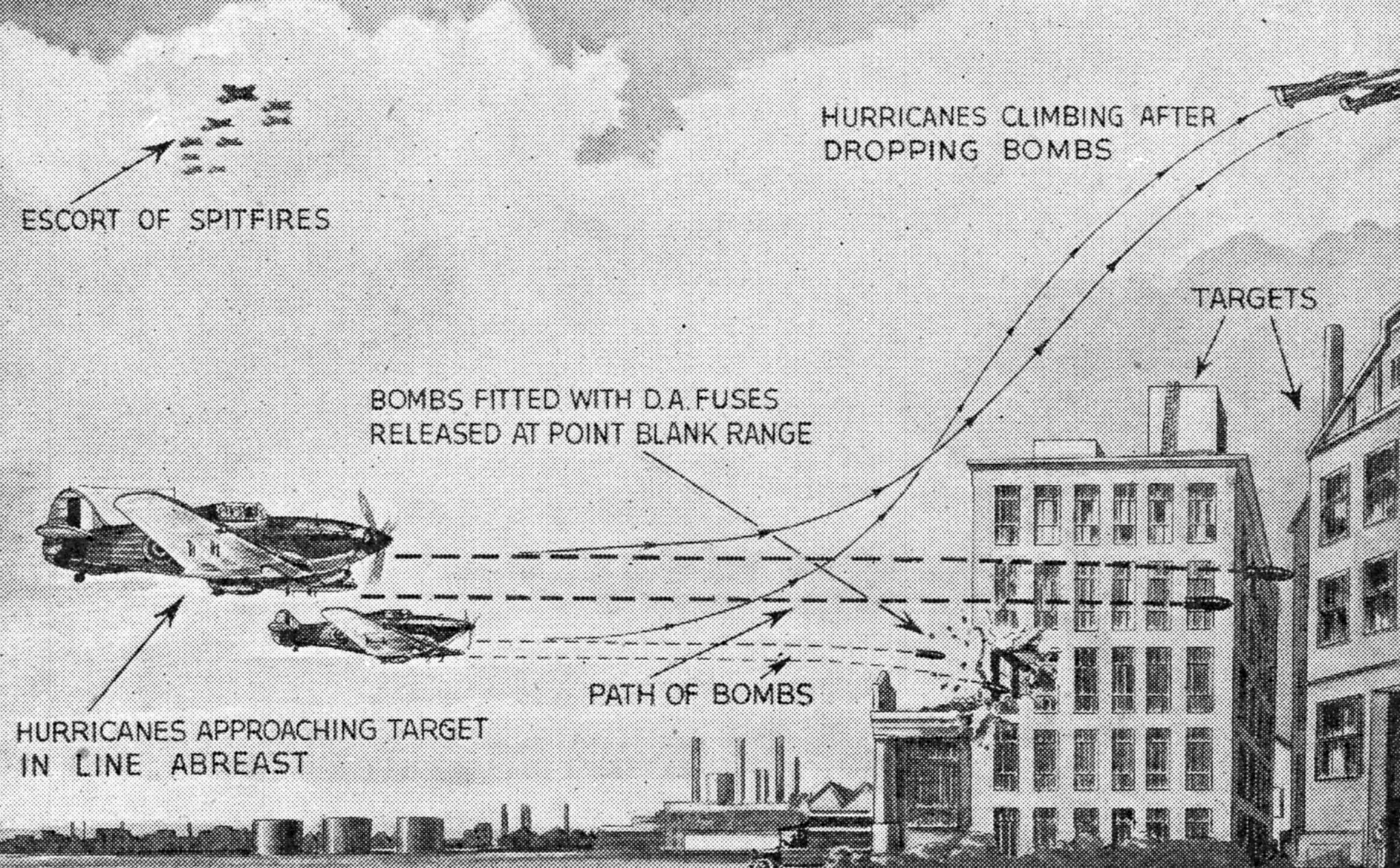
TACTICS
OF THE HURRI-BOMBER
Fig. 17.
Hurricane bomber pilots aim their aircraft at the target and release
their bombs at point-blank range, swerving away just in time to avoid
hitting their objective
Fighter losses on sorties of
this kind have been surprisingly small, and the tactics employed have
presented the enemy with some nice problems of defence. Hurricanes
(Fig. 18) travel too fast and fly too low for ordinary A.A. defence
measures to be effective, so the Germans have built anti-aircraft
towers about 30 feet high so that they can fire down on the Hurricanes
from above.
Besides carrying out home defence duties and
offensive sweeps, fighter pilots are frequently called upon to escort
bombers on daylight attacks on objectives in enemy territory. These
combined sorties are known as circus operations, and the fighters, which
usually meet the bombers over a prearranged rendezvous take up
positions which are calculated to cover the weakest parts of the bomber
formation. A full description of a circus operation is given in Chapter
5, so there is no need to go into further detail here.

CLOSE-UP
OF THE HURRICANE BOMBER
Fig. 18.
The Hurricane carries two 250-lb. bombs in racks beneath the wings, as
shown above. When it has released its load it becomes an ordinary
fighter again, and is able, if necessary, to fight its way home. The
bombs are fitted with special short duration fuses
PREPARING
FOR AN OFFENSIVE SWEEP
The
Spitfire fighters in the above picture are just about to set out on an
offensive sweep over enemy territory. On such patrols almost
anything is lawful prey for the pilots, who may be shooting up
E-boats one minute and attacking enemy aerodromes the next
Up
to the moment we have considered only the work and training of day
fighter pilots, but there is another branch of the fighter fraternity who
operate under the cover of darkness and who, because of the special
difficulties of their work, have to undergo a very specialized course
of training. We refer, of course, to the night fighters.
Their
training up to the F.T.S. stage is the same as for day fighter pilots,
but from then on the man who has shown a special aptitude for this type
of flying, and has been earmarked as a night fighter, is given a special
course calculated to fit him for what is, perhaps, the most arduous and
difficult form of flying in the Air Force today.
The night fighter
must be prepared to readjust his time-table. He turns himself as it
were into a night club waiter, going to bed at dawn, and beginning his
day’s work when other people are thinking of going to bed. His first
meal of the day may be roast beef, Yorkshire and two veg.—an
unpalatable breakfast until he has become accustomed to it. This
readjustment of one’s time table is largely a matter of personal drill,
and it is surprising how quickly one can settle down to the new mode of
life.
One of the chief requirements of the night fighter is
patience. He must be prepared to fly for many hours in all weathers
without even sighting a Hun. When he does find his enemy he must
exercise self-restraint and resist the natural desire to rush in and
mix it. His job is to stalk the enemy much as a cat stalks a mouse, and
when he pounces he must be certain of getting his quarry. If he misses
the first time, the odds are that he won’t get another chance, for at
night the enemy stands a good chance of escape once he knows he is
spotted.
The
embryo night fighter really starts to get down to
the business of night flying when he reaches his O.T.U.
At first he feels somewhat out of his element; he finds that
without
visual aids to help him he must rely more and more on his instruments,
and that his chief worry, once he has become airborne, is the question
of landing again safely all in one piece. This thought,
at first at
any rate, is apt to preclude all others.
TRAINING NIGHT FIGHTERS
The
first task of instructors at night O.T.U.’s, therefore, is to make their
pupils feel thoroughly at home in the air at night, for the man who is
thinking about the probabilities or otherwise of his landing safely is
not looking for targets, which in darkness have to be searched for with
every available ounce of concentration.
Most night fighting
aircraft today are twin-engined, as two engines mean longer endurance.
Pilots are selected according to their particular talents, and when
competent, start flying with an observer, who will probably go with the
pilot to his squadron.
Once the pilot is competent to fly and
land his aircraft safely at night he receives instruction in the more
advanced aspects of his work. He carries out practice interceptions,
firing practice, and R/T procedure. In conjunction with his flying
training the pilot receives ground instruction on the theory and
practice of his work and spends many hours practising in the Link
Trainer.
The night fighter pilot relies to a far greater extent
on his instruments than does the pilot who flies by day, and the Link
Trainer is of the greatest service in helping him to gain confidence in
his instruments.
Much of the pilot’s work at his O.T.U. is
similar to, but more elementary than the work he will do with
his
squadron. Why he has to learn what he does will be clearer when we
consider in more detail the operational side of night fighting.
Let
us now follow the night fighter pilot to his operational squadron where,
anxious though he is to start shooting in earnest, he has first to
undergo a further short period of training to polish up his technique.
At
night, owing to the limitations on seeing aircraft, a far more exact
control is necessary from the ground to bring the pilot within visual
distance of his enemy, so the pilot’s first days—or rather nights—are
taken up practising in conjunction with the ground control.
Instructions are passed to the pilot by R/T (radio telephony) and a set
procedure is laid down which has to be thoroughly assimilated. R/T is,
as it were a string, one end of which is tied to the ground control
station and the other to the aircraft. Upon this connexion the pilot
relies for all information concerning the whereabouts of the enemy.
Without it he would be quite unable to perform his task.
A
patrol at night does not merely involve taking off, completing the
allotted time in the air and then landing. There are numerous
preparations that have to be made before setting out. The aircraft
themselves are tested during the day to make sure that everything is in
order.
SIGNALS AND LIGHTS
Then,
before he goes on patrol the pilot has to make himself thoroughly
familiar with the various recognition signals and lights that are used
at night. Sometimes the R/T breaks down, and if the pilot does not know
where he is he has at least to know what to do to make certain that he
gets back to his own base or some other aerodrome. These preparations
after practice become more or less automatic, but to the new pilot they
are apt to be confusing and make him feel that he is overburdened with
details. All the details, however, are vitally important and careful
training and preparations are necessary if the pilot is not to go flying
in a confused state of mind. This would be most undesirable, for the
night fighter pilot, even more than the day fighter, must have every
faculty keyed up to its most efficient pitch.
FLIGHT IN DARKNESS
Let
us go with a night fighter pilot on a typical night flight and see how he
performs his duty. We will assume that he has completed a satisfactory
day test and is sitting in a hut on the aerodrome ready to take off. He
will be wearing dark goggles in order to adapt his eyes to the dark,
for it takes about an hour before human eyesight becomes thoroughly
accustomed to seeing at night, and he will have most of his flying
clothing on so that he can take off quickly. Some of the squadron’s
aircraft are already in the air, and it will soon be his turn to take
off. As the time for his patrol draws near he puts on the rest of his
flying clothing—his parachute, helmet, goggles and “Mae West”—and
strolls out to his aircraft. The mechanics strap him in, and he starts
up, tests his engines, and taxies gently across the darkened aerodrome
to the take-off point. Here he waits until he gets the O.K. from the
aerodrome control officer telling him that he may take off. Opening up
his engines he gathers speed and is soon airborne. The faint light of
the aerodrome flare path goes out, and he and his observer are alone in
a world of darkness.
Once in the air the pilot relies entirely
on R/T for his directions, and soon the voice of the controller comes
through his earphones giving him the course he is to steer. He changes
course slightly and flies on. Again comes the voice from below, this
time telling him to increase height to 15,000 feet. He pulls the stick
back gently and watches the needle of the altimeter. At the prescribed
height he throttles down slightly, eases the stick forward, and carries
on. For a long time he receives no instructions and then, just as he is
giving up hope, comes the news he has been hoping for. The controller’s
voice informs him that a bandit has been plotted and gives him a course
and height correction.
Pilot and observer are now straining
their eyes to catch a glimpse of the enemy. The darkness seems
impenetrable. Another slight alteration of course from control comes
through the R/T, and this time the controller tells the pilot that the
bandit is very near him. At that moment the aircraft enters a patch of
thin cloud, and as it emerges on the other side a black shadow some
hundred yards ahead vanishes into another cloud patch slightly to
starboard. The game of cat and mouse has begun in real earnest.
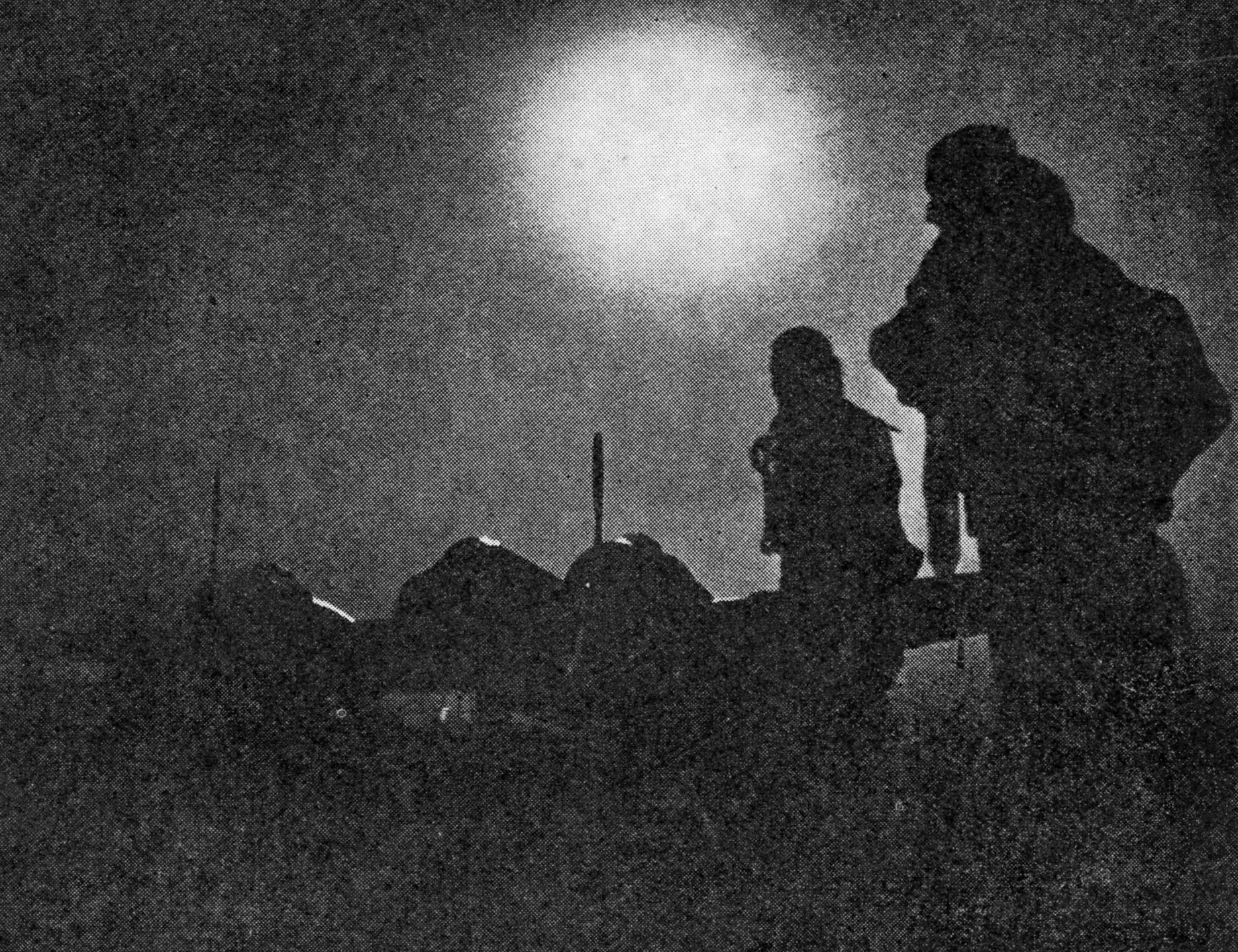
A
“BEAU” GOES ON PATROL
The Bristol Beaufighter, with its
overwhelming fire power, is the terror of enemy airmen over Britain. A
short burst from its cannon and machine guns is sufficient to
disintegrate the enemy and cause it to crash, often before the crew
have had time to take to their parachutes. Above a “Beau” night fighter
is seen just about to take off on a night patrol
SIGHTING THE ENEMY
Altering
course slightly the pilot steers for the cloud that has given the
raider temporary shelter. He knows that the sky is fairly clear and
that once clear of this patch he stands a good chance of finding the
enemy again. He is planning to attack from behind and below, from which
position he will be invisible to the enemy, so he eases the stick
forward and gathers speed in a shallow dive. Suddenly he is in clear
air again and there, about six or seven hundred yards ahead he can see
the dark outline of the bandit. His calculations have been good, for he
has manoeuvred into an excellent position. The enemy is blissfully
unaware of his presence, and unless he suddenly changes course, or
spots his pursuer, he should be a real sitting shot.
Gradually
the distance separating the aircraft lessens. Now he is well within
range, but our pilot is going to make sure of his quarry so he holds on
for a bit. Nearer and nearer he gets to his prey, holding his fire until
there is no possibility of a miss. He gets the target well in the
sights. Immediately he presses the gun button and four vicious flashes
leap forth. At first nothing seems to happen, then a dull glow appears
in the fuselage of the aircraft in front. He gives him one more burst
just to make sure, and in a moment the sky is lighted up. The bandit
goes into a shallow dive, smoke pouring from its tail. The dive gets
steeper—he is obviously out of control. Our pilot follows him for a bit
and then, satisfied that he has finished him off, circles slowly waiting
for him to crash. It seems an age before the bandit reaches the ground,
but all of a sudden, far away below, there is a violent burst of flame
as the enemy strikes the earth.
The pilot now calls up his base
and reports “bandit destroyed.” In return he is given the course to
steer for home. Soon he is back again over the aerodrome, which he
circles while he is waiting for permission to land. Below him he can
see the faint twinkle of the flare-path lights, and, putting his nose
down and lowering his flaps he glides in across the aerodrome in order
to make a perfect landing.
He taxies his aircraft off the flare-path and hands it over to the
maintenance crew. No damage has been done to his machine, so he has
nothing to report. Both he and his observer stroll over to the
operations block for the interrogation. They are looking forward to it
for once. They have good news and are eager to tell the intelligence
ofiicer of their success.
THE PILOT’S PROBLEMS
Night fighting is not always as easy as it sounds from the above
description and things do not always go so smoothly. In winter, flying
conditions are generally rather unpleasant. There may be plenty of
cloud which makes it difficult to locate the enemy. Again, having
sighted the enemy, our pilot might in turn be detected and violent
evasive action on the part of the enemy might enable him to escape. In
addition, there is always the chance, and quite a big chance, that the
enemy might start shooting back, so our pilots cannot, and do not,
expect to emerge from such combats unscathed. German bombers nowadays
are being more heavily armed against attack from astern, and although
the odds are usually in favour of the attacker, there are times when
the enemy gets his shot in first.
There is another class of work carried out by night fighters which makes
a strong appeal to the more venturesome pilots. That is paying a visit
to enemy bomber aerodromes and waiting for their prey to return. The
operation is known as “Intruder.” In operations of this kind the pilot,
who knows pretty accurately the time when the raiders will be returning
to their base, goes direct to the enemy aerodrome, where he flies about
in the neighbourhood until he spots a raider coming in to land. The
usual procedure is to get on the enemy’s tail and glide in behind him.
The flare-path on the aerodrome will warn him of the enemy’s approach,
even if he does not spot him beforehand. Then, just as the enemy is
about to land, he presses the button and “gives him the works.” More
often than not the enemy pilot is confused at the moment when he is
concentrating on landing his aircraft with the result that a crash
follows. The fighter pilot may then shoot up some of the aerodrome
buildings as he streaks low over the ground on his way home.
German night fighter pilots, too, have tried these tactics, but with the
extremely efficient system of radiolocation used in Britain, they are
usually located and brought to book before they have been in the
neighbourhood of the aerodromes for long.
Some of the aircraft used for night fighting have been much in the
public eye since they have been released off the secret list. The
Beaufighter twin-engined aircraft is probably one of the better-known
types, and it is certainly the most deadly. It is one of the most
heavily armed aeroplanes in the world, carrying four cannon and six
machine guns. The effect, when a well-aimed burst hits the target, is
amazing. The pilot is more likely to suffer damage from flying pieces of
Hun than from the return fire of the Hun’s guns. The “Beau” carries a
pilot and an observer who also loads the cannon. It is capable of more
than three hundred and thirty miles per hour, and can stay airborne for
many hours on end.
NIGHT FIGHTER AIRCRAFT
The Havoc is another type of twin-engined night fighter. Originally
built in America as a bomber and known in its bomber form as the
Boston, the Havoc is a very fast and manoeuvrable aeroplane armed with
a number of machine guns. The tricycle under-carriage makes it very
suitable for night landing. It is illustrated here.
Single-engined aircraft used for night fighting include the Hurricane
with four cannon or twelve machine guns, and the Spitfire. Both
these aircraft are continuing to do excellent work.
When pilots come off patrol they have one duty to perform, which often
is irksome, but nevertheless of great importance—the results of the
patrol have to be reported to the intelligence officer so that the
damage the enemy has suffered can be estimated.
There are three categories of results. Firstly, aircraft destroyed. To
claim this, a pilot, if possible, must have confirmation from an outside
source, such as another pilot who saw the aircraft crash, or if the
enemy was brought down over England, reports from witnesses on the
ground. If, however, no outside confirmation is found, the pilot’s word
for having destroyed an aircraft is taken. The Air Force prides itself
on the fact that aircraft claimed as destroyed are definitely so.
The second category is, “probably destroyed.” If a pilot sees vital
pieces breaking off the aircraft as a result of his fire, or if
both engines are set on fire, he still may not see the ultimate
end of the combat. The enemy may go into cloud, or at night may
disappear by reason of violent evasive tactics. But if, in the opinion
of the pilot, the damage inflicted was such as to make it improbable
that the enemy would get back to his base, the claim is a probable.
The third category is “damaged.” This claim is made when a pilot sees
his shots striking his antagonist, but cannot say definitely that the
enemy was destroyed or probably destroyed.
It will be realized from this that when reports in the newspapers state
that a certain number of enemy aircraft were destroyed, it is almost
certain that a number of others were probably destroyed and damaged. To
estimate the damage a careful check is made of all pilots’ claims so
that a reasonably true estimate of the enemy’s resources can be made.
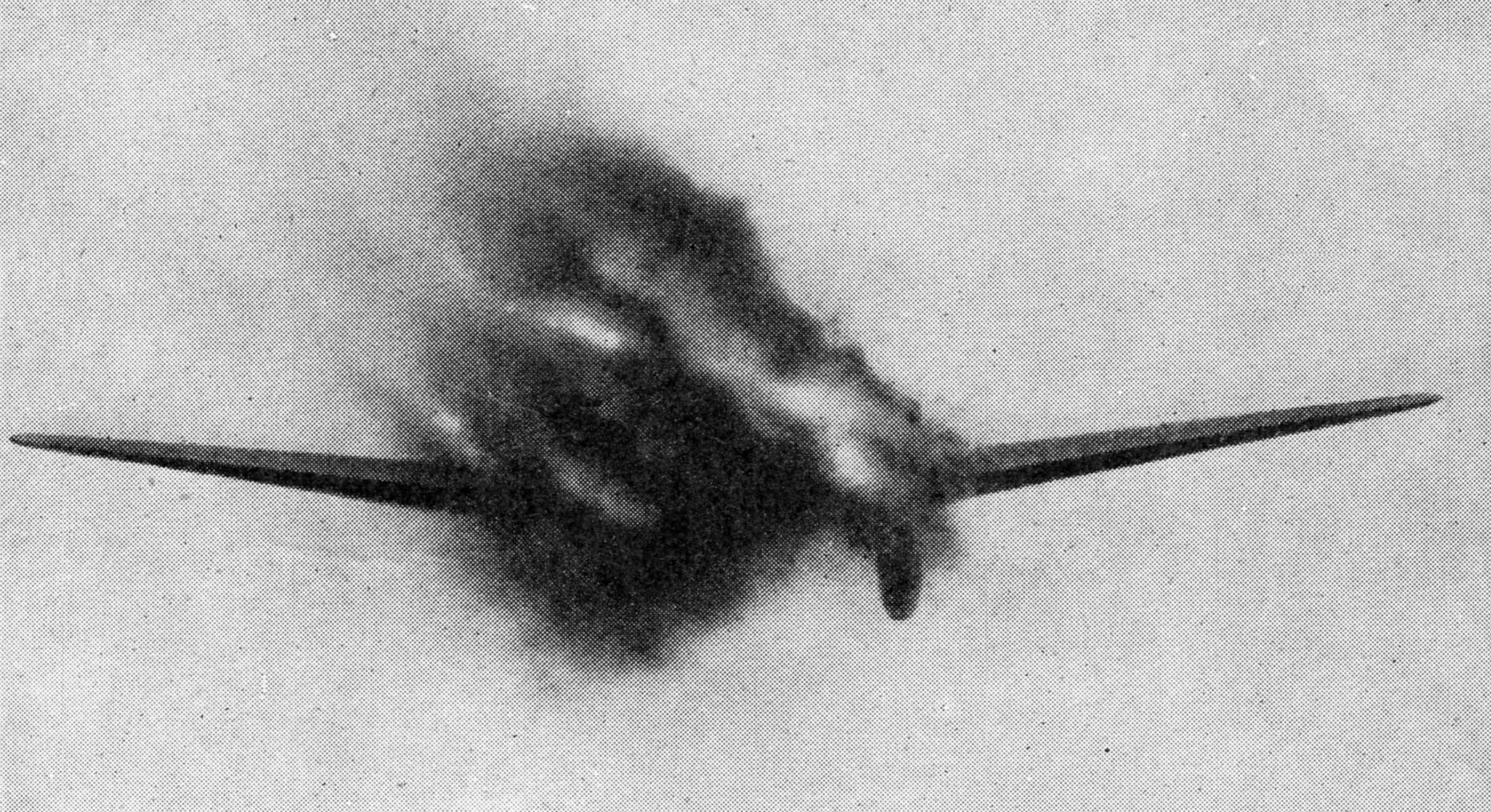
END
OF A HEINKEL III
This enemy bomber was caught
fair and square in the hail of fire from an eight-gun fighter. The effect
of cannon fire is more spectacular even than this, and has to be seen to
be believed. This picture was taken by a camera the shutter of which is
worked by the gun button
A
FIGHTER PILOT MAKES HIS REPORT
The fighter pilot seen above has
just returned from a patrol and is making his report to an intelligence
officer. The results of fighter combats are classified under three
headings—aircraft destroyed, aircraft probably destroyed, and aircraft
damaged—and it is a point of honour with R.A.F. pilots only to claim
aircraft destroyed when they know that they are definitely so.
Information obtained from pilots helps the R.A.F. to estimate the
enemy’s resources
There is one other method of using fighters, but little can be said
about it at the moment. It is known as “cata-fighters,” meaning
the catapulting of fighters. When the U-boat menace became serious and a
large part of the Atlantic could not be patrolled by existing aircraft,
the only way to give merchant ships air protection was by providing
them with fighters they could carry with them. Hurricanes were
accordingly adapted to be shot into the air by means of a catapult
which could be fitted on the restricted deck space of a merchant ship
and the R.A.F. was asked to provide fighter pilots who would be prepared
to travel across the Atlantic and back, perhaps never having a combat,
and who would fly off ready to pancake into the sea if necessary because
they were too far out to reach land.
The service was placed under the control of the Navy and has been
successful. Pilots have many times been shot into the air on the
approach of long-range German bombers and have beaten them off to save
the ship, being picked up afterwards or managing to reach land quite
ready to sail again as soon as their vessel had unloaded, and had
turned round for another voyage.

ATTACKS
ON ENEMY TRANSPORT
The R.A.F. has greatly developed
the use of fighters for daring low level attacks on the enemy’s
transport in daylight. Types of aircraft used for such operations
include Typhoons, Hurricanes and Whirlwinds. Low level bombing and
ground strafing are packed with thrills, but all the pilots selected for
this work undergo a special and severe course of training first